Opalite Meaning, Identification, Properties & Uses
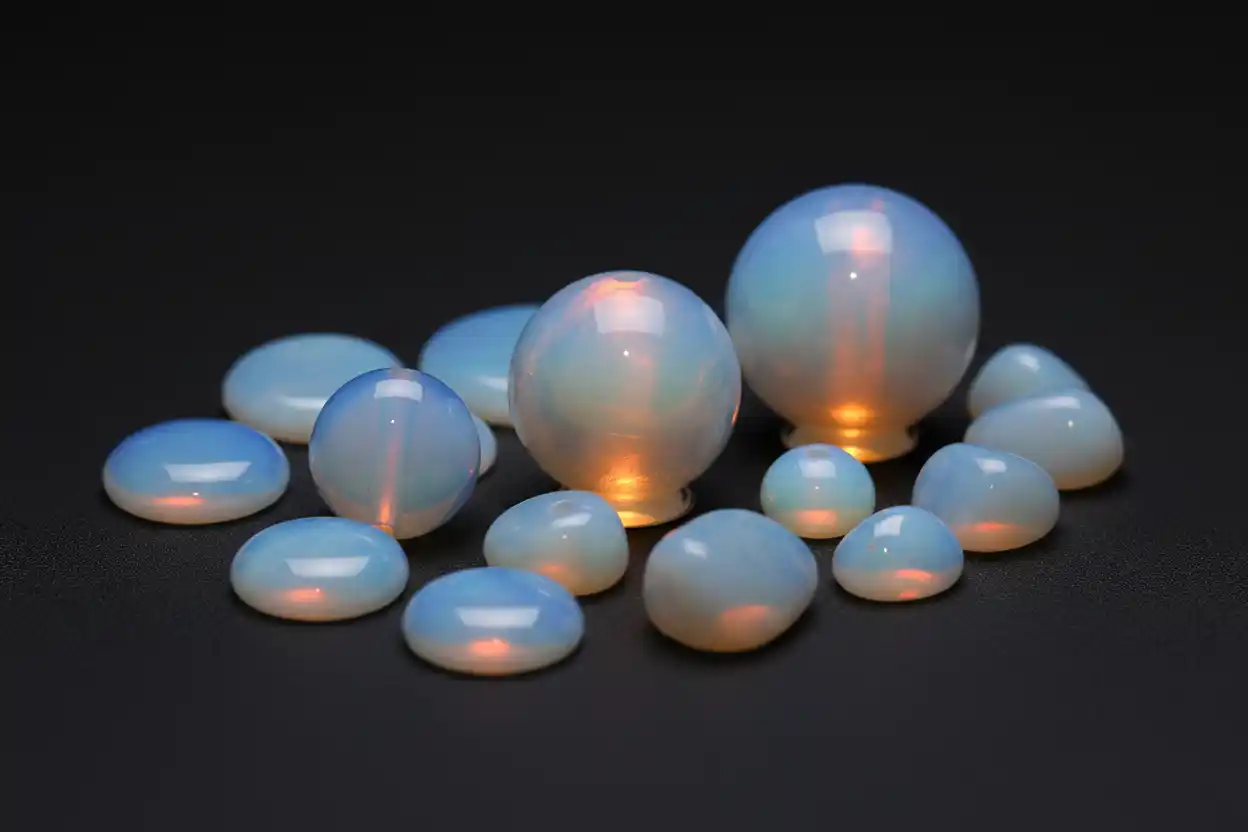
Opalite is the modern trade name most commonly used for manufactured opalescent glass with a milky blue appearance and a warm orange or golden glow when illuminated from behind. It is widely cut into beads, cabochons, spheres, tumbles, carvings, and inexpensive jewelry.
The name is ambiguous because it has also appeared historically for natural common opal and other opal-like materials. In today’s crystal and jewelry market, however, a smooth blue-white “opalite” stone is usually man-made glass rather than natural opal, moonstone, or a laboratory-grown version of either mineral.
Opalite at a Glance
| Property | Modern commercial opalite |
|---|---|
| Material type | Manufactured opalescent glass; resin or other imitations may also use the name |
| Natural mineral species? | No |
| Composition | Variable glass formula; no universal mineral formula applies |
| Common colors | Milky white, pale blue, blue-white, translucent clear, peach, orange, pink, green, and artificially colored varieties |
| Structure | Amorphous glass rather than a crystalline mineral |
| Typical appearance | Blue or milky in reflected light; amber, peach, or orange in transmitted light |
| Luster | Vitreous |
| Transparency | Transparent to translucent |
| Mohs hardness | Variable by glass formulation, commonly around 5–6.5 |
| Cleavage | None |
| Fracture | Conchoidal to uneven |
| Tenacity | Brittle |
| Common uses | Beads, cabochons, pendants, earrings, bracelets, carvings, spheres, decorative objects, and craft components |
| Main care concern | Scratching, chipping, thermal shock, misleading natural claims, coatings, and glued construction |
Opalite Is Usually Man-Made Glass
Modern opalite is produced intentionally rather than mined. Its smooth appearance, consistent pale color, and low production cost make it suitable for calibrated beads and decorative carvings.
Because glass lacks long-range crystalline order, it should not be described scientifically as a crystal. The crystal trade often uses that word loosely for any polished decorative stone.
The material belongs to the manufactured category explained in lab-grown versus natural gemstones. However, opalite is not necessarily a laboratory-grown counterpart of a natural mineral.
A laboratory-created gemstone duplicates the essential composition and structure of a natural species. Ordinary opalite glass instead imitates an appearance without reproducing opal’s hydrated silica structure.
The distinction between amorphous glass and crystalline material is explored more directly in glass versus crystal.
Why the Opalite Name Is Confusing
Mineral references have used opalite for more than one material. Older usage may refer to impure, colored, or common natural opal that lacks play-of-color.
Modern crystal retailers usually apply the name to synthetic opalescent glass. The two meanings should not be merged.
A seller offering natural opalite should identify the underlying material as common opal, opalized rock, or another verified substance. The product should not resemble standardized blue-white glass while being advertised as an exceptionally rare natural crystal.
Names such as sea opal, opal moonstone, moonstone opalite, Tiffany opal, and opalized glass may also appear. These phrases are commercial descriptions rather than approved mineral species.
The safest product wording is “man-made opalescent glass sold as opalite.”
Opalite Is Not Natural Opal
Natural opal is hydrated amorphous silica, commonly written as SiO₂·nH₂O. Precious opal displays spectral play-of-color because of ordered microscopic silica structures.
Opalite glass does not normally reproduce that internal architecture. Instead, its visual effect comes from light scattering within manufactured glass.
Natural opal can contain irregular patterning, matrix, crazing, potch, play-of-color, or locality-specific features. Opalite is usually more uniform and may be produced in nearly identical beads.
The parent opal guide owns natural opal’s formation and properties, while the opal color guide distinguishes genuine bodycolor from spectral play-of-color.
Synthetic opal also differs from ordinary opalite. A true laboratory-grown opal product may reproduce organized silica structures and display recognizable play-of-color.
Why Opalite Looks Blue and Orange
Opalite’s familiar color shift is a form of wavelength-dependent light scattering.
Shorter blue wavelengths scatter more strongly within the glass, so the material often appears blue-white when light reflects from or passes across its surface.
When the glass is illuminated from behind, more blue light scatters away from the direct path. The transmitted light therefore appears warmer, often yellow, peach, amber, or orange.
The effect is especially visible around thin edges, small beads, and spheres placed over a strong light source.
This blue-reflected and orange-transmitted contrast differs from precious opal’s moving patches of spectral play-of-color. Opalite usually produces a diffuse glow rather than discrete red, green, and blue flashes.
Manufacturers can modify the effect by changing glass composition, particle size, opacity, and colorants. No one chemical recipe applies to every product sold under the name.
How Opalite Glass Is Made
Manufacturers melt a glass batch containing silica and other components that control melting temperature, stability, transparency, and color.
Opalescence is created by dispersing microscopic particles, droplets, crystallites, or compositionally different phases through the glass. These internal features scatter light.
The finished glass is cooled, formed into blocks, rods, beads, or molded shapes, and then cut or polished.
Exact formulas are often proprietary. Claims that all opalite consists of one specific combination of dolomite, metal compounds, resin, or quartz should therefore be treated cautiously unless the manufacturer provides documentation.
Some low-cost products sold as opalite may be resin or plastic rather than glass. Others combine glass with coatings, foil, glue, or painted backing.
Opalite and Moonstone
Moonstone is a natural feldspar material that displays adularescence from microscopic intergrowths within its crystalline structure.
Its glow usually appears as a floating band or patch beneath the surface. Opalite tends to show a more uniform milky body with blue scattered light and orange transmission.
Natural moonstone may contain cleavage, fine inclusions, uneven transparency, or internal layering. Manufactured opalite glass often appears smoother and more uniform.
The dedicated moonstone-versus-opal comparison explains why opal and moonstone are already separate materials. Opalite introduces a third category: a manufactured glass imitation whose name references both markets.
A seller should never use “natural opalite moonstone” without clearly establishing what the object actually contains.
Opalite and Cubic Zirconia
Cubic zirconia is a manufactured crystalline material made from zirconium dioxide. It usually displays stronger brilliance, greater density, and a sharper faceted appearance than opalite.
Opalite is amorphous glass and often appears softly translucent rather than diamond-like.
Both are man-made and can be attractive without being natural gemstones. Their value depends largely on manufacturing quality, cutting, setting metal, design, and disclosure.
Colorless cubic zirconia may receive an opalescent coating, so a multicolored manufactured stone should not be called opalite solely from appearance.
Opalite and Natural Glass
Natural glass forms without deliberate human manufacture. Obsidian develops when silica-rich lava cools rapidly enough to prevent crystal growth.
Libyan Desert Glass formed through an extreme natural event involving intense heat in the desert environment.
Opalite is manufactured in a furnace and shaped for decorative use. Its glass structure does not make it natural volcanic or impact glass.
These distinctions matter because natural origin, locality, rarity, and cultural context contribute to the value of obsidian and impact glass but do not apply automatically to mass-produced opalite.
How to Identify Modern Opalite
A polished opalite piece commonly appears milky blue against a dark background and warm orange when a light shines through it.
Natural-looking inclusions are usually absent. Instead, magnification may reveal round gas bubbles, flow lines, uniform cloudiness, mold seams, or polishing marks.
Beads in one strand may have nearly identical color and transparency. Natural materials usually show more internal variation, although manufactured glass can also vary.
The fracture of broken glass is conchoidal and can produce sharp curved edges. Deliberate breakage is unsafe and unnecessary.
A gemologist can measure refractive index, density, optical character, and spectrum. Glass normally gives a single refractive reading or over-the-limit response depending on its formulation and testing method.
The general testing sequence in how to identify crystals helps distinguish visual clues from conclusive laboratory evidence.
Common Mislabeling and Imitations
Ordinary opalite is already an imitation or manufactured decorative material, so the main problem is misleading disclosure rather than counterfeiting a high-value opalite mineral.
Plastic or resin may be sold as opalite glass. Such material can feel lighter and warmer, scratch more easily, and show mold seams.
Dyed clear glass may imitate blue, pink, green, or purple opalite. Surface coatings can add rainbow color that scratches at exposed edges.
Foil or reflective backing may strengthen the appearance of a thin cabochon. Glue lines and assembled layers can become visible under magnification.
Some sellers call opalite natural moonstone, synthetic moonstone, natural opal, aura quartz, or rare sea opal. These names can create false expectations about composition and value.
The broader warning signs appear in how to spot fake crystals. Natural-opal simulants and assembled stones are covered separately in real versus fake opal.
Durability and Jewelry Suitability
Opalite glass is suitable for earrings, pendants, beads, brooches, and occasional-wear rings.
Its hardness varies with glass formulation but normally falls below quartz. Dust containing quartz can therefore scratch the polished surface.
Glass has no mineral cleavage, yet it remains brittle. A hard impact can produce conchoidal chips or break a thin carving.
The gemstone hardness chart provides the scratch-resistance context, while gemstone toughness versus hardness explains why a smooth glass object can still break suddenly.
Rounded cabochons and beads survive better than sharp points. A protective bezel also reduces edge damage in rings.
Because opalite is inexpensive, replacement may be easy in common sizes. Custom carvings, matched inlay, and sentimental jewelry can still be difficult to reproduce.
Treatments and Manufactured Variations
Opalite’s appearance is created during manufacture, so it should not be marketed as an untreated natural stone.
Additional dye can produce pink, green, blue, purple, black, or multicolored products. Metallic coatings may add an aura-like surface effect.
Glass may be etched, frosted, coated, painted, backed, drilled, glued, or combined with resin.
Some products contain a thin opalescent glass layer over another material. Others use crushed glass or fragments in a resin matrix.
These constructions can be attractive when described accurately. The problem arises when sellers use treatment language designed for natural gems to imply a mined origin.
The wider differences among coating, filling, dyeing, assembly, and impregnation appear in gemstone treatments explained.
Current Opalite Asking Prices
Opalite is a mass-produced decorative material, so the glass component usually contributes only a small part of a finished item’s price.
| Opalite product | Broad retail asking range |
|---|---|
| Small tumbled stone | About $1–$6 |
| Worry stone or small palm stone | About $5–$20 |
| Small sphere or marble set | About $8–$25 |
| Medium sphere, tower, or carving | About $15–$60 |
| Standard bead strand | About $5–$25 |
| Simple bracelet | About $8–$35 |
| Basic pendant or earrings | About $10–$60 |
| Sterling-silver opalite jewelry | About $30–$150 |
| Gold or designer jewelry | Determined mainly by metal, brand, and craftsmanship |
These figures are broad current retail asking ranges rather than appraisals or likely resale prices.
Labels such as AAA, rare, premium, natural, or collector grade do not create geological rarity. Manufacturing consistency, polish, size, carving, and setting quality provide more meaningful comparisons.
What Gives Opalite Value?
Workmanship is more important than raw-material scarcity. Symmetry, even polish, clean drilling, and a well-proportioned carving can improve the finished object.
The opalescent effect should appear smooth and attractive rather than patchy, muddy, or filled with distracting bubbles.
Size raises production and shipping costs but does not create natural rarity. Large spheres and carvings can still command more because they require more glass and finishing labor.
Jewelry value depends heavily on metal. Sterling silver, gold, handmade settings, engraving, and brand reputation can exceed the value of the glass.
Condition also matters. Scratches, chips, cloudy glue, worn coating, and damaged drill holes reduce appeal.
Accurate disclosure adds trust. A well-made object honestly sold as opalescent glass is preferable to the same product promoted as a rare natural crystal.
Buying Opalite
Confirm that the seller describes the product as man-made glass. Phrases such as simulated opal, opalescent glass, or sea-opal glass are more accurate than natural gemstone.
Inspect the piece under front and back lighting. Genuine opalescent glass should show the expected blue-to-warm transmission change without requiring digital saturation.
Check beads for chipped holes, uneven drilling, sharp edges, cracks, and obvious glue.
For jewelry, identify the metal separately. “Silver tone,” silver plated, sterling silver, and solid gold describe very different values.
Ask whether any additional coating, foil, dye, or backing is present. These features affect cleaning and long-term appearance.
Opalite is indexed in the crystals beginning with O directory and the gemstones beginning with O directory, although those directories do not change its manufactured status.
Cleaning and Storage
Clean ordinary uncoated opalite glass with lukewarm water, mild soap, and a soft cloth.
A soft brush can be used around sturdy settings, but force should not be applied to glued stones or delicate wirework.
Avoid sudden temperature changes. Moving cold glass directly into hot water can create thermal stress.
Do not use abrasive toothpaste, scouring powder, or rough polishing cloths. These can leave fine scratches.
Ultrasonic and steam cleaning are unnecessary, particularly when the piece is coated, glued, foiled, fractured, or assembled.
Brief water contact is usually acceptable for plain glass, but jewelry construction may be less tolerant. The guide to crystals in water explains why glue, metal, coating, and assembly must also be considered.
Store opalite away from quartz, topaz, sapphire, diamond, and other harder stones. A separate pouch protects both polished surfaces and brittle edges.
Opalite Meaning and Symbolism
Opalite has no ancient mineral tradition specific to the modern manufactured glass product. Most symbolic interpretations developed within recent crystal and jewelry culture.
Its blue reflected glow is commonly associated with communication, calm, imagination, and emotional distance from an immediate problem.
The orange appearance seen under transmitted light inspires themes of warmth, creativity, optimism, and hidden potential revealed under different conditions.
Because opalite is made intentionally, it can also symbolize human creativity, reinvention, and the idea that manufactured beauty does not need to pretend to be natural.
These meanings remain personal, artistic, or spiritual interpretations. Scientific evidence does not show that opalite treats illness, changes hormones, improves sleep, or produces guaranteed emotional effects.
Frequently Asked Questions
Is opalite a natural crystal?
Modern crystal-shop opalite is usually manufactured opalescent glass. It is not a natural crystal or approved mineral species.
Is opalite the same as opal?
No. Natural opal is hydrated amorphous silica, while commercial opalite is normally manufactured glass.
Is opalite a synthetic opal?
Ordinary opalite is better described as an opal simulant. True synthetic opal reproduces more of natural opal’s composition and internal structure.
Why does opalite look blue against a dark background?
Shorter blue wavelengths scatter strongly within the glass, giving it a pale blue reflected or side-lit appearance.
Why does opalite turn orange in front of a light?
Blue wavelengths scatter away from the direct transmitted beam, leaving warmer yellow, peach, or orange light visible through the glass.
Is opalite the same as moonstone?
No. Moonstone is a natural feldspar with adularescence. Opalite is manufactured glass with a different structure and optical mechanism.
Can natural common opal be called opalite?
The word has been used historically for some common opal, but the usage is ambiguous. A seller should identify natural material as opal rather than relying on the opalite name.
Does opalite contain resin?
Most familiar opalite is glass, but resin and plastic products can also be sold under the name. Composition should be confirmed by the seller or through testing.
Is opalite durable enough for rings?
It can be worn in a protected ring, but glass scratches and chips more readily than quartz, sapphire, or diamond.
Can opalite be placed in water?
Plain uncoated glass tolerates brief washing. Avoid soaking glued, coated, foiled, cracked, or assembled jewelry.
Is expensive opalite rare?
No. The glass itself is mass-produced. High prices should reflect precious metal, craftsmanship, size, design, or branding rather than geological rarity.
What does opalite symbolize?
Modern interpretations connect it with communication, changing perspective, creativity, optimism, and intentionally creating a new direction.
Opalite is best appreciated as manufactured optical glass rather than a natural stone whose origin must be disguised. Its identity becomes straightforward when examined through the same structural distinctions used in the site’s guide to telling glass from crystalline gems.