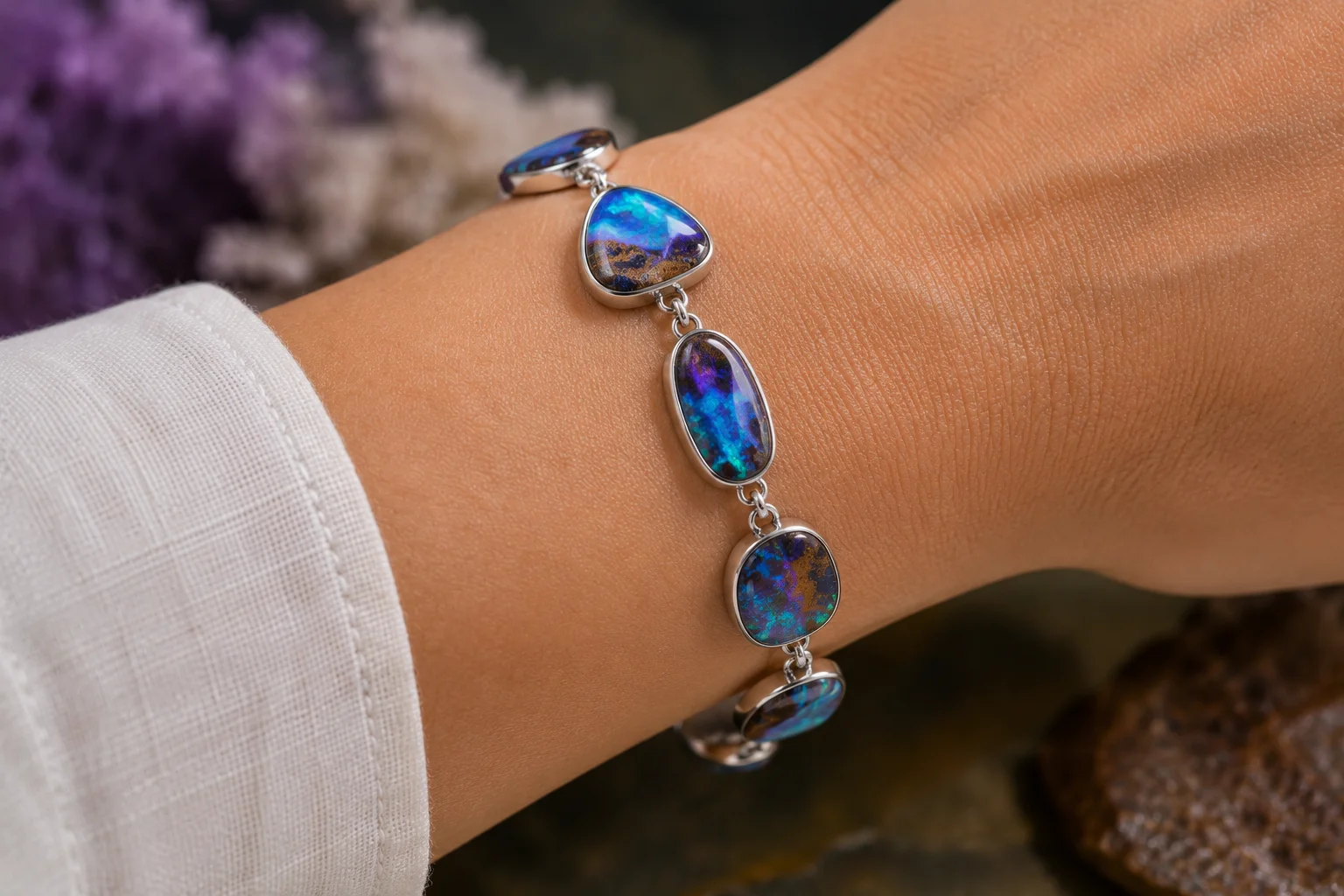
Opal Bracelets: How to Choose and Wear
Opal bracelets place the gemstone’s shifting color in continuous movement. As the wrist turns, red, orange, green, blue and violet flashes can appear, disappear and travel across individual cabochons or beads.
That movement also creates risk. Bracelets strike desks, doorframes, bags and other jewelry more frequently than earrings or necklaces. Opal is relatively soft, brittle and sometimes porous, making construction especially important.
A successful bracelet uses protected stones, flexible links, secure closures and a fit that limits uncontrolled rotation. The buyer must also understand whether the Opal is solid, backed, assembled, hydrophane, treated or synthetic because those distinctions affect care and value.
The broad Opal gemstone guide owns formation, play-of-color, history and symbolism. This page focuses specifically on bracelet styles, quality, structure, fit, buying and maintenance.
Opal Bracelets at a Glance
| Feature | What to evaluate |
|---|---|
| Material identity | Hydrated silica |
| Defining phenomenon | Play-of-color in precious Opal |
| Mohs hardness | Approximately 5–6.5 |
| Toughness | Very poor to fair |
| Common bracelet forms | Beads, bezel links, stations, tennis lines, cuffs and bangles |
| Most protective construction | Low individual bezel settings |
| Main quality factor | Bright play-of-color visible through normal wrist movement |
| Main structural concern | Scratching, chipping, crazing and exposed edges |
| Main disclosure concern | Solid, doublet, triplet, synthetic, dyed or treated |
| Main water concern | Hydrophane absorption, glue and assembled construction |
| Main fit concern | Excessive rotation and desk impact |
| Safest cleaning | Brief hand cleaning with warm soapy water |
Is Opal Suitable for Bracelets?
Opal can be worn in bracelets, but it is not a carefree wrist stone.
Its hardness is lower than Quartz, Topaz, Sapphire and Diamond on the Gemstone Hardness Chart.
More importantly, Opal can be brittle, fractured or prone to crazing. Some types also absorb liquids, while assembled products rely on adhesives.
The Gemstone Toughness vs Hardness guide explains why one hardness number does not describe all durability risks.
A low bezel-link bracelet worn carefully can be successful. A high shared-prong line worn during exercise, cleaning and desk work faces much greater risk.
Main Opal Bracelet Styles
| Bracelet style | Main advantage | Main concern |
|---|---|---|
| Bezel-link bracelet | Strong edge protection and face-up display | Many hinges and settings |
| Prong-link bracelet | Shows more of each Opal | Exposed girdles |
| Tennis-style bracelet | Continuous play-of-color | Matching and numerous prongs |
| Station bracelet | Lightweight and modern | Flipping settings and chain strength |
| Solid Opal bead strand | Continuous color and movement | Drill holes and abrasion |
| Hydrophane Opal bead strand | Strong color at accessible prices | Liquid absorption |
| Boulder Opal bracelet | Natural matrix and individual patterns | Irregular thickness |
| Cuff bracelet | Supports one large focal stone | Fit and impact |
| Hinged bangle | Structured formal appearance | Hinge and clasp |
| Inlay bracelet | Smooth geometric surface | Thin Opal and adhesive |
| Charm bracelet | Personalized accents | Stone-to-stone collision |
| Synthetic Opal bracelet | Consistent color and matching | Clear origin disclosure |
Bezel-Link Opal Bracelets
Individual bezels provide the strongest general construction for Opal cabochons.
The metal surrounds each perimeter and absorbs many side impacts. Low settings also reduce snagging and leverage.
Every link should articulate smoothly. A stiff joint can make the bracelet twist and transfer pressure into neighboring stones.
The bezel should meet each cabochon evenly without gaps, glue seepage or folded metal.
An open or partially open back can allow inspection and careful cleaning. A fully closed cup may conceal backing, adhesive or an extremely thin Opal layer.
Prong-Set Link Bracelets
Prong settings expose more of each Opal but leave the edges vulnerable.
The cabochon should rest in a supportive basket rather than hang only between prong tips.
Prongs must not press over visible cracks, pits or thin edges.
A bracelet contains many settings, so one weakened prong can become a loss risk even when the remaining line looks secure.
Prong-set Opal is more appropriate for controlled occasional wear than for a bracelet that remains on throughout the day.
Opal Tennis Bracelets
A tennis-style bracelet creates a continuous line of similarly sized Opals.
Matching involves body tone, play-of-color brightness, dominant colors, pattern scale, transparency and face-up dimensions.
Natural stones do not need identical patterns, but one dull or heavily cracked cabochon can interrupt the complete line.
The settings should keep each stone face-up without allowing girdles to collide.
A secure box clasp with one or two safety catches is appropriate for a valuable bracelet.
The line should flex evenly. A rigid section may indicate damaged hinges or poor construction.
Opal Station Bracelets
Station designs use fewer stones spaced along a chain.
They reduce total gemstone exposure and create a lighter everyday style.
Two-point connections help flat stations remain face-up. A single attachment allows greater rotation and may display the back frequently.
The chain should be strong enough for the total setting weight. Extremely fine chains can stretch or break before the Opal is damaged.
Adjustable sliders should hold firmly and remain easy to inspect for wear.
Solid Opal Bead Bracelets
Opal beads may be round, oval, barrel-shaped, faceted or irregular.
A solid Opal bead consists of Opal through its complete depth rather than a thin layer attached to another material.
Drill holes should remain centered and free from radiating cracks. Pressure concentrates at the opening every time the bracelet stretches or bends.
Knots between valuable beads reduce direct contact and limit loss if the cord breaks.
Stretch construction is convenient but should be rolled over the hand rather than pulled outward aggressively.
Opal beads can become heavy when large, although the material has lower density than many transparent gemstones.
Ethiopian Hydrophane Opal Beads
Much Ethiopian Opal is hydrophane, meaning it can absorb liquids through connected pore spaces.
Absorption can temporarily change transparency, weight and play-of-color. Oil, perfume, sweat, dye and skin products may also enter the stone.
The Ethiopian Opal guide owns the locality and material profile, while the Ethiopian Opal Buying Guide covers purchase checks.
Hydrophane bead bracelets should be removed before swimming, showering, applying lotion or handling oils.
Immersion should not be used casually as an authenticity test because cracking and appearance changes can occur.
Australian Opal Bracelets
Australian deposits produce white, Crystal, Black and Boulder Opal.
Many Australian sedimentary Opals are less absorbent than hydrophane Ethiopian material, but they remain vulnerable to scratching, impact and thermal shock.
A bracelet should still avoid prolonged soaking because settings, adhesives and stringing may be affected.
Australian origin does not guarantee superior play-of-color or stability. Individual quality remains more important than country name alone.
The Opal Buying Guide owns the broader source and quality comparison.
Black Opal Bracelets
Black Opal has a dark body tone that can make play-of-color appear especially vivid.
Natural Black Opal is valuable enough that bracelet stones should usually have clear documentation and careful matching.
The Black Opal Buying Guide owns body tone, pattern, treatment and origin evaluation.
A dark appearance can also result from backing, smoke treatment, dye or assembly. The bracelet’s construction should therefore be disclosed.
Current valuation belongs to the Black Opal Price Guide.
A high-value line deserves periodic professional inspection because replacing one matched stone can be difficult.
Boulder Opal Bracelets
Boulder Opal retains natural ironstone matrix behind or around the Opal.
The matrix can provide support and create irregular scenic patterns, although thin seams of color remain vulnerable.
Bezel settings work especially well because Boulder Opal frequently has nonstandard outlines.
The Boulder Opal Buying Guide owns matrix, seam thickness and quality evaluation.
Current market ranges belong to the Boulder Opal Price Guide.
The seller should distinguish natural attached matrix from an assembled doublet with a separately glued backing.
Fire Opal Bracelets
Fire Opal is defined mainly by yellow, orange or red bodycolor and may or may not show play-of-color.
Transparent examples can be faceted, while translucent material is often cabochon cut.
A bracelet of faceted Fire Opals should protect pointed corners and avoid excessive exposure.
The Fire Opal Buying Guide owns color, transparency and source evaluation.
Current valuation belongs to the Fire Opal Price Guide.
Fire Opal can be sensitive to drying and thermal shock, making low protected settings important.
White and Crystal Opal Bracelets
White Opal has a pale body tone, while Crystal Opal is transparent to semitransparent.
White Opal is widely used in calibrated commercial bracelets because matching lighter bodycolor can be easier than matching exceptional Black Opal.
Crystal Opal allows play-of-color to appear within a clearer host and may show different effects against skin, metal or a dark backing.
White Opal has its own material and symbolism profile.
A translucent stone should be inspected from the side to determine whether a dark setting or backing is strengthening its apparent color.
Doublet and Triplet Bracelets
A doublet usually combines a thin precious-Opal layer with a dark backing.
A triplet adds a transparent cap above the Opal layer.
These constructions can provide strong visible color at a lower cost than comparable solid Opal. They are legitimate when disclosed clearly.
The Real vs Fake Opal guide owns doublet, triplet, synthetic and imitation identification.
Bracelet use places additional stress on adhesive bonds. Prolonged soaking, heat and ultrasonic vibration should be avoided.
Side examination may reveal straight bonding lines and layers with different luster.
Synthetic Opal Bracelets
Laboratory-grown Opal reproduces an ordered silica structure capable of creating play-of-color.
Synthetic material can offer consistent matching across a complete bracelet, often with strong regular patterns.
Its manufactured origin must be disclosed.
Some products described as synthetic Opal are actually glass, resin or foil-based imitations rather than laboratory-grown silica material.
The Treated and Synthetic Opal guide owns treatment and origin distinctions.
Consistent color does not make the product inferior when its identity and price are accurate.
Evaluating Play-of-Color
The most important visual factor is the strength and coverage of play-of-color.
A bracelet should be viewed while moving through diffused light. The flashes should remain visible during normal wrist rotation rather than only under one intense spotlight.
Red and orange often receive strong demand, but brightness and pattern matter more than checking off every spectral color.
The Opal Color Meaning guide owns symbolism, while quality evaluation remains a gemological issue.
One brilliant stone does not compensate for several dead or cloudy links in a matched line.
Evaluating Pattern and Matching
Patterns may appear as pinfire, rolling flash, broad flash, ribbons, blocks or irregular patches.
A matched bracelet does not need identical patterns, but the scale and brightness should coordinate.
One large broad-flash stone beside small pinfire stones can look mismatched unless it serves as an intentional center.
Body tone and transparency should also progress deliberately.
Continuous video of the complete bracelet provides stronger evidence than separate photographs of selected stones.
Opal Clarity and Stability
Opal clarity includes transparency, internal inclusions, matrix, pits, cracks and crazing.
A surface-reaching crack is a structural concern rather than merely a clarity feature.
Crazing appears as a network of fractures and can progress after cutting. A crazed stone should not be used in a frequently flexed bracelet.
Cloudiness can indicate inclusions, liquid absorption or instability depending on the material.
A buyer should inspect every stone rather than assuming that a secure setting makes a compromised Opal durable.
Bracelet Fit
An Opal bracelet should sit close enough to limit impact but not so tightly that it stresses links, cord or settings.
Large stones occupy internal space, so laid-flat length may exaggerate the wearable circumference.
A loose bracelet rotates beneath the wrist and strikes desks. A tight bracelet places continuous pressure on hinges and drill holes.
Measure the wrist with a flexible tape and compare the result with the seller’s stated wearable size.
A safety chain should remain short enough not to catch on objects or strike the stones.
Clasps and Safety Features
A valuable line bracelet should use a secure box clasp, lobster clasp or another mechanism proportionate to its weight.
The clasp should engage positively without excessive force.
One or two safety latches provide useful redundancy for high-value tennis bracelets.
Inspect the links adjacent to the clasp because they receive repeated stress.
A magnetic clasp may be convenient but can open under pulling force and is not ideal for valuable Opal unless supplemented by another safety feature.
Metal Choices
Yellow gold provides warm contrast and can strengthen red, orange and green flashes.
White gold, platinum and silver create a cooler frame. Rose gold can complement Fire Opal and pink body tones.
The metal must separate Opal from harder accent stones.
Diamond, Sapphire and Tourmaline girdles can scratch Opal if they rub against it.
The Gemstones and Metals for Sensitive Skin guide explains alloy, plating and nickel concerns.
Stacking Opal Bracelets
Opal is not an ideal stone for unrestricted stacking.
Do not place it directly beside Diamond, Sapphire, Topaz, Tourmaline or rough-edged metal bracelets.
A smooth metal spacer can reduce contact but cannot eliminate impact from a very loose stack.
Wear the Opal bracelet alone when possible, particularly if it contains high-value or hydrophane stones.
Remove watches or bracelets that repeatedly strike the Opal settings during wrist movement.
Buying an Opal Bracelet Online
Follow How to Buy Gemstones Online Without Getting Scammed.
Request continuous video of the exact bracelet in motion under neutral light.
The listing should state whether the stones are solid, doublet, triplet, synthetic, treated, hydrophane or attached to natural matrix.
Confirm stone dimensions, wearable length, total weight, metal alloy, clasp type, treatment, origin claims and return terms.
Current general valuation belongs to the Opal Price Guide.
A laboratory report may be proportionate for an important Black Opal line or disputed treatment. The Gemstone Certification guide explains report scope and limitations.
Wearing Opal Bracelets
Remove the bracelet before exercise, swimming, showering, gardening, cleaning and cooking.
Avoid perfume, lotion, sunscreen and hair products while the Opal is on the wrist, especially when the material is hydrophane.
Do not sleep in a valuable Opal bracelet. Bedding can catch prongs, stretch stringing and place pressure on the stones.
An Opal necklace or pair of Opal earrings offers a lower-impact alternative.
An Opal ring requires equally careful or stricter wear.
Cleaning and Storage
Follow How to Clean Opal Jewelry Safely.
Use lukewarm water, mild soap and a soft cloth. Clean briefly and avoid soaking.
Do not use steam or ultrasonic equipment.
Avoid household solvents, bleach, alcohol and abrasive powders.
Hydrophane, doublet, triplet, glued and treated bracelets require especially conservative care.
Store the bracelet flat in a padded compartment. Do not hang a heavy bead or link bracelet permanently from its clasp.
Frequently Asked Questions
1. Is Opal durable enough for a bracelet?
It can be worn carefully, but Opal is relatively soft, brittle and vulnerable to impact, scratches and thermal shock.
2. What is the safest Opal bracelet style?
A low individual bezel-link bracelet provides the strongest general edge protection.
3. Are Opal tennis bracelets practical?
They can be beautiful but contain many exposed stones and settings. They require careful wear and periodic inspection.
4. What is a solid Opal bracelet?
Its visible stones consist of Opal through their complete depth rather than thin layers attached to backing.
5. Are Opal doublets and triplets fake?
No. They are assembled Opal products and are legitimate when their construction is disclosed.
6. Can Ethiopian Opal bracelets get wet?
Hydrophane stones can absorb liquids and change appearance. Avoid soaking, swimming and exposure to oils or cosmetics.
7. Is Black Opal suitable for bracelets?
Yes, but valuable Black Opal needs strong protective settings, documentation and careful wear.
8. Can Opal beads be placed on elastic?
Yes, but drill holes must be sound and the elastic should be replaced when it loosens or frays.
9. Can Opal be stacked with Diamond bracelets?
Direct stacking is not advisable because Diamond and its settings can scratch or chip Opal.
10. How should an Opal bracelet fit?
It should move comfortably without rotating excessively or placing continuous tension on links and stringing.
11. Can an Opal bracelet be cleaned ultrasonically?
No. Ultrasonic vibration can damage Opal, treatments, glue and assembled construction.
12. When should an Opal bracelet be repaired?
Stop wearing it when a stone moves, a prong catches, a link stiffens, a crack appears or the clasp changes behavior.
An Opal bracelet succeeds when its movement reveals color without exposing the stones to uncontrolled impact. Protective settings, secure articulation and a close comfortable fit allow play-of-color to remain visible while acknowledging that Opal is one of the more demanding materials to place on the wrist.