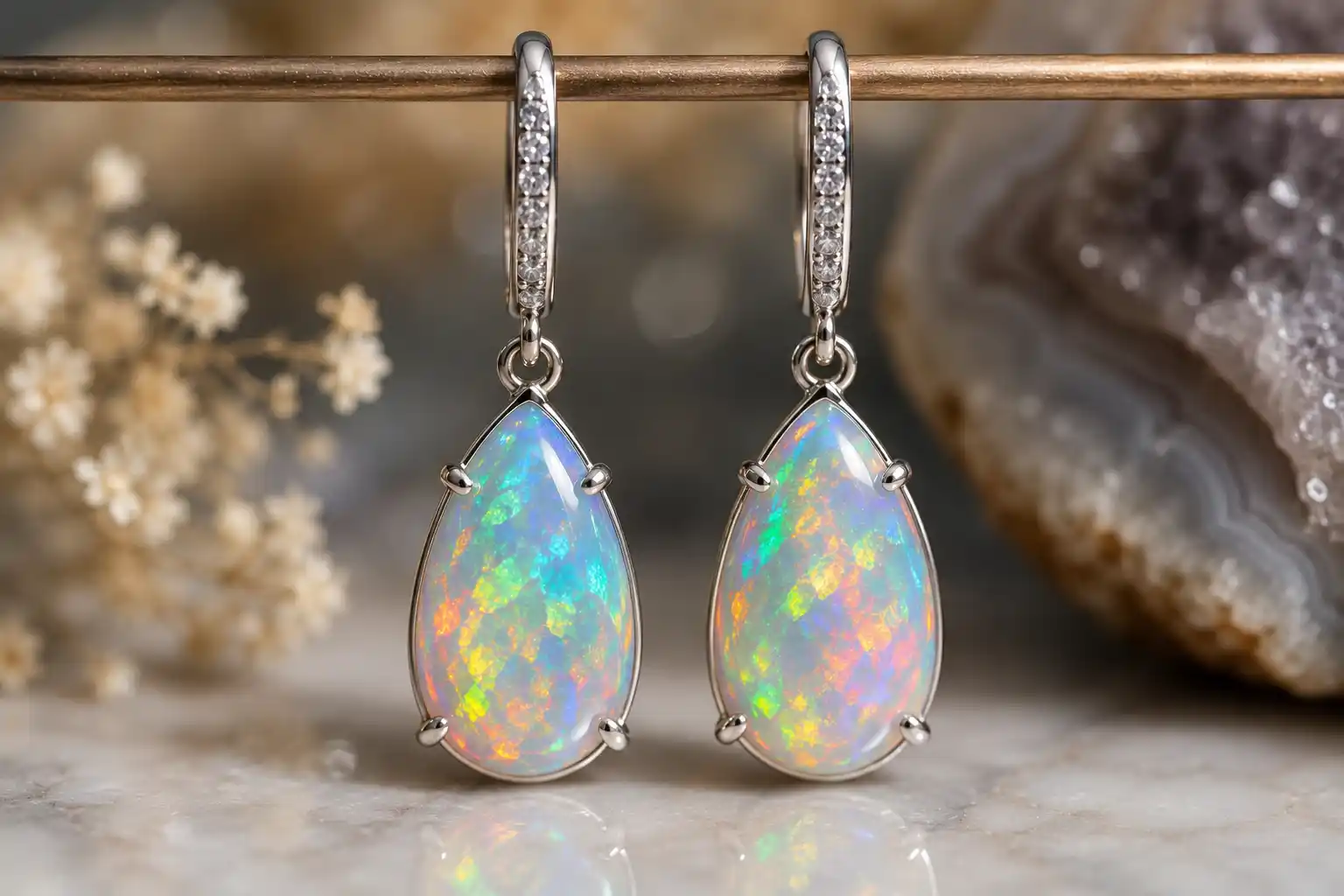
Opal Earrings: A Style Guide
Opal earrings place the gemstone’s shifting play-of-color in one of its safest jewelry positions. Unlike rings and bracelets, earrings rarely strike desks, tools or doorframes, allowing delicate solid Opals, doublets and carefully matched cabochons to be worn with less mechanical risk.
The principal challenge is matching. Two Opals can share the same dimensions and body tone yet look unrelated because their brightness, dominant colors, pattern scale, transparency or directional behavior differs. A successful pair should feel balanced when viewed together rather than merely having equal carat weights.
Construction matters almost as much as the stones. Opal is relatively soft and can be brittle, porous or assembled from several layers. Bezels, supportive baskets, secure backs and accurate treatment disclosure therefore deserve close attention.
The broader Opal gemstone guide owns the material’s formation, structure, varieties, history and symbolism. This page focuses specifically on earring styles, pair matching, settings, comfort, buying and care.
Opal Earrings at a Glance
| Feature | What to evaluate |
|---|---|
| Gem material | Hydrated silica |
| Mohs hardness | Approximately 5–6.5 |
| Toughness | Very poor to fair, depending on type and condition |
| Defining phenomenon | Play-of-color in precious Opal |
| Safest common style | Low bezel stud |
| Main pair-quality concern | Matching brightness, body tone, pattern and directional color |
| Main structural concern | Scratches, chips, cracks, crazing and exposed edges |
| Main construction disclosure | Solid, doublet, triplet, synthetic or imitation |
| Main source-related concern | Hydrophane absorption and treatment |
| Main comfort concern | Total weight, post position and back size |
| Main cleaning rule | Warm soapy water and brief hand cleaning |
| Main storage rule | Separate from harder gemstones and metal edges |
Why Earrings Suit Opal
Earrings expose Opal to much less impact than hand-level jewelry.
A pendant is similarly protected, but earrings offer an additional advantage: smaller stones can show intense color without needing the structural scale of a large necklace center. The low-impact position also makes earrings suitable for valuable Black Opal, delicate Crystal Opal and well-disclosed doublets or triplets.
An Opal bracelet experiences repeated wrist contact, while an Opal ring receives the greatest daily impact. An Opal necklace can support larger stones but must account for swinging and chain weight.
Earrings are not damage-proof. A dropped stud can chip, a long dangle can strike a shoulder or hard surface, and a weak post can cause the complete piece to be lost.
Main Opal Earring Styles
| Earring style | Main advantage | Main concern |
|---|---|---|
| Bezel stud | Strong perimeter protection and low snagging | Closed-back disclosure |
| Prong-set stud | Shows more of the Opal outline | Exposed girdle and pressure points |
| Halo stud | Strong contrast and larger visual spread | Hard accents and many prongs |
| Button earring | Broad play-of-color surface | Weight and forward tilt |
| Short drop | Movement with manageable length | Connector security |
| Long dangle | Strong color movement and formal scale | Weight, snagging and collision |
| Leverback drop | Secure closure and movement | Hinge condition |
| Huggie charm | Compact modern style | Charm contact with hoop |
| Cluster earring | Broad color from several stones | Matching and maintenance |
| Boulder Opal earring | Individual natural matrix patterns | Irregular shape and thickness |
| Opal doublet earring | Strong visible color at lower cost | Adhesive and water exposure |
| Fire Opal earring | Transparent yellow-to-red bodycolor | Pointed facets and thermal shock |
Opal Stud Earrings
Studs are the most practical Opal earring style.
Round and oval cabochons sit close to the lobe and expose relatively little stone. Small white or Crystal Opals can provide visible play-of-color without creating excessive weight.
The post should attach close to the center of gravity. A post placed too high on a broad cabochon may cause the earring to tilt toward the floor.
Large studs need broad support backs. A tiny friction back may hold the post but fail to distribute the stone’s weight comfortably.
The setting should remain low enough that the stone does not project unnecessarily from the ear.
Bezel-Set Opal Studs
A bezel surrounds the Opal with metal and provides the strongest general perimeter protection.
The rim should meet the stone evenly without sharp folds, gaps or visible glue. Because many Opals are translucent, the color of the metal or backing can influence their appearance.
A fully closed back may support a thin stone or assembled product. It may also conceal a dark backing that strengthens play-of-color.
Closed construction is not automatically undesirable, but the seller should identify whether the stone is solid, a doublet or a triplet.
A small access opening behind a solid Opal can help with inspection and careful cleaning.
Prong-Set Opal Studs
Prongs reveal more of the stone’s outline but expose its edges.
The Opal should rest inside a supportive basket rather than hang only between the prong tips. Pressure must remain distributed so one prong does not press directly against a crack, pit or thin edge.
Rounded cabochons are safer than pointed or angular stones in open prongs.
A prong that catches hair may already be lifted or worn. Continued wear can allow the Opal to move or escape.
Prong-set studs are most appropriate for sound solid stones and wearers who inspect their jewelry regularly.
Halo Opal Earrings
A halo surrounds Opal with Diamond, laboratory-grown Diamond, Moissanite, Sapphire, Zircon or Cubic Zirconia.
The bright border increases apparent size and creates contrast with Opal’s changing colors. White metal can make blue and green flashes appear cooler, while yellow gold can emphasize red and orange.
Every accent stone should be identified accurately.
Hard accent girdles must not touch the Opal directly. Diamond, Sapphire and Moissanite can scratch it if movement or repair brings the materials into contact.
A halo also introduces numerous small prongs, increasing maintenance compared with a simple bezel.
Opal Drop Earrings
Drop earrings allow larger Opals and more visible movement.
As the earring turns, play-of-color may appear across a wider range of angles. This makes a moderately directional stone more effective than it might be in a fixed stud.
The connector should keep each Opal facing forward rather than rotating sideways continuously.
Short drops generally provide the strongest balance between movement and comfort. They are less likely to strike the shoulder, become caught in clothing or pull heavily on the piercing.
Leverbacks and locking posts provide stronger security than open hooks for valuable stones.
Long Opal Dangles
Long dangles can combine several Opals, metal links or contrasting gemstones.
Request the weight per earring. Large cabochons, substantial bezels and decorative metal can become heavier than their visual delicacy suggests.
Articulated sections should move without allowing the Opals to strike one another.
The lowest element should clear the shoulder during normal head movement. Repeated contact can chip the stone or bend the connector.
Long Opal earrings should be removed before changing tight clothing or brushing long hair.
Opal Cluster Earrings
Cluster earrings use several smaller Opals to create a flower, star, fan or geometric shape.
A cluster can provide broad visible color without requiring one large high-value stone. It can also combine several dominant colors intentionally.
Matching remains important. One dull cabochon among several bright stones can interrupt the complete design.
Shared prongs make the cluster lighter but place several stones under the control of the same small metal components.
A damaged shared prong may loosen more than one Opal.
Matching Opal Pairs
Pair matching begins with body tone.
White, dark, transparent, orange or matrix-backed stones should coordinate unless the design deliberately uses contrast. Next, compare play-of-color brightness and coverage.
The dominant colors should feel related. One earring flashing mainly red and orange can look mismatched beside one showing only faint blue.
Pattern scale matters as well. A broad-flash Opal may not pair naturally with a fine pinfire stone.
Exact duplication is not necessary. Natural Opal is valued partly because each pattern is individual.
Directional Play-of-Color
Some Opals show strong color from a broad range of angles, while others reveal their best display only in one direction.
A matched pair should present attractive color simultaneously when held in the wearing position.
Separate photographs can conceal directional mismatch by tilting each earring differently.
Request continuous video showing both earrings upright under one moving light source.
A highly directional pair can still be successful when the settings orient both stones consistently.
White Opal Earrings
White Opal has a pale body tone and may show red, orange, green, blue or violet play-of-color.
White Opal is widely available and suits both minimal studs and larger vintage-inspired designs.
Brightness matters more than a perfectly white background. A slightly cream body with vivid play-of-color may be more attractive than a bright-white stone with weak flashes.
Pairs should coordinate in milkiness, transparency and dominant colors.
White Opal can look warmer in yellow gold and cooler in white metal.
Black Opal Earrings
Black Opal has a dark body tone that creates strong contrast with play-of-color.
Fine natural Black Opal can be valuable, making earrings difficult to match and expensive to replace.
The Black Opal Buying Guide owns the complete quality and source assessment.
A dark appearance can also come from backing, smoke treatment, dye or doublet construction. Side and reverse views are essential.
Black Opal earrings should have secure backs and protective settings proportionate to their value.
Ethiopian Opal Earrings
Ethiopian Opal can display vivid play-of-color and is frequently hydrophane.
Hydrophane material can absorb water, oil, perfume and other liquids, temporarily or persistently changing transparency and color.
The Ethiopian Opal Buying Guide owns source-specific purchase checks.
Earrings reduce direct exposure to soap and water compared with bracelets, but hairspray, perfume and cosmetics remain relevant.
Apply personal-care products before inserting the earrings and allow them to dry completely.
Fire Opal Earrings
Fire Opal is defined primarily by yellow, orange or red bodycolor and may or may not show play-of-color.
Transparent material is often faceted into ovals, pears and cushions.
Faceted Fire Opal requires protection at pointed ends and corners. Pear tips should use V-shaped prongs or a bezel.
A pair should coordinate in bodycolor and transparency even when neither stone displays spectral flashes.
Fire Opal can be sensitive to thermal shock and should remain away from steam and high repair heat.
Boulder Opal Earrings
Boulder Opal retains natural ironstone matrix behind or around the Opal.
The matrix creates irregular shapes and scenic patterns, making exact pair matching uncommon. A successful pair coordinates visual weight, color brightness and outline without forcing symmetry.
The natural backing can provide support, but thin seams of precious Opal remain vulnerable.
A bezel or custom frame should follow the irregular perimeter closely.
The seller should distinguish naturally attached matrix from a separately glued backing.
Solid Opal, Doublets and Triplets
A solid Opal consists of Opal through its visible depth.
A doublet normally combines a thin precious-Opal layer with a dark backing. A triplet adds a transparent cap.
The Real vs Fake Opal guide owns the complete identification workflow.
Doublets and triplets can offer bright, well-matched earrings at a lower price than equivalent solid stones. Their layered construction must be disclosed.
Adhesive makes prolonged soaking, steam and ultrasonic cleaning inappropriate.
Treatments and Synthetic Opal
Opal may be smoked, dyed, filled, coated, sugar-acid treated or assembled.
The Treated and Synthetic Opal guide owns those processes.
Synthetic Opal can reproduce an ordered silica structure and genuine play-of-color, but it forms through manufacturing. Other imitations may use resin, glass or foil.
A matched synthetic pair can provide vivid consistent color at an accessible price when origin is stated accurately.
Treatment and manufactured origin affect value and care but do not automatically make the earrings unattractive.
Choosing the Metal
Yellow gold emphasizes warm flashes and produces strong contrast with dark Opal.
White gold, platinum and silver create a cooler frame, while rose gold works well with pink common Opal and orange Fire Opal.
Metal composition also affects comfort. The Gemstones and Metals for Sensitive Skin guide explains nickel, solder, plating and alloy concerns.
Posts and backs create direct skin contact even when the decorative setting uses another metal.
A plated pair may require refinishing over time.
Posts, Backs and Comfort
Friction backs suit light studs when they grip the post securely.
Screw backs provide additional retention but can be slower to use. Locking backs combine convenience with mechanical security.
Large studs benefit from broad support disks that prevent forward tilt.
Leverbacks are useful for drops because the closure surrounds the piercing rather than relying on an open hook.
An asymmetrical pair should still have comparable weight unless intentional imbalance is part of the design.
Buying Opal Earrings Online
Follow How to Buy Gemstones Online Without Getting Scammed.
Request continuous video of the exact pair together under neutral light.
The listing should identify the Opal type, source claim, treatment, solid or assembled construction, stone dimensions, weight per earring, metal alloy and closure.
Current market context belongs to the Opal Price Guide.
A report may be useful for valuable Black Opal, disputed natural origin or significant treatment claims. The Gemstone Certification guide explains what documentation can and cannot establish.
Opal is also one of the stones recognized in the October Birthstone guide.
Cleaning and Storage
Follow How to Clean Opal Jewelry Safely.
Use lukewarm water, mild soap and a soft cloth. Keep contact with water brief, particularly for hydrophane, doublet, triplet, glued or treated pieces.
Never use steam or ultrasonic equipment.
Store each earring separately so posts, backs and accent stones do not scratch the other Opal.
Inspect the pair after a drop and stop wearing an earring if the stone moves, the post bends or a crack appears.
Frequently Asked Questions
1. Are Opal earrings suitable for everyday wear?
Yes, especially low studs and protected drops, although they should be removed before sleep, bathing and strenuous activity.
2. What is the safest Opal earring setting?
A low bezel provides the strongest general edge protection and reduced snagging.
3. Do matched Opals need identical patterns?
No. They should coordinate in body tone, brightness, dominant colors and pattern scale rather than look exactly alike.
4. Why do the two earrings flash differently?
Their internal structures or cutting orientations may display play-of-color at different angles.
5. Are Opal doublet earrings genuine?
They contain a genuine Opal layer attached to backing and are legitimate when the assembled construction is disclosed.
6. Are Opal triplets durable?
Their protective cap can reduce surface wear, but adhesive and layered construction remain sensitive to soaking and heat.
7. Can Ethiopian Opal earrings get wet?
Hydrophane stones can absorb liquids. Brief accidental contact may occur, but soaking, perfume and oil exposure should be avoided.
8. Is Black Opal suitable for earrings?
Yes. Earrings are one of the safer formats for valuable Black Opal when settings and backs are secure.
9. Are Fire Opal earrings always iridescent?
No. Fire Opal is defined by yellow-to-red bodycolor and may or may not display play-of-color.
10. Can Opal earrings be set with Diamonds?
Yes, provided metal separates the harder Diamond girdles from the Opal.
11. Can Opal earrings be cleaned ultrasonically?
No. Vibration can damage Opal, glue, treatments and assembled construction.
12. What should I do if one Opal becomes loose?
Stop wearing the pair and have the setting inspected before the stone is lost or damaged.
Opal earrings succeed when the pair is matched for movement rather than judged from two isolated photographs. Their colors should appear together in ordinary wear, while the settings and backs should protect stones that remain more delicate than their visual intensity suggests.