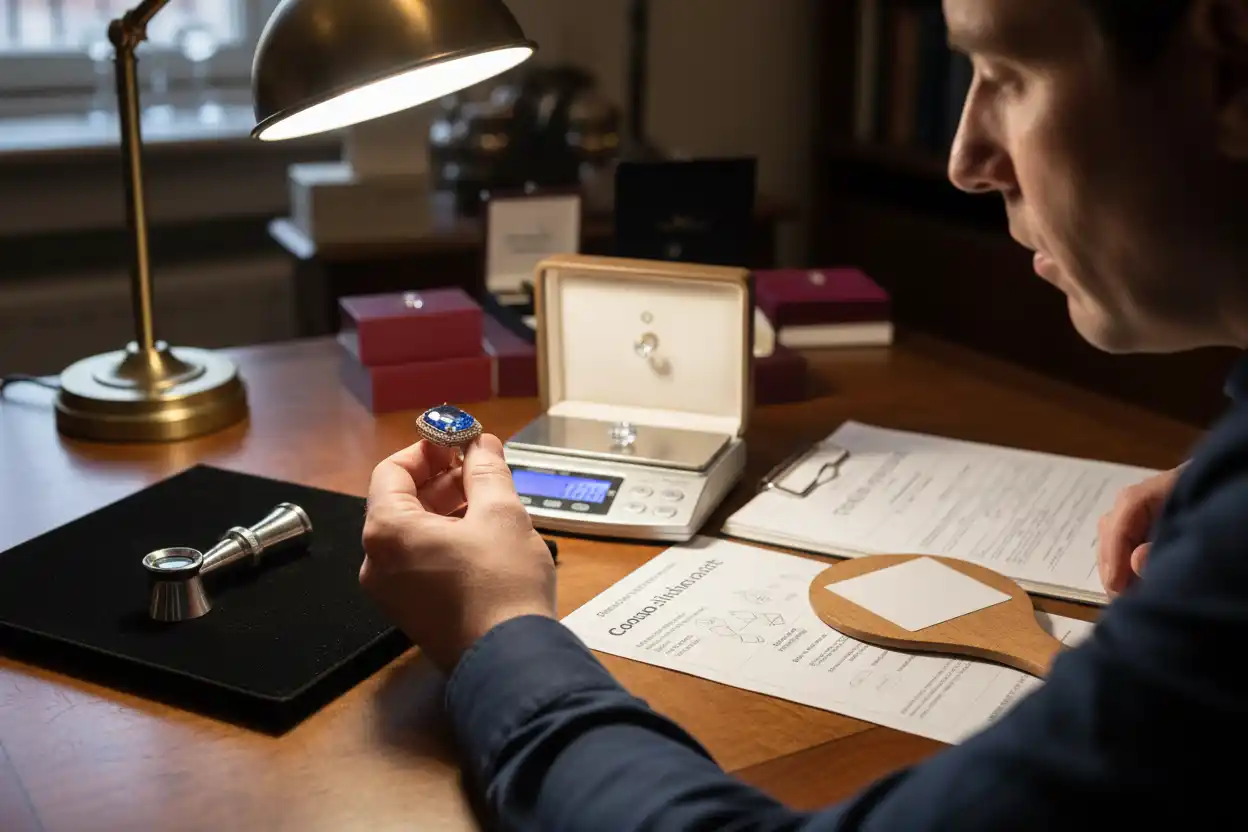
Why Gemstone Resale Disappoints
Gemstone resale disappoints because the original retail price and a secondary-market cash offer measure different transactions. A retailer sells a prepared product to an end consumer with presentation, service, warranties, expertise, and operating costs included. A resale buyer acquires an uncertain item that may require testing, repair, marketing, insurance, and months of inventory time before another customer appears.
The difference does not necessarily mean the original gemstone was fake or that every buyer is acting unfairly. More often, the gap reflects market structure, transaction costs, limited liquidity, and the risk transferred from the seller to the new owner.
Gemstone resale at a glance
| Resale factor | Effect on an offer |
|---|---|
| Original retail markup | The secondary buyer does not reimburse the first retailer’s overhead and services |
| Wholesale replacement cost | A dealer compares the item with what similar inventory would cost through trade channels |
| Inventory risk | Capital may remain tied up while the gemstone waits for a buyer |
| Authentication expenses | Testing, laboratory reports, appraisal research, and specialist labor reduce the amount available to pay the seller |
| Treatment uncertainty | Undisclosed or unclear treatments create pricing risk |
| Weak documentation | Missing reports, receipts, and provenance reduce confidence |
| Mounting complications | Settings can conceal damage and make accurate testing harder |
| Condition | Chips, abrasion, repairs, recutting, and worn settings reduce saleability |
| Selling fees | Auction, consignment, shipping, insurance, and payment charges reduce net proceeds |
| Limited demand | Specialized stones may have very few qualified buyers |
| Urgency | A fast sale usually means accepting a lower price from the buyers available now |
Retail price and resale value answer different questions
Retail price asks: What must a consumer pay to acquire this item from this seller under these conditions?
Cash resale value asks: What will a buyer pay the current owner now, after accounting for verification, operating expenses, risk, profit, and the possibility that the item may not sell quickly?
These values should not be expected to match.
The universal framework behind retail gem pricing appears in How Gemstone Prices Are Determined. The broader question of long-term preservation belongs to Do Gemstones Hold Their Value?, while species with stronger collector potential are compared in Best Gemstones for Investment.
The original retailer sold more than raw materials
A jewelry purchase may include:
- Gemstone sourcing and selection
- Design and manufacturing
- Metal and setting labor
- Staff expertise
- Rent and security
- Photography and advertising
- Packaging and presentation
- Payment processing and financing
- Returns and warranties
- Sizing, cleaning, or repair services
- Profit needed to keep the business operating
A resale buyer receives only the item and whatever transferable documents remain. The original customer experience, store presentation, and prior seller’s services cannot be resold.
Brand value may survive when the jewelry comes from a sought-after maker and retains its signatures, serial numbers, paperwork, box, condition, and recognizable design. Ordinary retail markup usually does not.
Dealers compare your item with replacement inventory
A dealer rarely begins with the price printed on your receipt. Instead, the dealer asks what it would cost to acquire comparable inventory through established suppliers, estate channels, trade contacts, auctions, or existing stock.
If the dealer can obtain a similar gemstone at a predictable trade price with reliable disclosure and return privileges, a privately offered stone must compensate for its additional uncertainty.
The comparison also includes saleability. A vivid, well-documented sapphire in a popular size may be easier to stock than an unusual stone requiring a highly specialized buyer. Even when the rare stone has a high theoretical value, slow turnover can weaken the immediate offer.
Inventory risk has a real cost
A dealer who buys a gemstone for cash becomes responsible for:
- Confirming identity and treatment
- Insuring and storing the item
- Repairing or remounting it
- Photographing and describing it
- Handling customer questions and returns
- Waiting for the appropriate buyer
- Absorbing market changes
- Accepting the risk that it may never sell at the expected price
Cash tied up in slow inventory cannot be used elsewhere. Therefore, the buyer needs enough margin to cover both operating expenses and uncertainty.
A higher expected retail listing price does not automatically produce a high purchase offer. The relevant figure is the probable net sale price after time, costs, negotiation, and risk.
Gemstone pricing is not fully standardized
Most colored gemstones lack a universally accessible price system that converts a few grades into a dependable cash number. Color, tone, saturation, transparency, cutting, origin, treatment, size, condition, and local demand interact.
Two sapphires of identical weight can have dramatically different market positions. Emerald clarity enhancement complicates comparisons further, while opal pattern, jadeite texture, alexandrite color change, and Paraiba tourmaline chemistry require specialized judgment.
Published retail listings are also asking prices rather than proof of completed transactions. A seller may list a gemstone at a high amount for months without finding a buyer.
As a result, a resale buyer often prices conservatively when comparable completed sales are scarce.
Treatment uncertainty lowers trust
Treatments can materially affect value, durability, and the market category of a gemstone. A buyer who cannot verify treatment status must either pay for testing or assume a less favorable possibility.
Common concerns include:
- Glass-filled ruby
- Diffusion-treated sapphire
- Oiled or resin-filled emerald
- Dyed or polymer-impregnated jadeite
- Stabilized or dyed turquoise
- Coated topaz or other coated gems
- Irradiated or heated materials
- Filled diamonds
- Assembled opal, turquoise, or other composites
- Laboratory-grown material sold without reliable disclosure
The foundational differences are covered in Gemstone Treatments Explained. When layered construction is possible, Gemstone Doublets and Triplets explains why the visible face may not represent one solid natural stone.
A vague invoice stating “genuine gemstone” does not answer these questions.
Laboratory reports reduce uncertainty but do not create a price
A report from a respected laboratory can help establish identity, natural or laboratory-grown origin, detectable treatments, and sometimes geographic origin. It may improve saleability when the findings address concerns that materially affect value.
However, the report is not an appraisal, price guarantee, or promise that a buyer exists. Its market usefulness depends on:
- The laboratory’s reputation among intended buyers
- The report’s age and verifiability
- Whether the identifying information matches the stone
- Whether the report addresses relevant treatments or origin
- Whether the stone has been recut, damaged, or altered
- Whether the expected sale price justifies the testing cost
Gemstone Certification Labs Compared covers laboratory selection, and How to Read a Gem Lab Report explains how to interpret findings without confusing them with monetary valuation.
Missing documents create additional work
A resale package is stronger when it includes:
- Original receipt and item description
- Laboratory report and verifiable report number
- Independent appraisal stating its purpose
- Treatment disclosures
- Stone weight and measurements
- Metal fineness and jewelry weight
- Maker documentation or serial numbers
- Repair and service records
- Earlier auction catalogs
- Provenance records
- Clear current photographs
- Original box and accessories for collectible branded jewelry
Missing paperwork does not prove that a gemstone lacks value. It means the buyer may need to reconstruct its identity and history, price the uncertainty, or decline the item.
Mounted gemstones are harder to evaluate
A setting can conceal portions of a gemstone, including chips, cavities, inclusions, foil, adhesive, composite layers, and previous repairs. Exact weighing may be impossible without removal, while some laboratory tests become more difficult in a mounting.
Removing a stone introduces labor, liability, and the possibility of damage. Fragile gems or worn settings require particular caution.
Jewelry buyers must also decide whether the item should be sold intact, repaired, scrapped for metal, or dismantled. The wrong choice can destroy design, maker, or provenance value.
Physical vulnerability is not captured by the Mohs scale alone. Gemstone Cleavage Explained and Gemstone Toughness vs Hardness explain why chips, abrasions, and structural weaknesses influence resale.
An insurance appraisal is not a cash offer
Insurance appraisals commonly address replacement: what it might cost to obtain a comparable item from an appropriate retail source after loss or damage.
A dealer purchasing the item for resale answers a different question. That buyer must obtain the piece below the eventual selling price, invest additional work, accept inventory risk, and earn a margin.
Therefore, an appraisal can be professionally prepared and still differ substantially from a dealer’s cash offer. The correct response is not to compare the figures without context. Instead, review the appraisal’s purpose, market, effective date, assumptions, and definition of value.
A fair-market-value appraisal prepared for the relevant resale market may provide a more useful baseline, but it still does not force a buyer to pay that amount.
Natural and laboratory-grown markets behave differently
A laboratory-grown gemstone may be beautiful and technically impressive, but its resale market can weaken when new production becomes more efficient or retail prices decline.
Buyers also need clear evidence that the material is laboratory-grown rather than natural. Ambiguous documentation creates risk in both directions.
Lab-Grown vs Natural Gemstones explains why initial price, production supply, consumer expectations, and disclosure affect the two markets differently.
Auction commissions and estimate risk
Auction can provide international exposure, competitive bidding, specialist cataloging, and access to collectors. Yet the channel is not free or guaranteed.
Potential deductions and risks include:
- Seller commissions or negotiated charges
- Insurance and shipping
- Photography, illustration, or catalog costs
- Laboratory testing
- Repair or preparation
- Unsold-lot charges where applicable
- Reserve restrictions
- Payment delays
- Currency movement in international sales
- The possibility that bidding stops below expectations
The auction estimate is a marketing and specialist judgment for a particular sale. It does not guarantee that the item will sell, reach the estimate, or produce that amount after deductions.
Auction works best when the property suits the auction house’s audience and price level. Ordinary commercial gemstones may perform better through local resale, consignment, or direct consumer channels.
Consignment can improve price but delays payment
In a consignment arrangement, the owner retains title while a dealer or platform markets the item. The consignor may receive more than in an immediate dealer sale because the intermediary does not invest the full purchase price upfront.
However, the owner accepts:
- A waiting period with no guaranteed sale
- A commission or fee
- Insurance and custody questions
- Possible price reductions
- Return, repair, or shipping risk
- Dependence on the consignee’s reporting and marketing
The contract should specify the asking price, minimum acceptable price, commission, insurance responsibility, duration, payment timing, return procedure, and authority to discount.
Online marketplaces transfer risk to the seller
Direct online selling can reach more buyers, but it requires the owner to establish trust without an established trade reputation.
Challenges include:
- Fraudulent payments and chargebacks
- Item-switching claims
- Returns after damage or alteration
- Inadequate shipping insurance
- Disputes about color or treatment
- Buyers relying on edited photographs
- Platform fees
- Tax-reporting obligations
- Personal-security concerns
- Difficulty selling high-value items without independent verification
The transaction safeguards in How to Buy Gemstones Online Without Getting Scammed also reveal what a legitimate secondary buyer expects from a seller: accurate identity, clear disclosure, verifiable reports, secure payment, insured shipping, and a documented inspection process.
Species-specific pricing complicates resale
A generic statement such as “precious stones retain value” ignores the variables inside each market.
Ruby buyers may focus on heat treatment, filling, color, size, and origin. Sapphire buyers add diffusion concerns and a wide range of color categories. Emerald buyers assess enhancement and structural condition. Diamond buyers use a more standardized grading framework but still account for cut, fluorescence, market supply, and report details.
The Ruby Price Guide, Sapphire Price Guide, Emerald Price Guide, and Diamond Price Guide illustrate why the gem name and carat weight cannot produce a reliable resale figure by themselves.
Jadeite adds treatment classification, translucency, texture, and concentrated regional demand, as discussed in the Jade Price Guide. Opal requires evaluation of body type, play-of-color, pattern, brightness, stability, treatment, and composite construction; see the Opal Price Guide and Opal Buying Guide.
Why emotional expectations amplify disappointment
Owners often remember the purchase occasion, the store’s presentation, the appraisal figure, or the person who gave them the jewelry. A buyer sees material, condition, documents, probable customer demand, and resale cost.
Neither perspective is inherently dishonest. They answer different questions.
An inherited ring can remain priceless to a family while producing a modest commercial offer. A low offer does not erase its history. It means the financial market does not compensate the owner for private memories unless the history also creates documented collector provenance.
A hypothetical resale example
Consider a ring originally purchased for $5,000. The price may have included the gemstone, gold, design, setting labor, retail service, warranty, marketing, and profit.
Years later, a dealer evaluates the ring. The stone is mounted, the treatment status is unclear, the style is slow-moving, and the setting needs repair. Before resale, the dealer may need laboratory testing, stone removal, photography, insurance, cleaning, and months of inventory time.
The dealer’s offer could therefore be far below $5,000 even though the ring remains genuine. No fixed percentage applies because a signed collectible jewel, an exceptional natural gemstone, and a mass-market treated stone would produce very different outcomes.
How to improve gemstone saleability
Identify the item correctly
Obtain an independent opinion from a qualified gemologist or appraiser when the potential value justifies the cost. Do not rely solely on the original sales description.
Choose the correct appraisal purpose
Tell the appraiser that you are considering resale. A replacement-value appraisal prepared for insurance may not answer the question.
Organize the documentation
Keep the report, receipt, appraisal, treatment disclosure, provenance records, service history, and photographs together. Verify laboratory reports before offering the item.
Avoid unnecessary alteration
Do not recut, repolish, remove, clean aggressively, or reset an important piece before obtaining specialist advice. Alteration can reduce weight, damage fragile material, or destroy period integrity.
Compare sale channels
Request opinions from more than one appropriate buyer. A pawnbroker, scrap buyer, colored-stone dealer, estate jeweler, auction house, and private collector serve different markets.
Ask for net proceeds
When considering auction or consignment, calculate the amount remaining after every commission, fee, test, repair, shipping charge, insurance cost, and tax obligation.
Allow sufficient time
Urgency reduces the number of available buyers. A patient seller may pursue specialist consignment or auction, while someone needing immediate cash must often accept a dealer’s risk-adjusted offer.
Present the item accurately
Use neutral photographs, exact measurements, report details, treatment disclosure, condition notes, and a clear return or inspection policy. Exaggerated claims reduce trust.
Questions to ask a potential buyer or consignee
- Which market and value level are you using?
- Are you buying the item for inventory, scrap, dismantling, or a specific client?
- Which characteristics support your offer?
- What testing or repair do you expect to perform?
- Is the offer conditional on laboratory results?
- Who pays for testing, shipping, insurance, and removal?
- What would make the item more saleable?
- Does the mounting add value or hinder evaluation?
- What are the total consignment or auction deductions?
- When will payment occur?
- What happens if the item does not sell?
- Is the item insured while in your custody?
Final resale checklist
Before offering a gemstone or jewel for sale:
- Confirm the identity of the gemstone.
- Investigate treatment and laboratory-grown status.
- Match the stone to any existing report.
- Obtain the correct appraisal type when appropriate.
- Document weight, dimensions, setting, metal, maker, and condition.
- Preserve receipts, boxes, service records, and provenance.
- Photograph the item before handing it over.
- Decide whether the gem should remain mounted.
- Compare several appropriate sale channels.
- Review every commission and fee in writing.
- Calculate expected net proceeds rather than the listing price.
- Use secure, insured shipping and payment.
- Allow enough time to reach specialist buyers.
- Treat guaranteed sale prices with skepticism.
- Separate sentimental importance from market expectations.
Frequently Asked Questions
1. Why did a dealer offer much less than I paid?
The dealer is pricing a new transaction that includes verification, inventory risk, operating costs, resale time, and profit. The original retail price included services and overhead that cannot be resold.
2. What percentage of retail value should I expect?
No reliable universal percentage exists. The result varies by gemstone, quality, treatment, documentation, maker, condition, demand, sale channel, and urgency.
3. Is a low offer proof that my gemstone is fake?
No. Genuine gemstones can receive low offers because they are commercial quality, heavily treated, difficult to verify, unfashionable, damaged, or slow to sell.
4. Why is my insurance appraisal higher than the cash offer?
The appraisal may estimate retail replacement cost, while the buyer is calculating an immediate acquisition price for resale. These are different value definitions and markets.
5. Will a laboratory report raise the resale price?
It may improve trust and saleability when identity or treatment materially affects value. It will not necessarily increase the price enough to recover the testing cost.
6. Should I remove the gemstone from its setting before selling?
Only after receiving qualified advice. Removal may improve testing access, but it can damage the stone or setting and may destroy value in signed, antique, or historic jewelry.
7. Is auction always the best way to sell a valuable gemstone?
No. Auction works best for property suited to the house’s audience. Private sale, specialist brokerage, or consignment may be more appropriate for other items.
8. Can consignment produce more than a cash sale?
Potentially, because the intermediary does not assume the same upfront inventory cost. However, the owner waits longer, pays a commission, and receives no guarantee of sale.
9. Why do online buyers distrust privately sold gemstones?
Private sellers may lack established reputations, reliable treatment disclosure, laboratory documentation, secure return procedures, and professional photographs. Buyers price those uncertainties.
10. Does the original receipt prove current value?
No. It proves a past transaction under specific retail conditions. Current value requires present-day analysis of the item and the relevant market.
11. Should I pay for an appraisal before selling inexpensive jewelry?
Not always. The appraisal cost may exceed any improvement in the sale result. Begin with a preliminary opinion from an appropriate professional.
12. How can I get the highest realistic resale price?
Identify and document the item accurately, preserve its condition, choose the market that understands it, compare sale channels, disclose treatments, calculate net proceeds, and allow sufficient time.
Conclusion
Gemstone resale disappoints when owners compare a consumer retail purchase with a dealer’s immediate risk-adjusted offer. Retail overhead, wholesale replacement options, authentication, treatment uncertainty, condition, mounting complications, fees, and limited liquidity all widen the gap.
A better result begins with accurate identification, the right appraisal purpose, organized documentation, realistic market selection, and patience. The objective is not to recover every dollar represented by an old receipt or insurance figure. It is to place the item in front of the buyer most capable of recognizing its actual qualities—and to understand the net amount that remains after the transaction is complete.