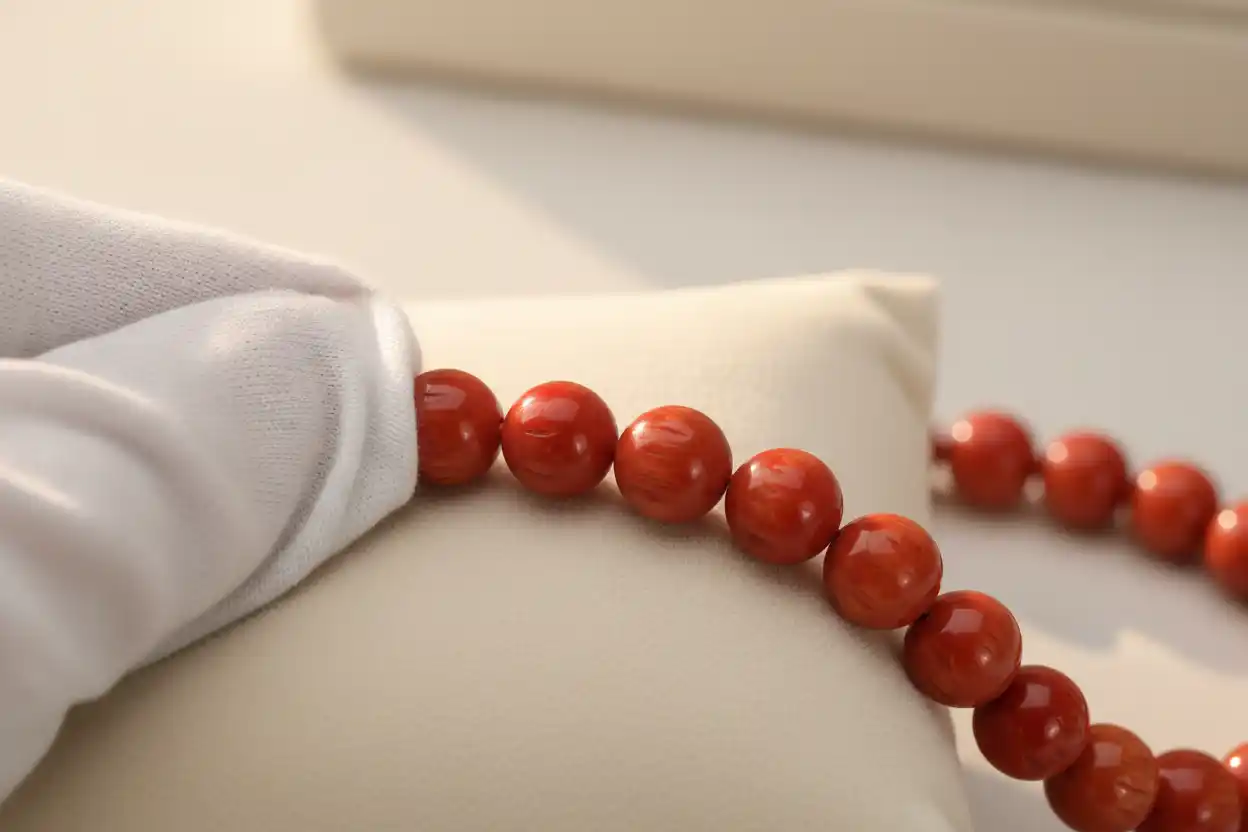
How to Clean Coral Jewelry Safely
Coral jewelry should be cleaned with a soft cloth and minimal moisture. Confirmed untreated precious coral may receive a brief rinse with lukewarm water and a very small amount of mild soap, but it should never be soaked, steam cleaned, placed in an ultrasonic machine, or exposed to acids, solvents, abrasives, or high heat.
Dyed, coated, stabilized, filled, reconstructed, and imitation coral may require even stricter care. When treatment is unknown, a dry or barely damp cloth is safer than immersion or chemical cleaning.
Why Coral Is More Delicate Than Mineral Gemstones
Jewelry coral is a biogenic material formed from the skeletons of marine organisms rather than a conventional mineral crystal. Its material history and symbolism are covered in the Coral meaning guide.
Precious coral commonly consists largely of calcium carbonate and has a porcelain-like luster after polishing. It ranks only about 3 to 3.5 on the Mohs scale, making it vulnerable to scratching from dust, metal components, and most faceted gemstones.
The practical difference between scratch resistance and resistance to breakage appears in the gemstone hardness chart and gemstone toughness versus hardness guide.
| Coral characteristic | Care consequence |
|---|---|
| Material type | Organic or biogenic gem material |
| Common composition of precious coral | Primarily calcium carbonate |
| Mohs hardness | Approximately 3 to 3.5 |
| Surface | Soft and capable of losing polish |
| Porosity | May absorb colored liquids or contaminants |
| Safest routine care | Soft dry cloth or minimal damp wiping |
| Ultrasonic cleaning | Never recommended |
| Steam cleaning | Never recommended |
| Main risks | Scratching, acids, solvents, heat, thermal shock, drying, dye loss, and coating damage |
Coral’s surface may also be porous. Consequently, perfume, perspiration, cosmetics, colored liquids, chlorine, and chemical cleaners can stain it or reduce its polish.
Identify the Type of Coral Before Cleaning
The word “coral” covers several materially different products. Precious red, pink, orange, and white coral differs from bamboo coral, sponge coral, black coral, reconstructed coral, plastic imitations, and fossil coral.
The types of Coral guide owns those variety and classification distinctions. For cleaning purposes, the main question is whether the piece contains untreated precious coral or a material that has been dyed, bleached, filled, impregnated, coated, reconstructed, or assembled.
Sponge coral often requires resin or polymer stabilization before polishing. Bamboo coral may be bleached and dyed to imitate red or pink precious coral. Black coral has a different organic skeletal composition from calcareous precious coral.
Fossil Coral is a separate lapidary material in which ancient coral structures have been replaced or filled by minerals. Its care should not automatically be assumed from the instructions for modern precious coral.
Look for Treatments and Composite Construction
Coral treatments may include bleaching, dyeing, filling, impregnation with resin or polymer, waxing, oiling, coating, and surface coloration.
Some treatments remain vulnerable to water, detergent, solvents, heat, abrasion, or intense light. A cleaning method that leaves untreated coral unharmed may remove dye or soften a coating.
The tracker’s Gemstone Treatments Explained guide provides the broader treatment framework. Composite construction is covered separately in Gemstone Doublets and Triplets.
Inspect the side, back, drill holes, and recesses. Unnaturally concentrated color, transparent surface layers, filled cavities, and seams may indicate treatment or assembly, although professional examination may be required.
Inspect the Jewelry Before Cleaning
Check every bead, cabochon, carving, drill hole, prong, bezel, clasp, knot, and stringing material.
Look for cracks, chips, a chalky surface, peeling color, lifting coating, loose beads, frayed thread, stretched cord, cloudy adhesive, or movement in the setting.
Do not clean a damaged piece at home. Pressure from wiping may worsen a crack, while moisture can enter an unstable coating, filled cavity, or drilled area.
Older coral jewelry may contain silk, cotton, natural thread, foil, shellac, glue, or metal components that impose stricter care limits than the coral itself.
Routine Care with a Soft Cloth
After wearing coral, wipe it gently with a clean, dry, lint-free cloth or soft leather. This removes perspiration, skin oils, and fresh cosmetic residue before they remain on the surface.
Use light, straight movements rather than vigorous circular rubbing. Repeated aggressive polishing may gradually soften carved details or create uneven wear.
A soft dry brush can remove dust from carving recesses and around the mounting. Avoid stiff toothbrushes, abrasive cloths, paper towels, and powered polishing tools.
When dry wiping removes the residue, no water is necessary.
Cleaning Confirmed Untreated Precious Coral
For sound untreated precious coral, prepare lukewarm water with only a trace of mild soap. Dampen a soft cloth or briefly rinse the piece rather than leaving it immersed.
Wipe the surface gently and keep the cleaning period short. Use a second cloth dampened with clean water to remove soap residue.
Blot the jewelry immediately and allow it to dry at room temperature. Do not place it on a radiator, sunny windowsill, heated surface, or beneath a hair dryer.
Avoid saturating drill holes, knots, thread, adhesives, and backing materials. A strand may require local bead cleaning rather than complete immersion.
Cleaning Dyed, Coated, or Stabilized Coral
When the coral has been dyed, coated, filled, impregnated, waxed, or stabilized, begin with a dry cloth.
Use a barely damp cloth only when the seller or laboratory documentation confirms that moisture is appropriate. Some treatments can be altered by detergents, colored liquids, solvents, heat, or prolonged water contact.
Do not assume that ordinary dish soap is safe for every treated coral. Even a mild formulation may affect unstable dye, resin, wax, or a superficial coating.
If color appears on the cloth, stop immediately. Continued wiping may remove treatment and leave a patchy surface.
Never Use an Ultrasonic Cleaner
Coral should never go in an ultrasonic cleaner. The vibration, cleaning solution, and heat can damage a soft porous surface, widen cracks, loosen beads, or alter treatments.
Organic and biogenic gem materials generally react differently from diamond, sapphire, or cubic zirconia. A machine that works well for a hard transparent gemstone can permanently damage coral.
The broader equipment comparison appears in Which Gemstones Can Go in an Ultrasonic Cleaner?.
Never Steam Clean Coral
Steam introduces heat, pressure, and rapid temperature change. Coral can crack through thermal shock or lose structural moisture in hot, drying conditions.
Heat may also soften resin, affect wax, disturb adhesive, or alter surface color. Therefore, steam cleaning is unsuitable even when the coral is mounted in durable gold or platinum.
Acids, Solvents, and Household Chemicals
Coral’s calcium-carbonate component reacts with acids. Keep it away from vinegar, lemon juice, acidic bathroom cleaners, descaling products, and chemical jewelry dips.
Acetone, nail-polish remover, alcohol, paint thinner, perfume, and other solvents may attack dyes, coatings, resins, waxes, or adhesives.
Bleach, chlorine, ammonia, and strong alkaline cleaners are also inappropriate. Coral should be removed before swimming, bathing, cleaning, or using household chemicals.
The tracker’s broader water-safety guide should not be interpreted as permission to soak coral jewelry. Controlled cleaning and prolonged immersion are different exposures.
Perfume, Cosmetics, and Perspiration
Put coral jewelry on after perfume, hairspray, makeup, lotion, sunscreen, and other cosmetic products have dried.
Perspiration contains moisture, salts, oils, and acids that can accumulate on the polished surface. Wiping coral after wear is therefore more important than frequent deep cleaning.
Remove it before exercise, strenuous outdoor activity, or work that produces heavy perspiration.
Hand sanitizer should also remain away from coral. Alcohol and other ingredients may affect treatments and surface luster.
Cleaning a Coral Necklace
A Coral necklace often combines many drilled beads with silk, thread, knots, wire, clasps, and metal spacers.
Lay the necklace flat on a padded towel and wipe one bead at a time. Keep the thread as dry as practical, especially when its age or material is unknown.
Do not pull beads against one another. Friction between adjacent coral surfaces can create fine scratches.
Allow the necklace to dry flat. Hanging a wet strand may stretch the thread and concentrate weight at the clasp.
When knots become stained or thread frays, restringing is safer than repeated washing.
Cleaning Coral Earrings
For Coral earrings, wipe the coral component separately from the post, hook, back, hinge, or clip.
Alcohol-based disinfectant may be used locally on compatible metal fittings, but it should not contact the coral.
Avoid dipping the complete earring in silver cleaner or another metal solution. Clean the surrounding metal with a controlled method or ask a jeweler to handle the mixed-material piece.
Caring for Coral Cabochons and Carvings
Cabochons may be bezel set, prong set, or glued. Determine the construction before allowing water near the setting.
Carvings contain recesses where dust and cosmetics collect. Remove debris with a soft dry brush rather than soaking or scrubbing the entire carving.
Do not use household polishing compounds to restore a chalky or scratched surface. Coral can lose material rapidly during polishing, and superficial treatments may be removed.
A specialist familiar with organic gem materials should evaluate valuable or historic carvings.
Light, Heat, and Dry Environments
Strong natural or artificial light can fade certain color-treated corals or cause them to revert toward their original color.
Keep the jewelry away from hot windowsills, display lamps, radiators, vehicle dashboards, and rapid temperature changes. The wider light-stability question belongs to the guide to crystals that fade in sunlight.
Coral should not be stored in an excessively hot, desiccating environment. However, it also should not be kept submerged or continuously damp.
A stable indoor environment away from heat and chemical fumes is appropriate.
Storage
Store coral separately in a soft pouch or fabric-lined compartment. Harder gemstones and metal components can scratch it.
Do not wrap a necklace tightly or place heavy jewelry on top of carved pieces. Keep clasps and chains from rubbing against polished surfaces.
Inspect bead strands periodically. Restringing before a cord breaks is less costly than replacing a lost strand.
Buying, Disclosure, and Ethical Questions
Ask whether the material is precious coral, common coral, dyed bamboo coral, stabilized sponge coral, black coral, reconstructed material, fossil coral, or an imitation.
Treatment and construction should be disclosed clearly because they affect both value and cleaning. The Coral buying guide covers identification and seller questions, while the Coral price guide addresses the factors that affect market value.
Environmental and sourcing questions belong to Coral in Jewelry: The Ethics Problem. Care instructions cannot verify legality, species, harvesting method, or geographic origin.
For valuable or unusual pieces, the guides to gemstone certification and reading a gem laboratory report explain how identification and detectable treatment may be recorded.
The general seller-verification principles in How to Buy Gemstones Online Without Getting Scammed also apply to coral descriptions.
Frequently Asked Questions
1. What is the safest way to clean coral jewelry?
Wipe it with a soft dry cloth. Confirmed untreated precious coral may receive a brief lukewarm rinse with minimal mild soap.
2. Can coral get wet?
Brief controlled contact may be acceptable for sound untreated precious coral. Avoid soaking, especially when the piece is dyed, coated, stabilized, strung, glued, or of unknown treatment.
3. Can coral go in an ultrasonic cleaner?
No. Vibration, heat, and cleaning chemicals can damage coral and its treatments.
4. Can coral be steam cleaned?
No. Steam can cause heat damage, thermal shock, cracking, treatment failure, and loss of polish.
5. Is dish soap safe for coral?
A trace of mild soap may be used on confirmed untreated coral. Some treated corals should be cleaned without detergent.
6. Can vinegar clean coral?
No. Coral contains calcium carbonate that can be attacked by acids such as vinegar.
7. Can rubbing alcohol clean coral earrings?
Keep alcohol away from the coral. Use it only on a compatible metal fitting without allowing contact with the gem.
8. Why is coral color coming off on the cloth?
The piece may be dyed or coated. Stop cleaning because further wiping may remove more color.
9. Can coral necklaces be soaked?
No. Soaking can affect beads, thread, knots, dye, filler, and adhesives.
10. Can scratched coral be polished at home?
No. Coral is soft, and uncontrolled polishing may remove significant material or damage treatments.
11. How often should coral jewelry be cleaned?
Wipe it after each wear. Deeper cleaning should occur only when residue remains and the material’s treatment is understood.
12. When should coral go to a specialist?
Professional care is appropriate for cracks, peeling color, chalky surfaces, loose beads, frayed string, antique construction, unknown treatment, or valuable carvings.
Conclusion
Coral benefits more from preventive care than from intensive cleaning. A soft cloth after wear, minimal moisture, separate storage, and protection from cosmetics preserve its polish without exposing the material to acids, solvents, heat, or vibration. When coral shows fading, peeling, or a chalky surface, the next question is which treatment or construction is present—not which stronger cleaner should be tried.