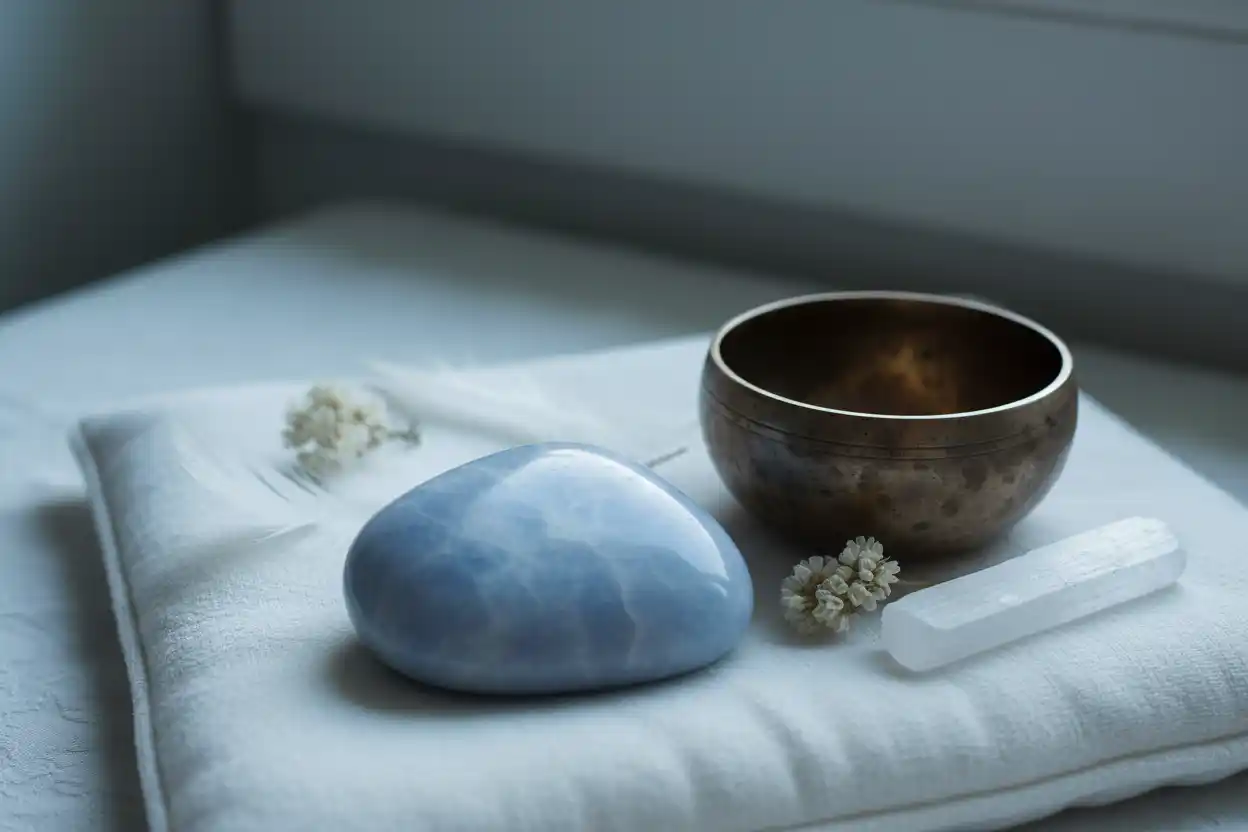
How to Cleanse and Charge Angelite
The safest ways to cleanse and charge Angelite are sound, intention, visualization, breath, a gentle dry-cloth ritual, and indirect moonlight indoors.
Angelite should not be soaked, rinsed repeatedly, placed in saltwater, buried in salt or soil, exposed to steam, or rubbed against harder crystals. It is a soft, brittle form of anhydrite with several strong cleavage directions, so non-contact rituals provide the best balance between personal symbolism and physical preservation.
What Cleansing and Charging Mean
Cleansing is a spiritual or personal practice used to mark a fresh start, release unwanted associations, or prepare an object for meditation.
Charging refers to associating the stone with an intention, routine, memory, or chosen purpose.
Neither practice is required to maintain Angelite as a mineral. Likewise, no established scientific evidence shows that cleansing changes its measurable energy or creates health effects.
The material’s geology, pale-blue color, symbolism, and uses belong to the Angelite guide.
Its mineral identity and broader physical properties belong to the Anhydrite guide.
Angelite Is Blue Anhydrite
Angelite is a commercial name commonly applied to compact pale-blue anhydrite.
Anhydrite is anhydrous calcium sulfate. It is chemically related to Gypsum, which contains water within its structure.
The relationship is explored further in the Gypsum guide.
| Property | Ritual implication |
|---|---|
| Mineral | Anhydrite |
| Composition | Calcium sulfate |
| Typical Angelite color | Pale powder blue to blue gray |
| Mohs hardness | Approximately 3 to 3.5 |
| Tenacity | Brittle |
| Cleavage | Perfect, nearly perfect, and good in three directions |
| Safest ritual methods | Sound, intention, visualization, breath, and indirect moonlight |
| Water exposure | Avoid |
| Salt contact | Avoid |
| Main risks | Scratching, cleavage, hydration, chipping, moisture, and surface alteration |
The gemstone hardness chart explains why Angelite can be scratched by Quartz, glass, metal, ceramic, and many common gemstones.
Its brittleness and multiple cleavage directions are more significant than its surface hardness alone. Those concepts appear in Gemstone Toughness vs Hardness and Gemstone Cleavage Explained.
Why Water Should Be Avoided
Anhydrite can hydrate toward Gypsum under suitable conditions. That process is not necessarily immediate after one droplet, and its rate varies with surface condition, temperature, water chemistry, particle size, and structure.
Nevertheless, soaking polished Angelite creates unnecessary risk.
Moisture may enter microfractures, alter a soft surface, leave pale deposits, weaken glue, stretch stringing, or encourage gradual mineral alteration.
Therefore, Angelite should not be submerged for cleansing. Wipe accidental moisture away immediately and allow the stone to dry naturally.
The tracker’s general water framework appears in Which Crystals Can and Can’t Go in Water.
The related discussion of another calcium-sulfate material appears in Is Selenite Safe in Water and Sunlight?.
Inspect Angelite Before Handling
Examine the stone beneath soft, indirect light.
Look for powdery areas, open cracks, chipped corners, new white patches, deep scratches, loose beads, damaged drill holes, cloudy glue, and lifting inlay.
Angelite commonly appears as tumbles, palm stones, beads, carvings, spheres, and polished slabs. These forms can conceal small cleavage-related breaks.
Do not press on a crack to see whether it moves. Anhydrite can split along more than one structural direction.
A damaged or antique piece should remain on a padded surface while you use a non-contact ritual.
Use Dry Physical Care First
Symbolic cleansing does not remove dirt or cosmetic residue.
For routine maintenance, wipe Angelite gently with a dry microfiber or very soft cotton cloth.
Do not use water, alcohol, sanitizer, jewelry dip, essential oil, vinegar, steam, or abrasive paste.
A soft makeup brush can remove dust from a carving or recessed area, provided you use minimal pressure.
Machine-cleaning limitations are covered in Which Gemstones Can Go in an Ultrasonic Cleaner?.
Angelite should never enter an ultrasonic or steam cleaner.
Method 1: Cleanse Angelite with Sound
Sound is the safest all-purpose method because it requires no moisture or contact.
Place Angelite on a thick folded cloth. Ring a bell, chime, tuning fork, or singing bowl nearby.
You may also hum, chant, clap gently, or play quiet music.
Do not place the stone inside a hard metal bowl. Direct contact and vibration can scratch or chip it.
Several gentle tones are sufficient. Loudness does not increase the ritual’s symbolic value.
Method 2: Use Intention
Leave Angelite on a padded surface or hold it loosely over a cloth.
Choose one simple purpose for the object. It might remind you to listen carefully, communicate calmly, pause before responding, or create a quieter evening routine.
State the intention aloud or silently.
Because the method requires no water, heat, or other minerals, it is suitable for polished stones, jewelry, carvings, and fragile specimens.
Method 3: Use Visualization
Place the Angelite where it cannot roll.
Imagine unwanted associations receding while the pale-blue object becomes connected with a new purpose.
Some practitioners visualize soft blue or white light. The chosen image is symbolic and does not imply that the mineral emits measurable energy.
Continue for several breaths or a few minutes.
Visualization is particularly useful for cracked, powdery, glued, or valuable pieces that should not be handled.
Method 4: Use Breath Carefully
Keep the stone on a soft cloth.
Take several slow breaths and exhale gently in its direction once or twice.
Avoid blowing forcefully or creating visible condensation. Moisture should not collect on the Angelite.
State your intention after the breath ritual.
This method works best in a dry indoor environment and should remain brief.
Method 5: Use Indirect Moonlight Indoors
Place Angelite near a window on a padded tray or inside an open lined jewelry box.
An hour, an evening, or overnight indoor placement can serve the symbolic ritual.
Do not leave it outside. Dew, fog, rain, soil, falling debris, and temperature changes create unnecessary risk.
Normal indoor light is not the principal concern; outdoor moisture and physical damage are.
The broader sunlight framework appears in Which Crystals Can and Can’t Go in the Sun.
Method 6: Use a Written Intention
Write a concise statement and place it beside or beneath the padded Angelite.
The paper can describe an action, such as speaking more deliberately, giving someone time to finish, or creating a calm transition between work and rest.
Leave the arrangement for several minutes or an evening.
Paper does not need to touch the stone directly. A cloth barrier provides additional scratch protection.
Method 7: Create a Dry Altar or Display
Place Angelite on a fabric-lined dish with a photograph, written phrase, dried flower, or other non-abrasive object.
Keep every component dry.
Do not use fresh flowers in standing water, moist plant soil, essential oils, salt, or metal objects that can scrape the surface.
A simple display can maintain symbolic meaning without repeated handling.
Method 8: Use a Mindful Dry-Cloth Ritual
Place the stone on a padded surface.
Wipe it once or twice with an exceptionally soft dry cloth while focusing on your intention.
Do not buff rapidly. Repeated friction may dull a soft polish or catch on a chipped edge.
This method works well for Angelite beads and smooth palm stones that collect fingerprints.
Stop immediately when the cloth catches on a crack.
Do Not Use Running Water
Running water combines moisture with the possibility of dropping the stone into a hard sink or drain.
Even a short rinse provides no symbolic advantage over sound, intention, or visualization.
If Angelite becomes wet accidentally, blot it rather than rubbing. Let it dry at room temperature away from heat.
Do not use a hair dryer, radiator, oven, heated cabinet, or direct sunlight to accelerate drying.
Do Not Use Salt or Saltwater
Salt crystals can scratch Angelite and enter cracks, drill holes, and carving recesses.
Saltwater adds moisture and dissolved ions to an already unsuitable method.
Do not bury Angelite in dry salt, Himalayan salt, sea salt, or table salt.
When salt carries personal symbolism, keep it in a separate bowl while the stone remains on a dry lined dish nearby.
Do Not Bury Angelite in Soil
Soil contains moisture, Quartz grains, fertilizers, organic acids, microorganisms, and abrasive particles.
These materials may scratch, stain, or alter the soft surface.
Outdoor burial also risks loss, pressure, rain, and temperature changes.
A nature-based alternative places Angelite beside a potted plant without allowing contact with soil, water, or wet leaves.
Use Smoke Only at a Distance
Smoke is sometimes used in spiritual traditions, but it can leave soot, oils, and fragrance residue.
Keep Angelite away from flames, hot ash, incense coal, and heated bowls.
A brief exposure to cool, dispersed smoke may be used in a ventilated room. However, sound or visualization is cleaner and eliminates the need to remove residue afterward.
Do not wipe smoke deposits with a wet cloth.
Do Not Apply Essential Oils
Essential oils, fragrance sprays, perfume, sanitizer, and alcohol-based preparations can stain or damage Angelite.
Oil can enter fractures and change the appearance of the surface.
Never apply liquid directly to “feed,” polish, seal, or charge the stone.
Commercial treatment categories are discussed in Gemstone Treatments Explained, but household oiling should not be treated as professional stabilization.
Can Angelite Touch Selenite or Quartz?
Angelite can scratch softer Selenite, while Quartz can scratch Angelite.
A cloth barrier should separate Angelite from both materials.
Direct mineral-to-mineral contact is not required for a symbolic charging arrangement.
A padded tray also prevents grit from becoming trapped between polished surfaces.
Another soft-stone ritual comparison appears in How to Cleanse and Charge Amber, while a more durable quartz comparison appears in How to Cleanse and Charge Amethyst.
Buying and Safety Context
The Where to Buy Real Angelite guide covers material identity, color, polish, cracks, imitations, and seller claims.
Do not lick, grind, drill, burn, or place Angelite in drinking water as part of a ritual.
Ordinary intact handling is different from creating dust or ingesting mineral material. The broader safety distinction belongs to the Toxic Crystals safety list.
Frequently Asked Questions
1. What is the safest way to cleanse Angelite?
Use sound, intention, visualization, breath, a dry cloth, or indirect indoor moonlight.
2. Can Angelite be cleansed in water?
No. Avoid soaking and repeated rinsing because Angelite is soft anhydrite and may undergo surface alteration or gradual hydration.
3. What should I do if Angelite gets wet?
Blot it immediately with a soft cloth and let it dry naturally at room temperature.
4. Can Angelite be left in moonlight overnight?
Yes, when kept indoors on a dry padded surface.
5. Can Angelite be charged in sunlight?
Indirect indoor light is safer. Outdoor sun introduces heat, weather, and accidental moisture without improving the ritual.
6. Can Angelite be cleansed with salt?
No. Salt can scratch the surface and enter cracks or drill holes.
7. Can Angelite be cleansed with smoke?
A brief cool-smoke ritual is possible, but sound or intention avoids soot and residue.
8. Can Angelite be placed on Selenite?
Use a soft cloth barrier. Angelite may scratch softer Selenite.
9. Can Clear Quartz charge Angelite?
Some practitioners use it symbolically, but Quartz can scratch Angelite, so the stones should not touch.
10. How long should Angelite charge?
A few minutes or an evening is sufficient. There is no scientifically required duration.
11. How often should Angelite be cleansed?
Use a schedule that fits your practice while minimizing unnecessary handling.
12. Does cleansing change Angelite scientifically?
No established scientific evidence shows that cleansing changes its chemistry, health effects, or measurable physical energy.
Conclusion
Angelite’s softness, brittleness, and relationship to water-sensitive calcium-sulfate minerals make non-contact rituals the clear choice. Sound, intention, visualization, and protected moonlight preserve the powder-blue surface without introducing moisture, salt, grit, or heat. A safe ritual should leave the Angelite exactly as it began—dry, unscratched, and structurally intact.
Crystal cleansing and charging are spiritual or personal practices, not scientifically established methods for changing health, energy, or the physical properties of Angelite.