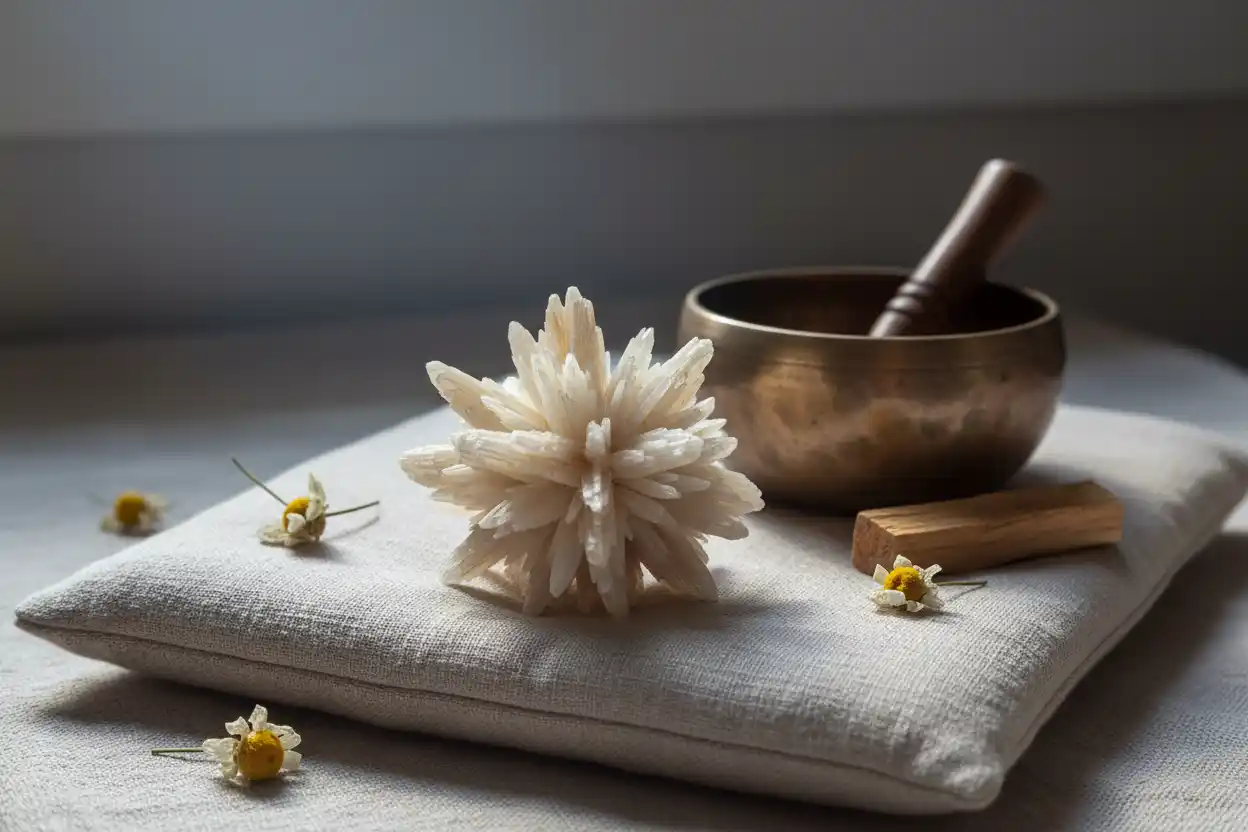
How to Cleanse and Charge Aragonite
The safest ways to cleanse and charge Aragonite are sound, intention, visualization, breath, indirect indoor moonlight, and a gentle dry-brush ritual. These methods avoid the acids, moisture, salt grains, heat, pressure, and abrasion that can damage its brittle calcium-carbonate crystals.
Aragonite should not be soaked in water, exposed to vinegar or lemon juice, buried directly in salt or soil, placed in an ultrasonic cleaner, or handled roughly. Clusters are particularly vulnerable because their radiating points, repeated twins, and fragile terminations can chip even when the mineral’s main body remains intact.
What Cleansing and Charging Mean
Cleansing is a spiritual or personal ritual used to mark a fresh beginning, release previous associations, or prepare an object for meditation and intentional use.
Charging generally means dedicating the stone to a purpose, routine, memory, or personal value.
Neither practice is required to maintain Aragonite as a mineral. No established scientific evidence shows that symbolic cleansing changes its chemistry, crystal structure, health effects, or measurable physical energy.
The mineral’s geology, crystal habits, localities, and traditional symbolism belong to the broader Aragonite guide.
This page focuses narrowly on ritual methods that preserve the specimen rather than duplicating the mineral guide’s meaning and geological content.
Why Aragonite Needs Dry, Low-Contact Methods
Aragonite is calcium carbonate with the same chemical formula as Calcite but a different crystal structure.
Aragonite is orthorhombic, whereas Calcite has a trigonal structure. The two are polymorphs: they share a composition but arrange their atoms differently.
| Property | Ritual implication |
|---|---|
| Composition | Calcium carbonate |
| Crystal system | Orthorhombic |
| Mohs hardness | Approximately 3.5 to 4 |
| Tenacity | Brittle |
| Cleavage | Distinct in one direction and imperfect in others |
| Common forms | Prismatic crystals, needles, radiating clusters, crusts, and banded masses |
| Safest ritual methods | Sound, intention, visualization, breath, and protected moonlight |
| Water exposure | Avoid soaking |
| Acid exposure | Never use |
| Main risks | Broken points, cleavage, scratches, acid etching, salt, matrix damage, and glue |
The gemstone hardness chart explains why Quartz, glass, steel, ceramic, and many jewelry stones can scratch Aragonite.
However, scratches are only part of the risk. Aragonite is also brittle and can split or chip along structural weaknesses. The distinction is covered in Gemstone Toughness vs Hardness and Gemstone Cleavage Explained.
Inspect the Specimen Before Beginning
Examine the Aragonite under soft, indirect light.
Look for loose needles, newly chipped points, powdery areas, open fractures, unstable matrix, repaired sections, cloudy glue, and grains that move when the specimen is tilted.
Many Aragonite clusters contain naturally intersecting crystals. Irregularity alone does not mean damage.
However, a point that shifts, a crack that widens, or loose fragments beneath the specimen indicate instability.
Do not squeeze a cluster to test its strength. Place it on a padded tray and select a non-contact method.
Physical Cleaning Is Separate from Symbolic Cleansing
Symbolic cleansing does not remove dust, soil, fingerprints, or accumulated debris.
For a sturdy massive or polished piece, a clean dry microfiber cloth may remove loose dust. A soft makeup brush or fine artist’s brush is more suitable for clusters.
Support the specimen from beneath while brushing outward from the center. Do not push bristles between tightly packed needles.
Avoid water, household jewelry cleaner, alcohol, sanitizer, steam, compressed air, and ultrasonic equipment.
A forceful air stream may break delicate crystals or drive grit deeper into the cluster.
When a valuable specimen contains old dirt, matrix deposits, or an unknown coating, professional mineral conservation is safer than household washing.
Method 1: Cleanse Aragonite with Sound
Sound is one of the safest methods because it requires no liquid or direct mineral contact.
Place the specimen on a thick folded cloth. Ring a bell, chime, tuning fork, or singing bowl nearby.
You may also hum, chant, clap softly, or play calm music at a comfortable volume.
Do not place Aragonite inside a metal singing bowl or directly against its rim. Hard contact and concentrated vibration can chip crystal points.
Several gentle tones are sufficient. The symbolic value does not increase with volume or physical vibration.
Method 2: Use Intention
Leave the Aragonite on its padded surface.
Choose one concise intention for the ritual. It might serve as a reminder to create structure, complete tasks in sequence, maintain patience during a transition, or stay connected with a supportive community.
State the intention silently or aloud.
A low-contact intention ritual works for polished pieces, clusters, cave formations, coral-like aggregates, repaired specimens, and pieces attached to matrix.
The stone does not need to be held for the ritual to feel deliberate.
Method 3: Use Visualization
Place the specimen where it cannot roll, tip, or fall.
Imagine previous associations fading while the Aragonite becomes linked with the new purpose you selected.
Some people visualize white, cream, golden, or neutral light. The imagery is symbolic rather than a measurable emission from the mineral.
Continue for several breaths or a few minutes.
Visualization is particularly useful for star clusters because the ritual does not require touching their radiating points.
Method 4: Use Breath Carefully
Keep the Aragonite on a padded cloth.
Take several slow breaths and exhale gently in the specimen’s direction once or twice.
Do not blow forcefully. Strong air movement can disturb loose grains, while moisture from repeated breath may condense on cool crystal surfaces.
State the intention after the brief breath ritual.
For a delicate cluster, direct your breath toward the space above it rather than into its central openings.
Method 5: Use Indirect Moonlight Indoors
Place Aragonite indoors near a window on a padded tray or inside an open display box.
An hour, an evening, or overnight indoor placement may be used according to personal preference.
Do not leave the specimen outdoors. Dew, rain, temperature shifts, animals, falling debris, and hard surfaces create unnecessary risks.
The moon phase does not change Aragonite’s physical properties. Selecting a full moon, new moon, or another phase is a symbolic preference.
The wider environmental framework appears in Which Crystals Can and Can’t Go in the Sun.
Method 6: Use a Written Intention
Write a concise statement and place it beside the Aragonite.
The statement might describe a practical behavior, such as completing one step before beginning the next or creating a stable routine during a busy period.
Keep pens, clips, pins, and metal objects away from the specimen.
A written ritual is suitable for fragile clusters because the mineral remains undisturbed on its display support.
Remove the paper when the ritual feels complete or leave it beneath the lined tray.
Method 7: Create a Dry Nature-Based Arrangement
Place the Aragonite near a dry leaf, piece of untreated fabric, photograph, or potted plant.
Keep the specimen on a separate lined dish.
Do not place it in wet moss, fresh flowers, standing water, damp soil, or directly against a ceramic plant pot.
A nature-based ritual does not require burial. Proximity provides the symbolism without exposing the mineral to moisture and abrasive particles.
Method 8: Use Another Symbolic Object Nearby
Aragonite can be placed near a meaningful keepsake, candle that remains unlit, journal, or another mineral.
Keep a cloth barrier between Aragonite and harder stones.
Clear Quartz, Amethyst, Citrine, and many common crystals can scratch it. Metal objects can also damage delicate points.
Direct contact is unnecessary. Arrange the objects with enough space that none can roll or press against the Aragonite.
Do Not Use Vinegar, Lemon Juice, or Acid
Aragonite is calcium carbonate, so acids react with its surface.
Vinegar, lemon juice, acidic sprays, bathroom cleaners, descaling products, and metal dips can etch, dull, pit, or partially dissolve the mineral.
Bubbling or fizzing is evidence of chemical reaction, not successful energetic cleansing.
Never use an acid reaction as an authenticity test on a valued specimen.
The same restriction applies to Calcite, discussed in How to Cleanse and Charge Calcite.
Do Not Soak Aragonite in Water
Calcium carbonate is not highly soluble in neutral water, but that does not make soaking a safe ritual.
Water can enter fractures, loosen dirt within a cluster, weaken glue, affect a porous matrix, leave mineral deposits, or create stresses during drying.
Needle-like and radiating specimens can also be damaged during handling, rinsing, and towel drying.
Use sound, intention, or visualization instead.
The broader difference between a mineral’s chemical water tolerance and the condition of a finished specimen appears in Which Crystals Can and Can’t Go in Water.
Do Not Use Salt or Saltwater
Coarse salt can scratch Aragonite and lodge among crystals, fractures, and matrix cavities.
Saltwater adds prolonged moisture and can leave deposits after evaporation.
Do not bury a star cluster in Himalayan salt, sea salt, table salt, or cleansing granules.
When salt carries symbolic importance, keep it in a separate bowl while the Aragonite remains on a padded dish nearby.
Do Not Bury Aragonite in Soil
Soil contains Quartz grains, mineral debris, moisture, fertilizers, organic acids, and microorganisms.
These materials can scratch, stain, or become trapped inside a cluster.
Outdoor burial also introduces pressure, weather, loss, and accidental impact.
Place the specimen near a plant rather than in the soil.
Avoid Smoke Residue and Heat
A brief cool-smoke ritual may be meaningful in some traditions, but smoke can leave soot, resin, and fragrance residue among Aragonite needles.
Keep the specimen away from flames, candles, incense coals, hot bowls, and ash.
Do not pass a cluster through a narrow smoke stream where it might strike the burner.
Sound, intention, or visualization provides the same ritual structure without creating residue that is difficult to remove.
Avoid Ultrasonic and Steam Equipment
Ultrasonic vibration can break fragile points, enlarge fractures, loosen matrix, and disturb repairs.
Steam combines heat, pressure, and rapid temperature change.
Neither machine is required for physical or symbolic care.
The broader equipment discussion belongs to Which Gemstones Can Go in an Ultrasonic Cleaner?.
Aragonite and Calcite Are Related but Not Interchangeable
Aragonite and Calcite share the formula calcium carbonate but have different structures, crystal forms, and cleavage behavior.
The broader Calcite profile belongs to the Calcite guide, while its varieties appear in Types of Calcite.
Aragonite commonly forms needles, radiating clusters, pseudohexagonal twins, shells, and biological hard parts. Calcite commonly forms rhombohedral crystals and shows perfect rhombohedral cleavage.
Both are soft, brittle, and acid sensitive. Consequently, the safest cleansing methods overlap: sound, intention, visualization, and protected moonlight.
Aragonite in Shell, Pearl, and Nacre
Aragonite is an important component of many mollusk shells, Pearls, and nacre.
However, a mineral specimen and an organic gem object require different construction-based care.
The material relationship is explained in the Mother of Pearl guide and Pearl guide.
Physical care for finished nacre belongs to How to Clean Mother of Pearl Jewelry Safely and How to Clean Pearl Jewelry Safely.
The symbolic Pearl ritual appears in How to Cleanse and Charge Pearl.
Do not assume that a shell, Pearl, or glued nacre object can be treated like a dry Aragonite specimen.
Buying and Safety Context
The Where to Buy Real Aragonite guide covers crystal form, color, repairs, coatings, matrix condition, imitations, and seller claims.
Inspect star clusters for glued points, broken terminations, dyed surfaces, repaired bases, and loose fragments.
Do not lick, grind, drill, burn, or place Aragonite in drinking water during a ritual.
Ordinary intact handling differs from intentionally generating dust or ingesting mineral material. The wider handling distinction belongs to the Toxic Crystals safety list.
Frequently Asked Questions
1. What is the safest way to cleanse Aragonite?
Use sound, intention, visualization, breath, a gentle dry brush, or indirect indoor moonlight.
2. Can Aragonite be cleansed in water?
Water is unnecessary and soaking should be avoided, especially for clusters, fractured specimens, glued pieces, and porous matrix.
3. Can Aragonite be left in moonlight overnight?
Yes, when placed indoors on a stable padded surface.
4. Can Aragonite be charged in sunlight?
Indirect indoor light is safer. Direct outdoor exposure introduces heat, weather, and handling risks without improving the ritual.
5. Can Aragonite be cleansed with vinegar?
No. Vinegar reacts with calcium carbonate and can etch or dissolve the surface.
6. Can Aragonite be buried in salt?
No. Salt can scratch the mineral and lodge among delicate crystals.
7. Can Aragonite be cleansed with smoke?
A brief cool-smoke ritual is possible, but sound or intention avoids soot and difficult-to-remove residue.
8. Can Aragonite touch Clear Quartz?
Use a cloth barrier. Quartz is much harder and can scratch Aragonite.
9. How should an Aragonite star cluster be handled?
Support it from beneath, avoid gripping the radiating points, and use non-contact cleansing methods.
10. How long should Aragonite be charged?
A few minutes or an evening is sufficient. There is no scientifically required duration.
11. How often should Aragonite be cleansed?
Use a schedule that fits your personal practice while minimizing unnecessary handling.
12. Does cleansing change Aragonite scientifically?
No established evidence shows that cleansing changes its chemistry, health effects, or measurable physical energy.
Conclusion
Aragonite’s radiating crystals make it visually striking but physically unsuited to dramatic cleansing rituals. Sound, intention, visualization, and protected moonlight preserve its points without introducing acid, water, salt, or pressure. A successful ritual should strengthen the meaning associated with the object while leaving every crystal exactly where it began.
Crystal cleansing and charging are spiritual or personal practices, not scientifically established methods for changing health, energy, or the physical properties of Aragonite.