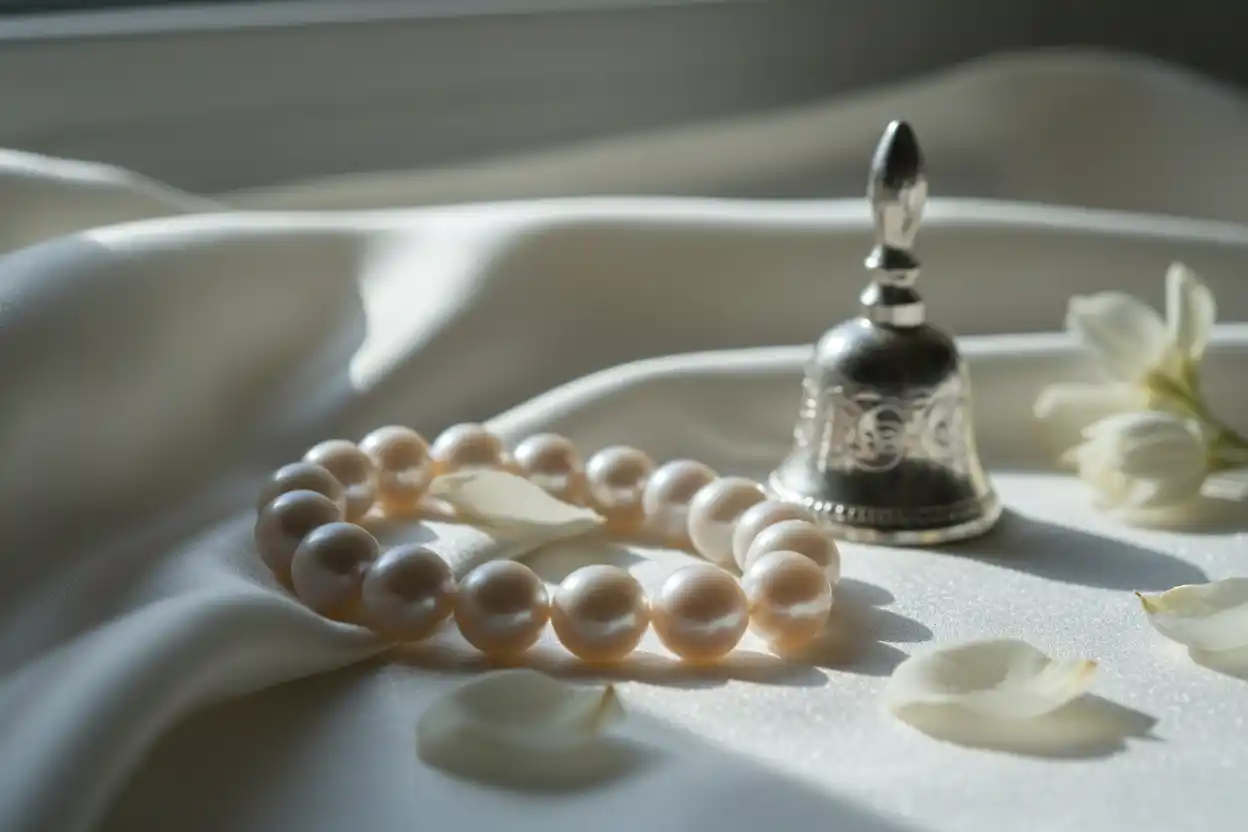
How to Cleanse and Charge Pearl
The safest ways to cleanse and charge Pearl are intention, visualization, gentle sound, indirect indoor moonlight, a written dedication, and mindful wiping with an exceptionally soft cloth. Brief warm-soapy-water cleaning may be appropriate occasionally, but ritual soaking should be avoided because nacre, drill holes, silk thread, knots, glue, dye, coatings, and metal fittings can all be affected.
Pearls should not be exposed to salt burial, vinegar, lemon juice, perfume, essential oils, smoke residue, steam, ultrasound, intense heat, or prolonged direct sunlight. Although Pearls form in mollusks and come from aquatic environments, finished Pearl jewelry is not designed for repeated soaking.
What Cleansing and Charging Mean
Cleansing is a personal or spiritual practice used to mark a transition, release earlier associations, or prepare an object for intentional use.
Charging generally means dedicating the Pearl to a purpose, memory, relationship, routine, or personal value.
Neither process is necessary to preserve nacre. No established scientific evidence shows that cleansing changes Pearl’s chemical composition, luster, health effects, or measurable physical energy.
Pearl’s formation, mollusk origin, symbolism, cultural history, and gemological properties belong to the broader Pearl guide.
Belief-based wellness claims belong separately to Pearl Healing Properties.
Pearl Is an Organic Gem
Natural and cultured Pearls form within mollusks.
Their surfaces consist mainly of calcium-carbonate crystals—commonly aragonite—held within an organic matrix and arranged in nacreous layers.
Some non-nacreous Pearls have different internal structures and surface appearances, but all require protection from abrasion, acids, cosmetics, and high heat.
| Property | Ritual implication |
|---|---|
| Gem category | Organic gem produced by a mollusk |
| Main surface material | Calcium carbonate with an organic matrix |
| Mohs hardness | Approximately 2.5 |
| Toughness | Usually good, though age and treatment may reduce it |
| Surface feature | Nacreous or non-nacreous luster |
| Safest ritual methods | Intention, visualization, gentle sound, moonlight, and soft cloth |
| Water exposure | Occasional controlled cleaning only |
| Main risks | Scratches, acids, perspiration, cosmetics, heat, dehydration, dye, coatings, thread, and glue |
The gemstone hardness chart explains why Pearls can be scratched by nearly every common gemstone, glass, metal, ceramic, and abrasive dust.
Their overall toughness can still be reasonably good, but surface abrasion remains easy.
The distinction between hardness and toughness appears in Gemstone Toughness vs Hardness.
Pearl does not have conventional mineral cleavage like a faceted crystal, but its layered nacre can crack, peel, or separate after damage. The wider structural concept appears in Gemstone Cleavage Explained.
Luster Comes from Layered Structure
Pearl luster is produced when light reflects from the surface and interacts with thin nacreous layers.
Fine Pearls may show bright reflections, strong contrast, orient, and subtle overtone colors.
Dullness can result from surface abrasion, cosmetic film, perspiration, dehydration, treatment deterioration, or weak original nacre quality.
A soft cloth can remove fresh residue, but cleansing cannot rebuild lost nacre or restore a deeply abraded surface.
Do not polish Pearls with abrasive cloths, toothpaste, baking soda, or metal cleaner.
Inspect the Pearls Before Beginning
Examine each Pearl under bright, indirect light.
Look for peeling nacre, chalky patches, cracks, drill-hole damage, exposed bead nuclei, loose knots, stretched thread, cloudy glue, color transfer, flaking coating, and worn clasps.
Baroque shapes and natural surface features are not automatically damage.
Small pits, rings, bumps, and growth marks may be part of the Pearl’s formation.
A new sharp flake, rough drill hole, widening crack, or exposed inner material indicates physical deterioration.
Do not tug a strand to test its strength. Lay it flat and inspect the knots and thread individually.
Treatments Affect Ritual Safety
Pearls may be bleached, dyed, irradiated, impregnated, coated, filled, polished, or otherwise processed.
Bleaching and irradiation can be stable under normal wear, while dye, impregnation, and coatings may change over time.
The treatment-identification workflow belongs to How to Spot Treated or Synthetic Pearl.
The broader enhancement framework appears in Gemstone Treatments Explained.
Strong chemicals, solvents, heat, rubbing, and repeated water exposure may affect treatments even when the underlying nacre remains present.
Physical Cleaning Is Separate
Symbolic cleansing does not remove cosmetics, perspiration, perfume, or skin oil.
The complete physical-care method belongs to How to Clean Pearl Jewelry Safely.
For routine care, wipe Pearls with a very soft clean cloth after wear.
Occasional warm-soapy-water cleaning may be suitable, but a strung piece must dry completely before it is worn or stored.
Pearls should never enter an ultrasonic or steam cleaner.
The broader equipment restriction belongs to Which Gemstones Can Go in an Ultrasonic Cleaner?.
Method 1: Charge Pearl with Intention
Place the Pearl or strand on a soft silk, microfiber, or clean cotton cloth.
Choose one clear purpose. It might represent maintaining a relationship, communicating with courtesy, preserving a family memory, approaching an event with composure, or caring consistently for something valuable.
State the intention silently or aloud.
Pearls are often heirlooms, wedding jewelry, or gifts, so a ritual may focus on the object’s documented history rather than an abstract spiritual claim.
Do not hold a strand by one end. Keep it fully supported.
Method 2: Use Visualization
Leave the Pearls on their padded surface.
Imagine earlier associations fading while their luster becomes connected with the chosen purpose.
Some practitioners visualize white, cream, silver, pink, gold, or neutral light according to the Pearl color.
The imagery is symbolic and does not change nacre thickness, orient, surface quality, or treatment.
Continue for several slow breaths or a few minutes.
Visualization is especially suitable for antique, dyed, coated, fragile, or high-value Pearls because no physical exposure is required.
Method 3: Use Gentle Sound
Place the Pearls on a soft cloth away from hard instruments.
Ring a small bell, chime, tuning fork, or singing bowl nearby. You may also hum, chant softly, or play quiet music.
Do not place Pearls inside a metal bowl or allow them to roll against one another.
Direct vibration and hard contact may abrade nacre, stretch thread, loosen knots, or damage a clasp.
Several gentle tones are sufficient.
Method 4: Use Indirect Moonlight Indoors
Place Pearls indoors near a window on a padded tray or inside an open lined jewelry box.
An hour or an evening is sufficient. Overnight indoor placement may also be used when the room remains stable.
Avoid direct morning sun and hot window glass.
Pearl is generally stable to ordinary light, but intense light combined with heat may dehydrate nacre and contribute to cracking.
Outdoor placement introduces dew, rain, dirt, animals, theft, and abrupt environmental changes.
The broader light-exposure framework belongs to Which Crystals Can and Can’t Go in the Sun.
Method 5: Use a Written Dedication
Write one concise statement and place it beside the Pearls.
A practical statement might focus on preserving a family tradition, communicating with kindness, approaching a ceremony calmly, or caring for an heirloom responsibly.
Keep pens, clips, staples, and rough paper edges away from the nacre.
Leave the note beside the Pearls for several minutes or an evening.
This method works particularly well for inherited jewelry because it can include a name, date, occasion, or provenance note.
Method 6: Use a Mindful Soft-Cloth Ritual
Lay the Pearls flat on a clean padded surface.
Use an exceptionally soft, clean cloth to wipe each Pearl gently while supporting the strand beneath it.
Do not pull the thread through the cloth or rub two Pearls together.
As you wipe, focus on the intention associated with the object.
This method removes fresh perspiration and cosmetic residue while also serving as a symbolic reset.
Stop if color transfers, a coating flakes, or the surface feels rough.
Method 7: Use Gentle Breath at a Distance
Keep the Pearls supported on their cloth.
Take several slow breaths and exhale gently toward the space above them once or twice.
Avoid visible condensation and do not blow directly into drill holes or knots.
Human breath contains moisture, so the method should remain brief.
State the intention afterward.
A strand does not need to be lifted or wrapped around the hand during the ritual.
Method 8: Use a Companion Object with Separation
Pearls may be placed near Mother of Pearl, Moonstone, a photograph, a wedding invitation, a journal, or another meaningful keepsake.
Use separate soft supports.
Hard gemstones, metal chains, crystal points, and earring posts can scratch nacre.
Direct contact is unnecessary for symbolic charging.
The related nacre material belongs to the Mother of Pearl guide, while its physical care appears in How to Clean Mother of Pearl Jewelry Safely.
Do Not Soak Pearl Strands
Pearls form in aquatic mollusks, but a finished strand includes thread, knots, drill holes, and a clasp.
Prolonged soaking may stretch or weaken silk, move dirt into drill holes, affect dye, soften glue, and leave moisture trapped between Pearls and knots.
When occasional physical washing is necessary, keep it brief and allow the strand to dry flat and completely.
Do not hang wet Pearls because the weight may stretch the thread.
The broader water framework belongs to Which Crystals Can and Can’t Go in Water.
Never Use Salt or Saltwater
Salt crystals can scratch nacre and become trapped around knots, drill holes, clasps, and settings.
Saltwater can weaken thread, affect metal, leave deposits, and dry the surface unevenly.
The fact that many Pearls form in marine mollusks does not make a finished necklace safe for saltwater rituals.
When salt carries personal symbolism, keep it in a separate closed bowl while the Pearls remain on a soft cloth nearby.
Avoid Vinegar, Lemon Juice, and All Acids
Pearl’s calcium-carbonate surface is vulnerable to acid.
Vinegar, lemon juice, acidic cosmetics, household cleaners, and even repeated contact with acidic perspiration can damage nacre.
A visible dull patch or rough surface indicates chemical damage rather than successful cleansing.
Do not use acid as an authenticity test.
The Pearl should also remain away from chlorine, ammonia, alcohol, and solvent-based products.
Apply Cosmetics Before Wearing Pearls
Perfume, hairspray, lotion, makeup, and skincare products can damage or coat nacre.
Apply these products first and allow them to dry before putting on Pearl jewelry.
After wear, wipe the Pearls gently before storage.
This preventive routine is more effective than repeated deep cleaning.
Do not spray perfume over Pearls as part of a charging ritual.
Avoid Essential Oils and Anointing
Essential oils may contain acidic or solvent-like constituents and can leave a persistent film on nacre.
Oil can collect around drill holes, knots, and settings.
It may temporarily deepen color while attracting dirt and changing surface reflection.
Do not apply oil directly to Pearl, thread, or glue.
A written dedication or intention provides the same symbolic purpose without altering the surface.
Avoid Smoke and Incense Residue
Smoke can leave soot, resin, fragrance, and oil on Pearls.
These deposits may dull luster and require additional wiping.
Keep Pearl jewelry away from flame, hot ash, incense coals, candles, and heated bowls.
When smoke belongs to a cultural or personal practice, let cool dispersed smoke remain at a distance and avoid carrying the Pearls close to the source.
Gentle sound or visualization is cleaner.
Avoid Intense Heat and Dry Storage
High heat can burn, discolor, split, or crack Pearl.
Intense light combined with heat may dehydrate nacre.
Keep Pearls away from radiators, fireplaces, hot vehicle interiors, steam, saunas, direct repair torches, and continuously heated display cases.
However, storage should not be excessively damp.
Use a soft pouch or lined compartment in an ordinary stable room rather than sealing the jewelry beside wet materials.
Mother of Pearl Is Related but Structurally Different
Mother of Pearl is nacre cut from the inner shell layer rather than a complete Pearl formed as a separate gem object.
It may appear in inlay, beads, watch dials, carvings, buttons, and jewelry components.
The material profile belongs to the Mother of Pearl guide.
Its broad variety framework appears in Types of Mother of Pearl.
Pearl and Mother of Pearl share acid, heat, abrasion, cosmetic, and ultrasonic restrictions, but their construction and mounting may differ.
Natural and Cultured Pearls
Natural Pearls form without deliberate human implantation, while cultured Pearls form after a technician introduces a nucleus, tissue graft, or other stimulus into a mollusk.
Both are genuine biogenic gems.
Imitations may consist of coated glass, shell beads, plastic, ceramic, or composite material.
The complete authenticity workflow belongs to Real vs Fake Pearl.
Cleansing response cannot determine whether a Pearl is natural, cultured, or imitation.
Pearl Types and Color
Akoya, South Sea, Tahitian, and freshwater cultured Pearls differ in mollusk species, cultivation method, size, shape, color, nacre structure, and market profile.
The complete family structure belongs to Types of Pearl.
White, cream, silver, gray, black, gold, pink, peach, lavender, and other colors may be natural, treated, or a combination of body color and overtone.
Color does not change the need for gentle handling.
Dyed and coated Pearls deserve especially conservative light, moisture, and rubbing.
Pearl Necklaces and Earrings
A Pearl necklace should be laid flat during any ritual so the strand remains fully supported.
Knots prevent Pearls from rubbing and reduce loss if the strand breaks, but worn thread still requires restringing.
Pearl earrings may use adhesive to attach the Pearl to a post or cup.
Avoid soaking glued earrings and keep alcohol-based disinfectants on compatible metal fittings rather than the Pearl or adhesive seam.
Buying, Price, and Birthstone Context
The Pearl buying guide covers type, luster, surface, shape, size, color, matching, nacre quality, treatment, and strand construction.
Market factors belong to the Pearl price guide.
Pearl is one of June’s recognized birthstones alongside Moonstone and Alexandrite, covered in the June birthstone guide.
Pearls also belong to the broader visual family in White Gemstones, although many Pearls are not white.
A ritual cannot rebuild damaged nacre, remove deep scratches, or repair weakened thread.
Safe Ritual Handling
Do not lick, grind, burn, dissolve, or place Pearl directly in water intended for drinking.
Commercial jewelry may contain dye, coating, glue, metal, thread, or treatment residue not evaluated for ingestion.
Ordinary intact wear differs from consuming calcium-carbonate material or exposing the body to processing chemicals.
The wider safety distinction belongs to the Toxic Crystals safety list.
Frequently Asked Questions
1. What is the safest way to cleanse Pearl?
Intention, visualization, gentle sound, indirect indoor moonlight, a written dedication, and soft-cloth wiping are safest.
2. Can Pearls be cleansed in water?
Occasional warm-soapy-water cleaning may be safe, but ritual soaking is unnecessary. Strands must dry completely before wear.
3. Can Pearls be left in moonlight overnight?
Yes, when kept indoors on a soft dry surface away from direct morning sun and excessive heat.
4. Can Pearls be charged in sunlight?
Prolonged intense sunlight and heat are not recommended because nacre can dehydrate, discolor, or crack.
5. Can Pearls be cleansed with salt?
No. Salt can scratch nacre, damage thread, and lodge around drill holes and knots.
6. Can Pearls be cleansed with smoke?
Smoke is not ideal because soot and fragrance residue can dull luster.
7. Can essential oils be applied to Pearls?
No. Oils can coat nacre, affect glue and thread, and attract dirt.
8. Can vinegar clean Pearls?
No. Pearl contains calcium carbonate and is damaged by acids.
9. Can Clear Quartz charge Pearls?
Some practitioners use it symbolically. Keep the objects separated because Quartz is much harder and can scratch nacre.
10. Should Pearls be worn frequently?
Careful wear is generally suitable. Wipe them afterward and protect them from cosmetics, perspiration, chemicals, and abrasion.
11. How long should Pearls charge?
A few minutes or an evening is sufficient. There is no scientifically required duration.
12. Does cleansing change Pearl scientifically?
No established evidence shows that cleansing changes nacre, luster, health effects, or measurable physical energy.
Conclusion
Pearl requires a different ritual approach from durable crystalline gemstones because its beauty depends on soft layered nacre and, often, delicate strand construction. Intention, visualization, gentle sound, and protected moonlight preserve luster without adding acid, salt, heat, or moisture. A meaningful ritual should respect both the Pearl’s organic origin and the practical care that allows it to remain wearable for generations.
Crystal cleansing and charging are spiritual or personal practices, not scientifically established methods for changing health, energy, or the physical properties of Pearl.