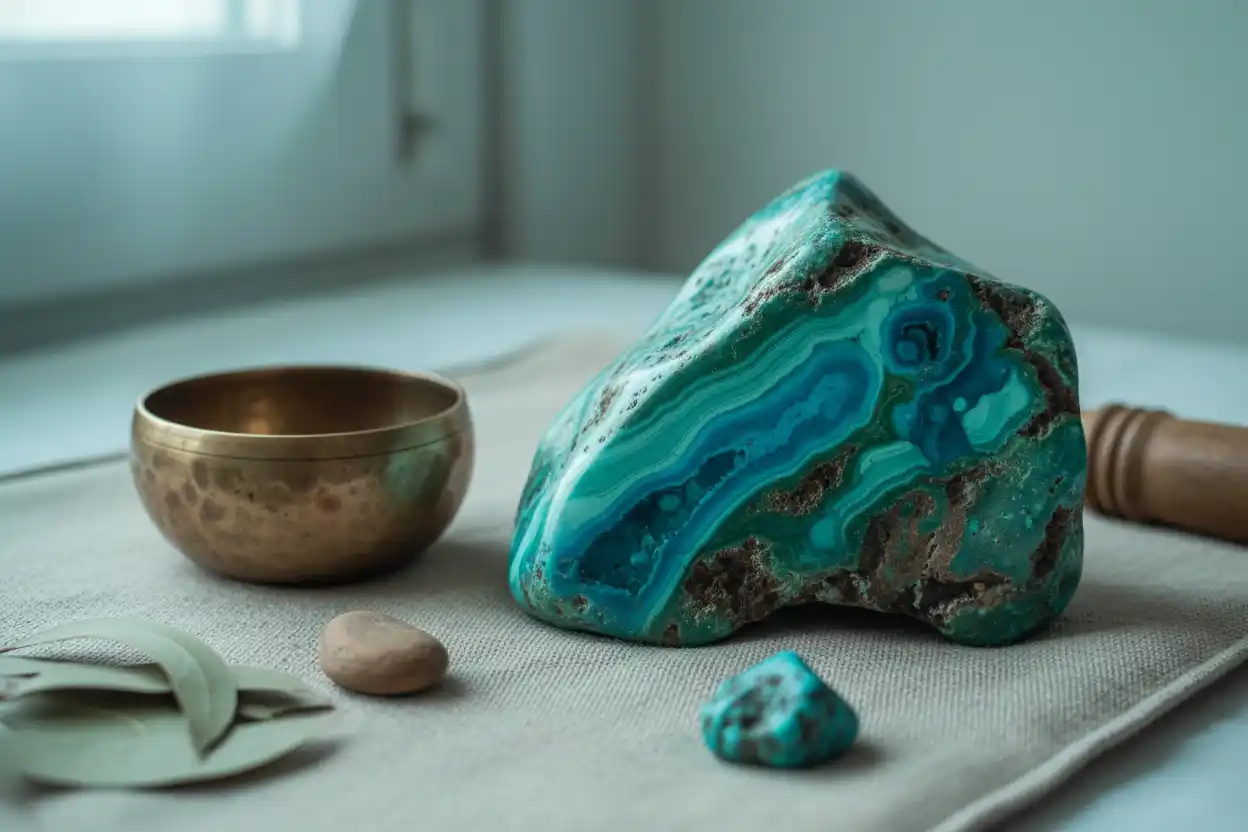
How to Cleanse and Charge Chrysocolla
The safest ways to cleanse and charge Chrysocolla are sound, intention, visualization, gentle breath, indirect indoor moonlight, and a dry-cloth or non-contact ritual. These methods protect its soft, brittle, copper-bearing material from moisture, acid, salt, oils, abrasion, heat, and accidental breakage.
Chrysocolla should not be soaked, rinsed repeatedly, buried in salt or soil, exposed to vinegar or lemon juice, steamed, ultrasonically cleaned, or used to prepare drinking water. Finished pieces may also contain Quartz, Chalcedony, Malachite, Azurite, Turquoise, resin, backing, dye, or glue, so the name alone does not determine care.
What Cleansing and Charging Mean
Cleansing is a spiritual or personal ritual used to mark a fresh beginning, release previous associations, or prepare an object for intentional use.
Charging generally means dedicating the stone to a value, practice, memory, meditation, or behavioral reminder.
Neither process is required for mineral preservation. No established scientific evidence shows that cleansing changes Chrysocolla’s chemistry, health effects, crystal structure, or measurable physical energy.
The mineral’s geology, blue-green color, copper-deposit associations, and symbolic interpretations belong to the broader Chrysocolla guide.
This article focuses on physically conservative ritual methods.
Why Chrysocolla Requires Identification Before Handling
Chrysocolla is a hydrous copper silicate material that commonly occurs in oxidized copper deposits.
It may form as botryoidal crusts, vein fillings, earthy masses, enamel-like coatings, fibrous aggregates, or cryptocrystalline material.
Its exact structure and composition can vary, and commercial objects sold as Chrysocolla may contain substantial amounts of other minerals.
| Property | Ritual implication |
|---|---|
| Material | Hydrous copper silicate or copper-rich silicate material |
| Typical colors | Blue, blue green, green, or turquoise blue |
| Mohs hardness | Commonly approximately 2 to 4 in relatively pure material |
| Tenacity | Brittle to somewhat sectile |
| Common forms | Botryoidal, earthy, fibrous, opaline, enamel-like, or massive |
| Transparency | Translucent to opaque |
| Safest ritual methods | Sound, intention, visualization, breath, and protected moonlight |
| Water exposure | Avoid soaking |
| Acid exposure | Avoid |
| Main risks | Scratches, fractures, copper-bearing dust, moisture, treatments, matrix, glue, and variable composition |
The gemstone hardness chart explains why Quartz, glass, metal, ceramic, and many common crystals can scratch relatively pure Chrysocolla.
Its brittle-to-sectile behavior and variable composition make hardness alone an unreliable care guide. The broader distinction appears in Gemstone Toughness vs Hardness and Gemstone Cleavage Explained.
Pure Chrysocolla and Gem Silica Are Not the Same
Relatively pure Chrysocolla is soft.
However, some valuable blue-green material consists of Chalcedony or Quartz colored by Chrysocolla. This material is commonly called gem silica or chrysocolla chalcedony and can be much harder and more durable.
A polished gem-silica cabochon may therefore behave differently from an earthy Chrysocolla specimen.
Other objects may combine Chrysocolla with Malachite, Azurite, Cuprite, Quartz, Opal, Turquoise-like material, or host rock.
When the exact material is unknown, use the gentlest Chrysocolla method rather than assuming the object has Quartz-level durability.
Inspect the Specimen Before Beginning
Examine the Chrysocolla beneath soft, indirect light.
Look for powdery blue-green areas, open fractures, loose crusts, crumbling matrix, lifting layers, damaged drill holes, cloudy glue, peeling coatings, unstable backing, and color transfer.
Botryoidal surfaces and natural cavities should not be scrubbed.
A polished cabochon may conceal fractures or resin stabilization. An earthy specimen may release particles through ordinary rubbing.
Do not shake, flex, scrape, or press the material to test its strength.
When the surface appears powdery or unstable, leave the specimen inside its display support and use a completely non-contact ritual.
Separate Physical Cleaning from Symbolic Cleansing
A spiritual ritual does not remove actual dirt.
A stable polished piece may be wiped gently with a clean dry microfiber cloth. A soft makeup brush can remove loose dust from a compact surface.
Do not brush earthy, velvet-like, crumbly, or powdery Chrysocolla.
Avoid water, alcohol, acetone, sanitizer, vinegar, jewelry dip, steam, ultrasonic equipment, and metal polish.
A valuable mineral specimen with ingrained dirt should be examined by a conservator rather than washed at home.
The wider machine-safety boundary appears in Which Gemstones Can Go in an Ultrasonic Cleaner?.
Method 1: Cleanse Chrysocolla with Sound
Place the stone on a thick folded cloth or leave it inside its stable display box.
Ring a bell, chime, tuning fork, or singing bowl nearby.
You may also hum, chant, clap softly, or play calm music.
Do not place the specimen inside a metal bowl or directly against a vibrating surface. Brittle crusts and matrix may crack under concentrated vibration.
Several gentle sound cycles are sufficient.
Method 2: Use Intention
Leave the Chrysocolla supported on its padded base.
Choose one clear purpose. It might remind you to communicate directly, listen before reacting, protect time for creative work, or approach a difficult conversation calmly.
State the intention silently or aloud.
This method suits polished cabochons, rough specimens, Chrysocolla-Malachite, gem silica, beads, carvings, and fragile matrix material because no moisture is required.
The stone does not need to be held.
Method 3: Use Visualization
Place the object where it cannot roll, tip, or fall.
Imagine previous associations fading while the blue-green material becomes linked with your selected purpose.
Some practitioners visualize blue, green, turquoise, white, or neutral light.
The imagery is symbolic rather than evidence that Chrysocolla produces measurable energy.
Continue for several breaths or a few minutes.
Visualization is the best option for powdery or repaired specimens because it requires no physical contact.
Method 4: Use Breath at a Distance
Keep the specimen on its support.
Take several slow breaths and exhale gently toward the space above it once or twice.
Do not blow directly at powdery surfaces, fine crusts, or loose matrix. Airflow can spread copper-bearing dust or detach particles.
Avoid creating condensation.
State the intention after the breath ritual.
Method 5: Use Indirect Moonlight Indoors
Place Chrysocolla indoors near a window on a lined tray or inside an open display box.
An hour, an evening, or overnight indoor placement may be used.
Do not place it outdoors. Dew, rain, humidity changes, grit, animals, and falling objects create unnecessary risks.
The moon phase affects the practitioner’s symbolism rather than the material’s chemistry.
The broader environmental framework appears in Which Crystals Can and Can’t Go in the Sun.
Method 6: Use a Written Intention
Write one concise statement and place it beside the specimen.
A practical statement may focus on speaking clearly, completing a creative task, or allowing someone else to finish before responding.
Do not move a fragile specimen merely to place paper beneath it.
Keep pens, clips, pins, and metal objects away from the soft surface.
The paper can remain beside the display until the intention changes.
Method 7: Create a Dry Blue-Green Mineral Arrangement
Place Chrysocolla near another symbolic blue or green object while maintaining physical separation.
The tracker’s broader color families appear in Blue Gemstones and Green Gemstones.
Use separate padded supports. Do not stack Quartz, Turquoise, Malachite, Azurite, or metal objects directly on the Chrysocolla.
A display arrangement provides symbolism without requiring mineral-to-mineral contact.
Keep all water dishes, fresh flowers, essential oils, and salt containers physically separate.
Method 8: Use a Mindful Dry-Cloth Ritual for Polished Material
This method is appropriate only for a stable polished cabochon, bead, carving, or gem-silica piece.
Place the object on a padded surface and wipe it lightly with a soft dry microfiber cloth.
Stop if the cloth catches on a crack, rough area, coating, or edge.
Do not buff repeatedly. Friction may dull soft Chrysocolla or damage resin and surface treatments.
As you wipe, focus on the intention connected with the object.
Powdery or earthy specimens should not receive this method.
Chrysocolla and Azurite
Chrysocolla and Azurite commonly occur in oxidized copper deposits and may appear together.
Azurite is a deep-blue copper carbonate mineral with its own acid, moisture, and dust restrictions.
The material profile belongs to the Azurite guide, while the dedicated ritual method appears in How to Cleanse and Charge Azurite.
A mixed specimen must follow the stricter requirements of its most fragile component.
Do not use acid, soaking, salt, steam, or ultrasound on either mineral.
Chrysocolla and Malachite
Chrysocolla frequently occurs with green Malachite.
The separate material profile appears in the Malachite guide, while its ritual page is How to Cleanse and Charge Malachite.
Finished Chrysocolla-Malachite may be stabilized with resin or backed to improve durability.
Physical jewelry-cleaning limits for Malachite belong to How to Clean Malachite Jewelry Safely.
When several copper minerals are present, avoid water-based rituals and treat every exposed surface as chemically and structurally sensitive.
Chrysocolla and Turquoise
Chrysocolla and Turquoise can overlap in blue-green color but have different compositions and structures.
The Turquoise material profile belongs to the Turquoise guide, while its ritual care appears in How to Cleanse and Charge Turquoise.
Finished-jewelry limits are covered in How to Clean Turquoise Jewelry Safely.
Both materials may be stabilized, dyed, backed, or glued. Therefore, color alone cannot determine whether water or solvents are safe.
Do Not Soak Chrysocolla in Water
Relatively pure Chrysocolla can be porous, soft, fractured, earthy, or mixed with matrix.
Water can enter openings, loosen particles, mobilize dirt, affect glue, leave deposits, and change the appearance of treated or stabilized surfaces.
Repeated wetting and drying may worsen cracks or expose fragile areas.
A harder gem-silica cabochon may tolerate brief physical washing, but this article addresses symbolic cleansing across the full Chrysocolla range. Dry methods remain safer.
The general water framework belongs to Which Crystals Can and Can’t Go in Water.
Avoid Vinegar, Lemon Juice, and Harsh Chemicals
Chrysocolla commonly occurs with carbonate copper minerals such as Malachite and Azurite, which acids can attack.
Acids may also affect matrix, glue, resin, coatings, metal, and polishing compounds.
Do not use vinegar, lemon juice, bathroom cleaner, metal dip, descaling product, bleach, ammonia, or solvent-based spray.
A visible reaction or color change indicates material damage rather than successful cleansing.
Do Not Use Salt or Saltwater
Salt grains can scratch soft Chrysocolla and lodge within botryoidal surfaces, fractures, drill holes, and matrix cavities.
Saltwater adds moisture and may leave deposits after evaporation.
Do not bury the stone in dry salt.
When salt has personal symbolism, keep it in a separate closed or lined bowl while the Chrysocolla remains several centimeters away.
Do Not Bury Chrysocolla in Soil
Soil contains Quartz grains, moisture, microorganisms, organic acids, fertilizers, and staining material.
These substances can scratch, contaminate, or become trapped inside the specimen.
Outdoor burial also risks pressure damage, rain, and loss.
Place the stone near a plant without allowing contact with soil, wet leaves, or plant water.
Avoid Smoke Residue and Heat
Cool dispersed smoke may be used cautiously in traditions that include it, but smoke can leave soot and oily residue on a porous blue-green surface.
Residue may be difficult to remove without washing.
Keep Chrysocolla away from open flame, candles, incense coals, hot ash, heated bowls, radiators, and intense lamps.
Sound, intention, and visualization are cleaner options.
Never Use Chrysocolla for Drinking Water
Chrysocolla contains copper and should not be soaked directly in water intended for drinking, cooking, topical sprays, or elixirs.
Do not lick, grind, sand, drill, burn, or intentionally create dust from the material.
Powdery specimens should be handled minimally. Wash your hands after contact with loose particles and keep the material away from food-preparation surfaces and children’s mouths.
Ordinary intact handling differs from ingestion or deliberate dust exposure.
The wider safety distinction belongs to the Toxic Crystals safety list.
Treatments, Stabilization, and Imitations
Chrysocolla objects may be resin stabilized, backed, coated, dyed, reconstructed, mixed with other minerals, or imitated with glass and manufactured composites.
Gem silica can also be mistaken for relatively pure Chrysocolla because both may display rich blue-green colors.
The broad enhancement framework belongs to Gemstone Treatments Explained.
Do not use scratching, solvent, heat, or acid tests to determine authenticity.
The purchase and condition workflow belongs to Where to Buy Real Chrysocolla.
Frequently Asked Questions
1. What is the safest way to cleanse Chrysocolla?
Use sound, intention, visualization, gentle breath at a distance, a written dedication, or indirect indoor moonlight.
2. Can Chrysocolla be cleansed in water?
Soaking is not recommended because the material may be soft, porous, fractured, stabilized, glued, or mixed with other copper minerals.
3. Can Chrysocolla be left in moonlight overnight?
Yes, when kept indoors on a stable padded surface.
4. Can Chrysocolla be charged in sunlight?
Indirect indoor light is preferable because outdoor exposure introduces heat, dust, weather, and treatment uncertainty.
5. Can Chrysocolla be cleansed with salt?
No. Salt can scratch the soft material and lodge in fractures or botryoidal surfaces.
6. Can Chrysocolla be cleansed with smoke?
A brief cool-smoke ritual is possible, but sound or visualization avoids soot and oily residue.
7. Can Chrysocolla touch Clear Quartz?
Use a soft barrier. Quartz is much harder and can scratch relatively pure Chrysocolla.
8. Is gem silica the same as pure Chrysocolla?
No. Gem silica is Chalcedony or Quartz colored by Chrysocolla and is generally much harder.
9. Can Chrysocolla be used to make crystal water?
No. Do not place copper-bearing Chrysocolla directly in water intended for drinking or topical use.
10. What should I do with powdery Chrysocolla?
Minimize handling, avoid brushing or blowing it, contain loose particles, and seek conservation advice for an important specimen.
11. How long should Chrysocolla be charged?
A few minutes or an evening can serve the ritual. There is no scientifically required duration.
12. Does cleansing change Chrysocolla scientifically?
No established evidence shows that cleansing changes its chemistry, health effects, or measurable physical energy.
Conclusion
Chrysocolla can range from soft earthy copper material to harder Quartz-rich gem silica, so one aggressive ritual cannot suit every specimen. Sound, intention, visualization, and protected moonlight avoid the uncertainty created by water, acid, salt, resin, matrix, and copper-bearing dust. The safest practice preserves the object’s blue-green surface while allowing its personal meaning to remain central.
Crystal cleansing and charging are spiritual or personal practices, not scientifically established methods for changing health, energy, or the physical properties of Chrysocolla.