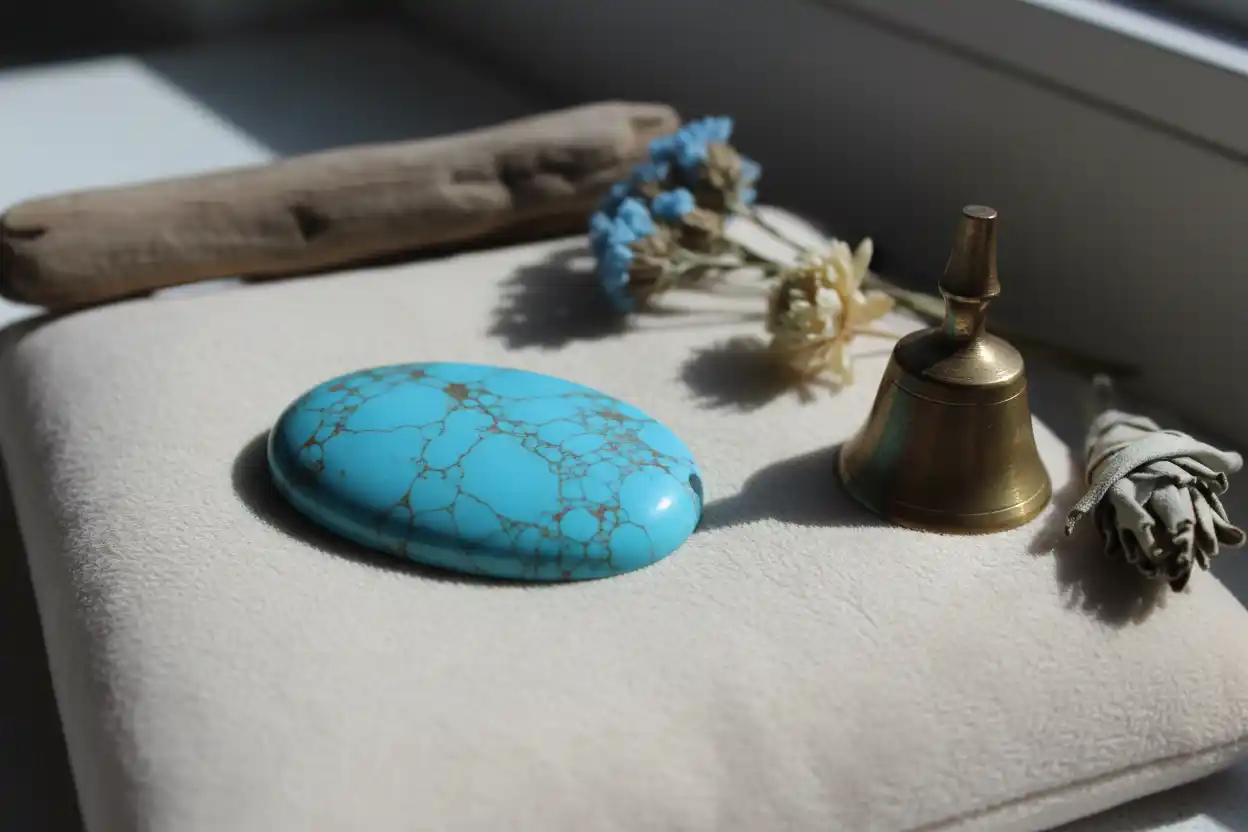
How to Cleanse and Charge Turquoise
The safest ways to cleanse and charge Turquoise are sound, intention, visualization, gentle breath, indirect indoor moonlight, a written dedication, and careful dry-cloth handling. A brief warm-soapy-water cleaning may suit some stable natural or treated stones, but ritual soaking should be avoided because Turquoise is porous and may be stabilized, dyed, waxed, oiled, backed, glued, reconstructed, or combined with sensitive jewelry components.
Turquoise should not be exposed to saltwater, vinegar, lemon juice, essential oils, perfume, alcohol, steam, ultrasound, intense heat, or prolonged skin-product residue. These substances can discolor the gem or damage its treatment and surface.
What Cleansing and Charging Mean
Cleansing is a personal or spiritual ritual used to mark a new beginning, release earlier associations, or prepare an object for intentional use.
Charging generally means dedicating the stone to a purpose, relationship, memory, value, or personal reminder.
Neither process is required to preserve Turquoise physically. No established scientific evidence shows that symbolic cleansing changes its copper content, porosity, health effects, color, or measurable physical energy.
The gemstone’s geology, blue-to-green color, mining traditions, cultural history, and symbolism belong to the broader Turquoise guide.
Turquoise Is a Porous Hydrated Phosphate
Turquoise is a hydrated copper aluminum phosphate that forms in dry regions through interactions among copper-bearing groundwater, aluminum-rich minerals, and phosphorus-bearing material.
Its blue-to-green color varies with chemistry, porosity, associated minerals, weathering, and treatment.
| Property | Ritual implication |
|---|---|
| Mineral species | Turquoise |
| Composition | Hydrated copper aluminum phosphate |
| Common colors | Sky blue, greenish blue, blue green, or green |
| Mohs hardness | Approximately 5 to 6 |
| Toughness | Fair to good |
| Transparency | Semitranslucent to opaque |
| Structure | Frequently porous or microcrystalline |
| Safest ritual methods | Sound, intention, visualization, breath, and indoor moonlight |
| Water exposure | Brief controlled cleaning only |
| Main risks | Oils, cosmetics, heat, solvents, dye, stabilization, backing, glue, and acids |
The complete color, locality, and matrix framework belongs to Types of Turquoise.
The gemstone hardness chart explains why Quartz, glass, metal, ceramic, and many jewelry stones can scratch Turquoise.
Its toughness is often fair to good, but surface condition, porosity, matrix, and treatment change practical durability.
The difference between scratching and breaking appears in Gemstone Toughness vs Hardness, while structural weaknesses are placed in context by Gemstone Cleavage Explained.
Matrix Is Part of the Stone
Turquoise may contain brown, black, gray, tan, or golden host-rock veins called matrix.
Spiderweb Turquoise displays fine interconnected matrix lines, while other stones show patches, islands, or broad host-rock areas.
Matrix is not dirt that should be scrubbed or dissolved away.
However, matrix may be more porous, fractured, or absorbent than the blue Turquoise surrounding it.
Do not use bleach, acid, oil, or a stiff brush to make the matrix lighter.
A matrix-free appearance can be natural, treated, reconstructed, or imitated, so visual uniformity alone does not establish quality or authenticity.
Treatment Is Common
Turquoise may be stabilized through resin impregnation to improve durability.
It may also be dyed, waxed, oiled, backed, coated, filled, reconstructed, compressed, or manufactured as block material from fragments and binder.
Some treatments are accepted when disclosed, while others substantially change value and care requirements.
The treatment-specific workflow belongs to How to Spot Treated or Synthetic Turquoise.
The broader enhancement framework appears in Gemstone Treatments Explained.
Heat and solvents can damage treated surfaces. Therefore, an unknown stone should receive dry, low-contact ritual care.
Inspect the Turquoise First
Examine the stone beneath bright, indirect light.
Look for cracks, chalky areas, fading, dye concentrated in fractures, cloudy glue, lifting backing, damaged drill holes, peeling coating, loose bezels, worn polish, color transfer, and changes around edges.
Natural matrix and small pits are not automatically damage.
A pale area near the surface may indicate weathering, abrasion, unstable dye, or worn treatment.
Do not scratch, heat, or apply solvent to test whether the color extends below the surface.
When the object is antique, inlaid, backed, glued, or visibly porous, use a completely dry ritual.
Physical Cleaning Is Separate
Symbolic cleansing does not remove cosmetics, perspiration, skin oil, dust, or setting residue.
The complete physical-care method belongs to How to Clean Turquoise Jewelry Safely.
Warm water with mild soap can be used cautiously for suitable Turquoise, followed by immediate drying.
However, prolonged soaking is inappropriate, and steam or ultrasonic equipment should never be used.
The machine-specific restriction belongs to Which Gemstones Can Go in an Ultrasonic Cleaner?.
When treatment is unknown, use a dry cloth rather than immersion.
Method 1: Cleanse Turquoise with Sound
Place the Turquoise on a thick folded cloth or padded tray.
Ring a bell, chime, tuning fork, or singing bowl nearby. You may also hum, chant, clap softly, or play quiet music.
Do not place the stone inside a hard metal bowl or allow it to vibrate against ceramic, glass, or another gem.
Several gentle tones are sufficient.
Sound is suitable for natural, stabilized, dyed, backed, glued, reconstructed, antique, and matrix-rich Turquoise because it introduces no moisture or solvent.
Method 2: Use Intention
Leave the Turquoise supported on a soft surface or hold it loosely above a cloth.
Choose one clear purpose. It might remind you to communicate honestly, protect a relationship boundary, travel thoughtfully, preserve a family tradition, or approach a difficult conversation calmly.
State the intention silently or aloud.
A behavioral intention allows the stone to serve as a meaningful reminder without presenting traditional beliefs as scientifically proven effects.
Return the object to padded storage after the ritual.
Method 3: Use Visualization
Place Turquoise where it cannot roll or fall.
Imagine previous associations fading while the blue or green surface becomes connected with your chosen purpose.
Some practitioners visualize blue, green, white, brown, gold, or neutral light according to the stone and its matrix.
The imagery is symbolic and does not change copper concentration, porosity, or treatment.
Continue for several slow breaths or a few minutes.
Visualization is particularly suitable for antique, dyed, backed, glued, or valuable Turquoise because no environmental exposure is required.
Method 4: Use Gentle Breath
Keep the stone on a padded cloth.
Take several slow breaths and exhale gently toward it once or twice.
Avoid visible condensation around matrix, fractures, drill holes, backing, glue seams, and settings.
Do not hold a strand by one end or grip a thin inlay piece.
State the intention afterward.
Method 5: Use Indirect Moonlight Indoors
Place Turquoise indoors near a window on a lined tray or inside an open jewelry box.
An hour, an evening, or overnight indoor placement may be used.
Turquoise is generally stable to ordinary light, so indoor moonlight is recommended mainly because it prevents rain, dew, dirt, theft, animals, and excessive heat.
The moon phase affects personal symbolism rather than mineral chemistry.
The broader light framework belongs to Which Crystals Can and Can’t Go in the Sun.
Method 6: Use a Written Dedication
Write one concise statement and place it beside the Turquoise.
A practical statement might focus on communicating directly, maintaining contact with someone important, traveling with care, or preserving an heirloom responsibly.
Keep pens, staples, clips, and rough objects away from the surface.
Leave the arrangement for several minutes or an evening.
A written dedication is appropriate for every treatment condition because the jewel remains dry and supported.
Method 7: Use a Mindful Dry-Cloth Ritual
Place a stable polished Turquoise piece on a padded surface.
Wipe it once or twice with a clean, exceptionally soft, dry microfiber cloth.
Use minimal pressure and stop if color transfers, the cloth catches on matrix, a coating flakes, or a pale area develops.
Do not use silver-polishing cloths, toothpaste, baking soda, paper towels, or abrasive fabric on the stone.
This method can remove fresh skin oil while also serving as a symbolic reset.
Method 8: Use a Brief Damp-Cloth Ritual
When physical residue requires moisture, dampen a soft cloth with lukewarm water and a trace of mild soap.
Test an inconspicuous area first.
Wipe briefly, remove soap with another lightly dampened cloth, and dry the piece immediately.
Do not immerse antique, dyed, backed, glued, inlaid, strung, reconstructed, or highly porous Turquoise.
The complete water-safety framework belongs to Which Crystals Can and Can’t Go in Water.
Water remains optional for the symbolic ritual.
Turquoise and Howlite
Howlite is naturally white or cream with gray-to-black veining.
It is frequently dyed blue to imitate Turquoise.
The Howlite material profile belongs to the Howlite guide, while its ritual care appears in How to Cleanse and Charge Howlite.
Dyed Howlite may release or fade color after moisture, solvent, heat, or abrasion.
An unidentified blue bead should therefore receive dry care until its material can be confirmed.
Turquoise and Magnesite
Magnesite is another pale porous mineral frequently dyed blue or green.
Its material profile belongs to the Magnesite guide.
Dyed Magnesite can resemble veined Turquoise, particularly in inexpensive bead strands and carvings.
Do not use acid or scratching to distinguish the materials. Magnesite is a carbonate and can react strongly with acid, while Turquoise and its treatments may also be damaged.
Professional observation is safer than a destructive test.
Turquoise and Chrysocolla
Chrysocolla can overlap with Turquoise in blue-green color.
It is a copper-bearing silicate material that may be soft, porous, earthy, stabilized, or combined with Quartz and other minerals.
The material profile belongs to the Chrysocolla guide.
Its dedicated ritual care appears in How to Cleanse and Charge Chrysocolla.
Dry sound, intention, and visualization are appropriate when the identity of a blue-green stone remains uncertain.
Turquoise and Variscite
Variscite is a hydrated aluminum phosphate that can resemble green or blue-green Turquoise.
Its material profile belongs to the Variscite guide.
Both materials may show matrix, porosity, veins, polish variation, and treatment.
Copper content and gemological testing help distinguish them, but household acid, heat, and solvent tests should not be used.
Avoid Perfume, Cosmetics, and Skin Products
Turquoise can be discolored by cosmetics, perfume, lotion, hairspray, perspiration, and skin oils.
Apply products first and allow them to dry before putting on Turquoise jewelry.
Wipe the gem gently after wear.
Do not apply perfume, sanitizer, essential oil, or skincare product directly as part of a charging ritual.
Repeated exposure may darken, green, spot, or dull porous material.
Never Use Essential Oils
Oil can enter porous Turquoise and permanently change its color.
It can also affect resin stabilization, dye, wax, glue, backing, metal, and matrix.
Do not anoint the stone with essential oil, carrier oil, coconut oil, or fragrance blends.
A temporary deepening of color does not mean the stone has been improved. It may indicate absorption or treatment alteration.
Avoid Vinegar, Lemon Juice, and Acid
Turquoise dissolves slowly in hydrochloric acid and can be damaged by acidic products.
Do not use vinegar, lemon juice, bathroom cleaner, metal dip, descaling solution, or chemical authenticity tests.
Acid may damage the mineral, matrix, resin, dye, backing, glue, and setting.
A visible reaction or color change indicates physical damage rather than successful cleansing.
Avoid Direct Salt Contact
Salt grains can scratch Turquoise and lodge inside pores, matrix, fractures, drill holes, and settings.
Saltwater adds prolonged moisture and may affect dye, stabilization, backing, glue, elastic, metal, and inlay.
Do not bury Turquoise directly in coarse salt.
When salt carries personal symbolism, keep it in a separate bowl while the stone remains on a lined tray nearby.
Avoid Soil Burial
Soil contains Quartz grains, moisture, fertilizers, microorganisms, organic acids, and staining material.
These substances can scratch, discolor, or become trapped within porous Turquoise and matrix.
Outdoor burial also creates pressure, loss, and weather risks.
A nature-based alternative places the stone near a plant while keeping it dry and physically separated from soil.
Avoid High Heat, Steam, and Hot Sun
Turquoise is generally stable to light, but high heat can cause discoloration, surface damage, and breakage.
Heat may also damage resin, wax, dye, backing, glue, and reconstructed material.
Keep the gem away from candles, incense coals, steam cleaners, radiators, fireplaces, hot vehicles, repair torches, and heated ritual bowls.
Brief ordinary daylight is different from leaving the stone on a hot windowsill.
Use Smoke Conservatively
A brief cool-smoke ritual may be used cautiously in traditions that include it.
Keep Turquoise far from flame, hot ash, and incense coal.
Smoke can leave oil, soot, and fragrance on a porous surface.
Removing residue may require moisture that the treatment or backing does not tolerate.
Sound and visualization provide cleaner alternatives.
Authenticity, Buying, and Value Context
The complete identification workflow belongs to Real vs. Fake Turquoise.
The Turquoise buying guide covers color, matrix, texture, porosity, treatment, origin claims, cutting, and seller disclosure.
Market factors belong to the Turquoise price guide.
Turquoise is one of December’s traditional birthstones, covered in the December birthstone guide.
A ritual cannot establish mine origin, prove natural color, identify resin, or distinguish Turquoise from dyed Howlite, Magnesite, Variscite, Chrysocolla, glass, ceramic, or block material.
Safe Ritual Handling
Do not lick, grind, burn, drill without controls, or place Turquoise directly in drinking water.
Commercial pieces may contain copper-bearing mineral, resin, dye, glue, wax, oil, metal, backing, and polishing residue.
Ordinary intact handling differs from ingestion, mineral dust production, or direct-soak elixirs.
The wider safety framework belongs to the Toxic Crystals safety list.
Frequently Asked Questions
1. What is the safest way to cleanse Turquoise?
Sound, intention, visualization, gentle breath, writing, dry-cloth wiping, and indirect indoor moonlight are safest.
2. Can Turquoise be cleansed in water?
Use only brief controlled cleaning when appropriate. Avoid ritual soaking, especially for dyed, stabilized, backed, glued, inlaid, or antique pieces.
3. Can Turquoise be left in moonlight overnight?
Yes, when kept indoors on a stable padded surface.
4. Can Turquoise be charged in sunlight?
Turquoise is generally light stable, but high heat and hot windowsills can cause discoloration or surface damage.
5. Can Turquoise be cleansed with salt?
No. Salt can scratch the surface, lodge in pores and matrix, and affect treatments or settings.
6. Can Turquoise be cleansed with smoke?
A brief cool-smoke ritual is possible, but porous Turquoise can retain soot and fragrance residue.
7. Can essential oils be used on Turquoise?
No. Oil may permanently darken or discolor porous material and damage treatment.
8. Can vinegar clean Turquoise?
No. Acid may damage the gem, matrix, resin, dye, glue, backing, and metal.
9. Can Clear Quartz charge Turquoise?
Some practitioners use it symbolically. Keep the stones separated because Quartz is harder and can scratch Turquoise.
10. Is blue Howlite the same as Turquoise?
No. Blue Howlite is normally dyed Howlite and remains a different mineral.
11. How long should Turquoise charge?
A few minutes or an evening is sufficient. There is no scientifically required duration.
12. Does cleansing change Turquoise scientifically?
No established evidence shows that cleansing changes its copper content, porosity, health effects, color, or measurable physical energy.
Conclusion
Turquoise’s beauty depends on a porous hydrated mineral structure that may also contain matrix, resin, dye, wax, backing, or glue. Sound, intention, visualization, dry wiping, and protected moonlight give the ritual meaning without forcing oil, acid, salt, or prolonged moisture into the stone. The safest practice preserves the exact blue or green surface that history, geology, treatment, and wear have produced.
Crystal cleansing and charging are spiritual or personal practices, not scientifically established methods for changing health, energy, or the physical properties of Turquoise.