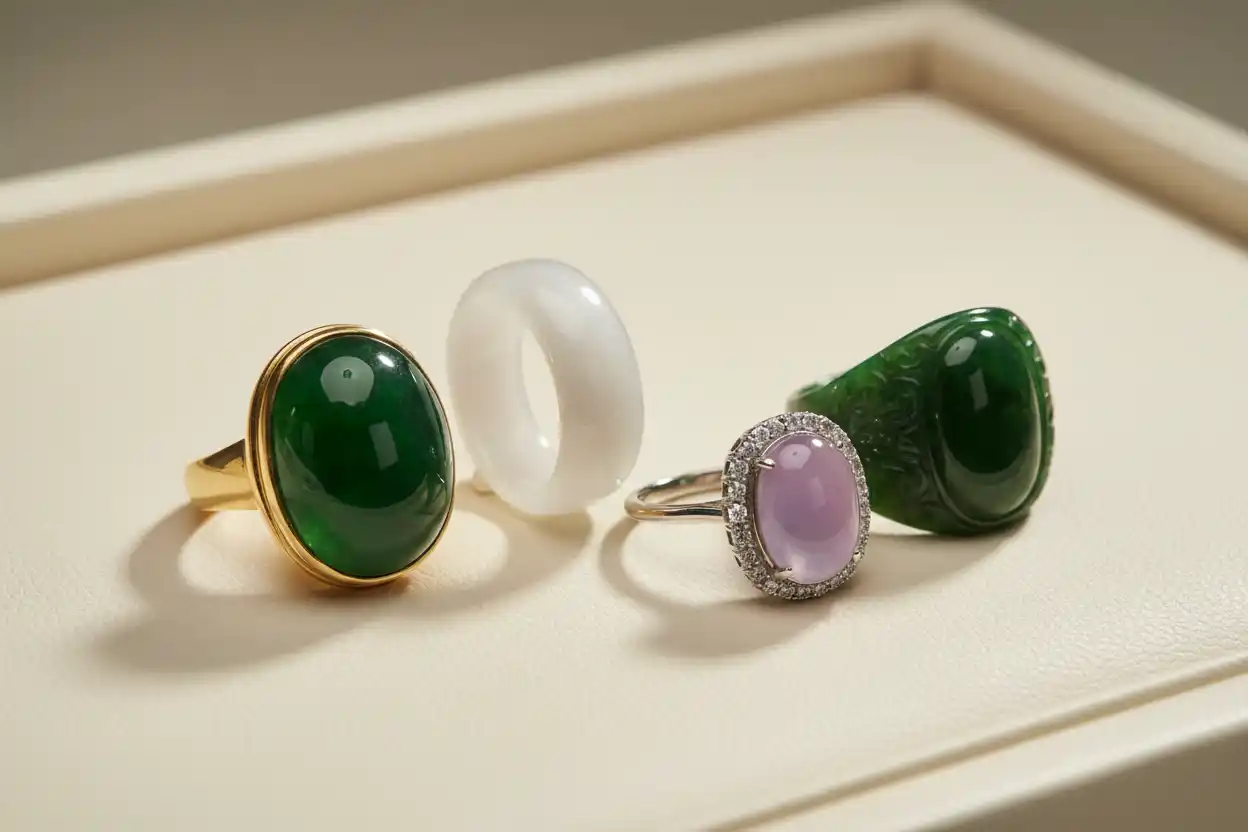
Jade Rings: Styles and Buying Tips
Jade rings can be carved entirely from one piece of stone or constructed around a jadeite or nephrite cabochon set in metal. Their exceptional toughness makes jade more practical for rings than many ornamental stones, yet surface scratching, treatment damage, thin carved sections, poor sizing, hard impacts, and insecure settings still create real risks.
The strongest purchase begins with material identity. Jadeite and nephrite are both genuine jade, but they differ in appearance, hardness, treatment patterns, and market value.
The broader jade meaning guide covers identity, history, symbolism, and family-level properties. This page focuses on ring construction, durability, settings, fit, buying checks, daily wear, maintenance, and repair.
Is Jade Good for Rings?
Jade is one of the toughest gem materials used in jewelry. Its interlocking structure resists crack propagation and gives it exceptional resistance to chipping and breakage.
However, jadeite and nephrite have moderate hardness rather than extreme hardness. Jadeite normally falls around 6.5–7 on the Mohs scale, while nephrite is approximately 6–6.5.
That means jade can survive impacts that might break a more brittle stone, yet it can accumulate scratches from quartz dust, sapphire, ruby, topaz, diamond, and abrasive surfaces.
The gemstone hardness chart explains scratch resistance, while gemstone toughness versus hardness explains why jade can be tougher than many gems that rank higher on the Mohs scale.
A well-made jade ring is suitable for regular wear, provided the owner removes it for heavy manual work and protects it from harder jewelry.
Jadeite or Nephrite for a Ring?
Jadeite offers the widest color range and can display greater translucency. Fine green, lavender, white, yellow, orange-red, gray, black, and mottled jadeite appear in rings.
Nephrite tends to show muted green, cream, white, gray, brown, yellow, and black. Its fibrous structure gives it exceptional toughness, making it well suited to carved bands, saddle rings, signet forms, and substantial cabochons.
The direct Jadeite vs. Nephrite guide covers their mineralogical differences. In a ring, neither name guarantees quality. Condition, treatment, setting, thickness, fit, and workmanship remain decisive.
Main Jade Ring Styles
| Ring style | Construction | Practical strength | Main concern |
|---|---|---|---|
| Cabochon solitaire | Jade set in metal | Protected dome and repairable setting | Exposed high profile or loose prongs |
| Bezel-set ring | Metal surrounds the jade | Strong perimeter protection | Hidden edge damage or excessive setting pressure |
| Halo ring | Jade center with accent stones | Halo can shield the center | Hard accent stones may contact jade |
| Signet ring | Broad jade or jade-set face | Stable, low-profile design | Corner wear and surface scratching |
| Saddle ring | Wide carved jade ring | Substantial wall thickness | Sizing difficulty and concealed fractures |
| Hololith band | Entire ring carved from jade | No metal setting to loosen | Cannot be resized conventionally |
| Carved ring | Relief or openwork decoration | Distinctive design | Thin projections and weak bridges |
| Cocktail ring | Large raised jade | Strong visual presence | Impact, snagging and leverage |
| Vintage ring | Older metal and jade construction | Character and craftsmanship | Worn prongs, repairs and uncertain treatment |
| Engagement-style ring | Jade center with durable mounting | Symbolic and distinctive | Long-term abrasion and documentation |
Cabochon Jade Rings
Cabochons are the most common jade ring form because a smooth dome displays color, texture, translucency, and polish while preserving material.
A well-cut cabochon should have an even outline, balanced dome, sufficient thickness, and clean polish. Very thin jadeite can appear more translucent, but a thin edge may become vulnerable during setting and wear.
The back may be flat, slightly curved, or irregular depending on the rough. A closed setting can protect the stone, although it may conceal fractures, poor color, glue, or a different backing material.
Fine jadeite cabochons are not always calibrated to standard sizes because cutters prioritize color and rough retention. Consequently, custom settings are common.
Bezel Settings
A bezel surrounds most or all of the jade’s perimeter with metal. It provides excellent protection against lateral impact and reduces exposed edges.
The setting must fit the cabochon accurately. Excessive pressure can damage a fracture, while a poorly fitted bezel may allow movement.
Inspect the bezel for:
- Gaps
- Uneven metal
- Crushed edges
- Glue seepage
- Hidden chips
- Areas where the stone rocks
- Abrasion from previous tightening
A low bezel usually works well for everyday rings because it protects the jade and resists snagging.
Prong Settings
Prongs expose more of the jade and can allow additional light around a translucent cabochon. However, they leave sections of the edge unprotected.
Four prongs may be sufficient for a moderate cabochon, while six prongs provide redundancy. Each prong should contact the stone securely without pressing on a fracture.
Rounded prong tips are preferable to sharp metal edges. The jade should sit low enough that the surrounding ring structure absorbs some impact.
Halo Rings
A halo of diamonds, sapphires, spinel, or other accent stones can increase visual spread and create contrast with green, lavender, or white jade.
A low halo may shield the center from side impacts. Nevertheless, the accent stones are often much harder than jade. Their exposed girdles should not rub against the jade or a neighboring ring.
A tall halo creates a larger silhouette but may increase snagging. Examine the ring from the side rather than judging protection only from above.
Hololith Jade Rings
A hololith ring is carved entirely from one piece of jade. Styles include narrow bands, broad saddle rings, signet-like shapes, rounded bands, faceted exteriors, and carved relief.
Hololith construction showcases jade’s toughness and uninterrupted color. It also creates unique sizing and repair limitations.
A solid jade ring cannot be enlarged or reduced through conventional metalwork. Grinding the interior changes thickness and symmetry, while adding material is generally impractical.
Therefore, fit must be resolved before purchase. A ring that is slightly loose may be stabilized with a removable insert, but a tight hololith should not be forced over the knuckle.
Saddle and Archer-Style Rings
Saddle rings have broad upper surfaces and substantial walls. Some derive inspiration from historical thumb or archer-ring forms, while others function as contemporary statement rings.
Thick construction improves impact resistance but adds weight. Wide bands also feel tighter than narrow rings of the same nominal size.
Check the interior for tool marks, fractures, filled cavities, and uneven thinning. A broad face can hide a repaired line that becomes visible only under transmitted light.
Carved Jade Rings
Carved rings may feature flowers, clouds, animals, leaves, geometric patterns, lettering, dragons, gourds, or abstract motifs.
Relief carving should retain enough material beneath the design. Thin petals, horns, openwork bridges, and raised corners can chip despite jade’s toughness.
The guide to Types of Jade helps interpret material and trade terms used for carved rings. A carving should use color variation intentionally rather than disguising fractures or treatment.
Jade Engagement Rings
Jade can serve as an unconventional engagement-ring stone, especially when its cultural meaning, family history, color, or carving has personal significance.
Its toughness is a major advantage. Nevertheless, jade scratches more readily than sapphire, ruby, moissanite, or diamond.
The guide to best gemstones for engagement rings provides a broader comparison, while green gemstones for engagement rings compares jade with emerald, tsavorite, sapphire, tourmaline and other green choices.
A jade engagement ring should ideally have a low protective setting, sound untreated stone, sufficient thickness, and a design that can be repaired without exposing the jade to excessive heat.
Someone who expects to wear one ring continuously through exercise, housework, gardening, mechanical work, and sleep should consider a more scratch-resistant center stone.
Color
Green jade rings range from pale gray-green to vivid emerald-like color. Jadeite may also appear lavender, white, yellow, orange-red, gray, brown, or black, while nephrite often has softer green, white, cream, brown, gray, or black tones.
The dedicated jade color meaning guide owns symbolism. For buying, evaluate:
- Hue
- Saturation
- Lightness or darkness
- Color distribution
- Thickness
- Lighting response
- Treatment disclosure
A concentrated patch of vivid green can be valuable when the cut positions it prominently. Uniform color is not always necessary, especially in carved or artistic rings.
Transparency and Texture
Fine jadeite may be semitransparent and appear to glow beneath the surface. Texture should look fine and even rather than coarse or granular.
Nephrite commonly has a waxier luster and more diffuse translucency. Fine material can appear smooth and creamy without the brighter internal return seen in top jadeite.
Inspect the ring in reflected and transmitted light. Backlighting can reveal fractures and color distribution, but it can also exaggerate transparency. Judge the ring in normal face-up lighting as well.
Treatments
Jadeite may be waxed, bleached, polymer impregnated, dyed, coated, heated, filled, glued, or assembled.
Type A jadeite has not undergone acid bleaching or polymer impregnation, although traditional surface waxing may be present. Type B has been bleached and polymer impregnated, Type C has been dyed, and B+C combines treatment types.
The complete treated jade guide explains identification and disclosure. Treatment is especially important in rings because hands encounter heat, soap, cosmetics, chemicals, sunlight, impact, and repair work.
Nephrite can also be dyed, coated, filled, repaired, or replaced with imitation material.
Authenticity
Green glass, aventurine, serpentine, quartz, calcite, composite products, and other materials may be sold as jade.
The guide to Real vs. Fake Jade explains safe identification. Avoid scratch tests, deliberate impact, hot needles, chemical tests, and striking the ring to judge sound.
For an expensive untreated-jade claim, request an independent report. Authentication should identify the material and disclose detectable treatment rather than relying on a retailer-produced card.
Ring Sizing
Metal-set jade rings can often be resized, but the jeweler must protect the stone from torch heat and pressure. Depending on construction, the jade may need removal before work begins.
Hololith jade rings cannot be resized conventionally. The interior can sometimes be enlarged through specialist grinding, but the process reduces wall thickness and may expose fractures.
Wide rings require more space than narrow bands. Measure the actual finger under normal conditions and consider swelling, climate, knuckle size, and the width of the ring.
Do not buy a valuable hololith based on generic small, medium, or large sizing.
Comfort
A low cabochon sits more comfortably than a high cocktail setting. Broad saddle rings distribute weight but can restrict finger movement if the inner profile is poorly shaped.
The inside should be smoothly polished with no sharp carving, exposed metal, glue, or rough drill marks.
For metal-set rings, alloy composition matters. The guide to best gemstones and metals for sensitive skin explains nickel, plating, gold alloys, titanium and platinum.
Everyday Wear
Jade is suitable for regular wear, especially in a low bezel or substantial hololith design. However, regular wear is not the same as unrestricted wear.
The guide to best gemstones for everyday wear places jade’s toughness in context.
Remove jade rings before:
- Weight training
- Gardening
- Construction
- Contact sports
- Mechanical work
- Moving furniture
- Cleaning with chemicals
- Swimming
- Showering
- Sleeping in raised settings
Even when the stone survives, metal, glue, prongs and treatments may not.
Matching Jade With Other Rings
Jade can be scratched by diamond, sapphire, ruby, topaz, and other harder gemstones. A neighboring ring with an exposed diamond girdle may abrade the jade’s side.
Use a spacer band or leave separation between rings. Do not stack two hololith jade rings when they strike one another repeatedly.
A coordinated jade bracelet, jade earrings, or jade necklace can repeat the color without exposing multiple pieces to direct contact on one finger.
Buying Checks
The full Jade Buying Guide covers material quality. For rings, add construction-specific checks.
| Buying check | What to verify |
|---|---|
| Material | Jadeite or nephrite |
| Treatment | Wax, dye, bleaching, polymer, coating, heat, repair or assembly |
| Size | Exact ring size, width and thickness |
| Condition | Fractures, chips, cavities and repaired areas |
| Setting | Secure bezel or prongs with no movement |
| Profile | Appropriate height for the intended wear |
| Metal | Alloy, hallmark, plating and shank thickness |
| Hololith wall | Even thickness and sufficient strength |
| Documentation | Independent report for high-value untreated jade |
| Return policy | Non-destructive inspection and fit confirmation |
The jade price guide explains how color, translucency, texture, treatment, size, workmanship and rarity influence value.
Cleaning
Use warm water, mild soap, and a soft cloth or brush. Rinse carefully and dry with a lint-free cloth.
Avoid warm acids, harsh jewelry dips, chlorine, repair heat and aggressive cleaning when treatment status is uncertain. Polymer-impregnated, dyed, coated, glued or repaired jade may react differently from untreated material.
Follow the complete procedure in How to Clean Jade Jewelry Safely.
Storage
Store jade rings individually in a fabric-lined compartment. Do not allow them to rub against diamonds, sapphires, rubies, topaz, or metal tools.
Hololith rings should rest on padded surfaces rather than hard ring posts. A heavy jade ring dropped onto tile can chip despite its exceptional toughness.
Keep documentation, photographs, dimensions and treatment reports with valuable pieces.
Repair
A metal-set ring can often receive prong, shank or bezel repair, provided the jeweler controls heat and pressure. Tell the jeweler that the stone is jade and disclose known treatment.
Chipped jade may sometimes be repolished or recut. A hololith ring with a complete break can be joined with adhesive, pins, metal wraps or custom caps, although repair generally reduces value and should be disclosed.
Do not use household glue. Poor adhesive spreads into the surface, discolors, and complicates professional repair.
Frequently Asked Questions
1. Is jade durable enough for an everyday ring?
Yes, jade is exceptionally tough and can suit regular wear. Its moderate hardness means it can still scratch, so remove it during heavy work and keep it away from harder gemstones.
2. Which is better for a ring, jadeite or nephrite?
Jadeite offers brighter colors and greater translucency, while nephrite generally offers even greater toughness and a waxier appearance. Treatment, condition, design and fit matter more than the species name alone.
3. Can a jade ring be used as an engagement ring?
Yes, particularly when jade has personal or cultural meaning. A low protective setting and careful wear are important because jade scratches more readily than sapphire or diamond.
4. Can a solid jade ring be resized?
Not through normal metal resizing. A specialist may enlarge the interior by grinding, but this reduces thickness and may not be safe. Buying the correct size is essential.
5. Do jade rings scratch easily?
They resist ordinary wear reasonably well, but quartz dust and harder gemstones can scratch them. Surface abrasion becomes more likely with daily ring wear than with earrings or pendants.
6. Is a bezel better than prongs for jade?
A well-made bezel generally gives better perimeter protection. Prongs can work when the jade is sound, low-set and adequately supported.
7. Can jade rings contain diamonds?
Yes. Diamonds create strong contrast, but their exposed edges must not rub against the softer jade. The setting should keep the materials separated.
8. Why is my jade ring changing color?
Lighting, skin oils, wax, residue and translucency can alter its appearance. Dye, polymer and coating can also change with time. The stone does not reliably change color in response to health or emotion.
9. Are carved jade rings fragile?
Substantial carvings can be durable, while thin petals, bridges, corners and openwork are more vulnerable. Inspect the thinnest areas rather than judging only the overall mass.
10. Should a jade ring have a laboratory report?
A report is advisable when an untreated jadeite or fine nephrite claim materially affects the price. It should identify the material and detectable treatment.
11. Can an antique jade ring be cleaned ultrasonically?
Do not assume so. Old glue, worn metal, fractures, polymer treatment and replacement stones can make ultrasonic cleaning unsafe. Gentle hand cleaning is the better default.
12. What should I do if a jade ring develops a crack?
Stop wearing it and store it in a padded box. A jade specialist should determine whether the line is an open fracture, old repair, stable structural feature or treatment-related damage.
A successful jade ring respects both sides of the material’s durability profile. Jade is extraordinarily resistant to breaking, yet it remains vulnerable to scratching, treatment damage and poor construction. Choose a sound stone or substantial hololith, verify treatment, insist on correct sizing, and favor a low protective design that matches the wearer’s actual routine.