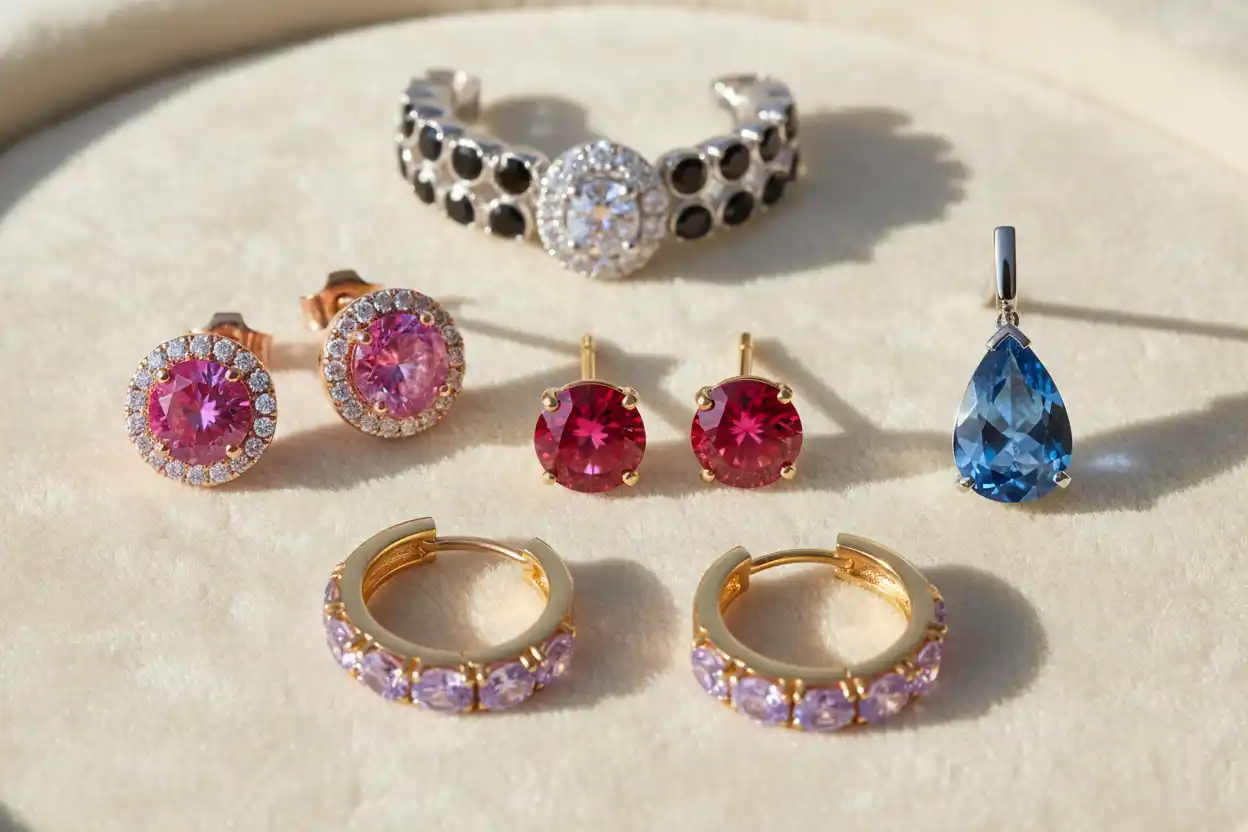
Spinel Earrings: A Style Guide
Spinel earrings combine excellent jewelry durability with a color range extending from vivid red and hot pink to cobalt blue, lavender, gray and opaque black. Their hardness of 8 makes Spinel practical for regular wear, while the earring format protects the stones from many impacts that affect rings and bracelets.
The strongest pair depends on more than gem color. Matching, cutting, total weight, setting construction, post length, backing security and comfort all determine whether the earrings will be worn regularly.
Spinel Earrings at a Glance
| Feature | What to Consider |
|---|---|
| Gem material | Natural or laboratory-grown Spinel |
| Common colors | Red, pink, orange, violet, blue, gray and black |
| Mohs hardness | 8 |
| Toughness | Good |
| Cleavage | No easy cleavage |
| Best everyday styles | Studs, compact hoops and low-profile bezel drops |
| Formal styles | Halos, long drops, chandeliers and clusters |
| Most important pair factor | Matching color, size and brightness |
| Common cuts | Round, oval, cushion, pear and mixed cuts |
| Treatment concerns | Heat, filling and diffusion in some stones |
| Safe cleaning | Warm water, mild soap and a soft brush |
| Birthstone connection | Spinel is an August birthstone |
Why Spinel Works Well in Earrings
Spinel offers greater scratch resistance than many popular colored stones. It is harder than Quartz, Garnet, Tourmaline and Tanzanite, although Sapphire and Diamond remain harder.
The mineral also lacks easy cleavage, reducing the risk of splitting along one preferred structural plane. A severe blow can still chip a gem, but earrings experience relatively limited surface contact.
Color creates another advantage. A buyer can select classic red, vivid pink, rare blue, understated gray or polished black without leaving the same gem species.
The broad Spinel meaning guide covers mineral identity and history, while Spinel color meaning explains the symbolism associated with individual shades.
Spinel Stud Earrings
Studs are the most versatile Spinel earring style. They sit close to the lobe, work with casual and formal clothing and avoid the movement of longer designs.
Round brilliant cuts produce even sparkle and are easier to match than unusual shapes. Cushions offer a softer outline, while ovals can create greater visible length for the weight.
Four-prong baskets allow light around the gem. Each prong should remain smooth, balanced and substantial enough to protect the stone.
A bezel provides stronger girdle protection and reduces snagging. The metal border may make the gem appear slightly smaller, but it creates a clean outline suitable for everyday use.
Large studs need supportive backings because a heavy setting can tip forward. The complete dimensions, not only carat weight, should guide the choice.
Halo Earrings
Halo earrings surround each Spinel with smaller accent stones, commonly Diamonds, white Sapphires or colorless Zircon.
A halo increases apparent size and creates contrast. White accents can make red, pink or blue Spinel appear more saturated, particularly when the center has a medium or dark tone.
The design requires additional maintenance because every accent has its own small prongs or beads. Residue can accumulate beneath the stones and reduce brightness.
The halo should frame the Spinel rather than hide its outline. An excessively large surround may make a fine center stone look secondary.
Spinel Drop Earrings
Drop earrings suspend the gem below the lobe, allowing movement to create changing flashes of color.
Pear, oval and elongated cushion cuts work particularly well. Their proportions follow the vertical line of the design and make efficient use of visible space.
Short drops can remain practical for regular wear. Long dangles feel more formal but may catch in hair, scarves or high collars.
Check every joint between the upper earring and the gemstone component. A decorative drop is only as secure as its smallest connecting ring.
Heavy designs should be worn long enough to assess comfort before the return period expires. Weight that feels manageable for one minute may become uncomfortable over several hours.
Spinel Dangle and Chandelier Earrings
Dangle earrings use multiple articulated components, while chandeliers create a wider decorative arrangement.
Multicolor Spinel suits these designs particularly well. Pink, purple, blue and gray stones can form a deliberate gradient, while red and orange gems create a warmer palette.
Each moving component should clear the others without striking hard enough to chip an edge. The reverse side must remain smooth against the neck.
Chandelier earrings distribute weight over a larger area, so the post, upper element and backing need to support the entire design.
These pieces are best stored flat or suspended separately to prevent tangling.
Spinel Hoop Earrings
Spinel may be set along the front of a hoop, around the outside and inside surfaces, or suspended as removable charms.
Front-facing stones provide the greatest visibility with less total weight. Inside-out hoops add sparkle but introduce more settings and potential skin contact.
A hinged hoop should close with a clear click. Check that the post aligns naturally with the receiving channel rather than requiring force.
Small Spinel charms can personalize plain gold hoops. Their jump rings should remain closed securely so that they cannot slip off when the hoop opens.
Cluster Earrings
Cluster earrings arrange several smaller Spinels into floral, geometric or asymmetrical patterns.
The design can create substantial color without requiring two large matching stones. This is especially useful for rare cobalt-blue or vivid-red material.
A multicolor cluster may combine pink, purple, lavender and blue Spinel. The stones should look intentionally graduated rather than randomly mismatched.
Inspect the gallery beneath the cluster. Open construction makes cleaning easier, but the framework must remain strong enough to support every setting.
Black Spinel Earrings
Black Spinel creates a graphic, neutral appearance in studs, hoops, drops and pavé designs.
The material is normally opaque, so its appeal comes from polish, luster and faceted reflections rather than transparent brilliance.
Black Spinel can resemble black Diamond, Onyx, Obsidian or coated glass. Accurate disclosure matters because these materials have different structures, values and care requirements.
White metal produces a crisp monochrome effect. Yellow or rose gold creates stronger warmth and contrast.
The broader black gemstones guide compares the principal dark jewelry materials.
Red Spinel Earrings
Red Spinel offers a durable alternative to Ruby while remaining a separate gem species.
Fine stones range from orangy red to slightly purplish red. Medium to medium-dark tone generally allows sufficient brightness, whereas extremely dark material can appear nearly black in weak light.
Matched red pairs can be difficult to assemble because the stones must coordinate in hue, saturation, dimensions and brilliance.
The Ruby versus Spinel comparison explains why many historic red Spinels were identified as Rubies. A wider three-gem distinction appears in Ruby versus Garnet versus Spinel.
Pink Spinel Earrings
Pink Spinel ranges from pale blush to intense hot pink. The strongest stones can rival fine pink Sapphire in saturation while retaining Spinel’s distinct singly refractive brilliance.
Pale pink studs suit understated daily wear. Hot-pink halos and drops provide greater visual impact.
Rose gold creates a warm tonal combination, while platinum or white gold makes saturated pink appear brighter.
The stones should be viewed beside each other under neutral light. One may lean orange while the other looks purple, even when both were sold simply as pink.
The pink gemstones guide compares Spinel with Sapphire, Tourmaline, Morganite and other materials.
Blue Spinel Earrings
Blue Spinel can range from grayish violet-blue to intense cobalt blue. Fine natural cobalt-bearing material is rare and can command significant prices.
Many natural blue Spinels contain a noticeable gray modifier. That appearance can suit modern minimalist jewelry even when it lacks the saturation of premium cobalt material.
Strongly colored blue stones deserve laboratory documentation because cobalt and nickel diffusion treatments have entered the market. Synthetic blue Spinel is also widely available.
A significant natural pair should have reports covering both stones rather than one representative gem alone.
The blue gemstones guide compares Spinel with Sapphire, Aquamarine, Tourmaline and Zircon.
Purple, Lavender and Gray Spinel Earrings
Purple and lavender Spinel creates a softer alternative to red or vivid pink. The colors can range from reddish purple to bluish violet and pale lilac.
Gray Spinel offers a neutral, contemporary look. Some stones show blue, green or violet undertones that become more obvious under different light.
These understated colors suit minimalist bezels, geometric drops and mixed-metal designs. They can also form attractive graduated sets.
The purple gemstones guide and gray gemstones guide provide broader color comparisons.
Matching a Spinel Pair
Matching is one of the most important quality factors in colored-stone earrings.
The two gems should coordinate in hue, tone, saturation, visible dimensions, clarity and face-up brightness. Equal carat weight does not guarantee equal visible size because one stone may be cut more deeply.
View the pair together rather than inspecting each stone separately. A subtle mismatch becomes more obvious when the earrings frame the face.
Cutting should also match. One stone should not show strong brilliance while the other has a dark center or visible window.
Large fine matched pairs are uncommon because high-quality Spinel rough is often cut in nonstandard dimensions to preserve weight.
Evaluating Cut
Rounds and cushions commonly provide good brilliance. Ovals preserve rough efficiently and create a larger-looking outline.
Pears suit drops, while marquises and trillions add a more angular style. Pointed shapes require secure protective prongs.
A window appears when the center leaks light and allows the setting or background to show clearly through the gem.
Extinction creates dark areas that do not brighten as the stone moves. Some darkness is normal in saturated stones, but a well-cut pair should remain lively.
Facet junctions should look crisp and symmetrical. Significant abrasion may indicate prior wear or poor finishing.
Evaluating Clarity
Many Spinels are eye-clean, especially compared with gem materials that routinely contain prominent inclusions.
Natural stones can still contain crystals, fingerprint-like inclusions, needles and healed fractures. Small internal features may confirm natural character without affecting beauty.
Surface-reaching fractures deserve more attention because they can weaken the stone or contain filling.
A perfectly clean pair at an implausibly low price may be synthetic, although appearance alone cannot establish origin.
Natural and Laboratory-Grown Spinel
Natural Spinel forms in geological environments, including metamorphic marble and related deposits.
Laboratory-grown Spinel has been produced for many decades. It may be sold as synthetic Spinel or used to imitate Sapphire, Aquamarine and other gems.
Synthetic material can provide large, clean and evenly colored earrings at a lower cost. It is a legitimate choice when disclosed accurately.
For expensive natural earrings, independent laboratory reports help establish identity, natural origin and detectable treatment.
The Spinel buying guide explains disclosure, reports and seller evaluation in greater detail.
Treatments
Spinel has a reputation for receiving less routine treatment than Ruby or Sapphire, but enhancements do occur.
Heat treatment may alter some material. Fracture filling can reduce the visibility of surface-reaching breaks, while cobalt and nickel diffusion can create or modify blue and green colors.
Treatment can influence rarity, price and cleaning. Written disclosure should accompany any significant purchase.
The Spinel price guide addresses how color, origin, treatment, size and quality affect market value.
Choosing Earring Size
Small studs provide concentrated color without significant weight. Larger stones make a stronger statement but require supportive settings and backs.
Dimensions are more helpful than carat weight alone. Two one-carat Spinels may face up differently if their depths vary.
A halo enlarges the total outline without requiring a much larger center stone.
For drops, assess the combined weight of the upper setting, gemstone, accent stones and lower components.
Earring Backings
Friction backs are convenient for small and moderate studs. They should grip securely without being difficult to remove.
Screw backs suit valuable earrings but take longer to fasten and may feel uncomfortable if the threaded post presses against the skin.
Locking backs provide strong security and a larger support surface for heavier studs.
Lever backs work well for drops and dangles. Open hooks should include small silicone stoppers when loss is a concern.
The backing should match the value and weight of the complete earring.
Metal Choices
White gold and platinum create strong contrast with red, pink, blue and black Spinel.
Yellow gold warms red, orange, black and purple stones. It can also give red Spinel a more historical appearance.
Rose gold complements pink and lavender material, although very pale stones may blend into the mounting.
Sterling silver offers a lower-cost option for black, gray and commercial multicolor Spinel. The construction should still be sufficiently strong.
People with known metal sensitivity should ask about post and alloy composition.
Spinel Earrings as August Birthstone Gifts
Spinel is one of August’s recognized birthstones, alongside Peridot and Sardonyx.
Earrings make practical gifts because they do not require ring or wrist measurements. Confirm that the recipient has pierced ears and identify the style normally worn.
Red, pink, blue, lavender and black all qualify as Spinel birthstone colors. The recipient’s wardrobe should guide the choice rather than an assumption that August jewelry must be green.
The August birthstone guide explains the monthly tradition. The August birthstone jewelry guide compares earrings with rings, necklaces and bracelets.
Comparing Spinel Jewelry Formats
A Spinel bracelet provides repeated color but receives more contact with desks and hard surfaces.
The forthcoming Spinel necklace guide allows larger stones with relatively low impact exposure. A Spinel ring makes the gem highly visible but subjects it to more abrasion.
Earrings offer one of the best balances of visibility, durability and practical sizing.
Cleaning and Maintenance
Clean Spinel earrings with warm water, mild soap and a soft brush. Work carefully behind the settings and around the posts, where cosmetics and skin oils collect.
Rinse briefly and dry with a lint-free cloth. Support the earrings over a bowl or closed drain.
Steam and ultrasonic cleaning may be suitable for untreated, unfractured Spinel in strong settings. Warm soapy water remains the safer default when treatment or fracture history is uncertain.
The dedicated guide to cleaning Spinel jewelry provides treatment-specific instructions.
Inspect prongs, posts, hinges and backs regularly. A loose backing is often a greater immediate loss risk than damage to the gemstone.
Storage
Keep each earring in a separate padded compartment. Allowing the pair to strike each other can abrade metal and damage delicate accents.
Store Spinel away from Diamond and Sapphire, which can scratch it.
Keep screw backs and locking components with the correct pair. Small mechanisms are easily misplaced when stored loose.
Spinel appears in the crystals beginning with S and gemstones beginning with S directories.
Frequently Asked Questions
1. Is Spinel durable enough for everyday earrings?
Yes. Spinel has a Mohs hardness of 8, good toughness and no easy cleavage, making it well suited to earrings.
2. Which Spinel earring style is most practical?
Low-profile studs and compact bezel drops are among the easiest styles for frequent wear.
3. What is the best Spinel color for earrings?
There is no universal best color. Red, cobalt blue, vivid pink and orange are highly valued, while lavender, gray and black provide distinctive alternatives.
4. How closely should Spinel earrings match?
The stones should coordinate in hue, tone, saturation, visible dimensions and brightness. One noticeably darker or more windowed stone can disrupt the pair.
5. Are blue Spinel earrings always natural?
No. Natural, synthetic and diffusion-treated blue Spinel all exist. Expensive vivid-blue pairs should have independent reports.
6. Is synthetic Spinel suitable for earrings?
Yes, when its laboratory-grown origin is disclosed. It can provide clean, well-matched color at a lower price.
7. Which earring backs are safest?
Locking or screw backs offer strong security for valuable studs. Lever backs are reliable for many drop designs.
8. Which metal looks best with red Spinel?
White metal creates strong contrast, while yellow gold adds warmth and a more traditional appearance.
9. Are Spinel earrings good August birthstone gifts?
Yes. Spinel is an August birthstone, and earrings avoid most sizing problems associated with rings and bracelets.
10. Does Spinel receive treatment?
Some Spinel is heated, filled or diffusion treated. Blue and green stones require particular attention to treatment disclosure.
11. Can Spinel earrings be cleaned ultrasonically?
Some untreated, unfractured Spinels in robust settings tolerate ultrasonic cleaning. Warm soapy water is safer when treatment or structural condition is uncertain.
12. How should Spinel earrings be stored?
Keep them in separate padded compartments with their matching backs. Avoid contact with harder Diamond and Sapphire jewelry.