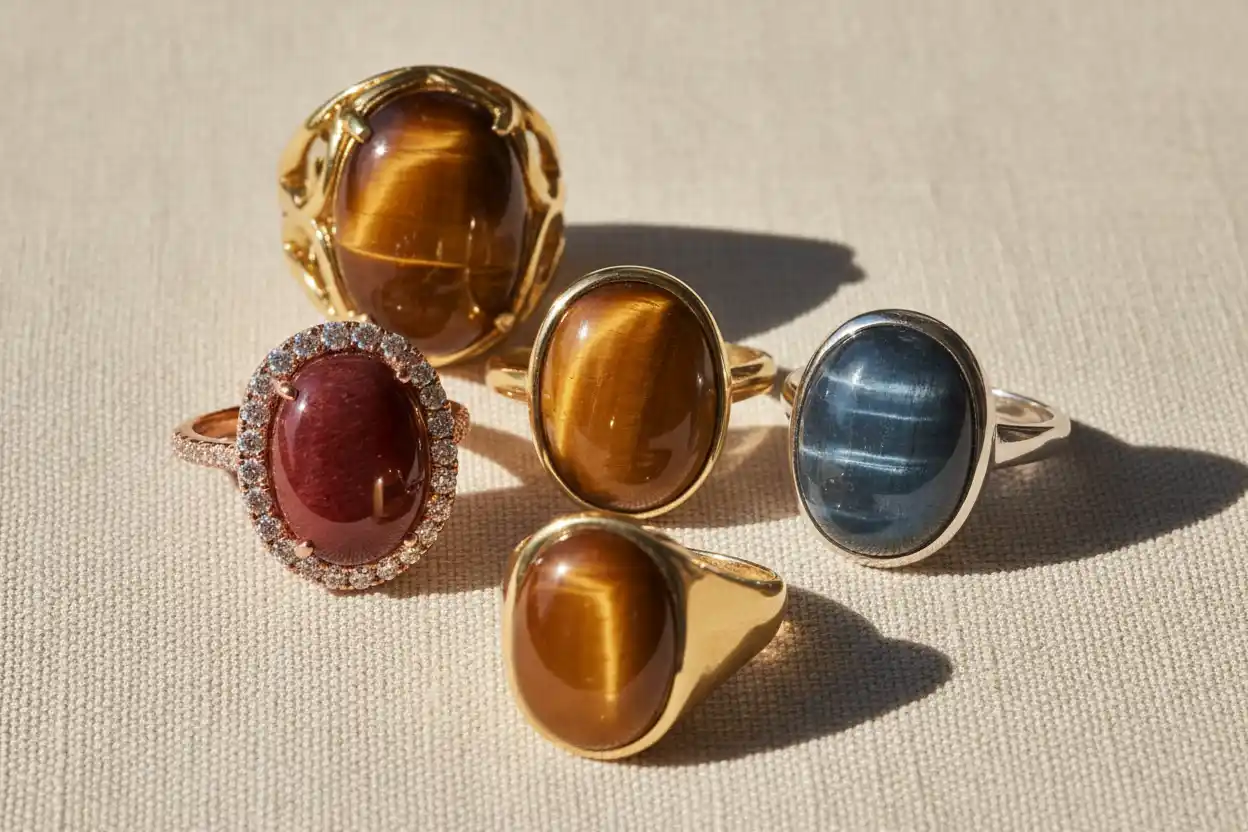
Tiger’s Eye Rings: Styles and Buying Tips
Tiger’s Eye rings place the stone’s moving chatoyant band in a position where the wearer can see it throughout the day. Golden-brown cabochons are the classic choice, while Blue Tiger’s Eye, Red Tiger’s Eye and mixed-color material offer cooler or warmer alternatives.
The hand is a demanding jewelry environment. Although Tiger’s Eye has useful Quartz-based hardness and no cleavage, rings still encounter impact, abrasive dust, hard countertops and neighboring gemstones. A protective setting, sound cabochon and realistic wearing routine remain important.
Tiger’s Eye Rings at a Glance
| Feature | What to Consider |
|---|---|
| Gem material | Chatoyant polycrystalline Quartz with fibrous inclusions |
| Common colors | Golden brown, blue-gray and reddish brown |
| Mohs hardness | Approximately 7 |
| Cleavage | None |
| Popular cuts | Oval, round, rectangular and freeform cabochons |
| Best protective setting | Full or partial bezel |
| Classic ring styles | Signet, bezel solitaire, halo, inlay and cocktail ring |
| Most important quality factor | Strong, centered moving chatoyant band |
| Common treatment concerns | Heating, dyeing, bleaching and resin |
| Everyday suitability | Good with suitable setting and care |
| Safest cleaning | Lukewarm water, mild soap and a soft brush |
| Main risk | Hard impact, scratched polish and edge chipping |
Is Tiger’s Eye Good for Rings?
Tiger’s Eye is practical for rings because Quartz gives it a Mohs hardness near 7 and the material lacks cleavage.
That durability does not make it indestructible. A fractured cabochon can chip, while a forceful strike can damage the polish or setting.
Quartz-rich household dust can also abrade a surface over time. Harder gemstones such as Topaz, Sapphire and Diamond can scratch it more easily.
A low bezel ring can handle regular wear. High projecting cocktail designs and thin freeform shapes are better reserved for lower-risk occasions.
The Tiger’s Eye meaning guide owns the mineral’s complete identity. This article focuses on ring design and purchasing.
Bezel-Set Tiger’s Eye Rings
A bezel surrounds most or all of the stone’s edge with metal.
It is the safest and most common setting for a Tiger’s Eye cabochon. The smooth rim protects the girdle and reduces snagging.
A full bezel creates the strongest protection. A partial bezel exposes more of the stone while leaving selected sides vulnerable.
The bezel should follow the cabochon evenly. Gaps may allow movement, while excessive pressure can damage a stone containing fractures.
Because Tiger’s Eye is opaque, covering the edge does not reduce transmitted light. The main optical effect remains visible through the polished top.
Signet Rings
Tiger’s Eye has a long-standing association with signet-style and men’s rings.
An oval, rectangular or cushion-shaped cabochon may be set flush with a broad metal top. The low profile provides useful protection and creates a substantial appearance.
The stone should sit level rather than tilting within the setting. The chatoyant band may run vertically, horizontally or diagonally according to the design.
A thick signet ring must still feel comfortable between adjacent fingers. Sharp shoulders and excessive weight can make regular wear unpleasant.
Engraving around the gem should not weaken the bezel or create rough edges.
Solitaire Rings
A solitaire displays one cabochon without a broad signet structure.
Oval and round stones provide traditional proportions. Rectangular and freeform cabochons create a more contemporary appearance.
Prong-set solitaires expose more of the gemstone but provide less edge protection. Substantial low prongs are preferable to thin high claws.
The cabochon should remain the visual focus. Decorative metalwork needs to support rather than obscure the moving line.
A wide enough shank helps prevent a large center from rotating around the finger.
Halo Rings
A halo surrounds Tiger’s Eye with small accent stones or decorative metal.
Colorless accents can increase contrast around golden, blue or red material. However, Diamond and Sapphire are harder than Quartz and must not touch the center stone directly.
A metal halo or engraved surround avoids that abrasion concern while increasing the ring’s visual size.
Low halos help protect the edge. Raised double halos add height and more settings that can catch on clothing.
The center’s chatoyancy should remain easy to see. An overly complex surround may distract from the defining optical effect.
Inlay Rings
Inlay places thin pieces of Tiger’s Eye into channels or recesses in metal.
The format can create stripes, geometric panels or alternating colors.
Thin inlay is more vulnerable than a thick cabochon. A direct impact can crack one segment, while worn adhesive may allow a piece to loosen.
The surface should remain level and smooth. Gaps between the stone and metal can trap residue or signal weak workmanship.
Inlay rings are best removed before soaking, cleaning and manual work because glue or backing may be present.
Cocktail Rings
Large Tiger’s Eye cabochons suit cocktail jewelry because commercial rough can produce dramatic sizes.
Broad golden bands, wavy fibers and naturally curved patterns become more visible in large stones.
A large setting also receives more impact. High domes, wide shoulders and projecting edges should be evaluated carefully.
Cocktail rings are generally better for occasional wear than constant daily use.
The complete ring should remain balanced. A heavy top may rotate unless the shank is sufficiently wide or shaped for stability.
Blue Tiger’s Eye Rings
Blue Tiger’s Eye, or Hawk’s Eye, provides a cooler alternative to the classic golden material.
Its color ranges from steel blue and slate gray to blue-green and nearly black. The moving band may appear pale blue or silver.
White gold, silver and blackened metal complement its cool tone. Yellow gold creates a stronger contrast.
Dark stones should retain visible chatoyancy indoors. A cabochon that appears completely black except beneath one spotlight may be less satisfying in regular wear.
The Blue Tiger’s Eye guide explains the variety. The planned page on buying real Blue Tiger’s Eye will own detailed authenticity checks.
Red Tiger’s Eye Rings
Red Tiger’s Eye can appear rust, brick red, mahogany or burgundy brown.
Much commercial red material has been heated. Dyed products also occur.
Yellow and rose gold emphasize warmth, while white metal makes the red-brown stone stand out more sharply.
Look for color concentrated in fractures or along the base of the cabochon. Extremely bright uniform red may warrant treatment questions.
The Red Tiger’s Eye guide covers the variety, while the planned red Tiger’s Eye buying guide will focus on seller disclosure.
Golden Tiger’s Eye Rings
Golden Tiger’s Eye remains the most traditional ring choice.
Fine material shows a bright gold band against bronze or brown surroundings. Honey-colored gems feel lighter, while chocolate-brown stones create a more formal appearance.
Yellow gold produces a harmonious tonal design. White metal creates a defined border that can make the bright line appear more vivid.
The stone should be judged in ordinary light. Strong retail illumination can make mediocre chatoyancy look more dramatic.
Related warm materials appear in the brown gemstones guide.
Evaluating Chatoyancy
A ring should show its strongest band when the hand rests in a natural position.
Hold the stone beneath one direct light and rotate it slowly. The line should travel across the surface rather than remain fixed.
A centered narrow eye is often preferred, but broad silky movement can also be attractive.
Curved fibers may create waves or several related bands. These patterns are natural and can make a large cabochon distinctive.
A premium ring should remain lively outside the seller’s carefully arranged photograph.
Cabochon Orientation
The cutter must place the fibrous direction correctly beneath the dome.
On an oval ring, the reflected line may run across the short dimension or follow a deliberate design direction. Either approach can work when it remains centered.
A crooked or weak band may indicate poor orientation.
The setting should keep the cabochon aligned with the finger. A loose stone can rotate and make the intended direction look accidental.
Matching orientation matters particularly in rings with more than one Tiger’s Eye stone.
Evaluating Polish
A smooth polish sharpens the moving band.
Scratches, pits and dull areas scatter reflection and reduce the eye-like effect.
Examine the dome in both direct and diffuse light. Strong glare may conceal surface abrasion.
The cabochon edge should remain intact. Tiny chips beneath a bezel may be cosmetic, while deep cracks can weaken the stone.
A thick resin coating may look glossy but does not represent the same finish as properly polished Quartz.
Natural Fractures
Tiger’s Eye can contain fractures parallel to or crossing the fibrous texture.
A closed internal line may have little effect on durability. A surface-reaching crack near the edge or base deserves more concern.
Inspect the stone from the side and beneath the setting.
A fractured stone should not be subjected to excessive setting pressure.
Resin stabilization may improve durability, but it should be disclosed.
Tiger’s Eye Versus Fiber-Optic Glass
Fiber-optic glass can produce a sharp moving line and is a common visual imitation.
Artificial material may show perfect uniformity, identical band width and repeated patterns.
Natural Tiger’s Eye usually contains irregular colors, curved fibers and variations across the cabochon.
Mold marks, gas bubbles or a different surface appearance may provide clues.
The general crystal identification guide explains why destructive home tests should be avoided.
The planned where-to-buy Tiger’s Eye guide will own the complete authenticity workflow.
Tiger’s Eye Versus Pietersite
Pietersite typically shows broken, reoriented chatoyant fragments in a storm-like pattern.
Tiger’s Eye more commonly presents continuous parallel or gently curved bands.
The completed Tiger’s Eye versus Pietersite comparison explains structure, appearance and buying terminology.
Irregular banding alone does not justify a Pietersite label.
Treatments
Heating commonly creates or intensifies red color.
Dye can produce strong red, blue, green, purple and other shades. Bleaching may lighten material, while resin can stabilize fractures.
Coatings may alter gloss or surface color.
Treatment does not prevent a ring from being attractive. It should influence the description, care and price.
Ask for written disclosure when the color appears unusual or the seller claims untreated rarity.
Choosing Ring Size
Accurate sizing is important because a rotating ring prevents the chatoyant band from facing consistently upward.
Wide signet rings usually fit more tightly than narrow bands. Measure the finger using a similar-width sample.
Finger size changes with temperature, activity and time of day. More than one measurement reduces error.
Heavy centers may need sizing beads, an inner sizing bar or a wider shank.
A ring that is excessively tight strains the setting and becomes uncomfortable, while a loose ring experiences more impact.
Resizing
Simple metal shanks can often be resized.
Inlay designs, full-pattern bands and rings with continuous decoration may have strict limits.
Heat from jewelry repair can affect resin, dye, adhesive and the stone’s structural condition. The jeweler may choose to remove the cabochon before using a torch.
Ask about resizing before purchase rather than assuming every signet can be altered substantially.
A replacement stone may not match the original setting if the cabochon was cut to a custom shape.
Metal Choices
Yellow gold emphasizes golden and red Tiger’s Eye.
Rose gold creates a softer warm pairing with mahogany stones.
White gold, platinum and silver provide strong contrast around golden material and complement Blue Tiger’s Eye.
Blackened silver or steel-colored finishes can create a dramatic design, although surface finishes may wear.
The metal should be substantial enough for the cabochon’s size. Thin prongs and weak shoulders undermine an otherwise durable gem.
Men’s and Women’s Ring Styles
Tiger’s Eye rings are not inherently gendered.
Broad signets and large rectangular cabochons are frequently marketed to men, while small ovals, halos and slender bands are often marketed to women.
These conventions do not determine who can wear a design.
Choose the shape, width and weight according to finger size, comfort and personal style.
Large stones may suit any wearer who prefers a statement ring, while compact bezels provide a quieter option.
Tiger’s Eye as an Engagement Ring
Tiger’s Eye can serve as an unconventional engagement-ring stone.
Its hardness and lack of cleavage make it more practical than many ornamental materials, although it will abrade sooner than Sapphire or Diamond.
An opaque cabochon creates a different visual language from a transparent brilliant-cut gem. The choice should reflect the wearer rather than imitate a conventional Diamond ring.
A low full bezel is preferable for continuous wear.
The couple should also accept that polishing, resetting or replacement may eventually be needed.
Daily Wear
A low bezel Tiger’s Eye ring can be worn regularly.
Remove it before weightlifting, gardening, cleaning, cooking with hard equipment and working with tools.
Avoid striking the cabochon against ceramic, stone or metal surfaces.
Do not stack it directly beside Topaz, Sapphire or Diamond bands.
The gemstone hardness chart provides comparative durability context.
Symbolism
Modern crystal traditions associate Tiger’s Eye with practical confidence, focus and measured courage.
A ring keeps the moving band visible, making it a convenient reminder to pause before acting.
The completed Tiger’s Eye healing-properties guide owns the detailed spiritual intent.
Symbolism does not protect the ring physically or guarantee success in a decision.
Comparing Other Tiger’s Eye Jewelry
A Tiger’s Eye necklace accommodates larger stones with less impact exposure.
Tiger’s Eye earrings offer safe wear near the face.
A Tiger’s Eye bracelet displays several moving bands but receives frequent desk contact.
Rings provide maximum visibility to the wearer and require the strongest setting protection.
Cleaning
Use lukewarm water, mild soap and a soft brush or cloth.
Work around the bezel or prongs where lotion and soap collect. Rinse briefly and dry completely.
Avoid prolonged soaking when treatment, resin or adhesive is uncertain.
Ultrasonic cleaning is unnecessary and may affect fractures, fills or setting condition.
The completed guide to cleaning Tiger’s Eye jewelry provides complete care instructions.
Storage
Place the ring in a separate padded compartment.
Do not allow it to rub against Topaz, Sapphire or Diamond.
Tiger’s Eye can scratch softer gems, so it should not remain loose with Calcite, Fluorite or feldspar jewelry.
Inspect the bezel or prongs after any significant impact.
The stone is listed in the crystals beginning with T and gemstones beginning with T directories.
Final Perspective
A Tiger’s Eye ring succeeds when its moving band remains visible in the position the hand naturally occupies. Color alone cannot compensate for weak orientation, poor polish or a cabochon that rotates constantly.
Once the stone performs visually, examine the setting and fit. A modest golden cabochon in a low, secure bezel will usually provide more lasting satisfaction than a larger treated stone placed high above a narrow shank.
Frequently Asked Questions
1. Is Tiger’s Eye durable enough for a ring?
Yes. Its hardness near 7 and lack of cleavage support regular ring wear, although hard impacts and harder neighboring gemstones should be avoided.
2. Which setting protects Tiger’s Eye best?
A low full or partial bezel provides the strongest edge protection.
3. Can Tiger’s Eye rings be worn every day?
Careful daily wear is possible. Remove the ring for exercise, cleaning, gardening and manual work.
4. What makes the bright band move?
Aligned fibrous inclusions reflect light and create chatoyancy as the stone or viewer changes position.
5. Is Blue Tiger’s Eye suitable for rings?
Yes. Natural Hawk’s Eye has similar general durability to golden Tiger’s Eye, though dye and fractures should be disclosed.
6. Is Red Tiger’s Eye treated?
Much commercial red material has been heated, and some has been dyed. Treatment should be disclosed.
7. Can Tiger’s Eye be used in an engagement ring?
Yes, particularly in a protective bezel. It is less scratch resistant than Sapphire or Diamond and may need maintenance over time.
8. How can a real Tiger’s Eye ring be distinguished from glass?
Natural material usually shows varied bands and internal irregularities. Fiber-optic glass may appear unusually uniform, but professional testing is safest.
9. Is a signet setting good for Tiger’s Eye?
Yes. A low signet design protects the cabochon and keeps the optical effect visible.
10. Can Tiger’s Eye rings be resized?
Many simple metal shanks can be resized, but inlay, complex decoration and treatment may limit repair options.
11. Can Tiger’s Eye be cleaned in an ultrasonic machine?
Hand cleaning is safer because fractures, resin, dye and setting condition may be uncertain.
12. How should a Tiger’s Eye ring be stored?
Keep it in a padded compartment away from harder gemstones and inspect the setting after impact.