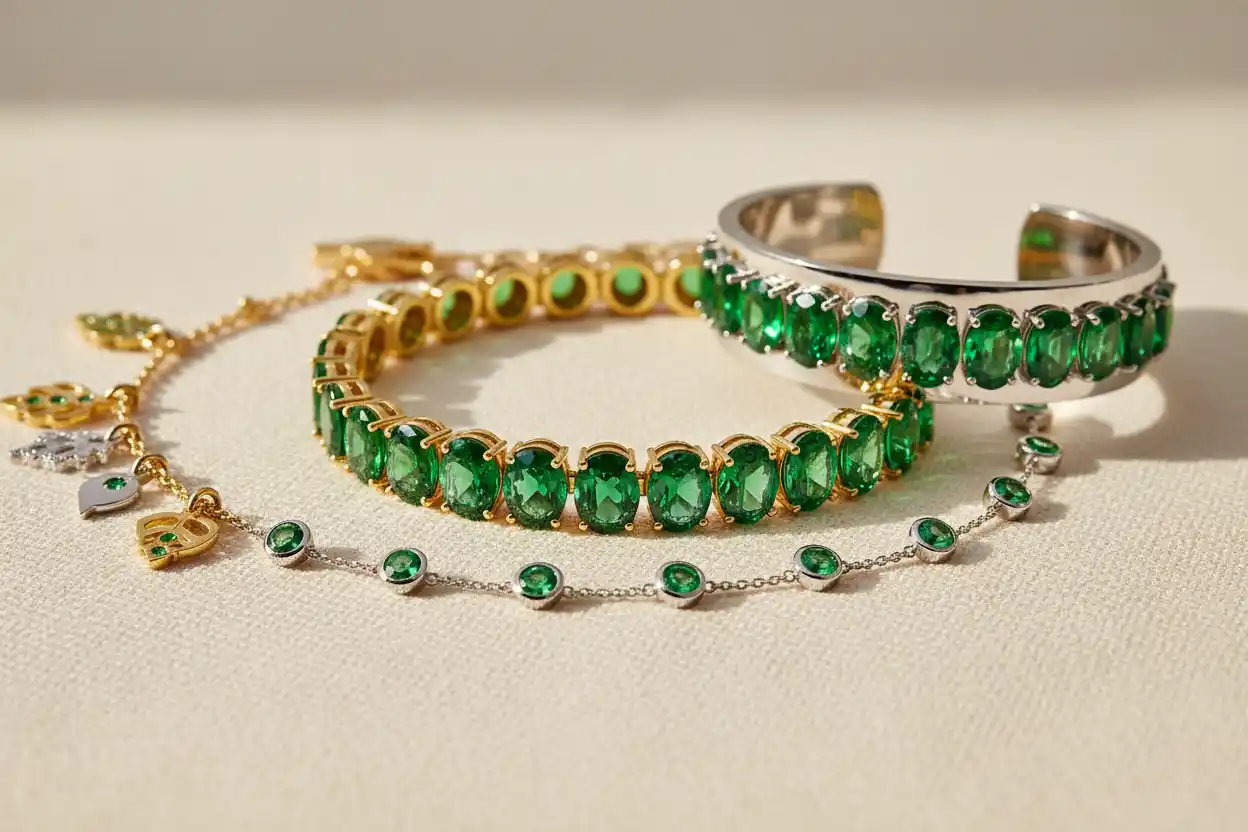
Tsavorite Bracelets: How to Choose and Wear
Tsavorite bracelets display vivid green Garnet in a format that can range from one protected station to a complete line of closely matched faceted stones. Fine gems may show yellowish green, pure green or slightly bluish green color, often with brightness that remains lively without the clarity enhancement commonly associated with Emerald.
The gemstone has useful hardness, no cleavage and fair-to-good toughness, making it one of the more practical green choices for jewelry. Bracelets still require care because the wrist regularly encounters desks, counters and other hard surfaces.
Color matching, inclusion placement, cutting, setting protection, articulation and clasp security determine whether a Tsavorite bracelet provides lasting value.
Tsavorite Bracelets at a Glance
| Feature | What to Consider |
|---|---|
| Gem variety | Green Grossular Garnet |
| Main color causes | Primarily vanadium, with chromium in some material |
| Typical colors | Yellowish green, vivid green and slightly bluish green |
| Mohs hardness | Approximately 7–7.5 |
| Toughness | Fair to good |
| Cleavage | None |
| Common styles | Tennis, line, station, charm, cuff and bangle |
| Best protective setting | Low individual bezel or substantial prongs |
| Main matching factor | Hue, tone, saturation, size and brilliance |
| Treatment expectation | Usually untreated; fracture filling is uncommon but possible |
| Safest cleaning | Warm water, mild soap and a soft brush |
| Birthstone family | Garnet, associated with January |
What Is Tsavorite?
Tsavorite is a transparent green variety of Grossular Garnet.
Grossular is a calcium-aluminum Garnet whose pure form would be colorless. Vanadium and, in some material, chromium produce Tsavorite’s green color.
The variety became commercially associated with deposits in East Africa, especially Kenya and Tanzania. Additional Grossular material, including Tsavorite, has also been documented from Madagascar and other localities.
The completed Tsavorite meaning guide owns the gem’s mineralogy, locality and symbolism. This page focuses on bracelet design, buying and wear.
Why Tsavorite Works Well in Bracelets
Tsavorite belongs to the harder side of the Garnet family, commonly reaching approximately 7–7.5 on the Mohs scale.
It has no cleavage, reducing the risk of splitting along one predictable structural plane.
Fair-to-good toughness makes it suitable for bracelets when the stones and settings are sound.
Nevertheless, a bracelet receives more impact than earrings or necklaces. Exposed girdles and projecting corners remain vulnerable.
Small individually protected stones usually provide a safer arrangement than one large Tsavorite raised above the wrist.
The completed guide asking whether Garnet is durable provides broader family context.
Tsavorite Tennis Bracelets
A tennis bracelet places individually set Tsavorites in a continuous flexible line.
Rounds are common because they produce balanced brilliance and can be calibrated efficiently. Ovals provide greater visible length, while cushions create a softer geometric outline.
The stones should match in face-up hue, tone, saturation, visible dimensions and brightness.
Every link must articulate smoothly. A rigid or twisted section can concentrate stress and cause adjacent girdles to strike one another.
A valuable bracelet should use a box clasp with at least one secondary safety mechanism.
Individual settings provide separation between stones. Shared-prong designs look lighter but place greater responsibility on each prong.
Tsavorite Line Bracelets
Line bracelets may use a uniform row, graduated sizes or alternating accent stones.
A graduated design places larger Tsavorites near the center and smaller gems toward the clasp.
The transition should remain smooth. One dark, pale or heavily included stone can interrupt the complete line.
Diamond accents create strong contrast but must not touch Tsavorite directly because Diamond is much harder.
Alternating Tsavorite and Diamond designs should use metal separation or independent settings.
The bracelet should lie flat instead of rolling toward one edge.
Tsavorite Station Bracelets
Station bracelets place several individually mounted Tsavorites along a chain.
This format requires fewer gemstones and allows each stone to remain visually distinct.
Bezel-set stations provide excellent edge protection and reduce snagging.
The settings should remain balanced so the stones face outward rather than flipping against the skin.
An adjustable chain provides fitting flexibility, although the extension and clasp still need adequate strength.
A station bracelet is a practical choice for someone who wants natural Tsavorite color without the cost of a complete matched line.
Tsavorite Charm Bracelets
A charm bracelet may contain one Tsavorite birthstone drop or a small bezel-set green gem.
The charm should connect through a soldered or mechanically secure ring.
Thin open jump rings can separate when caught on clothing.
A low bezel charm is safer than a long exposed pear or marquise.
Place the Tsavorite away from rough metal charms and harder gemstones that may strike it repeatedly.
One high-quality center charm can offer stronger color and construction than several poorly matched small stones.
Tsavorite Cuffs and Bangles
Rigid cuffs and bangles may hold one central Tsavorite or a short row of stones.
The rigid structure controls the gem’s orientation and prevents link twisting.
Low bezels and protected galleries suit regular wear better than high clusters.
Hinged bangles need a reliable clasp and a smoothly aligned hinge.
An open cuff should not be bent repeatedly to place it on the wrist. Continual reshaping weakens the metal and may apply pressure to the setting.
A large Tsavorite center deserves especially strong shoulders and a balanced bracelet profile.
Evaluating Tsavorite Color
Color is the most important visible quality factor.
Fine Tsavorite commonly shows vivid green or slightly bluish-green color with medium tone and strong saturation.
Yellowish-green stones can remain attractive, especially when bright and lively. Excessive yellow or gray may reduce market demand.
Very dark material can lose brilliance and appear nearly black indoors.
Evaluate the bracelet under daylight-equivalent light, ordinary room light and warmer evening lighting.
Strong retail spotlights can make dark gems appear brighter than they will during normal wear.
The completed Tsavorite buying guide explains the loose-stone quality hierarchy in more detail.
Vanadium and Chromium
Vanadium is an important cause of Tsavorite’s green color.
Chromium can also contribute in some material.
The exact balance influences hue and spectral behavior but cannot be established from appearance alone.
A green Garnet is not necessarily Tsavorite. Demantoid, Mali Garnet, green Grossular and other Garnet materials can overlap visually.
Laboratory testing may be useful when the variety name materially affects value.
The completed Grossular Garnet guide places Tsavorite within its parent Garnet species.
Matching Bracelet Stones
A uniform Tsavorite bracelet should be matched face-up rather than by carat weight alone.
Stones of equal weight can differ in diameter and brightness because their depths and cuts vary.
Hue differences become especially obvious across a continuous line. One yellowish stone among blue-green gems may look accidental.
Tone should also remain consistent. A single dark gem can create a visible interruption.
Perfect identity is not required, but the complete bracelet should read as one intentional suite.
Clarity Expectations
Fine Tsavorite may be eye-clean, but inclusions are common.
Crystals, needles, feathers and fluid-related features can appear.
A small internal inclusion may have little effect on beauty or durability. A fracture reaching the girdle, prong or corner deserves more concern.
Inspect every stone from the side as well as from the top.
Bracelets contain many gems, so one structurally weak stone can become the first point of failure.
The completed Garnet quality and grading guide explains family-wide quality concepts.
Inclusions and Value
Color can outweigh perfect clarity when the stone remains bright and structurally sound.
However, an inclusion that interrupts transparency across the entire gem may reduce brilliance.
Open fractures can collect residue and may be vulnerable to impact.
Filling with glass-like or resin material is uncommon but possible in Garnet. Filled stones require special care and disclosure.
A bracelet represented as fine untreated Tsavorite should not contain heavily filled material without clear documentation.
Evaluating Cut
Tsavorite should return light evenly across its face.
Rounds produce strong brilliance and are easy to match. Ovals and cushions preserve rough efficiently.
A shallow stone may show a transparent window. Excessive depth makes it look smaller and can create dark extinction.
Facet junctions should remain crisp, while girdles and corners should be free of chips.
Tsavorite is not commonly cut into large emerald cuts because rough shape, yield and color influence cutting decisions. A well-made unusual cut may therefore carry additional workmanship value.
Carat Weight and Size
Tsavorite is available in small calibrated stones, while fine large gems become progressively rarer.
Bracelet designs usually use small to medium stones because matching many large Tsavorites would be difficult and expensive.
Total carat weight does not indicate quality. A bracelet can have a high combined weight but weak color, excessive depth or poor matching.
Compare each stone’s millimeter dimensions and face-up performance.
A few bright stations may offer better value than a large line made from dark or heavily included material.
Treatments
Tsavorite and most Garnets are generally sold without routine color treatment.
This is one of the variety’s market advantages when compared with gems that are commonly heated, dyed or clarity enhanced.
Rare fracture filling may occur, especially where surface-reaching breaks reduce apparent clarity.
A seller should disclose filling or any other treatment in writing.
Claims of “untreated” do not automatically establish high quality. Color, cutting, clarity and craftsmanship still determine the bracelet’s appeal.
Tsavorite Versus Emerald Bracelets
Tsavorite and Emerald can overlap in green color.
Tsavorite generally has greater toughness, no cleavage and fewer routine treatment concerns. Emerald is commonly fractured and often clarity enhanced with oil or resin.
Emerald belongs to the Beryl family, while Tsavorite is Grossular Garnet.
Fine Emerald can show a distinctive rich green and carries a different history and market identity.
The planned Tsavorite versus Emerald guide will own the direct comparison.
The completed Emerald bracelet guide provides the jewelry-specific alternative.
Tsavorite Versus Demantoid
Demantoid is a green Andradite Garnet rather than Grossular.
It can show stronger dispersion and may contain characteristic horsetail inclusions.
Tsavorite is generally harder and may display a purer vivid green without Demantoid’s yellowish tendency.
The completed Demantoid Garnet bracelet guide covers its separate style and durability considerations.
The two should not be priced or identified solely through color.
Tsavorite Within the Garnet Family
The main Garnet meaning guide explains the broad family.
A general Garnet bracelet guide covers mixed Garnet styles and construction.
The completed Garnet buying guide provides family-wide purchase principles.
Tsavorite’s intent remains narrower: transparent green Grossular, its color, clarity, rarity and bracelet performance.
The completed real-versus-fake Garnet guide explains common family imitations.
Bracelet Setting Protection
A low bezel provides the strongest edge protection.
Substantial prongs can also work when they remain evenly positioned and do not rest over fractures.
Pointed pears and marquises need V-shaped protection.
Shared-prong tennis settings reduce visible metal but make one damaged prong responsible for more than one stone.
The galleries should prevent the stones from striking the skin while providing enough access for cleaning.
Protective design should not apply excessive pressure to the gemstone.
Bracelet Articulation
Each link should move smoothly without excessive side play.
A bracelet that feels rigid may form stress points around the wrist.
Too much looseness can allow settings to flip and strike one another.
Hold the bracelet vertically and observe whether the links form an even curve.
Twisted or kinked sections may indicate damaged hinges, poor assembly or repair.
Articulation quality becomes particularly important in heavier graduated designs.
Clasp Security
A box clasp with a secondary safety latch suits fine tennis and line bracelets.
Lobster clasps work well for lighter station designs.
Magnetic clasps may open unexpectedly and are rarely appropriate for valuable Tsavorite.
Connecting rings should be soldered or sufficiently substantial.
Open and close the clasp several times before purchase. It should engage clearly without excessive force or looseness.
A safety chain can provide additional protection but should not catch constantly on clothing.
Bracelet Fit
Measure the wrist where the bracelet will sit.
A close but comfortable fit limits impact. An excessively loose bracelet swings and strikes surrounding objects more frequently.
A tight bracelet strains the links, clasp and settings.
Larger stones reduce the internal circumference, so outer length alone may not predict fit.
Try typing, bending the wrist and gripping an ordinary object.
The bracelet should not pinch, rotate continuously or interfere with circulation.
Choosing the Metal
Yellow gold creates a warm contrast that can emphasize yellowish or pure green Tsavorite.
White gold and platinum provide a cool frame and often make slightly bluish-green color appear more vivid.
Rose gold creates a less conventional contrast but can soften some yellow-green stones.
Sterling silver may suit small commercial Tsavorite, although thin prongs or weak clasps should be avoided.
Metal allergy, clasp strength and repair requirements should guide the choice alongside appearance.
January Birthstone Bracelets
Tsavorite belongs to the Garnet family, the traditional modern birthstone family for January.
The completed January birthstone guide explains why Garnet includes more than red stones.
The completed January birthstone jewelry guide compares bracelet, ring, necklace and earring gifts.
A green Tsavorite bracelet offers a less expected January option.
Birthstone identity should not be used to justify poor matching or weak construction.
Green Gemstone Context
Tsavorite appears in the completed green gemstones guide beside Emerald, Peridot, Jade, Tourmaline and other materials.
Its combination of vivid color, useful durability and limited routine treatment makes it especially appealing for fine jewelry.
The completed green engagement-ring stones guide focuses on center-stone choices rather than bracelet construction.
Color-category pages should provide comparison context without replacing Tsavorite-specific buying information.
Comparing Other Tsavorite Jewelry
Planned Tsavorite earrings will provide lower-impact wear and pair-matching guidance.
A planned Tsavorite necklace can display a larger center with less abrasion.
A planned Tsavorite ring will need stronger hand-wear protection.
Bracelets provide repeated green color but expose every stone and link to desk contact.
The safest choice depends on how often and where the piece will be worn.
Buying Priorities
Begin with face-up color.
Next, examine whether the stones match in hue, tone, saturation and visible size.
Check every girdle and corner for chips or surface-reaching fractures.
Flex the bracelet gently to assess articulation, then test the clasp and safety mechanism.
Confirm whether any stone has been fracture filled.
The completed Tsavorite price guide owns the value discussion and prevents this jewelry guide from duplicating price tables.
Cleaning Tsavorite Bracelets
Use warm water, mild soap and a soft brush.
Support the bracelet over a bowl or closed drain.
Work gently beneath the settings and around the clasp, where lotion and residue accumulate.
Rinse briefly and dry thoroughly.
Ultrasonic cleaning may be safe for some sound Garnets, but it should be avoided when fractures or filling are present. Steam is not recommended.
The completed guide to cleaning Tsavorite jewelry provides the full method.
Daily Wear
A well-set Tsavorite bracelet can be worn regularly with care.
Remove it before exercise, gardening, cleaning and work involving tools or hard surfaces.
Do not stack it tightly beside Diamond or Sapphire bracelets.
A watch case or metal bangle can also strike the settings repeatedly.
Inspect the prongs, links and clasp after a noticeable impact.
Storage
Fasten the clasp before storage.
Lay the bracelet in its natural curve rather than folding it sharply.
Keep Tsavorite away from Diamond, Sapphire and Topaz, which can scratch it.
Tsavorite can also scratch softer gems, so one shared pouch is not ideal.
Use a padded compartment that prevents the bracelet from moving during travel.
Final Perspective
Tsavorite is one of the strongest green choices for a fine bracelet because it combines vivid color, useful hardness, no cleavage and limited routine treatment.
The best bracelet still depends on engineering. Matching, articulated links, protected girdles and a secure clasp matter as much as the Garnet’s color.
A smaller suite of bright, well-cut Tsavorites in individual settings will usually provide more lasting satisfaction than a heavier bracelet made from dark, fractured or poorly matched stones.
Frequently Asked Questions
1. Is Tsavorite durable enough for bracelets?
Yes. Tsavorite has a hardness of approximately 7–7.5, no cleavage and fair-to-good toughness, although hard impacts should still be avoided.
2. Which Tsavorite bracelet style is safest?
A low station bracelet with individually bezel-set stones provides strong protection. Well-built tennis bracelets can also work.
3. Can a Tsavorite bracelet be worn every day?
Careful regular wear is possible. Remove it during exercise, cleaning, gardening and manual work.
4. What Tsavorite color is most valuable?
Vivid, strongly saturated green to slightly bluish-green material is generally highly prized, provided it remains bright rather than overly dark.
5. Are Tsavorites usually treated?
Most Tsavorite is sold without routine color or clarity treatment. Rare fracture filling may occur and should be disclosed.
6. Are inclusions acceptable in Tsavorite?
Small internal inclusions can be acceptable. Surface-reaching fractures near girdles and prongs require more caution.
7. Is Tsavorite more durable than Emerald?
Tsavorite generally has no cleavage, fair-to-good toughness and fewer treatment concerns, making it more practical for many bracelet designs.
8. Is Tsavorite the same as Demantoid?
No. Tsavorite is Grossular Garnet, while Demantoid is Andradite Garnet.
9. Why are large Tsavorite bracelets expensive?
Fine large Tsavorite is scarce, and assembling many closely matched stones requires substantial sorting and cutting.
10. Does a Tsavorite bracelet need a laboratory report?
Routine small-stone bracelets may not. Reports become more useful for large, valuable or unusually represented stones.
11. Can Tsavorite be cleaned ultrasonically?
Warm soapy water is safer. Ultrasonic cleaning should be avoided when fractures or filling are present.
12. How should a Tsavorite bracelet be stored?
Keep it fastened in a padded compartment, laid in its natural curve and separated from harder gemstones.