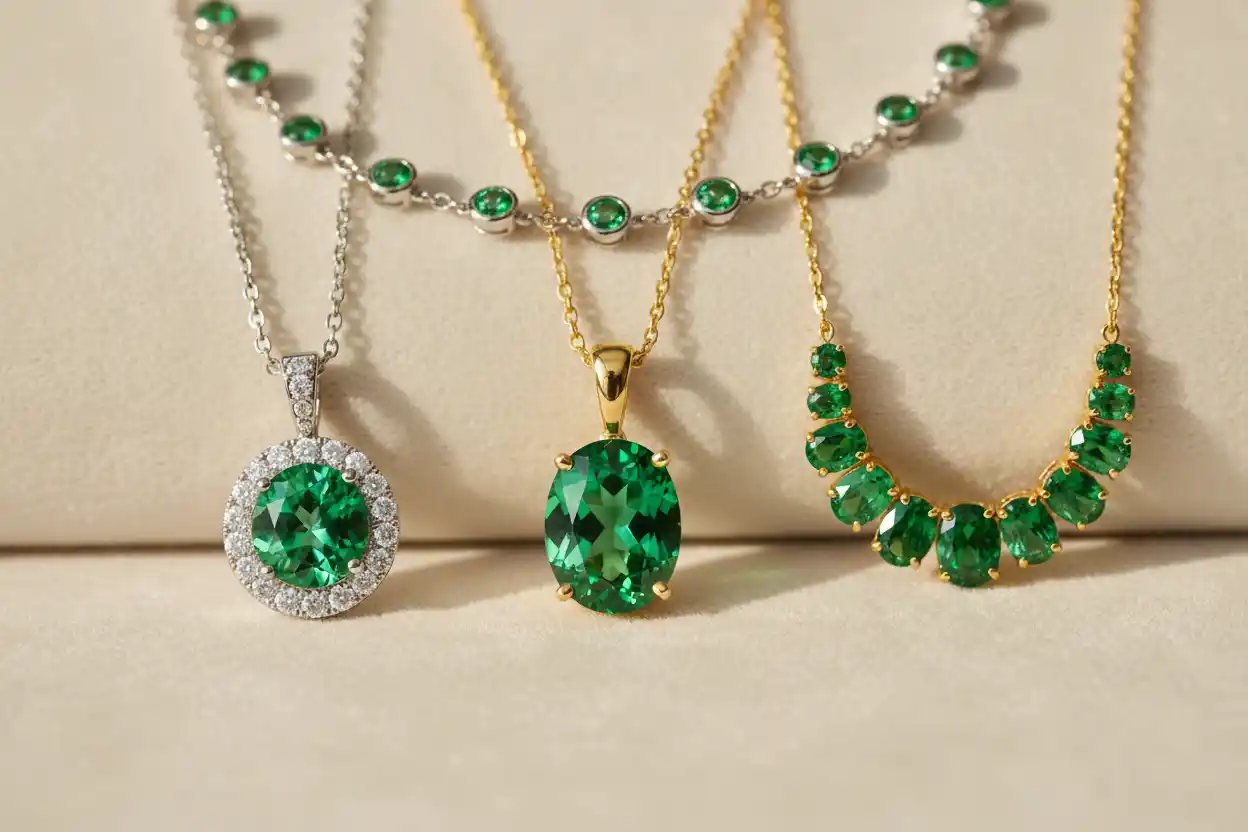
Tsavorite Necklaces and Pendants Guide
Tsavorite necklaces place vivid green Grossular Garnet in one of its safest and most visually effective settings. A pendant can display a larger gemstone than a typical earring, while station and graduated necklaces can build an uninterrupted line of natural green color.
The necklace position reduces impact compared with rings and bracelets, yet construction remains essential. A valuable Tsavorite pendant depends on a secure setting, a bail proportionate to the total weight, a chain strong enough to support it and a clasp that will not release unexpectedly.
Color, cutting and clarity determine the gemstone’s visual quality. Chain length, balance and setting profile determine whether that quality remains visible during wear.
Tsavorite Necklaces at a Glance
| Feature | What to Consider |
|---|---|
| Gem variety | Green Grossular Garnet |
| Common colors | Yellowish green, vivid green and bluish green |
| Main color agents | Primarily vanadium, sometimes chromium |
| Mohs hardness | Approximately 7–7.5 |
| Toughness | Fair to good |
| Cleavage | None |
| Popular necklace styles | Solitaire, halo, station, graduated line and lariat |
| Best protective setting | Full or partial bezel |
| Main structural concern | Bail, chain and clasp strength |
| Treatment expectation | Usually untreated; rare fracture filling |
| Safest cleaning | Warm water, mild soap and a soft brush |
| Birthstone association | Garnet family for January |
What Is a Tsavorite Necklace?
A Tsavorite necklace may contain one faceted green center stone, several stations or a complete suite of matched gems.
Tsavorite is transparent green Grossular Garnet. The completed Grossular Garnet guide explains the parent species, while the completed Tsavorite meaning guide covers the green variety’s geology and symbolism.
Most Tsavorite necklace designs emphasize transparency and brilliance. Cabochons are less common than faceted stones because fine material generally benefits from light-returning cuts.
The necklace format is particularly effective for unusually large or valuable stones that deserve protection from hand-level impact.
Why Tsavorite Works Well in Necklaces
Tsavorite has useful hardness, no cleavage and fair-to-good toughness.
A pendant rests against the chest rather than striking desks repeatedly. Consequently, it can accommodate a larger stone or a more open setting than an everyday ring.
Movement also helps the facets catch changing light. A well-balanced pendant can remain lively without turning sideways.
Long necklaces face greater risk because the stone can swing against counters and sinks. Short and medium lengths generally provide stronger protection.
Solitaire Tsavorite Pendants
A solitaire pendant places one Tsavorite at the center of the design.
Round, oval and cushion cuts provide strong brilliance. Pear cuts create a natural downward point, while emerald cuts emphasize clean lines and broad flashes.
The gemstone should remain attractive in its normal hanging position. A pendant that only looks bright when tilted may appear dark during wear.
The setting should remain proportionate to the gem. A large center suspended from a very fine chain creates a structural weak point.
A low gallery helps the pendant lie flat and reduces snagging.
Bezel-Set Tsavorite Pendants
A bezel surrounds all or part of the girdle with metal.
This design protects the edges and creates a smooth profile. It is especially useful for valuable gems with minor inclusions or unusual shapes.
A full bezel offers maximum protection. A partial bezel reveals more of the stone while leaving selected areas open.
The jeweler should close the metal evenly without pressing over a fracture.
Yellow gold can intensify the warmth of yellowish-green Tsavorite, whereas white metal produces a crisp border around vivid or slightly bluish green.
Prong-Set Tsavorite Pendants
Prongs expose more of the gemstone and reduce the amount of visible metal.
Four-prong settings create an open appearance. Six prongs provide additional retention for large rounds and ovals.
Pear and marquise cuts need V-shaped protection at the point.
Each prong should remain substantial and evenly positioned. Thin claws may catch on clothing and can loosen over time.
Because the pendant moves, the bail and basket should be inspected together. A secure stone in a weak hanging mechanism is not a safe necklace.
Halo Tsavorite Pendants
A halo surrounds the Tsavorite with smaller accent stones.
Diamond and white Sapphire create strong contrast but are harder than Garnet. Their girdles must remain separated from the center.
A halo can increase the complete visible outline of a smaller Tsavorite and may provide partial edge protection.
Compact single halos are generally lighter and easier to clean than tall double surrounds.
The center stone should remain the main visual focus. An oversized halo may overwhelm subtle differences in Tsavorite color and cutting.
Tsavorite Station Necklaces
Station necklaces place several individually set Tsavorites along a chain.
This format gives each gemstone visual space and requires fewer stones than a complete line necklace.
Bezel-set stations protect the girdles and help keep the stones facing forward.
Every setting should balance properly. A station that flips continually reveals its back and may appear darker against the skin.
The chain connections need enough strength to withstand repeated movement at each solder point.
An adjustable station necklace is a practical gift when the wearer’s preferred length is uncertain.
Graduated Tsavorite Necklaces
A graduated necklace places larger Tsavorites near the center and progressively smaller stones toward the clasp.
Matching many stones in green hue, tone and brilliance is demanding. Fine large Tsavorite is scarce, so the price can rise quickly as the center stones increase in size.
The transition should remain smooth. One dark or yellowish gem can interrupt an otherwise uniform suite.
A graduated necklace must articulate naturally around the neck without forming stiff corners.
The clasp should remain proportionate to the value and weight of the complete piece.
Tsavorite Line Necklaces
A line necklace contains a continuous or nearly continuous row of faceted Tsavorites.
Round stones provide uniform brilliance and are easier to calibrate than unusual shapes.
Individual settings separate the girdles and reduce direct contact. Shared-prong constructions use less visible metal but require especially reliable workmanship.
The necklace should remain flat when worn. Twisting can turn pavilion facets outward and increase snagging.
For a high-value suite, a box clasp with one or more safety mechanisms is preferable to a simple spring ring.
Tsavorite Lariat and Y-Necklaces
Lariats and Y-necklaces create a vertical drop from the neckline.
Pear-shaped Tsavorite works naturally at the lower end, while smaller stations can continue upward along the chain.
Movement increases brilliance but also allows the gem to swing farther from the body.
A slider must hold its position securely. Two drops should not collide repeatedly.
Remove a long Tsavorite lariat before leaning over sinks, counters or work surfaces.
Evaluating Tsavorite Color
Fine Tsavorite shows vivid green without becoming excessively dark.
Slight yellow or blue modifiers occur naturally. Medium tone often provides a strong balance between richness and brightness.
Examine the gemstone under several lights. Dark material may look vivid beneath a concentrated lamp but nearly black indoors.
The color should remain attractive against the wearer’s skin and chosen metal.
The completed Tsavorite buying guide owns the detailed color-quality hierarchy, while the completed Tsavorite price guide explains value.
Evaluating Clarity
Tsavorite can contain crystals, needles, feathers and fluid-related inclusions.
A pendant can safely display somewhat included material because it experiences less impact than a ring. Nevertheless, surface-reaching fractures remain relevant.
Inspect the gemstone from the side and back. Metal may conceal cracks near the girdle.
An inclusion that causes haze across the complete stone reduces brilliance more than one small isolated crystal.
Fracture filling is rare but possible. Filled material needs disclosure and more conservative care.
Evaluating Cut
A well-cut Tsavorite should return light across the complete face.
Rounds produce strong brilliance. Ovals and cushions can preserve rough while presenting an attractive size.
A shallow stone may have a transparent window. Excessive depth retains weight but reduces visible dimensions.
Facet junctions should remain crisp and the girdle should be free from chips.
The cut must also suit the pendant’s orientation. An asymmetrical or poorly balanced gem may make the piece hang at an angle.
Carat Weight and Visible Size
Carat weight measures mass rather than the outline seen from the front.
Tsavorite becomes increasingly scarce in larger sizes, so a small increase in dimensions can have a substantial effect on price.
Compare length, width and depth in millimeters.
A deep stone may weigh more without looking larger. It may also make the pendant heavier and require a more substantial chain.
A bright, well-proportioned gem can provide greater visual impact than a heavier stone with windowing or darkness.
Bail Construction
The bail carries the full pendant and setting weight.
A fixed bail controls orientation but limits the range of compatible chains. A hinged bail allows movement and can help the pendant settle flat.
Hidden bails create a seamless appearance, although they may be harder to inspect.
An enhancer bail can attach the pendant to pearls or thicker chains, provided its hinge and lock remain strong.
The chain should pass through easily without binding. A narrow bail rubbing against a thick chain will wear both components.
Chain Strength
Cable chains provide a versatile foundation for small and medium pendants.
Box and wheat chains offer more structural substance for large Tsavorites and heavy halos.
Snake chains create a smooth appearance but can kink when stored incorrectly.
Rope chains add texture, which may compete with a complex center setting.
The chain should support the total pendant weight with a reasonable safety margin.
Confirm whether the advertised necklace includes the chain before comparing prices.
Clasp Security
Lobster clasps suit many solitaire and station necklaces.
Heavy line and graduated suites benefit from box clasps with secondary safety catches.
Magnetic clasps are convenient but may release unexpectedly, making them unsuitable for many valuable Tsavorite designs.
Connecting rings should be soldered or sufficiently substantial.
The clasp should engage clearly and should not contain sharp edges that catch clothing or hair.
Choosing the Metal
Yellow gold adds warmth and creates a traditional green-and-gold combination.
White gold and platinum produce a cooler outline that can make vivid green appear especially crisp.
Rose gold provides an unconventional contrast but may emphasize yellow modifiers in some stones.
Sterling silver is possible for smaller commercial gems, although its settings and clasp must remain strong enough for the stone’s value.
Metal sensitivity, maintenance and chain strength should guide the choice alongside appearance.
Tsavorite Versus Emerald Necklaces
Tsavorite and Emerald can create similar green necklace styles, but their gemological properties differ.
Tsavorite is Grossular Garnet with no cleavage and few routine treatment concerns. Emerald is green Beryl and is commonly fractured and clarity enhanced.
The planned Tsavorite versus Emerald guide owns the direct comparison.
The completed Emerald necklace guide explains Emerald-specific pendant and bead-strand decisions.
A Tsavorite pendant may appear more brilliant, while Emerald may offer a deeper garden-like visual character.
Tsavorite Versus Demantoid Necklaces
Demantoid is green Andradite Garnet.
It may display stronger dispersion than Tsavorite, creating small spectral flashes. Tsavorite is generally harder and can show a cleaner vivid-green appearance.
The completed Demantoid Garnet necklace guide owns that variety’s construction and buying intent.
A necklace should be identified through gemological testing rather than green color alone.
Tsavorite Within Garnet Jewelry
The planned Garnet necklace guide covers broad family styles, including red, orange and green varieties.
The completed real-versus-fake Garnet guide explains common substitutes.
The planned Garnet quality and grading guide will address nonstandard seller grades.
Tsavorite’s dedicated page remains focused on green Grossular and the chain, bail and setting decisions that matter specifically in necklaces.
January Birthstone Necklaces
Garnet is January’s modern birthstone family.
The completed January birthstone guide explains Garnet’s wide color range.
A Tsavorite pendant provides a green alternative to conventional red Garnet and avoids ring or wrist sizing.
The completed January birthstone jewelry guide compares necklaces with earrings, rings and bracelets.
An adjustable chain makes a birthstone gift easier to fit.
Green Gemstone Context
Tsavorite appears in the completed green gemstones guide alongside Emerald, Peridot, Jade and green Tourmaline.
Its advantages include vivid natural color, useful durability and limited routine enhancement.
The planned green engagement-ring stones guide focuses on hand jewelry rather than necklaces.
Color directories provide comparison context but should not replace Tsavorite-specific evaluation.
Comparing Other Tsavorite Jewelry
A completed Tsavorite bracelet guide creates repeated green color but experiences desk contact.
Tsavorite earrings offer low-impact wear and require close pair matching.
A Tsavorite ring gives the wearer maximum visibility but needs stronger protection.
Necklaces are generally the best format for unusually large, valuable or visibly included Tsavorite.
Buying Priorities
Begin with the gemstone’s face-up green color.
Next, evaluate clarity and cutting, paying particular attention to windowing, darkness and surface-reaching fractures.
Inspect the setting and bail as one structure. A fine gemstone suspended from a weak attachment remains a poor purchase.
Confirm the chain material, length, weight capacity and clasp type.
The necklace should hang flat and present its strongest color without constant adjustment.
Cleaning Tsavorite Necklaces
Use warm water, mild soap and a soft brush.
Support the necklace over a bowl or closed drain. Work gently around the bail, gallery and clasp.
Rinse briefly and dry thoroughly.
Steam cleaning is not recommended. Ultrasonic cleaning should be avoided when the stone contains fractures or has been fracture filled.
The completed guide to cleaning Tsavorite jewelry provides the full method.
Storage
Fasten the clasp before storage.
Lay long chains flat or hang them from an appropriate organizer. Prevent heavy pendants from swinging inside travel cases.
Keep Tsavorite away from Diamond, Sapphire and Topaz, which can scratch it.
Tsavorite can scratch softer gemstones, so mixed jewelry should not share one loose pouch.
Use a padded compartment that supports the pendant without straining the chain.
Final Perspective
A Tsavorite necklace combines one of Garnet’s most vivid colors with a position that protects the gem from much of the impact experienced by hand jewelry. The format can support anything from a small birthstone station to a rare large solitaire.
The gemstone’s beauty still depends on face-up brightness, while the necklace’s longevity depends on its bail, chain and clasp. A well-proportioned system will provide more lasting value than a larger stone suspended from weak or poorly balanced findings.
Frequently Asked Questions
1. Is Tsavorite suitable for necklaces?
Yes. Its hardness, lack of cleavage and protected necklace position make it well suited to pendants and station designs.
2. Which pendant setting protects Tsavorite best?
A low full or partial bezel provides strong edge protection. Substantial prongs can also work.
3. What color should a fine Tsavorite pendant show?
Vivid medium-tone green to slightly bluish green is highly prized, although bright yellowish-green stones can also be attractive.
4. Are large Tsavorite pendants rare?
Fine large Tsavorite is substantially less common than small calibrated stones, particularly when color and clarity remain strong.
5. Is Tsavorite usually treated?
Routine treatment is uncommon. Rare fracture filling may occur and should be disclosed.
6. Is Tsavorite more practical than Emerald in a necklace?
Tsavorite generally has no cleavage and fewer clarity-enhancement concerns, although both gems can work well in protected necklaces.
7. Which chain is best for a large Tsavorite pendant?
A correctly proportioned cable, box or wheat chain can work. The bail and clasp must also support the complete weight.
8. Does a Tsavorite necklace need a laboratory report?
Routine small pendants may not. Reports become more useful for large, valuable or unusually represented stones.
9. Can Tsavorite be used in a tennis necklace?
Yes. Matching many stones is difficult and expensive, but the gem’s durability is suitable when settings and articulation are strong.
10. Can Tsavorite necklaces be layered?
Yes, provided the lengths keep the gemstone away from harder pendants and rough metal edges.
11. Can Tsavorite be cleaned ultrasonically?
Warm soapy water is safer. Avoid ultrasonic cleaning when fractures or filling are present.
12. How should a Tsavorite necklace be stored?
Fasten the clasp and place the necklace in a padded compartment away from harder gemstones and heavy jewelry.