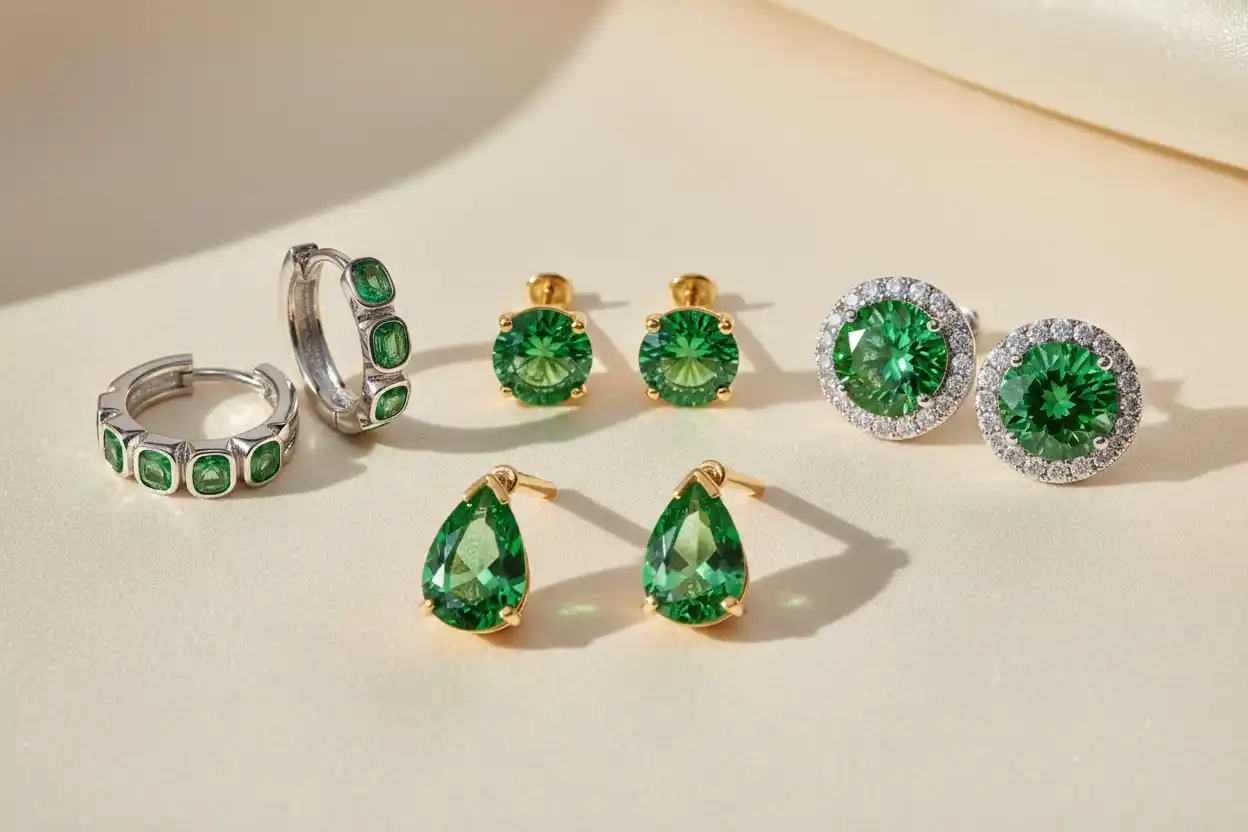
Tsavorite Earrings: A Style Guide
Tsavorite earrings place one of Garnet’s brightest green varieties in a relatively protected jewelry position. Fine stones can show lively yellowish green, pure green or slightly bluish-green color without the routine clarity enhancement associated with many Emeralds.
Earrings also remove most ring-sizing and bracelet-fit concerns, making them practical gifts. Nevertheless, an attractive pair depends on more than choosing two green stones of similar carat weight. Hue, tone, saturation, visible dimensions, brilliance, inclusion placement, cutting and setting height all affect whether the earrings look balanced around the face.
Tsavorite Earrings at a Glance
| Feature | What to Consider |
|---|---|
| Gem variety | Green Grossular Garnet |
| Typical color range | Yellowish green to slightly bluish green |
| Main color agents | Primarily vanadium, sometimes with chromium |
| Mohs hardness | Approximately 7–7.5 |
| Toughness | Fair to good |
| Cleavage | None |
| Common earring styles | Studs, halos, drops, hoops and clusters |
| Best everyday setting | Low bezel or compact prong basket |
| Main pair-matching factor | Face-up color and visible size |
| Treatment expectation | Usually untreated; fracture filling is rare |
| Safest cleaning | Warm water, mild soap and a soft brush |
| Birthstone connection | Garnet family for January |
What Are Tsavorite Earrings?
Tsavorite earrings contain transparent green Grossular Garnet.
Grossular is one of the principal Garnet species. The completed Grossular Garnet guide explains the parent mineral, while the completed Tsavorite meaning guide owns the variety’s geology, locality and symbolism.
Fine Tsavorite can display intense green color in small stones, which makes it effective in studs, halos and delicate drops. Larger clean gems are less common, so a well-matched pair can require substantial sorting.
Tsavorite should not be confused with Demantoid, Emerald, green Tourmaline or glass merely because the materials occupy overlapping green shades.
Why Tsavorite Works Well in Earrings
Tsavorite ranks toward the harder end of the Garnet family and has no cleavage.
These properties support frequent earring wear when the stones remain structurally sound. Earrings also avoid the repeated impact that rings and bracelets experience against desks, sinks and equipment.
The gem’s brilliance benefits from movement near the face. Even compact stones can appear lively when the cut returns light evenly.
Unlike some green gems, Tsavorite is not routinely oiled or color treated. The appearance buyers see is commonly associated directly with the natural material and its cut.
Tsavorite Stud Earrings
Studs provide the simplest and most adaptable style.
Round brilliant Tsavorites offer balanced sparkle and are relatively straightforward to match. Ovals look larger for their width, while cushions create a softer geometric outline.
A compact basket should hold the stone close to the earlobe. Tall settings may tilt forward, particularly when the center is large or the metal is heavy.
Four-prong settings reveal more of the gemstone. Six-prong settings provide additional retention for larger rounds and ovals.
A low bezel creates a smooth outline and protects the complete girdle, making it especially suitable for frequent wear.
Bezel-Set Tsavorite Earrings
A bezel surrounds all or part of the stone with metal.
The border protects the girdle from impact and reduces snagging on hair, scarves and clothing.
Full bezels provide the strongest protection. Partial bezels expose more of the gemstone while leaving selected areas less guarded.
The metal should follow the stone evenly. Gaps can allow movement, whereas excessive pressure can damage a gem containing a surface-reaching fracture.
Yellow gold creates a warm contrast with vivid green. White gold and platinum produce a cooler, more defined outline.
Prong-Set Tsavorite Earrings
Prong settings reveal more of the gemstone and allow easier access during cleaning.
Each prong should remain evenly positioned and should not rest over a visible fracture.
Round and oval stones commonly use four or six prongs. Pears and marquises require protective V-shaped prongs at their points.
The two baskets should match in height and angle. Even a small difference can cause one earring to sit flatter than the other.
Prongs should be checked periodically because a loose claw can release the stone before the gem itself shows visible damage.
Tsavorite Halo Earrings
A halo surrounds Tsavorite with smaller colorless or contrasting stones.
Diamond and white Sapphire are common accents because they create strong contrast around the green center. However, both are harder than Tsavorite and must not contact it directly.
A compact halo can increase the visible outline of smaller Tsavorites and may partially shield their edges.
The pair should match in complete diameter, center height and halo spacing.
Double halos create more visual scale but add weight and many small prongs. A low single halo is generally easier to maintain and more comfortable for prolonged wear.
Tsavorite Drop Earrings
Drop earrings suspend the gemstones below the earlobe.
Pear, oval and cushion cuts work naturally in a vertical design. A smaller upper stone can connect to a larger lower center for a graduated appearance.
Movement makes the green flashes more visible. It also means that every connecting ring must remain secure.
Soldered or mechanically locked links are preferable for valuable gems. Thin open jump rings can separate when caught in clothing.
Short drops provide movement without excessive tangling. Longer designs are better suited to occasions where hair, collars and scarves will not interfere.
Tsavorite Dangle Earrings
Dangle earrings may combine several Tsavorites or mix them with Diamond, Sapphire or other green gems.
A graduated arrangement should move smoothly in visible size. One dark or poorly cut stone can interrupt the complete design.
The components should remain separated enough that harder accent gems do not strike the Tsavorite repeatedly.
Total weight deserves attention. Several Tsavorites, metal galleries and accent stones can become uncomfortable even when each component looks delicate.
The backs and connecting elements should remain smooth against the neck.
Tsavorite Hoop Earrings
Tsavorite may be set along the front of a hoop or suspended as removable charms.
Front-facing stones provide the best visibility without adding gems around the entire circumference. Inside-out hoops create more sparkle but also increase setting count and weight.
Hinged hoops should close with a clear, secure click. The posts need accurate alignment with the receiving mechanism.
Removable Tsavorite charms should have loops that cannot slip over the open post.
The gemstones should remain separated from direct contact with each other as the hoop moves.
Tsavorite Cluster Earrings
Clusters arrange multiple small Tsavorites into floral, geometric or organic patterns.
This format can create substantial green coverage without requiring two large matched center stones.
Each gem should remain lively. A heavily windowed, pale or nearly black stone will stand out among brighter neighbors.
The metal structure beneath the cluster needs enough strength to support all settings. It should also allow cleaning around the pavilion areas.
Clusters often look larger than their total center-stone weight suggests, which can offer useful visual value when workmanship remains strong.
Matching Tsavorite Pairs
Pair matching should begin with face-up appearance rather than carat weight.
Two stones can weigh the same yet differ in length, width and brightness because one has been cut more deeply.
Hue should also coordinate. A yellowish-green Tsavorite may look mismatched beside a cooler bluish-green gem.
Tone determines how light or dark the pair appears. One medium-toned stone and one dark gem can create obvious imbalance.
Saturation and brilliance should remain compatible. The pair does not need to be mechanically identical, but neither stone should dominate the other.
Evaluating Color
Fine Tsavorite usually shows vivid green with enough tone to appear rich but not so much that the gem becomes dark.
Slight yellow or blue modifiers are natural. Personal preference matters, although intensely saturated medium-tone green generally attracts strong market interest.
Examine the earrings in daylight-equivalent light, ordinary indoor lighting and warmer evening light.
Retail spotlights can make dark stones appear more brilliant than they will during routine wear.
The completed Tsavorite buying guide explains color quality in greater depth, while the completed Tsavorite price guide owns current value factors.
Evaluating Clarity
Tsavorite can contain crystals, feathers, needles and fluid-related inclusions.
A small internal inclusion may have little effect on beauty or durability. Surface-reaching fractures around prongs or girdles require more caution.
Both stones should show comparable clarity. One clean gem paired with one heavily fractured stone can look unbalanced and may wear differently.
A pair represented as fine quality should remain transparent and lively rather than hazy.
Rare fracture filling can reduce the visibility of cracks. Any detectable filling should be disclosed.
Evaluating Cut
A well-cut Tsavorite returns light evenly across the face.
Rounds produce strong brilliance. Ovals and cushions preserve rough efficiently, while pears suit drops.
A shallow stone may show a transparent window through its center. Excessive depth can reduce visible size and create dark areas.
Facet junctions should remain crisp and edges should be free from chips.
Compare the pair from the front and side. Similar face-up outlines can conceal substantial depth differences that affect weight and setting height.
Evaluating Carat Weight
Carat weight measures mass rather than visible size.
Fine Tsavorite becomes increasingly scarce in larger sizes, and assembling two matching gems adds another layer of difficulty.
A smaller vivid pair can be more attractive and valuable than larger stones with weak color or poor cutting.
Dimensions in millimeters provide a more practical comparison than total carat weight alone.
When purchasing halo earrings, consider the center-stone size separately from the complete earring diameter.
Tsavorite Versus Emerald Earrings
Tsavorite and Emerald occupy overlapping green ranges but belong to different mineral families.
Tsavorite is Grossular Garnet, while Emerald is green Beryl. Tsavorite generally has no cleavage, fair-to-good toughness and fewer routine treatment concerns.
Emerald commonly contains fractures and is often clarity enhanced with oil or resin.
The planned Tsavorite versus Emerald guide will own the direct identification comparison. The completed Emerald earrings guide covers Emerald-specific setting and care decisions.
Neither gem is automatically better. Tsavorite offers brighter untreated green and practical durability, while Emerald provides a different color character, history and market identity.
Tsavorite Versus Demantoid Earrings
Tsavorite is green Grossular Garnet, whereas Demantoid is green Andradite Garnet.
Demantoid can display stronger dispersion, sometimes producing visible flashes of spectral color. Tsavorite is generally harder and may show a purer saturated green.
The completed Demantoid Garnet earrings guide owns that variety’s pair-matching and setting decisions.
A horsetail-like inclusion relates to some Demantoids rather than Tsavorite.
Color alone is not enough to distinguish the two reliably.
Tsavorite and the Garnet Family
The broader planned Garnet earrings guide covers red, orange, green and other Garnet varieties together.
The planned Garnet quality and grading guide will explain why seller-created AAA, AA and A labels are not standardized gemological grades.
The completed real-versus-fake Garnet guide covers common imitations and laboratory identification.
Tsavorite’s dedicated page remains narrower: vivid green Grossular, its earring suitability and the challenges involved in matching a pair.
Choosing the Metal
Yellow gold produces a warm contrast and can complement yellowish-green Tsavorite.
White gold and platinum make vivid or slightly bluish green appear crisp and modern.
Rose gold creates an unconventional contrast, although it may make some yellow-green stones appear warmer.
Sterling silver can be appropriate for small commercial stones, provided the prongs, posts and backs remain strong.
Metal sensitivity matters because posts pass through pierced skin. Ask about alloy composition when nickel sensitivity is known.
Choosing Earring Size
Small studs offer practical daily color and minimal weight.
Medium stones make Tsavorite’s saturation and brilliance more visible.
Large matched gems are scarce and can become expensive. They may also require broad backs to prevent forward tipping.
A halo can increase the complete visible size without requiring two unusually large centers.
Compare the earring’s total diameter and weight, not only the center-stone carats.
Earring Backings
Friction backs work for small and medium studs when they grip securely.
Broad disc backs help stabilize larger centers and halos.
Screw backs provide additional retention but take longer to fasten. Threaded posts may feel uncomfortable to some wearers.
Locking backs combine security with a supportive surface.
Lever backs suit drops and dangles. Open hooks should use small silicone stoppers where loss is a concern.
The backing should remain proportionate to the earring’s complete weight and value.
January Birthstone Earrings
Tsavorite belongs to the Garnet family, January’s traditional modern birthstone.
The completed January birthstone guide explains why Garnet includes far more than familiar red varieties.
Green Tsavorite earrings provide a less expected January option and avoid the need for ring or bracelet sizing.
The completed January birthstone jewelry guide compares earrings with necklaces, rings and bracelets.
A birthstone label does not replace gemological identification or quality assessment.
Styling Tsavorite Earrings
Vivid Tsavorite works well with black, navy, cream, white and earth-toned clothing.
Yellow gold creates a warmer appearance, while white metal gives the green a cooler frame.
Studs suit professional and daily wear. Drops and halos create stronger formal statements.
When combining Tsavorite with other jewelry, avoid placing the earrings beside competing green stones that differ only slightly in hue unless the contrast is intentional.
A simple Diamond accent often allows the green center to remain dominant.
Comparing Other Tsavorite Jewelry
A completed Tsavorite bracelet guide creates repeated green color but encounters more impact.
A Tsavorite necklace can display a larger single gem with similarly low abrasion risk.
A Tsavorite ring places the stone in the most visible position while demanding stronger protection.
Earrings provide one of the strongest combinations of color visibility, physical safety and gift flexibility.
Cleaning Tsavorite Earrings
Use warm water, mild soap and a soft brush.
Work gently behind the settings and around the posts, where cosmetics and skin oils collect.
Rinse briefly and dry with a lint-free cloth.
Steam cleaning is not recommended. Ultrasonic cleaning may be suitable for some sound Garnets, but it should be avoided when fractures or filling are present.
The completed guide to cleaning Tsavorite jewelry provides the detailed process.
Storage
Store each earring separately with its backing.
Diamond, Sapphire and Topaz can scratch Tsavorite. Tsavorite can also scratch softer gemstones.
Long drops should remain flat or suspended individually to avoid tangling.
Do not allow the pair to strike each other inside a travel case.
Tsavorite appears in the completed green gemstones guide and the planned green engagement-ring stones guide, where it can be compared with other green jewelry materials.
Final Perspective
Tsavorite earrings succeed when the two stones look balanced under ordinary lighting rather than merely matching on an invoice. Face-up hue, tone, saturation, dimensions and brightness deserve more attention than identical carat weights.
Once the pair is visually convincing, inspect the settings and backs. Secure low mountings and proportionate support will preserve fine green Tsavorite more effectively than oversized stones placed in weak or excessively tall baskets.
Frequently Asked Questions
1. Is Tsavorite suitable for earrings?
Yes. Its useful hardness, lack of cleavage and protected earring position make it suitable for regular wear.
2. Why are matched Tsavorite earrings expensive?
Fine large Tsavorite is scarce, and finding two stones with coordinated color, size, clarity and cut requires extensive sorting.
3. What is the best color for Tsavorite earrings?
Vivid medium-tone green to slightly bluish green is highly prized, although attractive yellowish-green stones can also look beautiful.
4. Are inclusions acceptable in Tsavorite?
Small internal inclusions can be acceptable. Surface-reaching fractures near prongs and girdles require more caution.
5. Is Tsavorite usually treated?
Routine color treatment is uncommon. Rare fracture filling may occur and should be disclosed.
6. Which setting protects Tsavorite earrings best?
A low full or partial bezel provides strong edge protection. Substantial prongs can also work.
7. Is Tsavorite more durable than Emerald?
Tsavorite generally has no cleavage and fewer clarity-enhancement concerns, making it practical for many earring styles.
8. Is Tsavorite the same as Demantoid?
No. Tsavorite is green Grossular Garnet, while Demantoid is green Andradite Garnet.
9. Which metal looks best with Tsavorite?
Yellow gold provides warm contrast, while white gold and platinum create a crisp cool frame.
10. Do Tsavorite earrings need laboratory reports?
Routine small pairs may not. Reports become more useful for large, valuable or unusually represented stones.
11. Can Tsavorite earrings be cleaned ultrasonically?
Warm soapy water is safer. Avoid ultrasonic cleaning when fractures or filling may be present.
12. How should Tsavorite earrings be stored?
Keep each earring separately with its backing, away from harder gemstones and heavy jewelry.