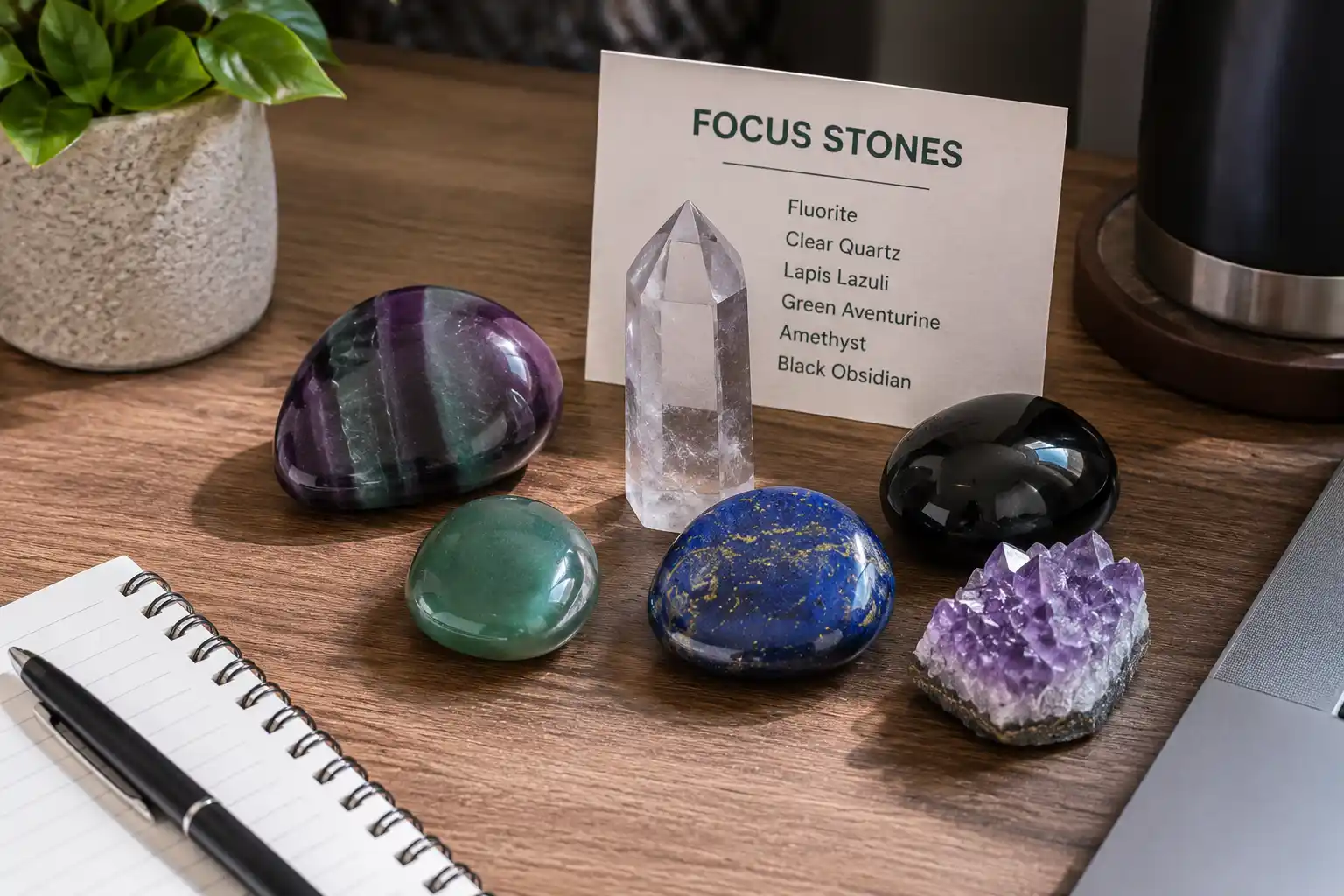
Best Crystals for Focus and Concentration
Crystals for focus are traditionally used as visual or tactile reminders to return attention to a chosen task. They are not scientifically established cognitive enhancers, but they can become part of a structured concentration routine involving clear goals, reduced distractions and regular breaks.
Purple fluorite and sodalite suit information-heavy work, clear quartz represents one defined priority, tiger’s eye complements decisions and smoky quartz provides a grounding cue when attention becomes scattered.
Best Crystals for Focus at a Glance
| Crystal | Traditional focus theme | Best task type | Practical cue |
|---|---|---|---|
| Purple fluorite | Mental organization and complex thinking | Studying and conceptual work | Sort information into categories |
| Green fluorite | Order, renewal and process clarity | Planning and administrative work | Simplify the workflow |
| Sodalite | Logic and coherent thought | Analysis, writing and meetings | Separate facts from assumptions |
| Clear quartz | Intention and prioritization | Any single high-priority task | Define the finish line |
| Tiger’s eye | Discernment and sustained confidence | Decisions and problem-solving | Continue without rushing |
| Smoky quartz | Grounding and perspective | Distracting or pressured environments | Return to the present task |
| Lapis lazuli | Thoughtful expression and understanding | Reading, research and writing | Identify the central argument |
| Blue tiger’s eye | Calm alertness and observation | Detailed review and preparation | Slow down enough to notice |
| Chevron amethyst | Reflection and mental settling | Quiet study and review | Reduce unnecessary mental input |
| Red jasper | Endurance and steady effort | Repetitive or physically grounded tasks | Maintain a sustainable pace |
Focus, Concentration and Mental Clarity
Focus, concentration and clarity overlap, but they are not identical.
Mental clarity involves understanding what matters and seeing a problem more coherently. Focus involves selecting a target for attention, while concentration describes maintaining or repeatedly returning attention to that target.
A person may understand a task clearly yet still struggle to begin. Conversely, someone may concentrate intensely on work that is not currently important.
The completed guide to crystals for mental clarity owns the broader clarity intent. This article concentrates on structuring attention during study, work and other defined tasks.
Purple Fluorite for Studying Complex Material
Purple fluorite is traditionally associated with mental organization, discernment and the integration of complex ideas. Its cubic crystal habit also provides a visual metaphor for orderly structure.
Use purple fluorite when studying material that contains several interconnected concepts. Before beginning, divide the topic into sections, define what must be understood and choose one question for the work period.
During review, explain the concept without looking at the source. Any gap that appears becomes the next specific study target.
Fluorite does not improve comprehension automatically. Its purpose is to reinforce an active learning method rather than passive rereading.
Green Fluorite for Organized Workflows
Green fluorite is associated with organization, renewal and the removal of unnecessary mental or environmental clutter. It suits planning, scheduling and administrative work.
Place the stone near the document or system being organized. Then identify the actual source of friction: unclear ownership, scattered information, too many process steps or an unrealistic volume of work.
Rearranging stationery or collecting new productivity tools may feel organized without improving the process. Green fluorite can symbolize simplification rather than cosmetic tidiness.
Because fluorite is relatively soft and has perfect cleavage, keep it away from desk edges, keys and heavy objects.
Sodalite for Logical Concentration
Sodalite is traditionally linked with logic, truth and coherent communication. It may be especially useful for analytical writing, research, technical planning or meetings that require careful reasoning.
Begin by stating the question in one sentence. Next, separate known facts, interpretations and assumptions. This structure reduces the chance that attention will be consumed by arguments that do not answer the central question.
Sodalite also suits tasks that end in communication. However, the completed guide to crystals for communication explores speaking and expression more fully; here, sodalite supports the reasoning that comes before the message.
Clear Quartz for a Single Priority
Clear quartz is commonly described as an intention-setting or amplifying crystal. For concentration, its transparent appearance can represent a clearly defined target.
Write the task beside the stone using a finishable verb: draft the introduction, reconcile the invoice list, review twenty pages or answer the five highest-priority messages.
Avoid instructions such as “work on the project,” which leave the stopping point unclear. Attention is easier to sustain when the brain can recognize completion.
If several tasks appear urgent, choose the one whose delay creates the greatest meaningful consequence. Clear quartz then becomes a reminder not to renegotiate the priority every few minutes.
Tiger’s Eye for Decision Focus
Tiger’s eye is associated with discernment, confidence and practical judgment. It fits tasks in which concentration breaks because the person repeatedly questions each small decision.
Before starting, define which choices can be made quickly and which require deeper review. A reversible formatting decision, for example, does not deserve the same analysis as a financial commitment.
Tiger’s eye can symbolize forward movement without carelessness. Once enough evidence exists for a proportionate decision, choose and continue.
Smoky Quartz for Returning After Distraction
Smoky quartz is traditionally associated with grounding and present-moment awareness. It may help structure a return routine after interruption.
When a distraction appears, write it on a separate capture list rather than acting on it immediately. Touch or look at the stone, restate the current task and resume from the last completed step.
This method acknowledges the distracting thought without allowing it to control the work period. At the end of the session, review the capture list and decide which items require action.
Smoky quartz is particularly suitable when pressure creates frequent task-switching disguised as productivity.
Lapis Lazuli for Reading and Written Analysis
Lapis lazuli has longstanding associations with knowledge, truth and thoughtful expression. Its traditional symbolism suits reading, research and analytical writing.
Before reading a chapter or report, identify what information is needed. After each section, summarize the central claim and supporting evidence in your own words.
For writing, keep lapis near the outline rather than using it as a general decoration. Each paragraph should advance one claim, explanation or example.
Lapis lazuli commonly contains lazurite, calcite and pyrite. Its variable composition makes soaking, acids and harsh cleaners inappropriate.
Blue Tiger’s Eye for Calm Alertness
Blue tiger’s eye is traditionally associated with observation, composure and calm confidence. It may suit tasks that require close checking without excessive tension.
Use it during proofreading, quality assurance, interview preparation or detailed review. Work from a checklist so that attention does not depend on remembering every criterion simultaneously.
Calm alertness differs from passivity. The purpose is to notice errors and inconsistencies without rushing because the task feels uncomfortable or repetitive.
Chevron Amethyst for Quiet Review
Chevron amethyst combines purple amethyst with white quartz banding. In crystal traditions, it is associated with reflection, intuition and mental calm.
It may suit quiet study sessions, end-of-day review or work that requires stepping back from immediate details. Before beginning, reduce avoidable sensory input by closing unused tabs, silencing nonessential notifications and clearing unrelated materials.
Chevron amethyst cannot sedate the mind or medically reduce hyperactivity. Its value lies in marking a deliberate low-distraction environment.
Red Jasper for Steady Effort
Red jasper is traditionally associated with endurance, stability and practical action. It works well for tasks that are important but not intellectually exciting.
Administrative cleanup, data entry, revision and routine maintenance often require persistence rather than inspiration. Red jasper can symbolize maintaining a sustainable pace until a clearly defined stopping point.
Pair it with shorter work intervals when fatigue is high. Consistency usually produces better accuracy than forcing one prolonged session after concentration has declined.
Choosing a Crystal by Task Type
| Task | Best starting crystal | Supporting method |
|---|---|---|
| Studying complex concepts | Purple fluorite | Active recall and self-testing |
| Organizing projects | Green fluorite | Remove unnecessary process steps |
| Analytical writing | Sodalite | Separate facts from assumptions |
| Completing one priority | Clear quartz | Write a measurable finish line |
| Making decisions | Tiger’s eye | Distinguish reversible and consequential choices |
| Returning after interruption | Smoky quartz | Record the distraction, then resume |
| Reading and research | Lapis lazuli | Summarize each section |
| Proofreading and checking | Blue tiger’s eye | Follow a defined checklist |
| Quiet review | Chevron amethyst | Reduce sensory and digital input |
| Repetitive work | Red jasper | Use sustainable timed intervals |
A Practical Crystal Focus Routine
A focus routine should make the next action obvious before the work period begins.
First, choose one task and write its completion condition. Place one relevant crystal beside the work area, then remove unrelated materials and silence notifications that do not require immediate attention.
Work for a realistic interval based on the task and current capacity. When a distraction appears, record it without switching activities. During the break, move physically, rest the eyes and decide whether the next interval should continue the same task.
At the end, document the exact restart point. This final step reduces the effort required to begin again later.
Crystals for Studying
Purple fluorite, sodalite and lapis lazuli form a useful symbolic study combination. Purple fluorite represents organization, sodalite complements logical understanding and lapis supports summarizing knowledge in language.
However, collecting notes is not the same as learning. Effective study usually requires retrieval practice, spaced review, problem-solving or explaining material without consulting the source.
Place only one or two stones on the desk so that the arrangement does not become another form of distraction.
Crystals for Work and Career Tasks
Clear quartz suits prioritization, tiger’s eye fits decisions and smoky quartz supports returning after interruption. These stones may complement the professional themes covered in the guide to crystals for career and success.
For concentration, define a work product rather than a vague duration. “Complete the client summary” gives attention a clearer target than “be productive for two hours.”
Meetings also require focus. Read the agenda beforehand, record decisions separately from discussion notes and assign an owner to each action.
Crystals for Creative Focus
Creative work needs both idea generation and selection. The completed guide to crystals for creativity addresses inspiration more broadly, while a focus practice deals with developing one idea far enough to evaluate it.
Clear quartz can represent the chosen concept, carnelian may support beginning and smoky quartz can help set aside competing ideas temporarily.
Keep unused ideas in a separate document. Recording them reduces the fear that focusing on one direction will cause every alternative to be lost.
Desk Placement and Environmental Design
Place the crystal within sight but outside the space needed for typing, writing or tools. A stable corner of the desk is safer than balancing a stone on equipment or stacking it above the work area.
The environment should support the intended task. Keep reference material accessible, remove irrelevant objects and use headphones only when they improve rather than fragment attention.
Heavy clusters, sharp points and fragile fluorite specimens require secure placement. No crystal should obstruct ventilation or create a fall hazard.
Wearing a Focus Crystal
A bracelet, pendant or smooth pocket stone may provide a discreet tactile cue to return attention. Nevertheless, jewelry should not interfere with typing, laboratory work, food preparation, machinery or other safety-sensitive activities.
Some people find a pocket stone more useful because touching it can become part of a deliberate return routine. Others may become distracted by repeatedly handling it.
Choose the format that reduces friction rather than the one described as spiritually strongest.
Focus Crystals and ADHD
Attention-deficit/hyperactivity disorder is a recognized neurodevelopmental condition. Crystals cannot diagnose, prevent or treat ADHD, and they should not replace medication, professional assessment, coaching, accommodations or other evidence-based support.
A crystal may still serve as an external cue within a broader system. For example, it can mark the location of a written task, a timer or a distraction-capture page.
The useful support comes from the structure surrounding the object, not from a claimed neurological effect of the mineral.
Memory, Learning and Cognitive Performance
No crystal has been demonstrated to improve memory capacity, intelligence or processing speed. Statements that fluorite, sodalite or quartz directly enhance the brain should therefore be understood as spiritual symbolism rather than established physiology.
A crystal routine may indirectly support learning when it prompts behaviors such as active recall, scheduled review, adequate breaks and reduced distraction.
Sleep, nutrition, health conditions, stress and workload can also affect concentration. Persistent or sudden cognitive difficulty deserves appropriate professional evaluation.
Caring for Focus Crystals
Fluorite is soft and cleaves easily, while lapis lazuli may react poorly to acids, soaking and abrasive cleaning. Quartz and jasper are harder, although fractures, coatings and jewelry settings can still create vulnerabilities.
Use a soft dry cloth for routine dust removal unless material-specific guidance supports another method. The guide to cleansing crystals outlines symbolic options without assuming every stone tolerates water, salt or sunlight.
Keep study stones away from drinks, desk edges and crowded storage containers.
Conclusion
The best crystals for focus provide a consistent cue to choose, sustain and return attention. Purple fluorite suits complex study, sodalite complements reasoning, clear quartz reinforces one priority and tiger’s eye supports decisions. Smoky quartz helps structure a return after distraction, while red jasper represents steady effort through routine work.
Crystals do not create concentration by themselves. Their most grounded role is to support a system built from defined tasks, a workable environment, deliberate breaks and methods appropriate to the kind of learning or work being performed.
Frequently Asked Questions
1. What is the best overall crystal for focus?
Clear quartz is the most adaptable choice because it can represent one clearly defined priority. Purple fluorite may be better for studying, while smoky quartz suits frequent distraction.
2. Is fluorite or sodalite better for concentration?
Fluorite suits organizing complex information, whereas sodalite complements logical reasoning and coherent explanation. The better choice depends on the task.
3. Which crystal is best for studying?
Purple fluorite is a popular study crystal because of its traditional association with mental organization. Pair it with active recall, self-testing and spaced review.
4. Which crystal is best for focus at work?
Clear quartz suits prioritization, tiger’s eye supports decisions and smoky quartz helps structure a return after interruptions. Choose the stone that matches the principal obstacle.
5. Can crystals help with ADHD?
Crystals cannot treat ADHD. They may function as visual or tactile reminders within a broader system that includes professional support, accommodations, timers, written tasks or prescribed treatment.
6. Do crystals improve memory?
No crystal has been scientifically shown to improve memory. A crystal routine may prompt effective study behaviors, but learning depends on practice, review, sleep, health and other factors.
7. Can several focus crystals be used together?
Yes, although two or three are usually sufficient. Give each one a distinct role, such as purple fluorite for study structure and smoky quartz for returning after distraction.
8. Where should a focus crystal be placed?
Place it within sight of the work area but away from the keyboard, drinks and desk edges. It should support the task rather than create clutter.
9. Is it better to wear a focus crystal?
Wearable crystals provide a portable tactile reminder, while desk stones create a location-specific cue. The better option is the one that causes fewer distractions and remains physically safe.
10. How should focus crystals be cleansed?
Use a method appropriate to the mineral. Fluorite and lapis lazuli should not be treated like durable quartz, and unidentified stones should not be soaked.
11. How long should I use a crystal during a focus session?
Use it for the length of a realistic work interval rather than following a fixed spiritual duration. The session should end when the defined task or planned interval is complete.
12. Can crystals increase intelligence or cognitive performance?
No reliable evidence shows that crystals increase intelligence, processing speed or cognitive capacity. They can only serve as optional symbols within practical concentration and learning routines.
Disclaimer: Crystals are not proven treatments for ADHD, memory problems, cognitive impairment or other medical conditions. Seek qualified medical or mental-health guidance for persistent, sudden or disruptive concentration difficulties, and do not stop prescribed treatment based on crystal claims.