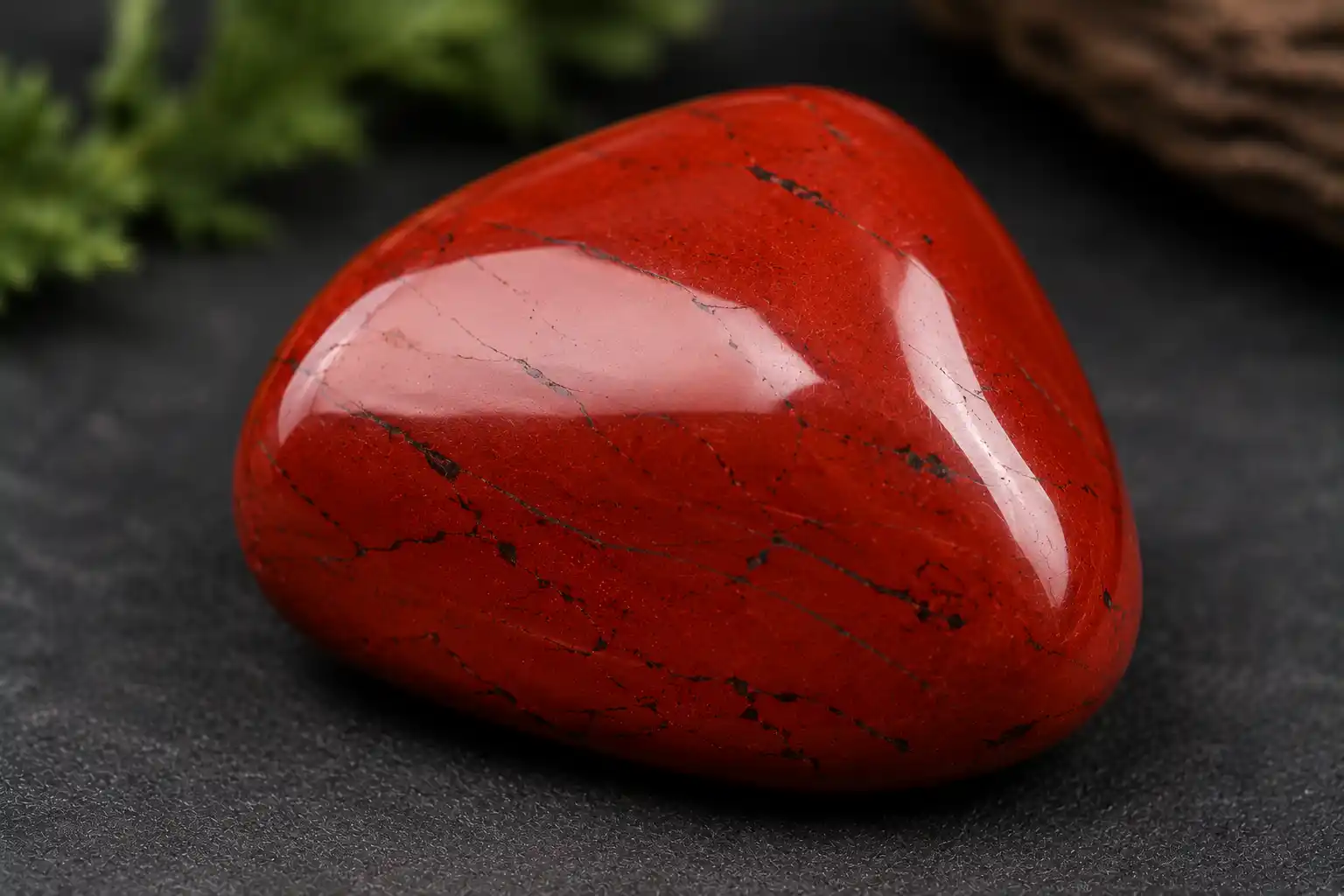
Red Jasper Meaning, Healing Properties, Uses and Care
Red jasper is an opaque, iron-rich variety of jasper known for its brick-red, rust, terracotta and brownish-red colors. It is composed principally of microscopic silica, commonly accompanied by hematite, goethite, clay minerals and other inclusions that create its earthy appearance.
In modern crystal traditions, red jasper is associated with grounding, persistence, courage and practical action. Rather than symbolizing sudden transformation, it is usually chosen as a reminder to work patiently, remain physically present and continue through responsibilities that require endurance.
Those associations are spiritual and symbolic. Red jasper is not a medical treatment, and its color or mineral composition does not prove that it changes circulation, strength, fertility or any other biological process.
Red Jasper at a Glance
| Property | Red jasper |
|---|---|
| Material type | Opaque silica-rich jasper or hematitic chert |
| Main composition | Microcrystalline quartz and chalcedony with iron oxides and other minerals |
| Typical colors | Brick red, rust red, brownish red, orange-red and mottled red |
| Color cause | Fine hematite, goethite and other iron-bearing inclusions |
| Crystal system | Aggregate material; quartz components are trigonal |
| Transparency | Opaque to slightly translucent at thin edges |
| Luster | Dull to waxy when rough; vitreous to waxy when polished |
| Mohs hardness | Commonly about 6.5–7 |
| Cleavage | None in the quartz component |
| Fracture | Conchoidal to uneven |
| Toughness | Generally good, though fractures and mixed minerals can weaken it |
| Common forms | Massive rough, pebbles, tumbled stones, beads, cabochons and carvings |
| Main care concern | Avoid hard impact, harsh chemicals and treatment-damaging heat |
| Traditional themes | Grounding, stamina, courage, discipline and practical confidence |
What Is Red Jasper?
Red jasper belongs to the broad jasper family described in the complete jasper meaning guide.
Jasper is not always one chemically uniform substance. In gemological use, it generally refers to opaque or nearly opaque silica-rich material composed of microcrystalline quartz, chalcedony and varying amounts of other minerals.
The term can include chert-like material, iron-rich sedimentary rock, altered volcanic silica and some metamorphosed silica-rich rocks. As a result, two specimens sold as red jasper may contain different proportions of quartz, hematite, clay, magnetite, carbonate and other phases.
This variability explains differences in hardness, pattern, density and polish. One piece may be uniformly brick red, while another contains yellow, brown, black, white or gray areas.
The complete variety structure belongs in Types of Jasper, while the symbolism attached to different colors appears in Jasper Color Meaning and Symbolism.
Why Is Red Jasper Red?
The red color usually comes from finely distributed iron oxides.
Hematite is especially important. Even microscopic hematite grains can create rich red, burgundy and rust shades when dispersed through silica.
Goethite and hydrated iron oxides may contribute yellow-brown, orange or earthy modifiers. Heating and geological alteration can convert some iron-bearing phases into more strongly red hematite.
Color may be distributed evenly or arranged in bands, spots, veins and brecciated fragments. Dark areas can contain concentrated iron oxide, magnetite or other associated minerals.
A very bright artificial red is not impossible in natural stone, but uniform neon color across a low-cost batch deserves closer inspection for dye or reconstructed material.
How Red Jasper Forms
Red jasper develops through more than one geological pathway.
Some material forms as silica-rich sediment or chemical precipitate associated with iron formations. Fine silica and iron compounds accumulate in layers, later becoming compact chert or jasper through burial and alteration.
Other jasper develops when silica-rich fluids fill fractures and cavities in volcanic rocks. Iron carried by the fluids or introduced during later weathering creates red coloration.
Metamorphism can recrystallize and compress iron-rich silica layers, producing tougher and more strongly patterned material.
Brecciation creates another appearance. Existing red jasper fragments break and are later cemented by silica, hematite, quartz or other minerals. The finished rock contains angular pieces separated by veins.
Because formation varies, the name red jasper describes appearance and broad material character more reliably than one deposit type.
Natural Red Jasper Colors and Patterns
Natural red jasper is rarely limited to one perfect red.
Common shades include:
- Brick red
- Rust red
- Brownish red
- Terracotta
- Orange-red
- Burgundy
- Red mixed with yellow, cream, gray, brown or black
Patterns may be solid, clouded, spotted, banded, brecciated or veined.
Thin white lines can consist of quartz or calcite. Dark metallic-looking areas may contain hematite or magnetite. Yellow and brown sections commonly reflect different iron-oxide states.
A polished piece can look much darker than rough material because polishing increases color saturation and contrast.
Red Jasper and Hematite
Hematite is a major source of red pigment in jasper.
When hematite occurs as extremely fine particles, it colors the silica body red without producing an obvious metallic surface. Coarser hematite can appear as dark gray or black metallic grains and bands.
Some specimens contain enough iron oxide to feel heavier or look more metallic than ordinary red jasper.
However, an iron-rich rock is not automatically jasper. Jaspilite, banded iron formation and hematite-rich quartzite can overlap commercially.
The completed jaspilite guide owns the iron-formation material rather than ordinary lapidary red jasper.
Red Jasper Meaning
The traditional meaning of red jasper centers on endurance grounded in reality.
Its opaque body and earthy red color are interpreted as symbols of physical presence, practical courage and long-term determination.
Unlike stones associated with quick inspiration, red jasper is commonly chosen for work that requires repetition. Its symbolism suits studying, rebuilding routines, completing a demanding project or maintaining boundaries over time.
Historically, red stones have often represented blood, life, protection, strength and survival. Modern crystal traditions continue those themes, although interpretations vary across cultures and practitioners.
The wider red color family appears in Red Crystals and Red Gemstones.
Red Jasper and Grounding
Grounding is the most common modern association attached to red jasper.
In spiritual practice, grounding means returning attention to the body, immediate environment and practical needs. It does not mean that the mineral physically changes gravity or electrical connection with Earth.
A practitioner may hold red jasper while noticing breathing, posture and physical sensations. Another person may keep it near a written schedule as a reminder to handle one task at a time.
Its symbolism is especially compatible with situations where imagination, worry or uncertainty has displaced practical action.
The effect comes from using the object as a focus for attention and intention rather than from a medically established emission.
Red Jasper and the Root Chakra
Red jasper is frequently associated with the root chakra.
In contemporary chakra systems, this energy center represents safety, shelter, resources, stability, belonging and physical presence.
The stone’s deep red and earthy opacity fit that symbolic framework. Practitioners may place it near the base of the body during meditation or carry it while working on financial, domestic or routine-related goals.
The complete stone list and balancing practices remain within Root Chakra Crystals.
Chakra associations are spiritual interpretations, not anatomical or clinical conclusions.
Traditional Healing Properties
Crystal traditions describe red jasper as a stone of stamina, steadiness and embodied confidence.
Emotionally, it is used as a symbolic support during periods that require patience. Rather than encouraging emotional suppression, its grounding meaning can represent staying present while difficult feelings are acknowledged.
Mentally, it is associated with sustained focus. A person may use it as a visual signal to finish a defined task before starting another.
Spiritually, red jasper is often linked with protection and connection to place. Some people include it in practices related to ancestry, land or personal boundaries.
Physical-healing claims involving blood, circulation, reproductive health, pain or detoxification are not scientifically established. Medical symptoms require qualified healthcare rather than gemstone treatment.
Red Jasper for Courage
Red jasper’s courage symbolism is generally practical rather than dramatic.
It can represent making a difficult phone call, attending an appointment, asking for clarification, protecting time or returning to a task after failure.
The stone is therefore well suited to intentions that can be translated into observable behavior.
A useful practice is to pair the stone with one written action. Instead of assigning it the vague intention “be brave,” write the specific step that courage requires.
The object then becomes a reminder of the commitment rather than a substitute for taking it.
Red Jasper for Motivation and Work
Red jasper is often placed on a desk or carried during long projects.
Its traditional association with steady energy fits work that does not provide immediate rewards. Research, training, rehabilitation, saving money and maintaining a household routine all involve repeated effort.
The stone can also symbolize realistic pacing. Endurance does not require constant intensity; it includes rest, planning and returning consistently.
For creative activity that needs more expressive or social symbolism, carnelian may feel more suitable.
The dedicated Carnelian vs Red Jasper comparison explains why translucent orange-red carnelian and opaque earthy jasper create different visual and symbolic impressions.
Red Jasper for Confidence
Confidence associated with red jasper is usually framed as competence developed through preparation.
It is less connected with outward glamour than ruby or sunstone and more connected with knowing what can be handled through experience.
A person might carry it before a practical examination, difficult meeting or unfamiliar journey.
The stone can also represent boundaries. In that context, confidence means communicating a clear limit without unnecessary aggression.
Red jasper does not create confidence automatically. It can support a deliberate routine that includes preparation, self-reflection and action.
Red Jasper for Emotional Balance
Red jasper is traditionally used when emotions feel scattered or overwhelming.
Its dense opaque appearance symbolizes containment and steadiness. Practitioners may hold it while naming what is happening without trying to solve every concern at once.
Because the color is warm and active, it is not always experienced as calming in the same way as pale blue or white stones. It is better understood as stabilizing attention while preserving enough energy to respond.
For gentler compassion-centered symbolism, rose quartz or rhodochrosite may fit better. Red jasper is more closely associated with endurance, boundaries and practical response.
Red Jasper and Creativity
Although carnelian and sunstone are more commonly linked with artistic expression, red jasper can support the practical side of creativity.
It symbolizes turning an idea into a repeatable process: scheduling practice, organizing materials, revising a draft and completing unfinished work.
Writers, artists and makers may use it during editing or production rather than brainstorming.
The sparkling red aventurine carries a brighter symbolism of optimism and forward momentum, while red jasper emphasizes consistency.
Red Jasper and Red Tiger’s Eye
Red tiger’s eye combines red-brown color with a moving chatoyant band.
Both stones are quartz-rich and commonly associated with confidence, focus and action.
Red tiger’s eye feels more directional because its band moves across the surface. Red jasper appears visually steadier and more opaque.
Much red tiger’s eye is heat-treated, while ordinary red jasper’s iron-related color is commonly natural. Dyed and reconstructed jasper still occur, so each material needs its own identification.
Red Jasper and Red Calcite
Red calcite can overlap red jasper in coral, orange-red and brick-red shades.
Calcite is much softer, has perfect cleavage and reacts with acids. Red jasper is harder, more durable and quartz-rich.
Their symbolic styles also differ. Red calcite is commonly interpreted as gentle emotional activation, while red jasper represents steadiness and persistence.
A visual match cannot determine the mineral. Hardness and professional testing provide the reliable distinction.
Red Jasper Uses
Red jasper is fashioned into tumbled stones, palm stones, spheres, worry stones, beads, cabochons, pendants and carvings.
Its opacity and fine grain allow a broad polished surface to display color and pattern clearly.
For meditation, a palm stone is comfortable and visually simple. A small tumbled piece works well as a pocket reminder.
Beads and pendants make the stone available during daily routines, although jewelry should be removed before exercise, cleaning and rough work.
Larger pieces can be placed near a workspace or entry area as decorative symbolic objects.
How to Meditate With Red Jasper
Choose one practical intention before beginning.
Hold the stone or place it nearby. Notice its weight, temperature, shape and color without attempting to force a spiritual sensation.
Slow the breathing and identify what currently needs attention. Then reduce the intention to one achievable action.
A short practice may end with writing the next step. This connects symbolism with behavior and prevents meditation from becoming a substitute for decision-making.
The general crystal-programming guide explains how to assign an intention without claiming that the mineral controls external events.
Wearing Red Jasper
Red jasper works well in beads, pendants and cabochons.
Bracelets expose it to desks, doorframes and other hard surfaces, so the polish may dull gradually.
Rings should use a setting that protects the edge. Although jasper has good scratch resistance, strong impact can chip a thin cabochon or open an existing fracture.
Metal settings can also be damaged even when the stone survives.
Keep the jewelry away from household chemicals, perfume residue and abrasive cleaners.
Red Jasper in the Home
A red jasper sphere or freeform can add warm earthy color to a room.
Symbolically, it is often placed near a work area, exercise space or entrance.
A desk placement can represent consistency. Near an entryway, it may symbolize boundaries and a grounded transition between public and private space.
Avoid placing valuable polished material where direct sunlight creates excessive heat or where the stone can fall onto a hard floor.
Decorative use should remain intentional rather than treating the stone as a device that physically alters the room.
Red Jasper Authenticity
Natural red jasper commonly shows subtle variation, iron-rich inclusions and mineral texture.
Imitations include dyed quartzite, dyed chalcedony, resin, ceramic, glass and reconstructed material.
Dye may collect in fractures, pores and drill holes. Resin can show bubbles, mold seams or fragment boundaries.
Perfectly repeated patterns across many beads suggest manufacturing, although adjacent beads cut from one slab can look related.
The planned Where to Buy Real Red Jasper owns the full seller and imitation workflow.
For general screening, use How to Spot Dyed Crystals, How to Spot Fake Crystals and How to Identify Crystals.
Hardness and Durability
Red jasper commonly ranks around 6.5–7 on the gemstone hardness chart.
It resists ordinary surface wear better than calcite, fluorite, glass and many organic gems.
However, a mixed jasper can contain softer veins or weak boundaries. Brecciated material may depend on natural silica cement or artificial resin.
The gemstone toughness-versus-hardness guide explains why a hard material can still chip.
Do not use scratch tests on finished stones. They damage the polish and reveal little about dye or reconstruction.
Water Safety
Stable untreated red jasper generally tolerates brief washing with water.
That does not mean prolonged soaking is useful. Water can enter fractures, affect adhesive and damage metal settings or undisclosed filler.
Do not place the stone directly in drinking water. Natural rock may contain iron oxides, sulfides, polishing residue, dye or other unknown components.
The crystal water-safety guide distinguishes physical cleaning from elixir safety.
Cleaning Red Jasper
Use lukewarm water, mild soap and a soft cloth or brush.
Rinse briefly and dry completely.
Avoid bleach, acid, abrasive powder and high heat. Ultrasonic or steam cleaning is unnecessary, particularly when fractures, resin or dye are present.
Store red jasper away from harder stones such as sapphire and diamond, which can scratch its polished surface.
Individual pouches or divided compartments reduce abrasion.
Frequently Asked Questions
1. What is red jasper made of?
It is principally microcrystalline silica mixed with hematite, iron hydroxides, clay and other minerals.
2. Why is red jasper red?
Fine hematite and related iron-bearing inclusions create most natural red, rust and brownish-red colors.
3. What does red jasper traditionally symbolize?
It is commonly associated with grounding, stamina, courage, boundaries and practical action.
4. Is red jasper linked with the root chakra?
Yes. Modern chakra systems frequently associate its earthy red color with safety, stability and physical presence.
5. Does red jasper have scientifically proven healing powers?
No. Its healing meanings belong to spiritual and symbolic traditions rather than established medicine.
6. Is red jasper the same as carnelian?
No. Red jasper is usually opaque and earthy, while carnelian is translucent orange-red chalcedony.
7. Can red jasper contain black or white areas?
Yes. Hematite, magnetite, quartz, calcite and other associated minerals can create contrasting areas.
8. Is bright-red jasper always dyed?
No, but uniform neon color, dye-filled cracks and identical inexpensive beads deserve closer inspection.
9. Can red jasper go in water?
Stable untreated material tolerates brief washing, but prolonged soaking and direct drinking-water use are not recommended.
10. Is red jasper suitable for daily jewelry?
It is reasonably durable, although exposed rings and bracelets can chip or lose polish through impact.
11. Where is red jasper found?
Commercial material comes from India, Brazil, South Africa, Madagascar, Australia, Russia, the United States and many other regions.
12. How should red jasper be stored?
Keep it dry in a separate pouch or compartment away from harder gems and abrasive surfaces.
Red jasper is indexed in Crystals That Start With R and Gemstones That Start With R.
Its lasting appeal comes from the connection between geology and symbolism. Iron oxides create the earthy red that made the stone a symbol of life, protection and endurance, while its dense quartz-rich structure suits objects meant to be handled frequently. Used responsibly, red jasper can serve as a practical reminder that steadiness is built through repeated action rather than sudden intensity.
Red jasper meanings and chakra associations are spiritual and cultural beliefs, not medical facts. Do not ingest stone powders or use unknown specimens to prepare drinking water.