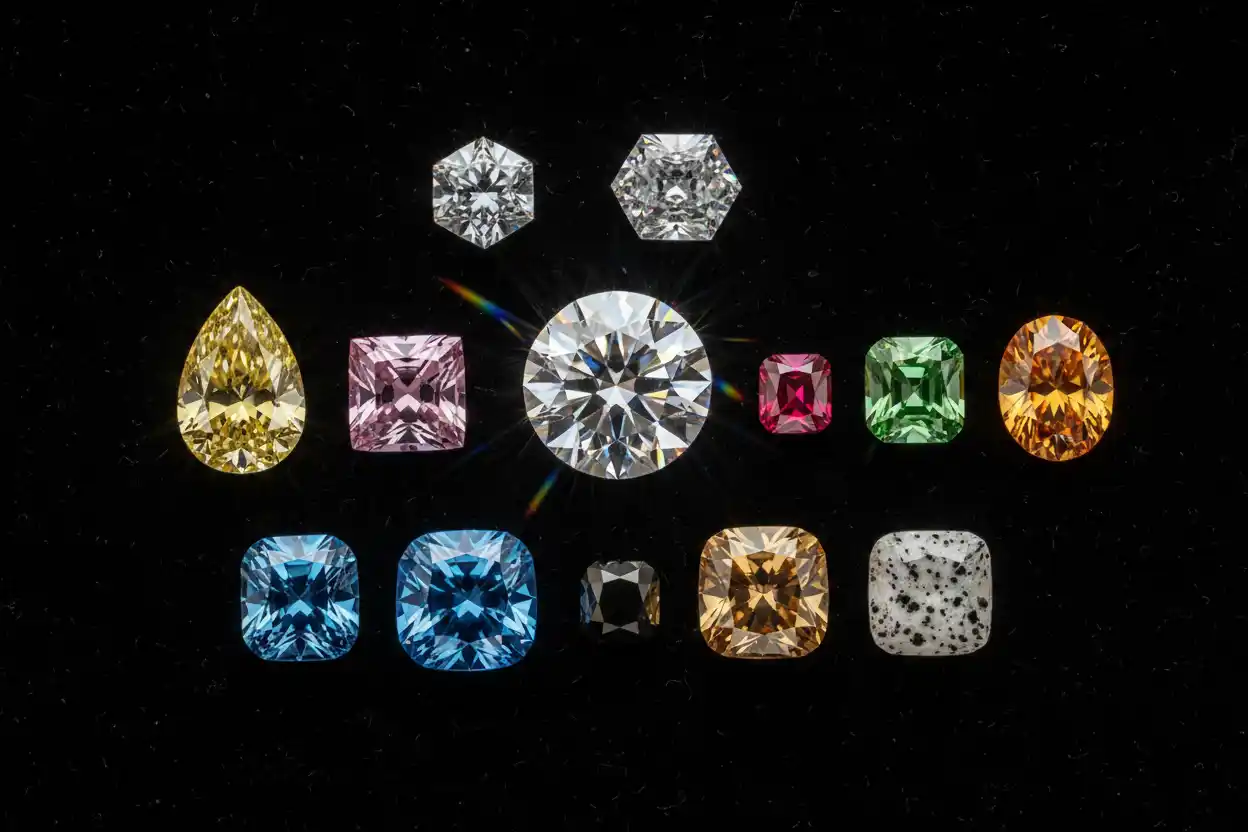
Types of Diamond: Colors and Varieties Explained
Diamond is a crystalline form of carbon, yet the word describes a remarkably broad range of natural materials. Diamonds may be classified by origin, atomic impurities, body color, crystal shape, internal structure, transparency, inclusion pattern, and suitability for gems or industrial use.
These categories overlap. A diamond can simultaneously be natural, Type Ia, fancy yellow, octahedral in its original rough form, and cut as a radiant. The main diamond meaning and properties guide covers the species as a whole, while this guide explains the distinctions among its principal types.
Diamond at a Glance
| Property | Diamond |
|---|---|
| Composition | Carbon, C |
| Mineral group | Native elements |
| Main colors | Colorless, yellow, brown, orange, pink, red, purple, blue, green, gray, black, and fancy white |
| Crystal system | Cubic |
| Typical habit | Octahedral, cubic, dodecahedral, tetrahexahedral, twinned macle, irregular aggregate, and rounded resorbed crystal |
| Luster | Adamantine |
| Transparency | Transparent to opaque |
| Mohs hardness | 10 |
| Cleavage | Perfect octahedral cleavage |
| Tenacity | Brittle despite extreme hardness |
| Common uses | Fine jewelry, cutting tools, abrasives, drilling, optics, electronics, thermal management, and scientific applications |
| Main care concern | Cleavage, chips at girdles and points, undisclosed treatments, fracture filling, and confusion among natural, laboratory-grown, and simulated stones |
How Diamonds Are Classified
No single diamond classification covers every consumer question.
Origin separates natural diamonds from laboratory-grown diamonds. Atomic structure divides them into Types I and II. Color grading separates D-to-Z diamonds from fancy colors. Crystal habit describes rough forms such as octahedra and macles. Microstructure distinguishes ordinary single crystals from polycrystalline carbonado.
Commercial labels add another layer. “Salt-and-pepper,” portrait, rose-cut, champagne, cognac, and black diamond may describe appearance or cutting rather than a distinct mineral variety.
The types of gemstones guide explains why these overlapping systems should not be mistaken for separate mineral species.
Natural Diamonds
Natural diamonds crystallize mainly in Earth’s mantle under high pressure and temperature. Volcanic eruptions later transport them toward the surface in kimberlite or lamproite, while erosion can release crystals into river, coastal, or marine deposits.
Most gem diamonds are ancient. Their internal inclusions can preserve evidence of deep-mantle minerals, fluids, and chemical conditions unavailable for direct observation.
A natural origin does not guarantee high gem quality. Many mined diamonds are too included, fractured, small, or oddly shaped for conventional jewelry and instead enter industrial or specialist markets.
Laboratory-Grown Diamonds
Laboratory-grown diamonds are crystalline carbon produced through high-pressure, high-temperature growth or chemical vapor deposition.
They have the same fundamental crystal structure, hardness, refractive properties, and chemical identity as natural diamonds. Their growth environment and microscopic features differ, allowing gemological laboratories to separate them.
Because the tracker contains dedicated pages for lab diamond meaning and types of lab diamond, this article does not duplicate the full HPHT and CVD classification.
The broader decision between origins belongs in lab-grown versus natural gemstones.
Type I Diamonds
Type I diamonds contain measurable nitrogen. They make up the overwhelming majority of natural gem diamonds.
Nitrogen may occur as isolated atoms or in aggregates. The arrangement influences color, infrared absorption, fluorescence, and response to treatment.
Type Ia Diamonds
Type Ia diamonds contain nitrogen atoms grouped into aggregates. They account for roughly 95% or more of natural diamonds.
Many Type Ia stones are colorless to light yellow or brown. The intensity depends on nitrogen arrangement, concentration, lattice defects, and deformation.
Type Ia is commonly divided into IaA and IaB. IaA diamonds contain paired nitrogen atoms, whereas IaB diamonds contain larger nitrogen aggregates around vacancies. Many natural stones contain mixed IaA and IaB characteristics.
Type Ib Diamonds
Type Ib diamonds contain isolated nitrogen atoms dispersed through the lattice.
They are extremely rare among natural diamonds and commonly display strong yellow, orange-yellow, or brownish yellow color. Saturated natural “canary” diamonds often belong to this category, although the term canary should be used as a color description rather than a guaranteed impurity classification.
Some HPHT-grown laboratory diamonds are also Type Ib because isolated nitrogen can enter the crystal during rapid growth.
Type II Diamonds
Type II diamonds contain no measurable nitrogen detectable by conventional infrared classification, or only extremely small amounts.
They are uncommon in nature but much more prominent among laboratory-grown diamonds.
Type IIa Diamonds
Type IIa diamonds contain no significant nitrogen or boron. They are chemically among the purest diamonds.
Some famous exceptionally colorless diamonds are Type IIa. However, plastic deformation can produce brown, pink, red, or purple colors even in chemically pure material.
Type IIa status does not automatically mean flawless, colorless, untreated, or valuable. It describes an infrared absorption category rather than a complete quality grade.
Type IIb Diamonds
Type IIb diamonds contain boron, which can create blue or gray-blue color and electrical conductivity.
Natural Type IIb diamonds are rare. Some colorless or gray examples contain enough boron to show Type IIb behavior without a strong blue appearance.
Blue laboratory-grown diamonds may also owe their color to boron, so chemical type does not establish geological origin.
D-to-Z Colorless and Near-Colorless Diamonds
GIA grades the normal color range from D through Z. D represents the least observable body color, while increasing letters indicate progressively stronger yellow or brown.
The major commercial groupings are commonly described as colorless, near-colorless, faint, very light, and light. These broad terms help consumers navigate the scale but do not replace an individual grade.
A well-cut G or H diamond can face up very white because brilliance masks some body color. Conversely, a poorly proportioned stone can reveal warmth or grayness more clearly.
The D-to-Z scale ends before color becomes strong enough for a fancy-color grade. Detailed color symbolism belongs in the dedicated diamond color meaning guide.
Fancy Yellow Diamonds
Yellow is the most commercially available fancy diamond color. Nitrogen-related defects absorb blue light and allow yellow to dominate.
Fancy grades progress through categories such as Fancy Light, Fancy, Fancy Intense, Fancy Vivid, and Fancy Deep. Saturation, tone, distribution, secondary hue, size, and clarity all affect value.
Radiant and cushion cuts are popular because their facet patterns can concentrate color. A yellow diamond that looks weak as a round may show stronger saturation after recutting.
“Canary diamond” commonly describes bright saturated yellow, but it is not a formal laboratory color grade.
Brown, Champagne, Cognac, and Amber Diamonds
Brown is the most abundant natural fancy diamond color. Plastic deformation within the lattice commonly contributes to the appearance.
Commercial language transformed many brown diamonds into champagne, cognac, chocolate, and amber categories. These names describe hue and tone rather than standardized gemological varieties.
Light champagne stones can appear beige, golden, or grayish brown. Cognac generally implies deeper orange-brown or reddish brown.
Brown diamonds have become more visible in contemporary jewelry because warm neutral colors complement yellow and rose gold. Their price remains highly dependent on attractiveness rather than the trade name alone.
Orange Diamonds
Pure orange diamonds are rare. Many stones contain yellow, brown, or pink modifiers.
Nitrogen-related defects can contribute to orange coloration, but several mechanisms and impurity combinations may be involved. Strong unmodified orange receives exceptional collector interest.
Some stones described as pumpkin, apricot, or mandarin diamonds fall within orange or orange-brown trade categories. Only a laboratory report can establish the official color description.
Pink Diamonds
Most natural pink diamonds owe their color to structural distortion created by intense geological stress rather than a simple trace-element impurity.
Microscopic deformation bands alter the way light passes through the crystal. Color may appear in concentrated pink graining rather than evenly throughout the entire stone.
Natural pink ranges from pale blush and purplish pink to saturated rose and reddish pink. Secondary brown, orange, or purple modifies both appearance and value.
The closure of major historical sources has made fine natural pinks especially scarce. Laboratory-grown and treated pink diamonds are much more available, so origin documentation matters.
Red Diamonds
Natural red is among the rarest diamond colors. Red diamonds generally share structural color mechanisms with pink diamonds but display stronger saturation.
GIA typically uses Fancy Red without the long intensity sequence applied to many other colors. Even small natural red diamonds can have extraordinary collector value.
Red-brown, purplish red, and orangy red stones are more available than unmodified red, although all remain rare.
Purple and Violet Diamonds
Purple diamonds usually contain pink, red, gray, or brown modifiers. Lattice deformation and hydrogen-related defects may contribute depending on the material.
Violet is distinct from purple in formal color description and is particularly uncommon. Some violet diamonds contain hydrogen-related absorption features.
Trade photographs often exaggerate these colors, so laboratory wording should take precedence over screen appearance.
Blue Diamonds
Boron produces the classic natural blue of Type IIb diamond. Blue may range from pale gray-blue to saturated Fancy Vivid blue.
Many natural blue diamonds show a gray modifier. Pure, evenly distributed blue becomes increasingly rare as saturation rises.
Artificial irradiation can create blue or blue-green color, while laboratory-grown boron-bearing diamonds are also available. Consequently, a blue diamond requires testing for origin and treatment.
Blue diamonds are compared with other durable stones in blue engagement-ring stones, but their rarity places them in a very different value category.
Green Diamonds
Natural green diamond color commonly develops through exposure to radiation within the Earth.
Radiation damage can create a shallow green skin, localized green stains, or color distributed more deeply through the crystal. Determining whether the radiation exposure was natural or laboratory-induced can be extremely difficult.
Some polished diamonds retain natural green surface features as evidence, although cutting may remove them. A laboratory report is essential for any valuable green diamond.
Green, yellow-green, blue-green, and gray-green diamonds occupy separate descriptive categories depending on the dominant hue.
Chameleon Diamonds
Chameleon diamonds temporarily change color after gentle heating or prolonged storage in darkness.
Classic chameleons commonly shift from grayish or brownish green toward yellow or orange. The effect gradually reverses as the stone returns to ordinary conditions.
The phenomenon differs from pleochroism because diamond is singly refractive. It is also distinct from the rapid light-source change seen in alexandrite.
Heating a diamond at home to test this effect risks damage to treatments, inclusions, or the setting and should not be attempted.
Gray Diamonds
Gray diamond color may involve hydrogen-related defects, boron, clouds, inclusions, or combinations of structural features.
Some gray stones show blue, violet, green, or brown modifiers. Others have a silvery appearance caused by dense internal features.
The market increasingly uses names such as galaxy gray, steel, mist, and salt-and-pepper gray. These are descriptive labels rather than formal color grades.
Natural Black Diamonds
Many natural black diamonds owe their appearance to dense clouds of graphite, sulfides, magnetite, hematite, or other inclusions, together with fractures and graphitized areas.
The underlying crystal may be near-colorless, brown, or greenish rather than intrinsically black. Light absorption by the dense features creates the opaque appearance.
Natural-color black diamonds can be difficult to cut because inclusions and fractures interrupt the crystal. Treated black diamonds are also common and may begin as heavily fractured lower-value rough.
The dedicated treated diamond guide retains the full treatment-detection intent.
Fancy White Diamonds
Fancy white diamonds are not simply high-color D-grade diamonds. They have a milky, opalescent, or translucent white appearance produced by dense clouds of microscopic inclusions.
Their soft glow differs from transparent colorless diamond brilliance. Some examples resemble moonlight or diffused frost.
Because appearance depends on submicroscopic structures, cutting must preserve the visual effect while avoiding weak areas.
Carbonado
Carbonado is a natural polycrystalline diamond aggregate composed of numerous randomly oriented microscopic diamond crystals with non-diamond carbon and mineral matter.
It is typically opaque, porous, and black, gray, brown, or occasionally colored by included material. Unlike ordinary single-crystal diamond, carbonado lacks one continuous cleavage plane and can be extraordinarily resistant to mechanical wear.
Carbonado occurs mainly in alluvial deposits associated with Brazil and parts of Central Africa. Its origin remains scientifically debated.
Some carbonados are faceted for collector jewelry, although pores and irregular texture complicate cutting and polishing.
Bort, Boart, and Industrial Diamond
Bort or boart refers broadly to low-grade diamonds unsuitable for conventional transparent gemstones.
Material may be highly included, fractured, poorly crystallized, aggregated, or too small for jewelry. It can be crushed into abrasive grit or used in drilling and cutting tools.
Ballas is a rounded or radiating polycrystalline diamond aggregate valued for industrial toughness. These industrial categories are genuine diamond but do not belong to ordinary gem-quality grading.
Octahedral Diamond Rough
The octahedron is diamond’s most iconic natural crystal form. It has eight triangular faces arranged as two four-sided pyramids joined at their bases.
Well-formed octahedra can yield round brilliants efficiently, depending on internal strain, inclusions, and proportions. Their faces may show triangular growth or dissolution features called trigons.
Crystal habit records growth conditions, but it does not directly determine finished color or clarity.
Cubic and Dodecahedral Rough
Cubic diamond rough has six square faces. Natural cubes may show rough surfaces, layered growth, or strong color zoning.
Dodecahedral-looking diamonds often form through resorption of earlier octahedral crystals. Their faces are curved rather than ideal flat geometric planes.
Rounded resorbed rough can sometimes offer favorable cutting yield, although internal grain and inclusions remain decisive.
Macle Diamonds
A macle is a flattened twinned diamond crystal, commonly triangular in outline.
Macles often yield triangular, heart, shield, rose, or other shallow cuts more efficiently than deep round brilliants. Their internal twin plane influences sawing and polishing decisions.
Antique rose cuts frequently make intelligent use of thin macle rough rather than representing a technically inferior version of a modern brilliant.
Salt-and-Pepper Diamonds
Salt-and-pepper is a commercial term for transparent to translucent diamonds with visible white and black inclusions.
Each stone has a distinctive internal pattern. Some buyers appreciate this individuality, especially in rose cuts, portraits, kites, hexagons, and geometric shapes.
The label does not describe one clarity grade or impurity type. Large surface-reaching fractures can still threaten durability, so attractive inclusions should not distract from structural assessment.
Treatments and Color Enhancement
Diamond treatments include laser drilling, fracture filling, irradiation, annealing, HPHT processing, coating, and graphitization of fractures.
HPHT treatment can improve or modify the color of certain brown diamonds. Irradiation followed by heating can create green, blue, yellow, orange, pink, or other colors.
Fracture filling improves apparent clarity but can be damaged by heat, repair work, ultrasonic cleaning, or strong chemicals.
The broader terminology appears in gemstone treatments explained, while material-specific detection remains with the treated-diamond page.
Diamond Simulants
Cubic zirconia, moissanite, white sapphire, white zircon, glass, synthetic spinel, and several other materials can imitate diamond’s appearance.
A simulant may be natural or manufactured, but it does not have diamond’s carbon structure. The comparison in real versus fake diamond owns consumer identification questions.
For buyers comparing alternatives, lab diamond versus moissanite and the broader diamond-alternative guide address value and performance without diluting this classification page.
Cutting Behavior
Diamond’s extreme hardness makes it difficult to polish, yet directional hardness differences allow one diamond surface to polish another.
Perfect octahedral cleavage can help split rough along predictable planes, but it also creates risk. Modern planners use scanning, modeling, laser sawing, and inclusion mapping to choose the most valuable combination of polished stones.
Colorless rough is usually cut to maximize brilliance, weight, and clarity. Fancy-color rough may be cut deeper or with radiants and cushions to intensify color.
Black, carbonado, portrait, macle, and included rough require different strategies because ordinary round-brilliant planning may waste material or expose weaknesses.
Durability and Jewelry Suitability
Diamond defines Mohs hardness 10 and offers unrivaled resistance to scratching. The gemstone hardness chart explains why no common jewelry stone scratches diamond under normal contact.
However, hardness is not toughness. A sharp blow along a cleavage direction can chip the girdle, culet, or pointed corner.
The dedicated gemstone cleavage guide explains why princess, marquise, pear, and heart points require protective settings.
Well-set diamonds suit daily-wear rings, earrings, necklaces, and bracelets. Existing chips, feathers, laser drill holes, fillings, and extensive black inclusions require individual assessment.
Diamond Prices in 2026
Diamond prices cannot be summarized by color or carat weight alone. Cut, color, clarity, weight, grading report, shape, fluorescence, origin, treatment, provenance, and market conditions interact.
As a broad July 2026 retail reference, a one-carat natural round diamond of commercial engagement quality may cost roughly $2,500–$7,000. Fine D-to-F color, high clarity, excellent cutting, and premium reports can push a one-carat stone above $10,000–$20,000.
Natural fancy yellow diamonds may begin in the several-thousand-dollar-per-carat range, while saturated pink, red, blue, green, and orange diamonds can cost tens of thousands to millions of dollars per carat.
Brown, gray, salt-and-pepper, treated black, and heavily included diamonds may cost far less than conventional colorless stones. Natural-color black diamonds and exceptional carbonados occupy specialist markets with wide price differences.
The detailed valuation intent belongs in the diamond price guide. Market movement and collection risks for rare colors belong in colored diamond investment.
Buying Guidance
Decide first whether the stone is natural, laboratory-grown, treated, or simulated. Those categories cannot be compared through visual size alone.
For a significant natural diamond, obtain an independent grading report and verify its report number. Review measurements, cut quality, color, clarity, fluorescence, comments, inscription, and whether treatments are disclosed.
Fancy-color buyers should assess hue, tone, saturation, color distribution, origin of color, secondary modifiers, and how the cut concentrates color.
The dedicated diamond buying guide owns the complete 4Cs process. Setting choices are covered separately in diamond engagement rings and diamond rings.
Diamond Jewelry Types
Diamond’s durability allows it to appear in almost every jewelry form.
Diamond earrings experience relatively little impact and suit both high-clarity solitaires and included accent stones. Diamond necklaces can use pendants, stations, clusters, or continuous lines.
A diamond bracelet faces more surface contact, so secure articulated settings and periodic clasp inspection matter.
Different diamond types suit different designs. Fancy colors may be framed by colorless halos, while black and salt-and-pepper diamonds often work well in contemporary geometric settings.
Cleaning and Storage
Most untreated diamonds can be cleaned with lukewarm water, mild soap, and a soft brush. Oil adheres readily to diamond, so cleaning beneath the pavilion restores brilliance.
Avoid sudden temperature changes and inspect prongs before scrubbing. Fracture-filled, coated, heavily included, or damaged diamonds require gentler care.
Ultrasonic cleaning may be appropriate for many untreated secure diamonds, but it can threaten loose settings, fillings, feathers, and certain included stones. Review which gemstones can go in an ultrasonic cleaner and the dedicated diamond jewelry cleaning guide.
Store diamonds separately because they can scratch one another and nearly every other gemstone.
Meaning and Symbolism
Diamond has represented endurance, commitment, authority, purity, wealth, and resilience across different periods and cultures.
Colorless diamonds are commonly associated with clarity and lasting partnership. Yellow may symbolize optimism, pink affection, blue composure, green renewal, and black independence or strength.
Diamond is also the traditional subject of the April birthstone guide.
These meanings arise from social tradition, history, jewelry culture, and personal interpretation. They are not scientifically demonstrated effects of carbon crystal structure or color defects.
Frequently Asked Questions
1. What are the four scientific diamond types?
The principal infrared categories are Type Ia, Type Ib, Type IIa, and Type IIb, based mainly on the presence and arrangement of nitrogen or boron.
2. Which diamond type is most common?
Type Ia is by far the most common natural diamond category and represents roughly 95% or more of natural diamonds.
3. Is Type IIa always the best diamond?
No. Type IIa indicates very low measurable nitrogen, not superior cut, clarity, color, size, origin, or lack of treatment.
4. What type of diamond is naturally blue?
Many natural blue diamonds are Type IIb because boron creates blue or gray-blue color and electrical conductivity.
5. What causes pink diamond color?
Most natural pink color results from structural deformation within the diamond lattice rather than a simple trace-element impurity.
6. Are black diamonds always carbonado?
No. Many jewelry black diamonds are single crystals colored by dense inclusions, fractures, graphitization, irradiation, or treatment. Carbonado is a distinct polycrystalline aggregate.
7. Is a laboratory-grown diamond a real diamond?
It is diamond by composition and crystal structure, but its origin is laboratory growth rather than geological formation. That origin should always be disclosed.
8. What is a macle diamond?
A macle is a flattened twinned diamond crystal, often triangular, that commonly yields shallow or geometric polished shapes.
9. What is a salt-and-pepper diamond?
It is a commercial term for a diamond with visible contrasting inclusions. The term does not represent a formal clarity grade.
10. Can a diamond change color?
Chameleon diamonds temporarily shift color after heating or prolonged darkness. The effect differs from alexandrite-style light-source color change.
11. Which diamond color is rarest?
Natural red is generally considered among the rarest, while pure saturated blue, green, pink, orange, and violet are also exceptionally scarce.
12. Does diamond type determine price?
No. Scientific type is only one characteristic. Origin, color, clarity, cut, carat weight, treatment, report, provenance, and market demand have much greater direct influence.
Diamond types reveal how much complexity can exist within one carbon mineral. Nitrogen creates broad Type I families, boron produces Type IIb behavior, lattice distortion creates pink and brown, radiation creates green, inclusions create black and fancy white, while twinning and polycrystallinity produce macles and carbonado. Related entries appear in the crystals that start with D directory and the gemstones that start with D guide.