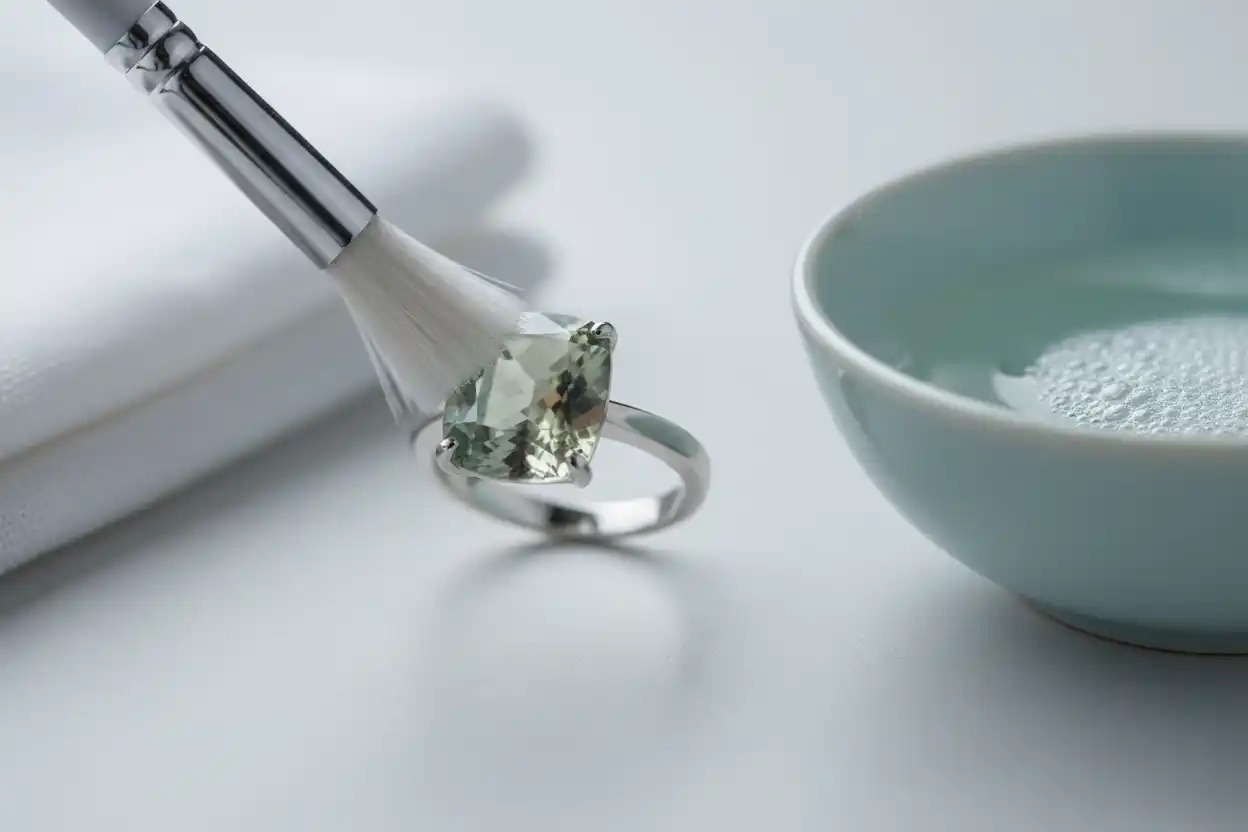
How to Clean Prasiolite Jewelry Safely
Prasiolite jewelry should be cleaned with warm water, mild liquid soap, and a soft-bristled brush. Ultrasonic cleaning is generally acceptable for a sound, unfilled stone in a secure setting, but steam should be avoided because unnecessary heat can affect quartz color, fractures, treatments, and surrounding jewelry components.
Most commercial Prasiolite acquired its green color through controlled treatment of suitable quartz. Consequently, routine cleaning should remove oils without exposing the gemstone to high heat, intense light, aggressive chemicals, or rapid temperature changes.
Why Prasiolite Needs Quartz-Specific Care
Prasiolite is transparent green quartz. It is sometimes marketed as Green Amethyst, although Prasiolite is the more precise gemological name.
Its mineralogy, color, history, and symbolic associations belong to the broader Prasiolite guide. Its position within the mineral family appears in the Quartz guide.
Quartz ranks 7 on the Mohs scale. It has no true cleavage, but it can still chip or fracture after a hard blow, particularly around thin girdles, pointed ends, internal inclusions, and surface-reaching breaks.
| Property | Cleaning implication |
|---|---|
| Mineral species | Quartz |
| Chemical composition | Silicon dioxide |
| Typical color | Pale yellowish green to medium leek green |
| Mohs hardness | 7 |
| Cleavage | None |
| Fracture | Conchoidal |
| Safest routine cleaning | Warm water, mild soap, and a soft brush |
| Ultrasonic cleaning | Usually safe when unfractured and untreated at the surface |
| Steam cleaning | Avoid |
| Main risks | Heat, thermal change, fractures, filling, coatings, and loose settings |
The gemstone hardness chart explains why Prasiolite resists many ordinary scratches but remains vulnerable to harder stones.
Scratch resistance is not the same as resistance to impact. That distinction appears in Gemstone Toughness vs Hardness and Gemstone Cleavage Explained.
Most Commercial Prasiolite Is Treated
Naturally green transparent quartz is uncommon. Much of the Prasiolite in jewelry is produced by heating specific Amethyst material, while some green quartz may involve irradiation followed by controlled heating.
Not every Amethyst responds by turning green. The starting material’s locality, iron-related color centers, crystal structure, and treatment conditions influence the result.
Treatment does not make Prasiolite unsuitable for jewelry. However, the owner should not assume that every green quartz has the same color stability or treatment history.
The broader enhancement framework belongs to Gemstone Treatments Explained.
Protect Prasiolite from a jeweler’s torch, prolonged concentrated heat, hot display lamps, and uncontrolled repair temperatures. Treatment details should be disclosed before resizing or retipping the setting.
Prasiolite, Amethyst, Citrine, and Ametrine
Prasiolite, Amethyst, Citrine, and Ametrine are all quartz varieties, but their colors result from different arrangements or states of iron-related defects and color centers.
The broader purple variety appears in the Amethyst guide, while yellow-to-orange quartz belongs to the Citrine guide.
Ametrine contains both Amethyst and Citrine color zones in one crystal.
These family connections help explain why Prasiolite should not be exposed casually to steam or repair heat. The same treatment conditions that create or modify quartz color demonstrate that high temperature can alter it.
The specialized sibling workflows for physical care belong to How to Clean Amethyst Jewelry Safely, How to Clean Citrine Jewelry Safely, and How to Clean Ametrine Jewelry Safely.
Inspect the Jewelry Before Cleaning
Examine the Prasiolite under bright, indirect light. Check for loose prongs, movement in the stone, chipped facet edges, open fractures, worn corners, damaged metal, and missing accent stones.
Transparent pale-green quartz can make some inclusions difficult to notice. Tilt the stone and inspect it from the side as well as from above.
Pay particular attention to pear, marquise, emerald, radiant, and other cuts with exposed corners or pointed ends.
Do not wash a jewel when the stone clicks, shifts, or catches against fabric. Cleaning may dislodge a gemstone from an already weakened setting.
Check for Filling, Coating, and Assembly
Quartz can occasionally be fracture filled, coated, dyed, backed, glued, or assembled with another component.
A surface coating may create a stronger or less natural-looking green. Fracture filler can improve apparent clarity but may respond poorly to heat, solvents, vibration, and repair procedures.
When treatment is uncertain, use manual warm-soapy-water cleaning and avoid ultrasound.
Do not use cleaning response as an identification test. Heat, solvent, scratching, and chemical experiments may damage both natural and treated quartz.
Prepare the Cleaning Solution
Fill a small bowl with warm—not hot—water and add several drops of mild liquid dish soap.
Prepare a second bowl of clean warm water for rinsing. Use a new soft toothbrush or a fine jewelry brush.
Place a lint-free cloth nearby for blotting and final fingerprint removal.
Do not clean directly over an uncovered sink. A loose accent stone or lightweight earring may disappear through the drain.
Avoid soaps containing bleach, abrasive particles, concentrated ammonia, harsh alkaline ingredients, or strong degreasers.
Clean Prasiolite Step by Step
Place the jewel briefly in the mild solution so skin oil, lotion, soap film, and cosmetics begin to loosen.
Brush the crown, girdle, pavilion, gallery, bezel, prongs, and underside of the gemstone.
Residue behind a pale transparent Prasiolite can make the stone appear grayer, darker, or less saturated.
Use light pressure around thin girdles, pointed ends, visible fractures, pavé, and decorative metalwork.
Do not insert pins, needles, or metal tools beneath the stone. These objects can bend prongs, scratch the setting, or exert concentrated pressure against the girdle.
Rinse and Dry Without Heat
Rinse the jewelry in the second bowl of clean warm water.
Inspect the underside carefully because dried soap can resemble internal cloudiness.
Blot the piece with a lint-free cloth and let hidden moisture evaporate naturally.
Do not use a hair dryer, radiator, heated jewelry cabinet, steam jet, or intense display lamp.
Once dry, inspect every prong again. A metal edge that catches on the cloth may be raised or damaged.
Can Prasiolite Go in an Ultrasonic Cleaner?
A sound Prasiolite with no visible fractures, filler, coating, glue, or loose setting can usually tolerate ultrasonic cleaning.
| Prasiolite condition | Ultrasonic recommendation |
|---|---|
| Sound, unfilled quartz in a secure modern setting | Usually safe |
| Visible or surface-reaching fracture | Avoid |
| Fracture-filled stone | Avoid |
| Coated or dyed green quartz | Avoid |
| Loose pavé or worn prongs | Avoid |
| Antique or repaired jewel | Professional assessment required |
| Glued components | Avoid |
| Treatment unknown | Prefer manual cleaning |
Ultrasonic vibration can enlarge fractures, disturb filler, release accent stones, or expose an already weak mounting.
The broader equipment boundaries belong to Which Gemstones Can Go in an Ultrasonic Cleaner?.
Avoid Steam Cleaning
Steam exposes the jewel to concentrated heat, pressure, and rapid temperature change.
Even when the quartz itself appears sound, heat may affect its treated green color, fracture filler, coating, glue, plating, soldered repairs, or accompanying gemstones.
Warm soapy water offers adequate cleaning without those risks.
Cleaning a Prasiolite Ring
Prasiolite rings commonly use large faceted stones because quartz is available in substantial sizes.
Brush through the gallery openings and around every prong. Large stones often collect lotion and soap across their broad pavilion surfaces.
Remove the ring before household cleaning, gardening, exercise, swimming, bathing, and heavy manual work.
Quartz is wearable, but exposed corners and raised settings can still chip.
Cleaning Prasiolite Earrings
Prasiolite earrings usually face less impact but collect hair products, cosmetics, and skin oils.
Clean posts, hooks, baskets, backs, and hinges separately. Keep alcohol-based disinfectant on compatible metal fittings and away from coatings, filler, glue, and the gemstone.
Dry screw backs and push backs completely before storage.
Cleaning a Prasiolite Necklace
A Prasiolite necklace or pendant may develop residue from perfume, sunscreen, lotion, and skin contact.
Apply cosmetics before putting on the jewel and allow them to dry.
Prevent the chain from rubbing across the faceted stone during cleaning and storage. Support a large pendant by its setting rather than gripping the quartz.
Cleaning a Prasiolite Bracelet
Prasiolite bracelets combine repeated wrist movement with multiple links, settings, hinges, and clasps.
Support the bracelet during cleaning and work on one section at a time.
Inspect every stone after rinsing. Remove the bracelet before desk work or activities that repeatedly bring the wrist against hard surfaces.
Prasiolite Versus Peridot
Prasiolite and Peridot can both appear yellowish green, but they are different minerals.
Prasiolite is quartz, while Peridot is olivine. Their refractive properties, inclusions, color origin, and heat sensitivity differ.
The full identification comparison belongs to Prasiolite vs Peridot.
Cleaning response should not be used to distinguish them. Peridot requires stricter protection from ultrasound and steam, so unidentified green jewelry should receive the gentler manual method.
Buying, Price, and Disclosure
The Prasiolite buying guide covers color, transparency, cut, treatment disclosure, size, setting quality, and misleading Green Amethyst terminology.
Market factors belong to the Prasiolite price guide.
Pale color is normal for much commercial Prasiolite. Aggressive cleaning will not deepen a naturally light stone.
Retain invoices, treatment statements, photographs, and repair records, particularly for unusually vivid green quartz.
Storage and Preventive Care
Store Prasiolite separately in a padded compartment or soft pouch.
Diamond, Sapphire, Ruby, Topaz, and harder gemstones can scratch it. Quartz can also scratch many softer materials.
Prevent chains and clasps from rubbing against its facets.
General exposure boundaries appear in Which Crystals Can and Can’t Go in the Sun and Which Crystals Can and Can’t Go in Water.
Physical Cleaning Versus Cleansing
Physical cleaning removes oil, dust, cosmetics, and setting residue.
Traditional symbolic practices belong to How to Cleanse and Charge Prasiolite.
Any such method should still avoid prolonged sunlight, high heat, saltwater, abrasive material, and sudden temperature changes.
Frequently Asked Questions
1. What is the safest way to clean Prasiolite?
Use warm water, mild liquid soap, and a soft brush, then rinse and dry the jewel at room temperature.
2. Can Prasiolite get wet?
Yes. Brief washing is normally safe for sound quartz, although glue, filler, coatings, watches, and delicate settings may impose limits.
3. Can Prasiolite go in an ultrasonic cleaner?
Sound, unfilled quartz may tolerate ultrasound. Avoid it when fractures, coatings, filler, glue, or loose settings are present.
4. Can Prasiolite be steam cleaned?
Steam is not recommended because unnecessary heat may affect color, treatment, fractures, and surrounding jewelry components.
5. Is Prasiolite naturally green?
Naturally green transparent quartz exists, but much commercial Prasiolite is produced by treating suitable quartz.
6. Is Green Amethyst the same as Prasiolite?
Green Amethyst is a commercial name for Prasiolite, although Prasiolite is the more precise term.
7. Can sunlight fade Prasiolite?
Color stability varies with how the green was produced. Avoid prolonged intense light and high heat, especially when treatment is unknown.
8. Is dish soap safe for Prasiolite?
A few drops of mild liquid dish soap are suitable. Avoid abrasives, bleach, and aggressive chemical formulas.
9. Can toothpaste polish Prasiolite?
No. Toothpaste can scratch the metal, wear plating, and leave residue beneath the setting.
10. Why does Prasiolite look pale after cleaning?
Its natural or treated color may be light, while cut orientation, windowing, lighting, and low saturation can also affect appearance.
11. How often should Prasiolite jewelry be cleaned?
Wipe it after wear and wash it when oil or cosmetics visibly reduce its brilliance.
12. When should Prasiolite receive professional care?
Professional care is appropriate for visible fractures, filling, coatings, loose pavé, antique settings, or unusual color changes.
Conclusion
Prasiolite combines quartz durability with a color that commonly reflects controlled treatment. Warm soapy water restores its brightness without exposing the green color or setting to unnecessary heat. When the stone remains pale after cleaning, its saturation, cut, and treatment history should be considered rather than escalating to steam or harsh chemicals.