Ametrine Meaning: Mineral Facts, History & Symbolism
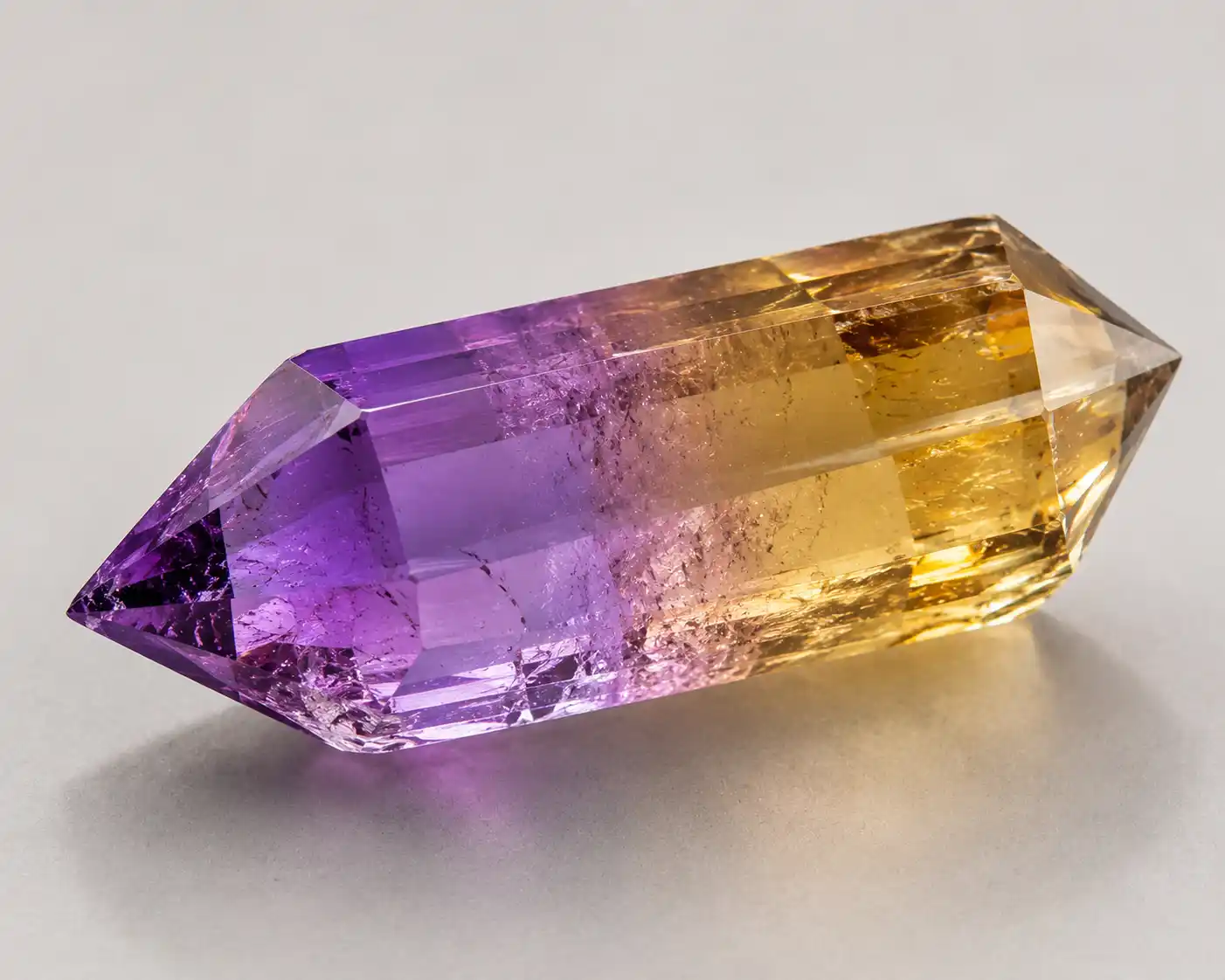
Ametrine is naturally bicolored quartz that contains both the purple color of amethyst and the yellow-to-orange color associated with citrine within a single continuous crystal. Its chemical composition is still silicon dioxide, SiO₂; the distinction comes from differences in iron-related color centers and growth conditions across different sectors of the quartz crystal rather than from two separate minerals being joined together.
That mineral identity provides the clearest foundation for ametrine meaning. Ametrine is neither amethyst glued to citrine nor an independent mineral species. It is quartz whose internal growth history produced contrasting purple and yellow-to-orange regions, sometimes divided by a sharp boundary and sometimes blended into complex geometric patterns that a skilled cutter can emphasize or deliberately mix.
Its unusual two-color appearance later encouraged symbolic associations with balance, integration, adaptability, clarity, and the reconciliation of contrasting priorities. Those interpretations can be personally meaningful, but they remain cultural or metaphysical readings rather than measurable properties of quartz.
Readers who want the wider mineral context can begin with quartz meaning, while the separate amethyst meaning and citrine meaning guides explain the individual purple and yellow quartz varieties.
Ametrine Identity at a Glance
| Property | Ametrine |
|---|---|
| Mineral species | Quartz |
| Variety | Naturally bicolored amethyst-citrine quartz |
| Chemical composition | SiO₂ |
| Crystal system | Trigonal |
| Principal colors | Purple or violet plus yellow, orange-yellow or orangy yellow |
| Main color influence | Different iron-related states and color-producing mechanisms within separate growth sectors |
| Typical transparency | Transparent |
| Refractive index | Approximately 1.544–1.553 |
| Birefringence | Approximately 0.009 |
| Specific gravity | Approximately 2.66 |
| Mohs hardness | 7 |
| Optical character | Uniaxial positive |
| Cleavage | No prominent easy cleavage in routine gem use |
| Fracture | Commonly conchoidal |
| Luster | Vitreous |
| Defining visual feature | Distinct or blended purple and yellow-to-orange zones in one quartz crystal |
| Important natural source | Southeastern Bolivia |
| Synthetic counterpart | Hydrothermally grown synthetic ametrine exists |
| Identification limit | Purple-yellow zoning alone cannot prove natural origin |
The terminology is straightforward when the material is correctly identified. Ametrine combines the names amethyst and citrine, while amethyst-citrine describes the same bicolored quartz more literally.
That does not mean every purple-and-yellow object is ametrine.
Glass, assembled gems, synthetic quartz, treated quartz, and other manufactured materials can reproduce a similar visual division. Mineral identity and natural origin remain evidence questions rather than conclusions drawn from color alone.
How Natural Ametrine Forms
Ametrine forms when quartz grows under an unusually specific combination of chemical conditions, temperature, fluid composition, iron availability, crystallographic growth behavior, and later irradiation.
The best-known natural material occurs in quartz veins cutting dolomitic limestone in southeastern Bolivia. Silica-bearing hydrothermal fluids moved through fractures and open spaces in the rock, allowing quartz crystals to develop within veins and cavities.
These quartz crystals did not incorporate their color-producing iron uniformly.
Different crystallographic growth sectors developed under slightly different conditions, controlling how iron entered or behaved within the quartz structure. Some sectors ultimately developed amethyst color, while others developed yellow-to-orange citrine-like coloration.
The result can be one crystal containing sharply different colors without any physical seam between them.
That distinction is central to ametrine meaning because the gem’s famous dual appearance is not created by joining two stones. It records differences within the growth history of one quartz crystal.
The Bolivian Geological Setting
The classic ametrine deposit is unusual because the quartz occurs in veins cutting dolomitic limestone rather than in the stereotypical volcanic geodes often associated with South American amethyst.
Quartz-rich veins penetrate the surrounding carbonate rock, and crystals can occupy open spaces within those veins. The deposit produces amethyst, citrine-colored quartz, colorless material, and ametrine rather than one uniform quartz variety throughout the system.
This geological setting matters because it demonstrates that color alone does not define formation.
An amethyst crystal from a basalt cavity and the purple sector of a Bolivian ametrine are both quartz, yet their geological contexts differ significantly.
Likewise, an isolated faceted ametrine cannot reveal every detail of the mine environment from appearance alone. Geological provenance requires documentation or appropriate analytical evidence rather than simply recognizing the characteristic purple-yellow pattern.
Why One Quartz Crystal Has Two Colors
The two colors of ametrine arise because iron behaves differently in different portions of the quartz.
In the purple amethyst sectors, iron-related defects within the quartz structure develop the familiar amethyst color after appropriate irradiation-related changes.
The yellow-to-orange regions involve a different iron-related state. Research on Bolivian material indicates that very small iron-bearing aggregates contribute to its natural citrine-like coloration, distinguishing the mechanism from simply imagining that all iron-containing quartz behaves identically.
The important principle is that the same crystal can preserve different iron environments in different growth sectors.
Growth rate, crystallographic face, temperature, chemical conditions, and defect formation all influence which color develops.
This makes ametrine a useful example of how gemstone color is controlled by atomic-scale structure rather than by broad statements such as “iron makes quartz purple” or “iron makes quartz yellow.”
Both can occur.
The structural context determines the result.
Natural Ametrine Is Not Simply Heat-Treated Amethyst
A common misunderstanding is that all ametrine must be produced by partially heating an amethyst crystal until half of it becomes yellow.
Natural ametrine exists.
Detailed field observations and experimental investigations of Bolivian material established that its characteristic amethyst-citrine pattern developed naturally and was not simply the result of laboratory heating after mining.
That does not mean treatment is irrelevant to the market.
Quartz color can be altered through heating and irradiation, and synthetic bicolored quartz can also be produced. A natural-looking purple-yellow division therefore does not prove geological origin.
The correct distinction is:
natural ametrine exists because one quartz crystal can naturally develop different color sectors.
Manufactured or altered materials can imitate the appearance, so visual similarity alone cannot establish origin.
Treatment-specific identification belongs outside this material-first meaning reference.
Ametrine Color Zoning Is Crystallographic
Many ametrine crystals contain color boundaries that look surprisingly geometric.
When a crystal is viewed in suitable orientation, purple and yellow regions can appear as wedges, triangles, sectors, alternating areas, or sharply bounded fields rather than as random clouds.
That pattern reflects quartz crystal growth.
Different crystallographic sectors can incorporate iron differently. Because the boundaries correspond to growth architecture, they often form geometries that would be unexpected if the colors resulted simply from surface staining.
The exact pattern varies from crystal to crystal.
Some rough contains relatively equal purple and yellow regions. Other material is dominated by one color, with the second appearing only as a smaller sector. Certain stones show several alternating regions rather than one clean division.
This variation is one reason two natural ametrines rarely look exactly alike.
A Sharp 50/50 Split Is Not Required
Commercial imagery often presents ametrine as an emerald-cut gemstone divided neatly into one purple half and one golden half.
That is only one cutting interpretation.
Natural rough does not organize itself to create a perfect jewelry advertisement. Its color boundaries follow crystal growth, and the strongest colors may not occupy equal volumes.
Cutting every piece for an exact 50/50 split can sacrifice substantial rough.
Some cutters instead deliberately blend the purple and yellow areas through rounds, ovals, pears, concave faceting, fantasy cuts, or other designs. The finished gem may display flashes of purple, yellow, peach, orange-red, or mixed colors as it moves.
Neither approach is inherently more authentic.
A sharp split emphasizes contrast.
A blended cut emphasizes interaction.
The dedicated ametrine price guide owns the value consequences of color balance, saturation, cut, clarity, and size.
Ametrine Versus Amethyst
Amethyst contains purple quartz coloration without a significant face-up yellow citrine region.
Ametrine contains both.
That sounds simple, but natural quartz can contain subtle yellowish, smoky, colorless, or brownish areas that make terminology less tidy than an ideal diagram suggests.
A stone should be called ametrine when the amethyst and citrine-colored components are both sufficiently developed to constitute a meaningful bicolor appearance.
A tiny warm modifier hidden in one corner of an otherwise purple amethyst does not necessarily make “ametrine” the most useful commercial description.
The individual purple variety is covered in amethyst meaning, while its market considerations belong in amethyst price.
Ametrine Versus Citrine
Citrine is yellow-to-orange quartz without a meaningful purple amethyst sector.
Ametrine contains both appearances in the same crystal.
The distinction becomes particularly important because commercial citrine can originate through heating suitable amethyst. A yellow quartz gem therefore has its own treatment and color-origin questions independent of whether ametrine exists naturally.
The full mineral and terminology context is covered in citrine meaning, while citrine price owns the separate valuation question.
Ametrine should not be treated as merely “half-priced amethyst plus half-priced citrine.” Its cutting, pattern and desirability operate as a bicolored gemstone category.
Diagnostic Characteristics of Ametrine
Because ametrine is quartz, its basic gemological properties are those of quartz.
Refractive Index
Ametrine falls around 1.544–1.553.
That is consistent with both amethyst and citrine because all three are quartz varieties.
A correct quartz refractive-index reading can support mineral identification.
It cannot determine whether the bicoloration is naturally formed.
Specific Gravity
A specific gravity around 2.66 provides another quartz-compatible measurement.
Again, this establishes material consistency rather than origin.
Synthetic quartz can produce essentially the same density because it has the same fundamental composition and crystal structure.
Birefringence
Quartz is doubly refractive, with birefringence around 0.009.
Appropriate optical examination can therefore help separate ametrine from some singly refractive glasses and other imitations.
Hardness
Ametrine has Mohs hardness 7.
That makes it considerably more scratch resistant than many ornamental gemstones, although hardness does not protect it from every chip or fracture.
Deliberately scratch-testing a finished ametrine remains unnecessary because numerous quartz varieties share the same hardness.
Color Architecture
Natural-looking sector zoning is valuable supporting evidence, particularly when it agrees with quartz growth structure.
It does not prove natural origin by itself.
That final limitation is one of the most important diagnostic points on this page.
Natural Versus Synthetic Ametrine
Synthetic ametrine can be grown hydrothermally.
Because the manufactured material is also crystalline quartz, ordinary properties such as hardness, refractive index, specific gravity, and chemical formula can closely match natural material.
That makes natural-versus-synthetic separation more difficult than distinguishing quartz from purple-and-yellow glass.
Gemologists can examine:
color-zone geometry;
twinning;
internal growth structures;
inclusions;
reaction under crossed polarizers;
infrared characteristics;
other microscopic or spectroscopic evidence.
Certain characteristic twinning and growth relationships can provide useful separation when properly observed.
No one photographic feature should be converted into a universal rule.
A perfectly clean ametrine can be natural.
A visibly zoned ametrine can be synthetic.
A sharp color boundary can occur naturally.
An apparently irregular boundary does not prove geological origin.
Professional identification depends on the combined evidence.
Ametrine Specimen and Photo Evaluation Checklist
Ametrine is especially well suited to structured photographic evaluation because the geometry of its color zoning can preserve useful information.
| Evaluation step | What to document | Why it matters |
|---|---|---|
| Photograph the entire rough specimen | Full crystal, broken areas and matrix | Preserves growth and provenance context |
| Include scale | Dimensions in millimeters or centimeters | Prevents exaggerated size impressions |
| Use a neutral background | Gray or neutral white | Reduces reflected color contamination |
| Use one neutral light source | Purple and yellow appearance under consistent illumination | Provides a baseline color record |
| Photograph through the c-axis when identifiable | Geometric relationship among color sectors | Can expose crystallographic zoning |
| Photograph perpendicular to the c-axis | Longitudinal color distribution | Shows how zones extend through the crystal |
| Use transmitted light | Boundaries, fractures and internal structures | Reveals whether color extends through the interior |
| Record every color boundary | Sharp, diffuse, triangular, alternating or irregular | Creates an analyzable zoning map |
| Photograph inclusions under magnification | Fluid features, fractures and particles | Preserves evidence for later interpretation |
| Photograph the pavilion of faceted stones | Cutting orientation relative to zoning | Explains face-up blending or separation |
| Retain unedited originals | Before saturation or white-balance changes | Preserves defensible visual evidence |
| Record seller origin claims separately | Do not embed them into the visual description | Prevents provenance from becoming assumed fact |
| Avoid heat experiments | Heating can permanently alter quartz color | Protects the specimen |
| Avoid scratch testing | Quartz hardness is already well established | Prevents needless damage |
| Escalate important stones | Microscopy, optical testing and spectroscopy | Distinguishes observation from origin determination |
The most useful output from this checklist is not “natural” or “synthetic.”
It is a reproducible record showing exactly where the purple and yellow zones lie, how they intersect the crystal, and which observations still require stronger testing.
Original Color-Zone Evidence Matrix
Ametrine claims are easier to evaluate when the strength of each type of evidence is stated explicitly.
| Observation | Supports | Does not prove |
|---|---|---|
| Purple and yellow occur in one continuous stone | Bicolored material consistent with ametrine | Natural origin |
| RI matches quartz | Material is compatible with quartz | Natural versus synthetic origin |
| SG matches quartz | Supports quartz identification | Natural color |
| Geometric sector zoning | Consistent with crystallographic growth | Geological origin by itself |
| Purple and yellow zones continue through the interior | Color is not merely a simple surface coating | Natural formation |
| Characteristic natural twinning is documented | Can strongly support natural quartz when correctly interpreted | Geographic origin |
| Hydrothermal synthetic growth features are observed | Supports synthetic origin | Every treatment history without further evidence |
| Seller states “Bolivian” | Records a provenance claim | Mine origin |
| Laboratory report identifies natural ametrine | Strong evidence for material and natural origin within report scope | A specific mine unless addressed |
| Old specimen label names a mine | Valuable provenance evidence | Guaranteed chain of custody |
| Perfect 50/50 color split | A cutting choice or natural zoning presentation | Higher authenticity |
| Blended purple-orange face-up appearance | Can result from facet mixing of the two zones | Treatment |
The matrix highlights a recurring gemological distinction:
quartz identification is easier than natural-origin determination.
Why Ametrine Can Look Peach or Reddish
A cut ametrine does not necessarily show only two visually isolated colors.
Facets act as mirrors and windows inside the gemstone. Purple light returning from one region can visually mix with yellow or orange light from another, especially in rounded, brilliant, concave, or fantasy cuts.
The resulting face-up appearance can include:
peach;
pinkish orange;
reddish orange;
blended violet-gold flashes;
mixed warm and cool reflections.
Those colors do not necessarily represent additional mineral varieties inside the quartz.
They can be optical mixtures generated by cutting orientation and internal reflection.
This makes face-up photographs insufficient for mapping the original rough’s color distribution. A pavilion view, side view, and transmitted-light image can reveal the zoning more directly.
Why Cut Matters So Much to Ametrine’s Identity as a Gem
Most transparent gemstones are cut primarily to balance brilliance, color, weight retention and shape.
Ametrine adds another variable: where should the color boundary appear?
A cutter can orient the stone so the purple and yellow halves remain visibly separate.
Another design can place the boundary diagonally.
A fantasy cut can repeat the colors in geometric reflections.
A brilliant or concave design can intentionally mix them.
This means two stones cut from similar rough can look radically different even though their mineral composition and original color zoning were comparable.
Cutting decisions belong partly to value and lapidary practice, so they should not overwhelm the mineral definition. Still, they explain why ametrine is more than ordinary quartz with two color patches.
The visual effect is an interaction among geology, crystal growth, orientation, and human cutting.
The Documented History of Ametrine
Natural ametrine is strongly associated with southeastern Bolivia, especially the Anahí mining district.
The deposit has generated a romantic story involving a Spanish conquistador, a marriage to a local princess, a mine given as a dowry, and ametrine being presented to European royalty. That story is widely repeated in gem literature.
It should be treated as legend rather than fully documented historical fact.
The modern commercial history is much firmer. Bolivian ametrine emerged as an important gem material after mining operations brought significant natural bicolored quartz to the international trade.
Scientific field investigations later became particularly important because unusual purple-and-yellow quartz had previously attracted suspicion that its appearance might be artificially produced.
Geological study of the deposit demonstrated that naturally occurring amethyst-citrine zoning was real.
That evidence transformed ametrine from an unusual trade curiosity into a well-characterized natural quartz variety.
“Bolivianite” and Other Names
Bolivianite is a trade name associated with Bolivian ametrine.
The name emphasizes geographic origin rather than describing a separate mineral species.
The internationally clear mineralogical description remains ametrine or amethyst-citrine quartz.
A label reading Bolivianite should therefore answer two questions:
Is the material actually ametrine?
Is Bolivian origin documented?
The trade name itself cannot prove either one.
Likewise, “natural bicolor quartz” can be a useful descriptive phrase but should not automatically be converted into ametrine if the colors are not actually amethyst and citrine-like regions.
Does Every Natural Ametrine Come From One Mine?
The Anahí mine is overwhelmingly associated with commercial natural ametrine and remains its defining source in standard gemological references.
Other Bolivian occurrences have also produced ametrine material, including nearby deposits that have been reported and examined gemologically.
This creates a useful precision point.
It is reasonable to describe Anahí as the classic and dominant commercial source.
It is less defensible to use an absolute statement implying that no naturally occurring ametrine has ever been documented anywhere else.
Geographic provenance should always follow the evidence available for the individual gem rather than being inferred because its colors look typical.
Ametrine Meaning in Modern Symbolism
Modern ametrine meaning often begins with the obvious visual fact that two contrasting colors coexist within one continuous quartz crystal.
That appearance naturally lends itself to symbolism involving balance, integration, flexibility, cooperation, perspective, and holding two priorities at the same time.
Someone might use ametrine as a reminder that two apparently competing ideas do not always require an either-or decision.
Another person may interpret the purple and yellow regions as a prompt to balance reflection with action.
Those interpretations are coherent metaphors because they begin with something the stone genuinely displays.
They do not show that quartz generates a measurable balancing force.
The broader Healing Crystal section separates symbolic traditions from physical mineral properties across other materials as well.
Ametrine as a Symbol of Integration
“Balance” can become vague when attached indiscriminately to gemstones.
Ametrine offers a more specific metaphor: its two visible regions remain chemically part of one quartz crystal.
The purple sector does not stop the yellow sector from existing.
The yellow sector does not need to replace the purple one.
A person might therefore use ametrine as a visual cue when working through two legitimate priorities—for example, ambition and rest, analysis and creativity, independence and cooperation, or planning and flexibility.
The stone does not solve the decision.
It provides a physical object onto which the person can attach a chosen reminder.
That distinction keeps symbolic ametrine meaning useful without presenting metaphor as physics.
Amethyst and Citrine Symbolism Should Not Simply Be Added Together
A common metaphysical description treats ametrine as though every spiritual claim attached to amethyst and every claim attached to citrine can simply be combined into one larger list.
That approach produces an almost unlimited set of unsupported promises.
A material-first interpretation is more restrained.
Ametrine’s distinctive symbolic identity comes from the visible coexistence and interaction of two color regions in one crystal. That gives it a natural metaphor for integration and contrast without requiring dozens of claims about wealth, sleep, detoxification, psychic perception, hormonal balance, creativity, protection, or manifestation.
Detailed claims traditionally attached specifically to amethyst belong on amethyst healing properties rather than being automatically transferred to ametrine as scientific effects.
Does Ametrine Have Healing Properties?
There is no established medical evidence that wearing, carrying, meditating with, sleeping beside, or placing ametrine on the body treats disease.
Its silicon dioxide composition does not provide a medical mechanism for claims involving anxiety disorders, depression, addiction, metabolism, digestion, hormone function, immunity, pain, detoxification, or other physiological conditions.
The fact that one portion looks like amethyst and another resembles citrine does not create two biological treatment systems inside the gemstone.
Personal ritual remains a different category.
Someone can hold ametrine while journaling about conflicting priorities, use it as a meditation focus, or keep it as a reminder of a decision they have made.
The reflective activity is real.
A medical effect from the quartz itself has not thereby been demonstrated.
The site’s Disclaimer provides the broader boundary for health and symbolic material.
Is Ametrine Suitable for Jewelry?
Yes. Ametrine has the same basic durability as crystalline quartz.
Its Mohs hardness of 7 provides useful resistance to scratching, while sound quartz has sufficient toughness for many rings, earrings, pendants, bracelets, and other jewelry forms.
Hardness does not make it indestructible.
Facet junctions can abrade, sharp impacts can chip edges, and pre-existing fractures can create weaknesses. A gemstone mounted high above a ring receives substantially more impact exposure than the same gem protected within a pendant.
Heat deserves additional caution because excessive temperature can alter quartz color.
The dedicated how to clean ametrine jewelry guide owns the detailed maintenance procedure rather than duplicating it here.
Safe Ownership
For ordinary intact ametrine, conservative quartz care is straightforward.
Avoid sharp impacts, particularly around exposed corners and thin girdles.
Store the gem separately from harder materials such as sapphire, ruby, and diamond where practical.
Keep it away from unnecessary high heat because its color-producing defects can be altered.
Use mild manual cleaning instead of exposing an unknown stone to aggressive chemicals or extreme temperature.
A specimen with unusual inclusions, old provenance, natural crystal faces, or scientific interest should be preserved before any recutting or polishing alters the evidence.
Symbolic cleaning rituals are a separate cultural subject and belong in how to cleanse ametrine.
What Photographs Cannot Prove
A good photograph can document:
purple and yellow color distribution;
whether the boundary appears sharp or blended;
face-up cutting style;
obvious fractures;
transparency;
apparent color zoning;
external crystal morphology;
visible inclusions;
surface damage.
It cannot independently establish:
natural versus synthetic origin;
geographic origin;
treatment history;
exact iron chemistry;
refractive index;
specific gravity;
microscopic twinning interpretation;
whether the displayed colors have been digitally altered.
That boundary is especially important with ametrine because color zoning looks so distinctive that viewers can become overconfident.
Distinctive does not mean diagnostic.
Price and Buying Questions Need Their Own Evidence
Ametrine value depends on the attractiveness and saturation of both color regions, contrast, cutting, clarity, carat weight, treatment disclosure, natural-versus-synthetic origin, and retail context.
Those factors belong in ametrine price rather than being compressed into a meaning reference.
Likewise, seller selection, transaction safeguards, returns, listing evidence, documentation, and marketplace risks belong in buy ametrine.
Separating those subjects allows this page to answer a more fundamental question:
What is ametrine, and what can responsibly be meant when people attach symbolism to it?
Ametrine Is More Than “Half Amethyst, Half Citrine”
The phrase is convenient but scientifically incomplete.
Ametrine is one continuous quartz crystal whose growth sectors developed different colors because of variations in the incorporation and state of iron-related color-producing features.
The boundary between the colors can preserve the geometry of quartz growth.
The cutter then decides whether to display, divide, repeat, or visually blend those sectors.
The resulting gem is therefore a collaboration among geological chemistry, crystallography, natural radiation, and lapidary design.
That is a more useful definition than treating the stone as two separate gemstones fused together.
What Ametrine Meaning Ultimately Describes
Ametrine meaning becomes clearer when three layers remain distinct.
Mineralogically, ametrine is transparent bicolored quartz with the SiO₂ composition and standard physical properties of quartz. Purple amethyst-like and yellow-to-orange citrine-like sectors coexist within one continuous crystal.
Geologically, its natural bicoloration records unusual growth conditions in which iron behaved differently among crystallographic sectors. The classic Bolivian material provides direct field evidence that such amethyst-citrine zoning can develop naturally.
Historically and symbolically, ametrine has acquired stories connected with Bolivia and modern associations with integration, balance, perspective, and adaptability. The famous colonial-era origin narrative is better treated as legend unless independently documented, while contemporary metaphysical meanings should be identified as interpretations rather than scientific effects.
Keeping those categories separate gives ametrine meaning a stronger foundation.
The stone does not require an invisible power to be unusual. One quartz crystal can preserve two contrasting color systems, geometric growth sectors can become visible to the naked eye, cutters can transform those boundaries into dramatically different face-up designs, and natural material can be difficult enough to distinguish from sophisticated synthetic quartz that evidence matters more than appearance.
For related quartz references, explore amethyst meaning, citrine meaning, amethyst price, citrine price, and Gems Lore’s broader Healing Crystal collection. Information about the site’s material-first editorial approach is available on About, while questions or factual corrections can be submitted through Contact.