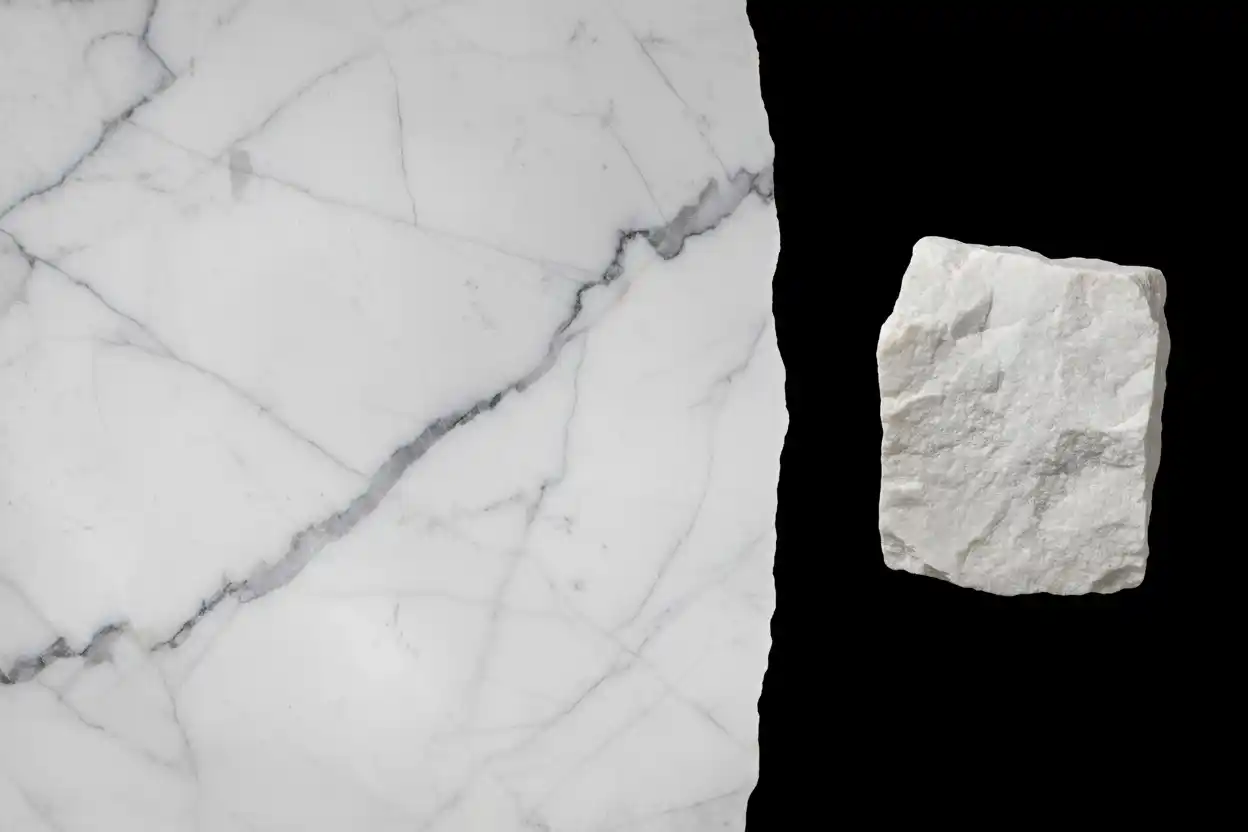
Marble: Meaning, Properties & Uses
Marble is a crystalline metamorphic rock formed when heat, pressure, and chemically active fluids recrystallize limestone or dolostone. Most marble consists mainly of calcite, dolomite, or a mixture of the two, although accessory minerals can produce green, pink, red, gray, black, gold, and strongly veined varieties.
Unlike a single mineral species, marble has no universal chemical formula, crystal system, or hardness. Each piece reflects the composition of its original carbonate rock and the geological conditions that changed it.
Marble at a Glance
| Property | Marble |
|---|---|
| Material type | Metamorphic rock and lapidary material |
| Main composition | Usually calcite, dolomite, or both |
| Possible accessory minerals | Quartz, mica, graphite, serpentine minerals, tremolite, diopside, iron oxides, pyrite, feldspar, and others |
| Common colors | White, cream, gray, black, green, pink, red, yellow, brown, and multicolored |
| Crystal system | No single crystal system applies to the rock |
| Texture | Interlocking crystalline grains; fine- to coarse-grained |
| Luster | Dull when rough; waxy to vitreous after polishing |
| Transparency | Usually opaque; thin edges may be translucent |
| Mohs hardness | Commonly about 3 for calcitic marble and 3.5–4 for dolomitic marble; accessory minerals may be harder |
| Cleavage | The rock has no single cleavage; calcite and dolomite grains have rhombohedral cleavage |
| Tenacity | Brittle; edges and grain boundaries can chip |
| Common uses | Architecture, sculpture, tiles, carvings, beads, cabochons, spheres, inlay, and decorative objects |
| Main care concern | Acids, scratching, staining, impact, and abrasive cleaning |
Marble Is a Rock, Not a Mineral
A mineral has a relatively defined composition and an ordered internal structure. By contrast, a rock consists of one or more minerals assembled through geological processes. This distinction places marble alongside the rock and lapidary materials described in the broader types of gemstones guide.
Calcitic marble consists predominantly of calcite, whose formula is CaCO₃. Dolomitic marble contains substantial dolomite, CaMg(CO₃)₂.
Some pieces approach a nearly single-mineral composition. Nevertheless, even a visually pure white marble may contain small amounts of mica, quartz, graphite, iron-bearing minerals, or silicates. Those accessory components can significantly change color, polish, durability, and reaction to acids.
Because composition varies, assigning one formula or crystal system to every marble would be misleading. A calcite crystal inside marble remains trigonal, but the marble itself is a polycrystalline rock.
How Marble Forms
Marble begins as limestone, dolostone, or another carbonate-rich sedimentary rock. Burial, mountain-building, intrusion of hot magma, or fault-related deformation then exposes that rock to elevated temperature and pressure.
During metamorphism, the original carbonate grains recrystallize. Tiny sedimentary particles grow into a mosaic of larger, interlocking crystals, often erasing fossils, bedding, pores, and other features inherited from the original rock.
Contact metamorphism forms marble where magma heats nearby carbonate rock. Regional metamorphism acts across larger areas during tectonic compression and mountain building. Meanwhile, chemically active fluids can add or remove elements and create new minerals within the marble.
Pure limestone may produce white calcitic marble. However, an impure limestone containing clay, silica, iron, organic matter, or magnesium can produce a far more complex rock. Consequently, metamorphism may form mica, graphite, garnet, diopside, tremolite, wollastonite, serpentine minerals, or other accessory phases.
The final grain size depends on temperature, time, fluid activity, and deformation. Fine-grained marble supports detailed carving, while coarse-grained marble may display a more visibly sparkling crystalline texture.
What Creates Marble’s Colors and Veins?
Pure calcite and dolomite are colorless or white. Most marble colors therefore come from impurities, mineral inclusions, alteration, and structural features.
Graphite and organic carbon can create gray or black areas. Iron oxides produce red, orange, yellow, and brown tones, while chlorite, serpentine minerals, diopside, and other silicates can contribute green.
Pink and reddish marble may contain iron oxides, hematite, manganese-bearing minerals, or colored silicates. Blue-gray material can owe its appearance to graphite, fine mineral inclusions, or light scattering within the crystalline texture.
Veins commonly represent fractures that later filled with calcite, quartz, iron oxides, or other minerals. Deformation may fold, stretch, or break those veins, producing the dramatic patterns valued in sculpture and decorative work.
Not every dark line is a crack. Some lines mark stable mineral bands, while others are healed fractures. However, open fractures, crumbly seams, and undercut veins may weaken a cabochon or carving.
Geological Marble and Commercial “Marble”
Geologists use marble for metamorphosed carbonate rock. The dimension-stone and decorative-stone trades use the word more broadly for many stones that accept a polish.
Commercial marble may include unmetamorphosed limestone, travertine, serpentinite, banded carbonate stone, or other decorative rocks. Therefore, a trade label does not always describe geological marble.
“Onyx marble,” for example, usually refers to translucent banded calcite or aragonite deposited from spring water. It is not the microcrystalline quartz material covered in the onyx guide. Its carbonate composition instead connects it more closely with calcite and aragonite.
Green stones sold as marble may contain substantial serpentine-group minerals. Some qualify as serpentinite rather than true carbonate marble, so their properties may resemble serpentine more closely than calcite.
Accordingly, buyers should treat names such as marble, jade marble, onyx marble, and serpentine marble as starting points rather than complete identifications.
Important Marble Varieties and Sources
Carrara marble from Tuscany, Italy, includes famous white and blue-gray stones quarried from the Apuan Alps. Its relatively fine texture and ability to take a detailed finish have supported architectural and sculptural use for centuries.
Makrana marble from Rajasthan, India, is a white calcitic marble used for buildings, monuments, carving, and decorative work. Fine-grained, low-porosity material can take a smooth polish and hold carved details.
Vermont has produced white, gray, green, and other commercial marbles. The state’s quarry districts include both calcitic and dolomitic deposits with long histories in dimensional stone and architectural work.
Connemara marble from western Ireland is a distinctive green decorative stone derived from metamorphosed dolomitic material. Its colors and mottled patterns reflect a complex mixture of carbonate and silicate minerals. It commonly appears in beads, pendants, small carvings, and regional souvenir jewelry.
Other notable marble regions include Greece, Turkey, Spain, Portugal, Pakistan, China, Afghanistan, and numerous parts of the United States. However, a country name alone does not confirm a specific quarry or commercial variety.
For lapidary pieces, accurate provenance requires documentation. Pattern recognition may suggest a source, but similar colors and veins can occur in unrelated deposits.
Identifying Natural Marble
Natural marble usually displays interlocking crystalline grains rather than a glassy, granular, or resin-like texture. A freshly broken calcitic surface may sparkle because light reflects from many small cleavage faces.
Most calcitic marble scratches more easily than glass. Dolomitic material can be slightly harder, while quartz-rich or silicate-rich marble may contain local areas that resist scratching.
Cold dilute acid produces strong effervescence on calcitic marble. Dolomitic marble reacts more slowly unless powdered or scratched. However, acid testing permanently etches polished surfaces and should never be attempted on finished jewelry, sculptures, or valuable specimens.
A hand lens can reveal grains, veins, pores, repaired fractures, and mineral boundaries. The systematic approach in how to identify crystals also helps distinguish visual clues from tests that damage the object.
Professional laboratories and geological services can use thin-section microscopy, Raman spectroscopy, X-ray diffraction, elemental analysis, or carbonate staining methods. These techniques can separate calcitic marble, dolomitic marble, quartzite, serpentinite, manufactured stone, and commercial substitutes.
Marble Compared with Quartzite
Marble and quartzite can both show interlocking crystalline textures, pale colors, and decorative veining. However, their dominant minerals produce very different properties.
Calcite marble usually has a Mohs hardness near 3 and reacts readily with acid. Quartzite consists mainly of quartz, measures near 7, and resists ordinary weak acids.
Marble can be scratched by a steel point or quartz grain. Quartzite commonly scratches glass and may damage a steel blade rather than accepting a clear scratch from it.
These differences matter in jewelry, carving, countertops, and flooring. A mislabeled quartzite may tolerate abrasion better than marble, while a mislabeled marble can etch when exposed to acidic cleaners or foods.
Is Marble a Gemstone?
Marble does not meet the strict definition of a single gem mineral. Nevertheless, the lapidary and jewelry trades use attractive marble as an ornamental gem material.
Fine-grained marble can be cut into cabochons, beads, cameos, intaglios, inlay, pendants, spheres, boxes, and small sculptures. Its value comes from color, pattern, provenance, carving quality, cultural associations, and craftsmanship rather than transparency or faceting performance.
Most marble remains opaque and too soft for conventional brilliant faceting. Instead, domed cabochons and polished carvings emphasize its veining and crystalline texture.
Marble also undercuts along softer grains or fractured veins. Therefore, lapidaries must adapt their abrasives and polishing compounds to each piece rather than treating all marble as uniform material.
Jewelry Suitability and Durability
Marble works best in earrings, pendants, brooches, beads, cufflinks, and protected cabochons. These formats reduce direct impact and abrasion while allowing the natural pattern to remain visible.
Rings expose marble to harder surfaces, dust, cosmetics, hand sanitizer, acidic food, and repeated knocks. A low-profile bezel can protect the edge, but it cannot prevent surface etching or scratches.
Calcitic marble ranks near 3 on the Mohs scale. Consequently, quartz dust and many common gemstones can scratch it. The gemstone hardness chart helps place that softness in practical context.
Hardness also does not describe resistance to breaking. Marble may chip at grain boundaries, along veins, or around drilled holes, as explained in gemstone toughness versus hardness.
Beads should have clean drill holes without radiating cracks. Meanwhile, carved edges should feel solid rather than chalky or granular.
Treatments and Imitations
Manufacturers may fill pores and fractures with resin, polyester, epoxy, or cementitious material. Fillers can stabilize weak areas, improve polish, or create a more uniform surface.
Dyes may intensify green, blue, black, red, or other colors. Because marble can contain pores and fractures, colorants may concentrate around veins, edges, drill holes, and repaired areas.
Wax, oil, and sealers can darken the surface temporarily and reduce staining. Clear coatings may produce a high gloss that differs from the polish of the underlying stone.
Reconstituted marble combines crushed carbonate stone with resin or cement. Engineered products can be useful decorative materials, but sellers should not describe them as solid natural marble.
Printed ceramic, glass, plastic, and resin can imitate marble veining. Repeated patterns, mold seams, round bubbles, unusually light weight, and surface-only designs may indicate an imitation. Broader warning signs appear in the fake-crystal buying guide.
Resin filling, dyeing, coating, and impregnation are established enhancement methods rather than proof of fraud when properly disclosed. Their purposes are explained in gemstone treatments.
Current Marble Asking Prices
The following ranges apply to lapidary, jewelry, and small decorative marble products rather than architectural slabs, flooring, or commissioned sculpture.
| Marble product | Broad retail asking range |
|---|---|
| Small tumbled piece or simple cabochon | About $2–$15 |
| Common bead strand | About $5–$30 |
| Connemara or named-locality bead strand | About $20–$60 |
| Simple pendant, earrings, or brooch | About $20–$100 |
| Palm stone or small polished freeform | About $10–$50 |
| Medium polished sphere | About $30–$150 |
| Small hand carving | About $25–$150 |
| Large or detailed decorative carving | About $100–$500 or more |
| Signed, antique, or documented sculptural work | From several hundred dollars to substantially more |
These figures represent broad retail asking prices, not appraisals or likely resale values. Precious metal, artist reputation, documented age, and carving quality can outweigh the raw stone’s cost.
What Gives Marble Value?
Color and pattern create the first impression. Strong veining, balanced contrast, unusual green or red coloration, and an attractive distribution of mineral bands generally increase decorative appeal.
Fine grain supports detailed carving and a smoother finish. By contrast, coarse grains may sparkle attractively but can chip around small features.
Structural condition also matters. Stable healed veins can enhance the design, while open cracks, soft fillings, pits, and undercut minerals reduce durability.
A verified locality can add regional, historical, or collector interest. Carrara, Makrana, Vermont, and Connemara labels carry greater meaning when accompanied by reliable documentation.
Craftsmanship often contributes most of the finished value. A precisely carved cameo or balanced cabochon can be worth far more than a larger but poorly finished piece.
Finally, sellers should distinguish natural marble from reconstituted, resin-bound, dyed, or generically named decorative stone.
Buying Marble for Jewelry or Collecting
First determine whether the item is true metamorphic marble or a product using the word commercially. Ask for the dominant mineral, source, treatment, and whether fractures have been filled.
Examine the surface under angled light. This reveals scratches, dull acid etching, resin patches, polishing marks, and chips that front-facing photographs may conceal.
Check the reverse side and drill holes for concentrated dye or filler. A natural color pattern should usually continue into exposed edges rather than ending abruptly at the surface.
For beads, compare hole quality and shape consistency. Slight natural variation is expected, but crumbly holes suggest weak material or careless drilling.
Select jewelry according to intended wear. Earrings and pendants tolerate softer marble better than bracelets and rings.
Marble appears in both the crystals beginning with M directory and the gemstones beginning with M directory, although its correct geological classification remains a metamorphic rock.
Cleaning and Storage
Remove loose dust with a soft dry cloth. When washing becomes necessary, use lukewarm water, a small amount of pH-neutral soap, and a soft cloth or brush.
Keep contact brief, particularly when the item contains dye, filler, glue, porous matrix, or delicate metalwork. Dry the piece immediately.
Avoid vinegar, lemon juice, bathroom descalers, acidic jewelry solutions, and harsh household cleaners. Even weak acids can dissolve calcite and leave dull etched patches.
Steam and ultrasonic cleaners may enlarge fractures, loosen fillings, damage glue, or separate weak grains. Abrasive toothpaste and scouring powders will also scratch the polish.
Store marble separately from quartz, topaz, corundum, and other hard materials. A padded compartment protects polished surfaces and fragile carved edges.
Although intact marble can tolerate brief contact with water, the guide to water-sensitive crystals explains why mixed composition and treatment must also be considered.
Marble Meaning and Symbolism
Marble’s long use in architecture, sculpture, monuments, memorials, and sacred spaces has connected it culturally with permanence, craftsmanship, dignity, remembrance, and enduring beauty.
White marble often symbolizes clarity, restraint, purity of form, or a fresh beginning. Green marble can inspire associations with nature, growth, and place, while black marble may suggest formality, depth, or solemnity.
Modern spiritual interpretations sometimes connect marble with patience, stability, discipline, and turning pressure into refinement. These ideas draw directly from the rock’s metamorphic formation.
Such meanings remain cultural, artistic, spiritual, or personal. Scientific evidence does not show that marble produces guaranteed emotional or medical effects.
Frequently Asked Questions
Is marble a mineral or a rock?
Marble is a metamorphic rock. It usually contains interlocking calcite or dolomite grains along with variable accessory minerals.
Can marble be considered a gemstone?
Attractive marble can function as an ornamental gem material in beads, cabochons, inlay, and carvings. However, it is not a single gem mineral.
How does calcitic marble differ from dolomitic marble?
Calcitic marble contains mostly calcium carbonate and usually reacts vigorously with dilute acid. Dolomitic marble contains substantial calcium-magnesium carbonate, tends to be slightly harder, and reacts more slowly.
Why does natural marble have veins?
Veins may form when mineral-rich fluids fill fractures or when metamorphism stretches and folds pre-existing layers. Calcite, quartz, iron oxides, and silicate minerals can all form veins.
How can I recognize natural marble?
Look for an interlocking crystalline texture, natural variation, mineral veins, and appropriate weight. Laboratory testing may be necessary when resin, ceramic, quartzite, or other stones imitate it.
What separates marble from quartzite?
Marble is carbonate-rich, relatively soft, and acid-sensitive. Quartzite consists mainly of quartz, is much harder, and does not readily react with ordinary weak acids.
Is “onyx marble” genuine onyx?
Usually not. Onyx marble is generally a translucent banded carbonate stone, whereas true onyx is a variety of microcrystalline quartz.
Is marble durable enough for a ring?
Marble can be used in a protected occasional-wear ring, but its softness and tendency to chip make it unsuitable for rough daily wear.
Can marble jewelry get wet?
Brief washing is generally acceptable for solid untreated material. Avoid soaking because dye, glue, filler, porous areas, and metal settings may be affected.
Why does vinegar damage marble?
Vinegar contains acid, which reacts with carbonate minerals and dissolves a microscopic portion of the surface. The result is a dull or rough etched patch.
Is marble commonly dyed or filled?
Some decorative marble receives dye, resin filling, wax, oil, or protective coatings. Sellers should disclose these treatments because they affect appearance and care.
What makes one marble piece more valuable than another?
Pattern, color, grain size, structural stability, locality, natural condition, polish, carving skill, age, and artist attribution all influence value.
Marble rewards close inspection because its beauty comes from geological variation rather than perfect uniformity. Anyone choosing rough for a cabochon, cameo, or sculpture can compare its working behavior with other materials in the guide to gemstones for carving and cabochons.
Cutting, sanding, or polishing marble can release fine carbonate and silica-bearing dust, depending on its composition. Use wet-working methods, suitable eye and respiratory protection, and effective dust extraction rather than dry grinding.