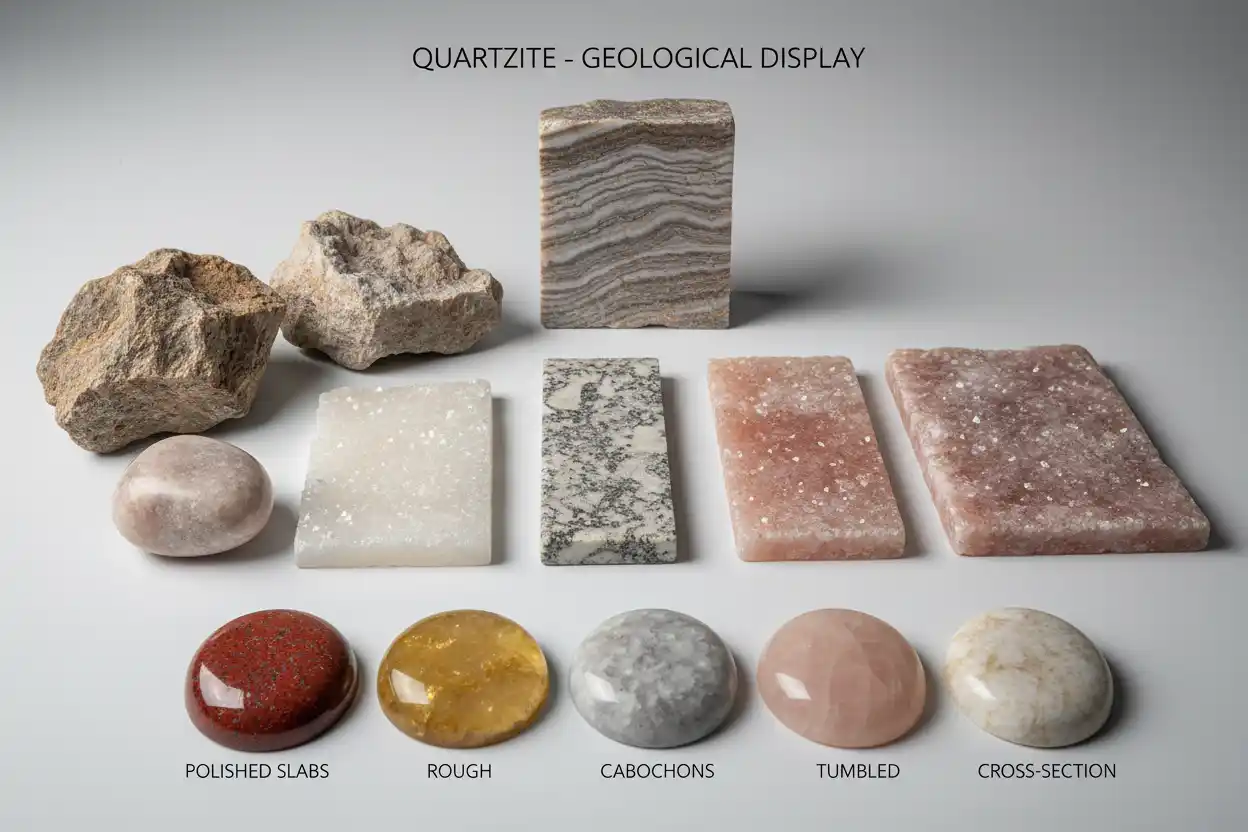
Quartzite Meaning, Properties, Identification & Uses
Quartzite is a dense, quartz-rich metamorphic rock formed when sandstone or another silica-rich sedimentary rock recrystallizes under heat, pressure, and chemically active fluids. The original sand grains and silica cement become an interlocking mosaic that is generally harder and more resistant than the parent sandstone.
Pure Quartzite is usually white or pale gray, while iron oxides, mica, feldspar, chlorite, fuchsite, kyanite, and other accessory minerals can produce pink, red, yellow, green, blue-gray, black, or multicolored material. It is used for architectural stone, countertops, road aggregate, tools, decorative objects, beads, and cabochons.
Quartzite at a Glance
| Property | Quartzite |
|---|---|
| Material type | Quartz-rich metamorphic rock |
| Typical parent rock | Quartz sandstone, quartz arenite, chert, or another silica-rich sedimentary rock |
| Main composition | Interlocking quartz grains, commonly more than 90% quartz in relatively pure material |
| Additional minerals | Feldspar, mica, hematite, magnetite, chlorite, fuchsite, kyanite, zircon, rutile, clay-derived minerals, and other accessory phases |
| Common colors | White, gray, cream, pink, red, yellow, orange, green, blue-gray, brown, and black |
| Crystal system | No single external system applies to the rock; quartz grains are trigonal |
| Typical texture | Granoblastic, interlocking, massive, sugary, banded, or locally foliated where mica is abundant |
| Luster | Dull to vitreous; polished surfaces can appear glassy or sparkling |
| Transparency | Usually opaque, with locally translucent thin areas |
| Mohs hardness | Commonly near 7 in quartz-rich areas |
| Cleavage | None for the quartz-rich rock |
| Tenacity | Brittle but mechanically strong in intact massive sections |
| Common uses | Countertops, flooring, cladding, aggregate, paving, tools, sculpture, slabs, cabochons, beads, and decorative objects |
| Main care concern | Brittle edges, natural fractures, resin-filled slabs, staining in impure material, mislabeling, and respirable silica dust during fabrication |
Quartzite Is a Rock, Not a Quartz Crystal
Quartzite and Quartz share a dominant chemical component, but they are not the same geological object.
Quartz is a mineral species with the formula SiO₂. It can form individual six-sided crystals, grains, veins, and microcrystalline aggregates.
Quartzite is a rock composed of numerous quartz grains that recrystallized and became tightly interlocked. Accessory minerals may remain between the grains or form bands, spots, veins, and colored layers.
Consequently, Quartzite has no single crystal habit or one universal formula beyond its quartz-rich character.
Its correct position within gem and ornamental classifications is explained by the distinction among minerals and multi-mineral rocks in types of gemstones.
How Quartzite Forms
Quartzite most commonly begins as a sandstone composed largely of quartz grains.
Burial carries the sediment into environments with greater pressure and temperature. Mountain building, crustal compression, nearby magma, and circulation of hot mineral-rich fluids can provide the conditions needed for metamorphism.
Quartz dissolves slightly where neighboring grains touch. Silica then recrystallizes around and between those grains.
As the process continues, the original rounded grain boundaries become increasingly difficult to distinguish. A tightly interlocking mosaic replaces the weaker sedimentary texture.
The rock may preserve original bedding, cross-bedding, heavy-mineral layers, or color bands even after substantial recrystallization.
More intense deformation can flatten or stretch impurity-rich zones. Nevertheless, relatively pure Quartzite generally remains non-foliated because equidimensional quartz grains do not align into sheets like mica.
Quartzite versus Sandstone
Sandstone usually breaks around individual grains or through the cement between them.
True metamorphic Quartzite tends to break across the former grains because recrystallization has fused the texture into an interlocking mass.
A fresh Quartzite surface may therefore look granular but lack the loose, gritty feel of weak sandstone.
Some extremely hard silica-cemented sandstone is called orthoquartzite. It can resemble metamorphic Quartzite and resist weathering strongly even though its sedimentary grains were not fully recrystallized.
The distinction may require a fresh broken surface or thin-section microscopy. Commercial stone names do not always separate the two carefully.
A seller should avoid using hardness alone as proof because both silica-cemented sandstone and metamorphic Quartzite can scratch glass.
Quartzite versus Engineered Quartz
Engineered quartz is a manufactured product made from quartz particles, pigments, polymers, and other additives.
Quartzite is a naturally formed metamorphic rock quarried as blocks and slabs.
Engineered surfaces often show repeated patterns, uniform distribution of aggregate, resin-rich texture, and relatively predictable coloration.
Natural Quartzite usually contains irregular mineral veins, changes in grain size, fractures, folding, and geological variation across a slab.
The name quartz countertop is frequently used for engineered material, while Quartzite countertop should refer to natural stone. Retailers sometimes confuse these terms, particularly when selling pale marble-like slabs.
Resin treatment can be present in either product. Therefore, the use of polymer does not by itself establish that an entire slab is engineered.
Quartzite versus Marble
Marble forms when limestone or dolostone recrystallizes.
Quartzite consists mainly of silica, whereas marble consists principally of calcite, dolomite, or related carbonate minerals.
Quartz-rich Quartzite normally scratches glass and resists weak household acids. Calcite marble is softer and can be etched by lemon juice, vinegar, and acidic food.
Dolomitic marble may react more slowly, but it remains softer than true Quartzite.
The countertop trade has sometimes sold marble or dolomitic marble under Quartzite-inspired commercial names because both can show pale flowing veins.
Acid tests permanently damage polished stone and should be performed only by professionals on inconspicuous samples.
Petrographic analysis, hardness, mineral reaction, and supplier documentation provide a stronger conclusion than the sales name alone.
Quartzite Colors
Relatively pure Quartzite is white, cream, or pale gray.
Hematite creates many pink, red, and reddish-brown colors. Fine iron staining can spread through grain boundaries and fractures.
Goethite and related iron-weathering compounds produce yellow, ochre, orange, and brown.
Magnetite, graphite, dark mica, carbonaceous material, and heavy minerals can create gray or black areas.
Green may come from chlorite, epidote-group minerals, amphiboles, or chromium-bearing mica such as Fuchsite.
Blue-gray tones can reflect fine mineral inclusions, light scattering, dumortierite-like phases, kyanite, or other deposit-specific minerals.
One rock can contain several bands because the original sandstone incorporated layers with different sediments before metamorphism.
Fuchsitic Quartzite and Aventurine
Chromium-bearing mica can give Quartzite a green color and sparkling surface.
Some massive green rocks sold as fuchsite Quartzite contain abundant quartz with flakes of fuchsite distributed through the matrix.
Aventurine is also a quartz-rich material known for glittering aventurescence from reflective mineral platelets.
Commercial boundaries overlap. A green sparkling rock may be described as Aventurine, fuchsite Quartzite, or quartz-mica rock according to texture, tradition, and seller preference.
The presence of fuchsite does not make every green Quartzite high-grade Aventurine. The optical sparkle, mineral proportions, structure, and polish should be evaluated directly.
Kyanite- and Mica-Bearing Quartzite
Impure sandstone can contain clay minerals that recrystallize into mica, garnet, staurolite, sillimanite, or Kyanite during metamorphism.
Blue kyanite blades inside white Quartzite create attractive mineral specimens and occasional decorative slabs.
Mica-rich Quartzite may develop a weak planar texture and split more readily than massive pure material.
These accessory minerals can also create uneven hardness. Quartz remains near Mohs 7, while mica-rich bands abrade faster.
A polished object should therefore be evaluated as the complete rock rather than assigned quartz’s durability without qualification.
Important Quartzite Regions
Quartzite occurs on every continent and forms many prominent ridges because it resists weathering.
Major geological units include the Baraboo Quartzite of Wisconsin, the Sioux Quartzite of the upper Midwestern United States, the Prospect Mountain Quartzite of the Great Basin, and extensive Precambrian and Paleozoic formations in Europe, Africa, Asia, Australia, and South America.
Brazil, India, Italy, Norway, South Africa, the United States, and several other countries supply dimension-stone slabs marketed as Quartzite.
Commercial names such as Taj Mahal, Cristallo, Azul Macaubas, Fusion, Patagonia, and Mont Blanc refer to quarry or design markets rather than one uniform geological grade.
Some stones sold through the countertop market contain substantial feldspar, mica, carbonate, or other phases. A decorative trade name should not replace petrographic identification.
Historical and Industrial Uses
Quartzite’s hardness made it useful for prehistoric cutting tools, hammerstones, projectile points, and grinding implements.
It remains important as crushed aggregate for roads, railway ballast, and construction.
High-silica Quartzite can serve as raw material for ferrosilicon, silicon metal, refractories, and specialized silica products.
Dimension-stone grades are quarried for floors, stairs, facades, landscaping, paving, monuments, and countertops.
Lapidaries cut colorful material into cabochons, beads, palm stones, spheres, bookends, and carvings.
The interlocking grain structure can accept a strong polish, although fractures and mixed minerals affect the result.
Its use in non-faceted ornamental work overlaps the materials described in the best gemstones for carving.
How to Identify Quartzite
A fresh surface should show tightly fused quartz grains rather than loose sand.
Quartz-rich material normally scratches ordinary glass and resists a steel point, although destructive testing should not be performed on a finished object.
Quartzite usually has no visible cleavage. It fractures across grains with an uneven-to-conchoidal surface.
Magnification may reveal an interlocking mosaic, flattened quartz boundaries, mica flakes, iron oxides, feldspar, accessory minerals, resin, and polishing marks.
A geologist can prepare a thin section and examine the texture under polarized light.
Raman spectroscopy identifies exposed mineral grains, while X-ray diffraction and petrography can determine whether the slab is quartz rich, carbonate rich, or mixed.
The broader testing sequence in how to identify crystals helps separate physical observations from a commercial label.
Common Mislabeling
Marble and dolomitic marble are among the most important substitutes in the architectural market.
Quartz-rich sandstone can be called Quartzite even when metamorphism remains limited.
Engineered quartz may be marketed with shortened wording that allows buyers to assume it is natural stone.
Dyed quartzite, resin-bound aggregate, ceramic, and concrete can imitate polished decorative rock.
White or green material may also be mislabeled as jade, Aventurine, Snow Quartz, or rare crystal simply because it accepts a polish.
Artificially repeated veining, pooled resin, mold seams, uniform aggregate, and identical patterning across several slabs provide warning signs.
The broader signs of composites, dye, coatings, and misleading certificates appear in how to spot fake crystals.
Treatments and Slab Processing
Natural Quartzite may contain fractures and porous impurity zones that need reinforcement during fabrication.
Clear resin can fill cracks, improve surface continuity, and strengthen thin slab areas.
Mesh or fiberglass backing is commonly applied to vulnerable architectural slabs.
Sealants reduce staining by oil, food, cosmetics, and environmental contaminants. A sealer does not make the stone scratch proof or permanently stain proof.
Dye and pigment can deepen or unify color in lower-grade decorative material.
Coatings can add gloss but may scratch, cloud, or yellow.
Lapidary cabochons can also be stabilized when mica-rich or fractured zones would otherwise separate.
Treatments should be disclosed because they influence cleaning, refinishing, repair, and value. Their broader definitions appear in gemstone treatments explained.
Durability in Jewelry and Decorative Use
Quartz-rich Quartzite generally approaches Mohs hardness 7.
Its scratch resistance can be compared on the gemstone hardness chart.
The material lacks quartz’s mineral cleavage but remains brittle as a rock. Veins, mica bands, former bedding planes, and natural fractures may break under impact.
The distinction between scratch resistance and structural durability appears in gemstone toughness versus hardness.
Sound cabochons work well in pendants, earrings, bracelets, bolo ties, and protected rings.
A bezel supports the perimeter more effectively than widely spaced prongs.
Countertops resist ordinary abrasion but can chip along exposed edges, sink cutouts, and unsupported corners.
Hot cookware should not be placed directly on resin-treated or sealed surfaces because the treatment and substrate can respond differently to thermal shock.
Current Quartzite Asking Prices
Quartzite occupies separate lapidary, specimen, landscaping, and architectural markets.
| Quartzite product | Broad July 2026 retail asking range |
|---|---|
| Small tumbled or pocket stone | About $2–$10 |
| Standard cabochon | About $5–$30 |
| Colorful or mineral-rich designer cabochon | About $20–$100 |
| Bead strand | About $10–$50 |
| Pendant or simple jewelry | About $20–$150 |
| Small polished slab or display piece | About $15–$100 |
| Sphere, carving, or large freeform | About $30–$300 |
| Decorative cutting board or small architectural piece | About $75–$250 |
| Full natural-stone slab | Commonly about $2,000–$6,000 before fabrication, depending on type and market |
| Installed countertop | Commonly about $65–$200 per square foot or more |
These figures represent broad current asking ranges rather than appraisals or guaranteed project quotations.
Architectural cost depends on slab rarity, thickness, fabrication, edge profile, transport, installation, waste, reinforcement, and geographic market.
What Gives Quartzite Value?
Mineral composition determines the market first. A common gray landscaping rock, green fuchsite-rich cabochon, and translucent architectural slab follow different pricing systems.
Color and pattern drive decorative value.
Fine veining, translucency, dramatic folding, contrasting accessory minerals, and balanced distribution generally attract stronger demand.
Structural integrity is essential. Open fractures, crumbly mica bands, large resin areas, and hidden backing reduce independent strength.
Lapidary pieces benefit from even polish and thoughtful pattern orientation.
Architectural slabs gain value through large usable dimensions, consistent thickness, attractive bookmatching, and limited defects.
Reliable geological identification matters because a softer acid-sensitive marble should not receive a Quartzite durability premium.
Buying Quartzite
Determine whether the product is natural metamorphic Quartzite, silica-cemented sandstone, marble, or engineered quartz.
Ask for the geological or petrographic classification rather than relying only on the slab name.
Inspect the full surface for resin-filled fractures, mesh backing, open veins, rust-prone minerals, and color variation.
For jewelry, request photographs of the back and edges so the grain structure, treatment, and pattern continuity remain visible.
Confirm whether dye, resin, coating, wax, or another treatment is present.
Avoid paying a gemstone rarity premium for ordinary construction-grade rock that has merely been polished.
Quartzite is indexed through the crystals beginning with Q directory and the gemstones beginning with Q directory.
Cleaning and Storage
Clean a polished lapidary piece with lukewarm water, mild soap, and a soft cloth or brush.
Rinse briefly and dry it thoroughly.
Avoid soaking material with mica bands, resin, dye, glue, backing, or open fractures. The broader limitations appear in which crystals can and cannot go in water.
Store jewelry separately from diamond, sapphire, ruby, and other harder gems.
For countertops, use pH-neutral stone cleaner and wipe spills promptly. Avoid abrasive pads, strong alkalis, acidic cleaners, and products that can affect sealant.
Heavy slabs require professional support and handling. An unsupported corner can fracture despite the rock’s high scratch resistance.
The difference between untreated rough and processed decorative pieces is also relevant to raw versus polished crystals.
Quartzite Meaning and Symbolism
Modern crystal traditions associate Quartzite with endurance, consistency, adaptation, and building strength through gradual pressure.
Its formation from loose sand into an interlocking rock provides a direct metaphor for separate experiences becoming part of a more stable structure.
Preserved sedimentary bands can symbolize memory and the persistence of earlier stages through transformation.
Green material receives associations with renewal and practical growth, while red and pink Quartzite are linked with motivation and warmth.
These interpretations remain personal, artistic, cultural, or spiritual. Scientific evidence does not show that Quartzite treats illness, strengthens bones, improves endurance, or guarantees emotional stability.
Frequently Asked Questions
Is Quartzite a mineral?
No. Quartzite is a metamorphic rock composed mainly of interlocking quartz mineral grains.
How does sandstone become Quartzite?
Heat, pressure, and chemically active fluids recrystallize the sand grains and silica cement into a tightly interlocking texture.
Is Quartzite the same as Quartz?
No. Quartz is a mineral species, while Quartzite is a rock made primarily from numerous quartz grains.
Is Quartzite the same as engineered quartz?
No. Quartzite is natural metamorphic rock. Engineered quartz is manufactured from quartz particles, pigments, and polymer binder.
How can Quartzite be distinguished from sandstone?
Quartzite tends to break across fused grains, while sandstone more commonly breaks around grains or through its cement.
How can Quartzite be distinguished from marble?
Quartzite is harder and silica rich. Marble is carbonate rich, softer, and usually reacts with acid.
What colors can Quartzite show?
White, gray, cream, pink, red, yellow, orange, green, blue-gray, brown, and black occur according to accessory minerals.
Is green Quartzite always Aventurine?
No. Green Quartzite can contain fuchsite, chlorite, epidote, or other minerals without displaying the aventurescence required for fine Aventurine.
Is Quartzite suitable for rings?
Sound material can be used in a protected setting, although fractures and mixed-mineral bands can still chip.
Is Quartzite commonly treated?
Architectural and lapidary material may be resin filled, sealed, backed, dyed, stabilized, or coated.
Can Quartzite go in water?
Brief washing is normally suitable for intact untreated material. Avoid soaking stones containing resin, dye, glue, backing, mica-rich bands, or open fractures.
What makes Quartzite valuable?
Color, pattern, translucency, mineral associations, structural integrity, polish, slab size, quarry identity, treatment disclosure, and craftsmanship determine value.
Quartzite is best understood as the metamorphic result of quartz-rich sediment rather than as a large Quartz crystal. Its interlocking texture explains both its resistance to weathering and its usefulness in lapidary and architectural work.
Cutting, drilling, grinding, polishing, or dry-sweeping Quartzite can release high concentrations of respirable crystalline-silica dust. Use wet fabrication, effective local exhaust, suitable respiratory protection, eye protection, protective clothing, and strict dust-control procedures.