
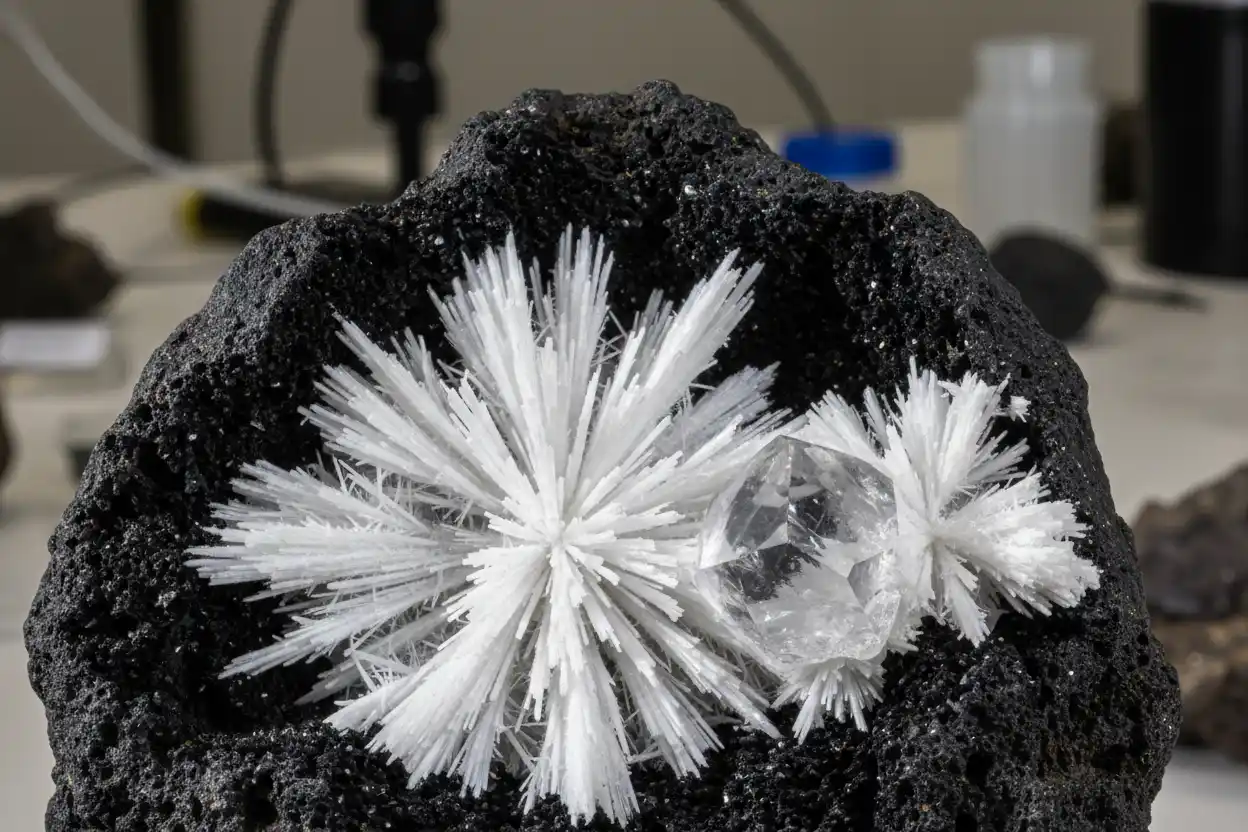

Natrolite is a hydrated sodium aluminosilicate mineral in the zeolite group. It is best known for slender white or colorless crystals that form sprays, radiating tufts, spherical clusters, and dense fibrous masses inside cavities in volcanic rocks.
Although transparent crystals can be faceted, most natrolite is collected as a mineral specimen rather than worn as a gemstone. Its brittle prismatic cleavage, delicate needle-like habit, low density, and water-bearing crystal framework require careful handling.
Natrolite at a Glance
| Property | Natrolite |
|---|---|
| Material type | Zeolite-group mineral and hydrated tectosilicate |
| Composition | Na₂Al₂Si₃O₁₀·2H₂O |
| Main structural cation | Sodium |
| Common colors | Colorless, white, cream, gray, pale yellow, pink, reddish, brownish, and occasionally greenish |
| Crystal system | Orthorhombic |
| Typical habit | Slender prismatic, acicular, radiating, fibrous, tufted, spherical, botryoidal, compact, or cavity-lining |
| Luster | Vitreous on crystals; silky or pearly in fibrous aggregates |
| Transparency | Transparent to translucent |
| Mohs hardness | Approximately 5–5.5, sometimes reported across a slightly wider range |
| Cleavage | Perfect prismatic cleavage |
| Tenacity | Brittle |
| Specific gravity | Approximately 2.2–2.3 |
| Common uses | Mineral specimens, teaching collections, rare faceted gems, polished eggs, spheres, cabochons, and geological study |
| Main care concern | Broken needle tips, cleavage, impact, acids, heat-driven water loss, and damage to fragile matrix specimens |
Natrolite within the Zeolite Group
Natrolite belongs to the family described in the zeolite guide. That parent page owns the shared framework structure, ion-exchange behavior, channel systems, and broad industrial significance of zeolite minerals.
At species level, natrolite is sodium-dominant and has the formula Na₂Al₂Si₃O₁₀·2H₂O. Water molecules occupy spaces within its aluminosilicate framework.
The name comes from words meaning soda and stone, referring to its sodium content. “Needle zeolite” is an informal descriptive name based on its common acicular habit.
Natrolite should not be used as a generic name for every white fibrous zeolite. Scolecite, mesolite, thomsonite-group minerals, and other species can produce similar sprays.
Precise identification matters because closely related zeolites can differ in chemistry, crystal symmetry, optical behavior, dehydration response, and locality.
Crystal Structure and Water Content
Natrolite’s framework consists of linked silicon-oxygen and aluminum-oxygen tetrahedra. Sodium ions and water molecules occupy channels within that framework.
The water is part of the mineral’s natural structure but is not bonded in the same way as hydroxyl groups in many other minerals. Heating can drive it from the channels and cause contraction or structural change.
Moderate ambient conditions do not normally cause a display specimen to collapse. Nevertheless, high heat, a jeweler’s torch, steam, or prolonged exposure to hot dry conditions can alter a zeolite more than they would affect quartz.
Rehydration behavior is complex. Some changes may reverse when water returns, while stronger heating can produce incomplete recovery or permanent structural alteration.
Therefore, an intact natrolite specimen should not be intentionally heated to “cleanse,” dry, sterilize, or test it.
How Natrolite Forms
Natrolite most commonly forms through low-temperature hydrothermal alteration. Mineral-rich water circulates through cavities, fractures, or porous zones in volcanic and alkaline igneous rocks.
Basalt lava can contain gas bubbles that become rounded cavities called vesicles. After the lava solidifies, circulating fluids deposit zeolites, calcite, quartz, and other secondary minerals inside them.
These mineral-filled cavities are called amygdules. Natrolite may line the cavity walls, form radiating sprays, or grow as later crystals over earlier minerals.
Natrolite also occurs in nepheline syenites and related alkaline rocks. In these settings, it may form through late-stage hydrothermal crystallization or alteration of sodium-rich feldspathoid minerals.
Some compact natrolite develops by replacing sodalite or related minerals. Others form veins and fracture fillings rather than open crystal-lined cavities.
Changes in fluid chemistry over time can produce layered associations of natrolite, mesolite, gonnardite, analcime, calcite, and other zeolites.
Crystal Habits
The classic natrolite crystal is a slender prism with a nearly square cross-section and a low pyramidal termination. Because the angles approach 90 degrees, a crystal can look tetragonal even though its symmetry is orthorhombic.
Fine needles grow in divergent groups that resemble hair, frost, fountains, or white sea urchins. In dense clusters, the individual points may be too small to distinguish without magnification.
Radial aggregates can develop rounded surfaces. When cut across the growth direction, they may reveal starburst or spoke-like textures.
Fibrous natrolite produces a silky luster because many parallel crystal surfaces reflect light together. However, “fibrous” is a description of habit and does not mean that natrolite is an asbestos mineral.
Transparent prismatic crystals are much less common than ordinary white sprays. Those clear crystals provide the limited rough used for faceting.
Color and Inclusions
Pure natrolite is colorless or white. Light scattering between tiny crystals can make a transparent material appear milky.
Iron oxides and hydroxides produce yellow, brown, orange, or reddish staining. Manganese-bearing material and inclusions may contribute pink or red.
Clay, chlorite, host-rock fragments, fluid inclusions, and other zeolites can modify color and transparency.
Color zoning may follow crystal growth or later alteration. A white interior with a rusty exterior usually indicates surface staining rather than a different mineral species.
Bright, perfectly uniform pink, blue, or green material deserves closer examination for dye, coating, or incorrect identification.
Natrolite fluorescence varies. A glow under ultraviolet light may support comparison with known locality material, but it does not prove species identity.
Important Natrolite Localities
The type locality is Hohentwiel in the Hegau volcanic region of Germany, where natrolite occurs in volcanic rocks.
The basalt districts of Maharashtra, India, are famous for zeolite-filled cavities. Natrolite may occur with stilbite, heulandite, calcite, apophyllite, scolecite, and other secondary minerals.
The Kola Peninsula in Russia has produced unusually large natrolite crystals and compact material from alkaline igneous complexes.
Mont Saint-Hilaire in Quebec, Canada, is renowned for diverse alkaline-rock minerals, including natrolite associated with rare species.
Puy-de-Dôme in France has yielded radiating white prismatic crystals. Historic occurrences are also known from Bohemia, Norway, Scotland, Northern Ireland, and several regions of the United States.
Oregon localities produce natrolite sprays in basalt cavities, while New Jersey and California have supplied notable specimens and mineral associations.
Locality affects value most when the label identifies a mine, quarry, volcanic field, or alkaline complex rather than only a country.
Natrolite, Scolecite, and Mesolite
Scolecite is a calcium-rich zeolite that also forms white sprays and slender prisms. It has monoclinic symmetry and can show different twinning and optical behavior.
Mesolite contains both sodium and calcium. It commonly forms exceptionally fine, delicate fibers and can occur intergrown with natrolite or scolecite.
Visual separation becomes difficult when crystals are very thin, broken, or intergrown. Locality and association may suggest an identity without proving it.
Laboratory methods such as X-ray diffraction, Raman spectroscopy, and chemical analysis provide much stronger confirmation than appearance.
Commercial sellers sometimes call all three minerals scolecite because that name has stronger retail recognition. A scientifically labeled specimen should preserve the actual identification.
Natrolite, Stilbite, and Heulandite
Stilbite commonly forms sheaf-like, bow-tie, tabular, or bladed crystals rather than straight square-looking needles.
Heulandite generally develops tabular or coffin-shaped crystals with pearly cleavage surfaces. Pink and peach colors are common in commercial specimens.
Natrolite typically appears more sharply prismatic and acicular. Its radiating sprays can look stiffer and more needle-like than stilbite’s curved sheaves.
However, volcanic cavities frequently contain several zeolite species. A mixed specimen should list each confirmed mineral rather than using one name for the entire assemblage.
Apophyllite often occurs with zeolites and can form clear, white, green, or pink crystals. Despite that association, apophyllite is not a zeolite mineral.
How to Identify Natrolite
Crystal habit provides the first clue. Look for slender orthorhombic prisms, nearly square cross-sections, low pyramid terminations, and radial needle sprays.
Natrolite has a white streak and vitreous-to-silky luster. Its low density makes a clean specimen feel lighter than many similarly sized carbonate or metallic minerals.
Its hardness around 5–5.5 allows quartz to scratch it. However, scratch testing can destroy delicate crystals and should not be used on a collector specimen.
Perfect prismatic cleavage contributes to breakage along the length of larger crystals. Needle tips can also snap from slight pressure.
Acid decomposes natrolite and can leave silica residue. This destructive reaction should not be used to identify a finished or valuable specimen.
A microscope may reveal nearly square prisms, striations, terminations, intergrowths, repairs, and associated minerals.
Professional laboratories use X-ray diffraction, Raman spectroscopy, infrared spectroscopy, electron-microprobe analysis, and optical crystallography.
The broader process in how to identify crystals explains why habit, hardness, density, cleavage, and locality must support one another.
Is Natrolite a Gemstone?
Transparent natrolite can be faceted, but suitable rough is scarce and usually small. Finished stones are therefore collector gems rather than mainstream jewelry material.
Faceted natrolite may appear colorless, pale yellow, pink, or lightly tinted. Its modest refractive index produces gentle brilliance rather than diamond-like fire.
The stone’s hardness is adequate for careful handling, yet cleavage and brittleness limit jewelry durability. A thin girdle or sharp corner can chip during setting.
Massive material may be shaped into eggs, spheres, cabochons, palm stones, and carvings. Such pieces can contain natrolite mixed with paranatrolite, host rock, other zeolites, or alteration products.
The classification principles in types of gemstones help distinguish a collectible mineral specimen from a conventional gem material suited to frequent jewelry wear.
Jewelry Suitability
A rare faceted natrolite is best used in a pendant, brooch, or carefully protected collector ring.
Prongs can place pressure on brittle edges. A well-designed bezel distributes contact more evenly, although setting pressure must remain low.
Needle clusters should not be mounted as exposed jewelry. Their points can break, catch fabric, scratch skin, and shed fragments.
Polished massive material is more practical, but its identity and structural uniformity should be confirmed. A mixed zeolite aggregate does not have one guaranteed hardness throughout.
The gemstone hardness chart places natrolite in a moderate range, while gemstone toughness versus hardness explains why brittle cleavage remains the larger concern.
Bracelets and daily-wear rings expose the material to more impact than earrings or pendants. For most buyers, a display specimen is the safer and more representative way to own natrolite.
Treatments, Repairs, and Imitations
Most crystal specimens are untreated apart from mechanical cleaning. Nevertheless, glued repairs are common because needles and matrix pieces break during extraction or transport.
Adhesive may reconnect a cluster to its host rock, secure individual crystals, or stabilize a cracked matrix. Ethical sellers should disclose significant reconstruction.
Acid cleaning can remove calcite or iron staining, but it can also attack natrolite and alter associated minerals. A chemically brightened specimen may not retain its original surface.
Clear coatings can hold fragile fibers together or increase gloss. Such coatings reduce scientific value and may yellow over time.
Dye can enter porous massive material, fractures, and aggregate boundaries. Uniform saturated color or concentrated pigment around cracks raises suspicion.
Glass fibers, resin sprays, synthetic decorative clusters, and other white zeolites may imitate natrolite. Some artificial pieces reveal glue pools, repeated needles, bubbles, or a molded base.
The general warning signs in how to spot fake crystals should be applied without assuming that every repaired specimen is fraudulent.
Broader enhancement methods appear in gemstone treatments explained.
Current Natrolite Asking Prices
Natrolite prices depend on crystal sharpness, locality, size, damage, associated minerals, transparency, and whether the material is a specimen or rare cut gem.
| Natrolite product | Broad retail asking range |
|---|---|
| Small loose crystal or inexpensive fragment | About $4–$20 |
| Small thumbnail specimen | About $10–$50 |
| Attractive miniature or small matrix piece | About $30–$100 |
| Medium radiating specimen | About $60–$250 |
| Fine large, historic, or rare-locality specimen | About $200–$1,000 or more |
| Polished pebble or small egg | About $40–$150 |
| Sphere or larger polished form | About $100–$300 or more |
| Rare transparent faceted natrolite | Often roughly $100–$300 per carat, with very limited comparables |
These figures represent broad July 2026 asking prices rather than appraisals. Sparse supply makes faceted-stone ranges especially uncertain.
A small undamaged crystal from a celebrated locality can be more collectible than a large polished object with ambiguous mineral content.
What Gives Natrolite Value?
Crystal form matters first. Sharp complete prisms, intact terminations, balanced radial sprays, and visible nearly square cross-sections attract collectors.
Damage has a strong effect because delicate tips break easily. A repaired but aesthetically important specimen may retain value when disclosure is complete.
Transparency raises interest in individual prisms and faceting rough. Clear crystals large enough to cut remain much less common than ordinary white needles.
Locality can transform the market. Kola Peninsula crystals, Mont Saint-Hilaire associations, Maharashtra cavity specimens, and historic European material each appeal to different collectors.
Associated minerals may add contrast. Natrolite with serandite, aegirine, analcime, benitoite, calcite, or another zeolite can command more than plain matrix.
Matrix proportion also matters. A natural, stable base supports the crystal group, while excessive host rock may obscure the specimen.
Old labels, collection history, and verified mine data add scientific provenance. A vague “Russian natrolite” or “Indian zeolite” label is less useful.
For polished objects, pattern, polish, structural stability, treatment disclosure, and confirmation that natrolite is the main material determine value.
Buying Natrolite
Ask whether the specimen has been identified through locality knowledge, visual assessment, or laboratory analysis.
Request photographs from several angles. Front views can conceal missing tips, glue, broken rear crystals, and an unstable matrix.
Check packaging quality. Delicate sprays should be immobilized without material pressing against their points.
Ask whether the specimen was acid-cleaned, glued, coated, reconstructed, or stabilized. Repairs may be acceptable, but they should not be hidden.
For polished eggs and spheres, request the mineral composition. Products labeled natrolite may contain paranatrolite, another zeolite, or a multi-mineral alkaline rock.
A faceted natrolite should have an independent report when its price reflects rare-gem status. Color and needle association alone cannot confirm the species.
The crystals beginning with N directory provides the matching alphabetical route for this mineral.
Buyers comparing retailers that specialize in similar fragile species can also review the dedicated guides to buying scolecite and buying stilbite, while recognizing that each species needs separate identification.
Cleaning and Storage
Do not wash a delicate needle cluster under running water. The force can break tips, loosen crystals, or detach the matrix.
Remove dust with a very soft air blower or gentle artist’s brush without pushing across the needles. Compressed-air cans can be too forceful and may discharge cold propellant.
Avoid prolonged soaking. Water may not immediately dissolve natrolite, but it can enter repairs, matrix cracks, clay, and associated minerals.
The broader water-safety guide for crystals provides general context, although fragile specimen construction remains the deciding factor.
Do not use acids, bleach, steam, ultrasonic cleaners, or strong solvents. Acid attacks the mineral, while heat and vibration threaten its hydrated framework and brittle crystals.
Keep natrolite away from direct heaters, hot display lamps, windows with large temperature swings, and jeweler’s torches.
Store the specimen in a rigid box or display case with space around every crystal point. Lift it by the matrix, never by a radiating cluster.
Secure display shelves against vibration. Even a minor bump can remove dozens of fine terminations.
Natrolite Meaning and Symbolism
Modern crystal traditions often associate natrolite’s radiating needles with mental clarity, focused intention, curiosity, and directing attention toward a chosen goal.
Its water-bearing zeolite framework has inspired symbolism involving adaptability, exchange, and making space for new information.
White and colorless specimens are commonly connected with simplicity, reflection, and honest communication. Pink or reddish examples may receive additional associations with warmth or emotional openness.
The mineral’s occurrence in hidden volcanic cavities also supports modern themes of discovering structure and beauty inside an ordinary exterior.
These meanings remain spiritual, cultural, or personal interpretations. Scientific evidence does not show that natrolite produces psychic experiences, treats illness, changes brain function, or guarantees emotional outcomes.
Frequently Asked Questions
Is natrolite a zeolite?
Yes. Natrolite is a sodium-rich hydrated aluminosilicate species in the zeolite group.
What is natrolite’s chemical formula?
Its commonly accepted formula is Na₂Al₂Si₃O₁₀·2H₂O.
Why does natrolite form needle-like crystals?
Its orthorhombic structure favors elongated prismatic growth, which can develop into acicular crystals and radiating sprays.
Is fibrous natrolite asbestos?
No. Natrolite is not an asbestos mineral, although its fine needles and cutting dust should still be handled cautiously.
How does natrolite differ from scolecite?
Natrolite is sodium-rich and orthorhombic, while scolecite is calcium-rich and monoclinic. Laboratory testing may be necessary for fine intergrown sprays.
Is apophyllite a type of natrolite?
No. Apophyllite often grows with zeolites but belongs to a different mineral group.
Where is natrolite found?
Important occurrences include Germany, India, Russia, Canada, France, Norway, the United Kingdom, and several parts of the United States.
Can natrolite be faceted?
Yes, but transparent rough large enough for faceting is rare. Most finished stones are small collector gems.
Is natrolite suitable for a ring?
Only with considerable protection and occasional wear. Its cleavage, brittleness, and replacement difficulty make pendants or display specimens safer.
Can natrolite be placed in water?
Brief contact may not destroy a solid crystal, but soaking is not recommended because clusters, matrix, repairs, and associated minerals can be damaged.
Does heat affect natrolite?
Yes. Heating can remove structural water and cause contraction or irreversible changes, so steam and high-temperature cleaning are unsuitable.
What makes a natrolite specimen valuable?
Sharp undamaged crystals, transparency, unusual size, balanced form, attractive associations, respected locality, minimal repair, and complete provenance increase value.
Natrolite’s identity becomes clearest when compared with its closest zeolite relatives rather than with every white needle crystal. The next useful family comparison is scolecite, whose similar habit conceals a different chemistry and crystal structure.
Sharp natrolite needles can break and create small splinters, while cutting or grinding produces aluminosilicate dust that should not be inhaled. Handle clusters by the matrix, use eye protection and wet dust controls during lapidary work, and do not ingest the mineral or place it in drinking water.