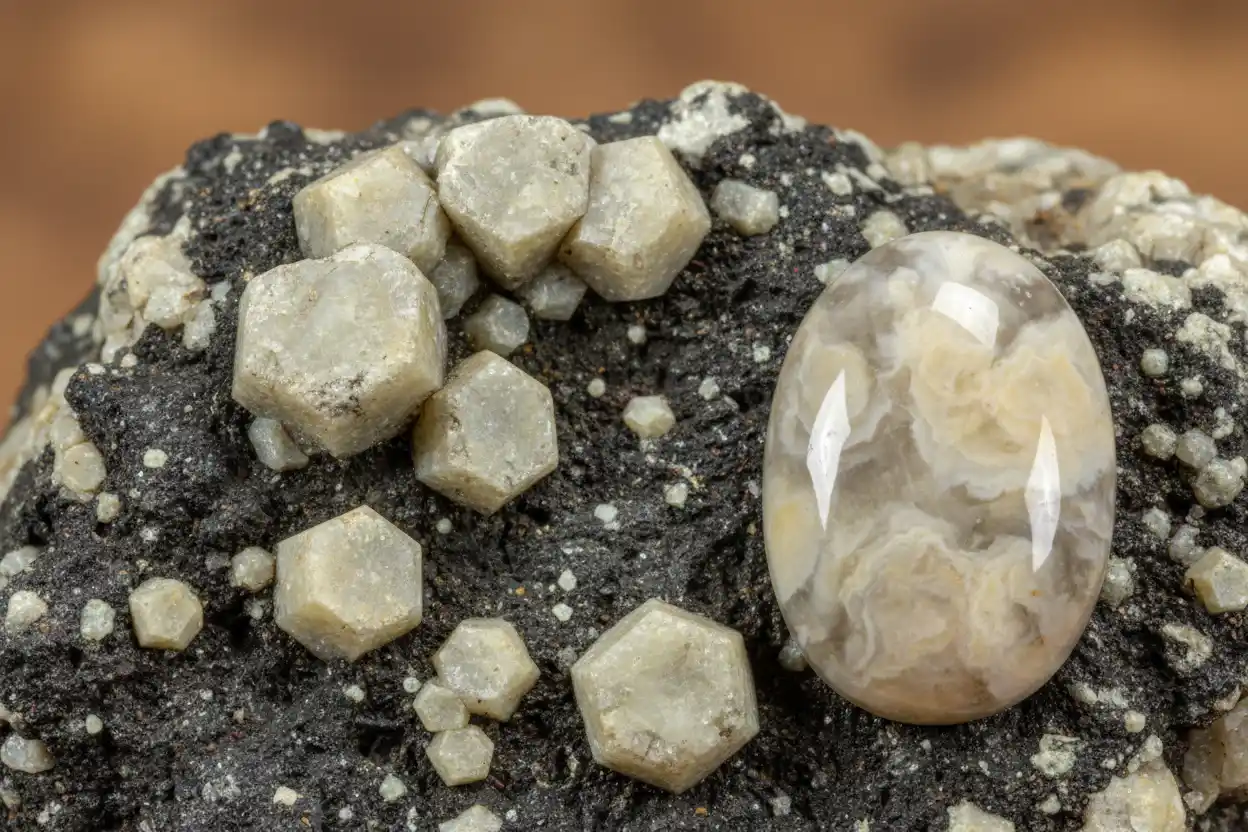
Nepheline Meaning, Properties, Identification & Uses
Nepheline is a sodium- and potassium-bearing aluminosilicate mineral that forms in silica-poor igneous rocks. It belongs to the feldspathoid group, whose members occupy a geological role similar to feldspar when a magma contains too little silica to form ordinary feldspar and quartz combinations.
Most nepheline appears as white, gray, cream, yellowish, brownish, or pale green granular masses. Distinct transparent crystals are uncommon, and facetable rough is exceptionally rare.
Nepheline at a Glance
| Property | Nepheline |
|---|---|
| Material type | Feldspathoid mineral and rock-forming tectosilicate |
| Composition | Commonly expressed as Na₃K(Al₄Si₄O₁₆) or approximately (Na,K)AlSiO₄ |
| Mineral group | Feldspathoid group |
| Common colors | Colorless, white, gray, cream, yellowish, greenish, brownish, or reddish |
| Crystal system | Hexagonal |
| Typical habit | Massive, granular, compact, short prismatic, tabular, or embedded grains |
| Luster | Vitreous to greasy |
| Transparency | Transparent to opaque |
| Mohs hardness | Approximately 5.5–6 |
| Cleavage | Poor or indistinct prismatic cleavage |
| Tenacity | Brittle |
| Fracture | Subconchoidal to uneven |
| Specific gravity | Approximately 2.55–2.66 |
| Common uses | Mineral specimens, geological collections, rare faceted stones, cabochons, and industrial nepheline-syenite products |
| Main care concern | Scratching, impact, acid attack, alteration, and silica-bearing dust from associated rock |
A Feldspathoid, Not Feldspar
Nepheline belongs to the feldspathoids, a group of aluminosilicate minerals that form in magmas deficient in silica.
Feldspathoids resemble feldspars chemically because both contain aluminum, silicon, oxygen, and alkali elements. However, feldspathoids contain less silica relative to sodium, potassium, and aluminum.
Therefore, nepheline is not a variety of feldspar. It has a different framework, composition, crystal symmetry, alteration behavior, and geological significance.
The formula is often written as Na₃K(Al₄Si₄O₁₆), reflecting an ideal sodium-to-potassium relationship. A simplified form, (Na,K)AlSiO₄, also appears in mineral references.
Natural nepheline departs from the ideal composition. Sodium, potassium, calcium, iron, water-related alteration, vacancies, and microscopic exsolution features can modify individual grains.
Why Nepheline and Quartz Rarely Occur Together
Nepheline indicates a silica-undersaturated environment. Quartz, by contrast, represents free silica and commonly develops in silica-saturated or oversaturated rocks.
Under normal igneous equilibrium conditions, nepheline and quartz react to form feldspar rather than remaining together. Their stable coexistence in the same simple magma would therefore be chemically inconsistent.
This relationship makes nepheline useful to petrologists. Finding it in an igneous rock immediately signals that the melt followed a different chemical path from a granite or quartz-rich rhyolite.
Apparent nepheline and quartz in one specimen may represent later veins, alteration, contamination, separate generations, or incorrect identification.
The mineral’s contrast with the wider quartz family is geological rather than merely visual.
How Nepheline Forms
Nepheline crystallizes from alkaline magmas that contain insufficient silica to build ordinary quartz-bearing assemblages.
It commonly occurs in nepheline syenite, an intrusive igneous rock resembling granite in grain size but lacking quartz. Feldspar, nepheline, pyroxene, amphibole, mica, sodalite-group minerals, and accessory phases may occur together.
Volcanic equivalents include phonolite and nephelinite. In these rocks, nepheline can form small grains or crystals within a fine-grained groundmass.
Alkaline pegmatites may produce larger crystals and unusual mineral associations. Such environments can concentrate sodium, potassium, rare elements, volatile components, and late-stage hydrothermal fluids.
Nepheline also forms in some high-temperature metamorphic rocks where the chemistry remains silica-poor. However, most collector material comes from alkaline igneous complexes.
The mineral can alter to natrolite, cancrinite, sodalite-group minerals, kaolin-like material, or fine white mica. That susceptibility explains why fresh transparent crystals are much less common than cloudy or massive material.
Crystal Form and Texture
Well-developed nepheline crystals are usually short hexagonal prisms terminated by flat basal faces. Distinct crystals remain less common than granular masses.
A crystal can appear more symmetrical than its actual internal arrangement. Etch figures and optical testing reveal the mineral’s polar hexagonal character.
Massive nepheline may form pale greasy-looking grains within dark pyroxene- or amphibole-rich rock. Coarse nepheline-syenite specimens can show crystals several centimeters across.
Fresh surfaces range from vitreous to greasy. The greasy luster is especially noticeable in compact material traditionally called elaeolite.
Thin transparent grains can resemble quartz or feldspar, while opaque weathered masses may be mistaken for calcite, sodalite-poor rock, or pale ceramic material.
Elaeolite and Other Descriptive Names
Elaeolite is an old variety name for massive, greasy-luster nepheline. The word refers to its oily-looking surface rather than a separate chemical species.
Elaeolite may be gray, greenish, brownish, reddish, or nearly black because of inclusions and alteration. Some polished pieces show a soft sheen or weak cat’s-eye-like effect.
Nephelite is an older spelling or synonym for nepheline. Both refer to the same mineral, although nepheline is the standard modern spelling.
“Gabbronite” has historically been used inconsistently for scapolite, nepheline, or related pale minerals. A commercial object carrying that name should therefore receive modern identification.
Nepheline syenite is a rock containing nepheline, alkali feldspar, and other minerals. It is not pure nepheline and should not receive one mineral formula or hardness.
Important Nepheline Localities
The type locality lies at Monte Somma in the volcanic complex of Mount Vesuvius, Campania, Italy. Vesuvian ejecta and alkaline volcanic rocks supplied many early mineralogical specimens.
The Kola Peninsula in Russia contains major alkaline complexes with nepheline, sodalite, eudialyte, aegirine, and numerous rare minerals. Some localities produce coarse crystals and nepheline-rich rocks.
Mont Saint-Hilaire in Quebec, Canada, is another famous alkaline complex. Nepheline occurs there with a wide variety of unusual mineral species.
The Bancroft region of Ontario has produced large nepheline crystals and coarse nepheline-syenite material.
Norway’s Langesundsfjord district is historically important for alkaline pegmatites and feldspathoid minerals. German volcanic regions, including the Eifel, also produce nepheline-bearing rocks.
Other occurrences are documented in Greenland, Arkansas, Maine, New Mexico, Tanzania, Kenya, Madagascar, Pakistan, and several additional alkaline provinces.
Locality value depends on a precise quarry, intrusion, volcanic complex, or pegmatite rather than a country name alone.
Nepheline and Sodalite
Sodalite is another silica-poor aluminosilicate associated with alkaline rocks. It commonly appears blue, gray, white, green, or pink and contains chlorine within its framework.
Nepheline usually lacks sodalite’s strong blue body color. It more often appears white, gray, cream, yellowish, or greasy green-brown.
Both can occur in nepheline syenite, which means a polished rock may contain visible areas of each mineral.
Sodalite has different chemistry, cubic symmetry, and fracture behavior. Visual identification becomes difficult when both minerals occur as pale massive grains.
Laboratory testing may be needed for a polished object, especially when a retailer uses a rock name as though it identified every grain.
Nepheline and Natrolite
Natrolite is a hydrated sodium zeolite that can form through the alteration of nepheline.
Fresh nepheline generally appears massive, granular, or short prismatic. Natrolite more commonly develops slender needles, radiating sprays, and fibrous aggregates.
Natrolite contains structural water and has a lower density. Nepheline is an anhydrous feldspathoid under its ideal composition.
A cloudy nepheline crystal may contain microscopic natrolite or related alteration products. Consequently, an altered specimen can behave differently from fresh material during cleaning or laboratory testing.
The broader zeolite guide explains why these secondary hydrated minerals commonly develop in cavities and altered alkaline rocks.
How to Identify Nepheline
Color and luster offer preliminary clues. Fresh nepheline commonly has a vitreous or greasy surface and appears white, gray, cream, or pale yellow.
Hardness falls around 5.5–6. A steel point may scratch it with difficulty, while quartz will scratch it more readily. Destructive testing should not be used on a valuable specimen.
Specific gravity near 2.6 makes nepheline lighter than many similarly colored gems but comparable with feldspar and quartz.
Its cleavage is poor rather than the strong two-direction cleavage typical of many feldspars. Broken surfaces may be subconchoidal or uneven.
The historic name comes from the Greek word for cloud because strong acid attacks nepheline and leaves it cloudy while silica separates. Acid testing is destructive and unsuitable for polished or collectible material.
Under a microscope, nepheline has low birefringence and optical characteristics distinct from quartz and feldspar. Professional methods include refractive-index testing, thin-section microscopy, Raman spectroscopy, X-ray diffraction, and chemical analysis.
The general workflow in how to identify crystals helps determine which tests are appropriate before damaging the specimen.
Industrial Importance
Individual nepheline crystals are not a major industrial commodity in the same way that collector specimens are sold.
Instead, industry uses nepheline syenite, a quartz-free rock rich in nepheline and alkali feldspar. The rock supplies alumina and alkalis while acting as a flux.
In glass and ceramic production, fluxes lower melting temperatures and improve manufacturing efficiency. Nepheline syenite can also enter paints, coatings, polymers, fillers, abrasives, and specialized construction products.
Industrial nepheline syenite is crushed and processed according to chemical purity, iron content, particle size, and end use. Those criteria differ completely from the aesthetic standards applied to a mineral specimen.
A polished sphere labeled nepheline syenite may contain attractive nepheline, feldspar, aegirine, sodalite, or other phases. It should be described as a rock rather than as one large nepheline crystal.
Is Nepheline a Gemstone?
Transparent facetable nepheline exists, but it is extremely rare. Most crystals are too cloudy, included, altered, fractured, or small for conventional faceting.
Rare cut stones may appear colorless, pale yellow, greenish, or gray. Their optical performance is gentle because the refractive index and dispersion are modest.
Elaeolite and other compact material can be cut into cabochons. A sheen or cat’s-eye effect may appear when aligned inclusions or internal structures reflect light.
Nepheline-rich rock is also shaped into beads, eggs, spheres, freeforms, and carvings. However, the finished object may contain several minerals with different properties.
The distinction between a facetable mineral and an ornamental rock is discussed in the types of gemstones guide.
Durability and Jewelry Use
Nepheline’s hardness of 5.5–6 provides moderate scratch resistance. It is softer than quartz and can acquire wear from harder dust and gemstones.
The mineral is brittle and has poor cleavage. Edge chipping remains possible, particularly in faceted stones with thin girdles.
A rare transparent gem is better suited to earrings, pendants, brooches, or protected collector jewelry than an exposed everyday ring.
Cabochons made from massive elaeolite or nepheline-rich rock may be more practical, although natural alteration and mixed minerals create variable durability.
A bezel protects edges and keeps a stone from receiving direct impact. Bracelets and rings remain the highest-risk formats.
The gemstone hardness chart provides the scratch-resistance comparison, while gemstone toughness versus hardness explains why brittleness remains relevant.
Treatments and Misidentification
Most mineral specimens receive no intentional treatment beyond cleaning. Nevertheless, repaired crystals, acid-cleaned surfaces, resin-stabilized matrix, and glued associations occur.
Massive material may be impregnated with resin to improve polish or stabilize fractures. Dye can enter porous alteration zones and intensify green, blue, yellow, or red colors.
Clear coatings may increase gloss on a dull surface. Such coatings can conceal weathering or create an appearance unlike natural greasy luster.
Aragonite, calcite, feldspar, sodalite-poor rock, ceramic, and other pale materials may be sold incorrectly as nepheline. Mineral references specifically warn that some marketplace specimens have carried incorrect nepheline labels.
A sphere or tower can be especially difficult to identify because polishing removes crystal habit. Buyers should ask whether the product is pure nepheline, elaeolite, nepheline syenite, or a mixed alkaline rock.
The warning signs of false labels and composites appear in how to spot fake crystals. Resin, coating, dye, and repair are covered in gemstone treatments explained.
Current Nepheline Asking Prices
Nepheline is common as a rock-forming mineral but uncommon in attractive isolated crystals or transparent cut gems.
| Nepheline product | Broad retail asking range |
|---|---|
| Small educational specimen | About $5–$20 |
| Small locality specimen | About $15–$50 |
| Medium crystal or nepheline-rich matrix specimen | About $40–$200 |
| Large, historic, or aesthetically strong specimen | About $150–$900 or more |
| Cabochon or small polished piece | About $10–$50 |
| Bead strand or simple pendant | About $20–$100 |
| Sphere, egg, or polished nepheline-rich rock | About $40–$250 |
| Rare transparent faceted nepheline | Often about $50–$300 per carat, with limited reliable comparables |
| Exceptional faceted stone | Individually priced because the market is extremely thin |
These ranges represent broad July 2026 asking prices, not appraisals or guaranteed resale values.
Faceted-nepheline price claims vary greatly because so few verified stones reach the market. A laboratory report becomes increasingly important as the asking price rises.
What Gives Nepheline Value?
Crystal form matters for specimens. Complete short prisms with clean faces are less common than massive grains.
Transparency raises value sharply because most nepheline is translucent or opaque. Facetable rough large enough to produce a clean gem is especially scarce.
Fresh luster also matters. Altered, chalky, or heavily weathered surfaces usually attract less interest unless the specimen has scientific importance.
Locality affects collector value. A documented specimen from Monte Somma, Kola, Mont Saint-Hilaire, Langesundsfjord, or another renowned alkaline complex may command more than unproven commercial material.
Associated minerals can add aesthetic and scientific interest. Aegirine, sodalite, eudialyte, feldspar, mica, and rare alkaline-complex minerals may create a more desirable matrix specimen.
For polished objects, pattern, structural stability, polish, confirmed mineral content, and treatment disclosure matter more than a vague rare-crystal label.
Buying Nepheline
Ask whether the item is an individual nepheline crystal, massive elaeolite, nepheline syenite, or another nepheline-bearing rock.
Request the exact locality when the specimen commands a collector premium. “Canadian nepheline” or “Russian crystal” remains too broad for an expensive purchase.
Inspect surfaces for chalky alteration, cracks, glue, resin, acid etching, and detached crystals. A pale coating may hide a damaged surface.
For a polished sphere or cabochon, ask whether mineral analysis has confirmed the main phase. Color alone cannot separate nepheline from feldspar, calcite, sodalite, or altered material.
Faceted stones should receive independent gemological documentation. Exceptionally high per-carat claims require more than a seller’s in-house certificate.
Nepheline appears in both the crystals beginning with N directory and the gemstones beginning with N directory, although most examples remain mineral or rock specimens rather than conventional gems.
Cleaning and Storage
Dust a crystal specimen with a soft dry brush. Avoid pressing against projecting terminations or weak matrix.
A stable polished piece can be wiped with a damp cloth and mild soap, then dried immediately. Prolonged soaking is unnecessary.
Do not use acids, vinegar, descaling products, or acidic jewelry dips. Nepheline decomposes in strong acid, and associated minerals may be even more sensitive.
Avoid ultrasonic and steam cleaning on altered, repaired, or matrix specimens. Heat and vibration can worsen cracks or loosen attached crystals.
Store nepheline separately from quartz, topaz, corundum, and harder stones. A padded compartment protects polished surfaces and brittle edges.
Mixed alkaline rocks may contain water-sensitive alteration products. The broader guide to crystals in water provides additional caution for multi-mineral pieces.
Nepheline Meaning and Symbolism
Nepheline’s name, derived from the Greek word for cloud, has inspired modern symbolism involving clarity emerging from uncertainty.
Its formation in silica-poor rocks also encourages interpretations centered on adaptation: the mineral forms successfully under chemical conditions where quartz cannot.
Collectors sometimes associate its pale greasy luster with quiet reflection, simplicity, and looking beyond a plain surface.
Because nepheline is primarily a geological and industrial mineral, it has little established ancient gemstone folklore. Most spiritual descriptions are recent additions to crystal culture.
These meanings remain personal, artistic, cultural, or spiritual interpretations. Scientific evidence does not show that nepheline treats illness, removes confusion, or produces guaranteed mental effects.
Frequently Asked Questions
Is nepheline a real mineral?
Yes. Nepheline is a recognized sodium-potassium aluminosilicate species in the feldspathoid group.
Is nepheline a type of feldspar?
No. Feldspathoids have less silica than feldspars and possess different structures and compositions.
Why are nepheline and quartz rarely found together?
Nepheline forms under silica-undersaturated conditions, while quartz represents excess silica. Under normal equilibrium, they react to form feldspar instead of remaining together.
What is nepheline’s chemical formula?
It is commonly written as Na₃K(Al₄Si₄O₁₆) or approximately (Na,K)AlSiO₄.
Why does nepheline become cloudy in acid?
Strong acid decomposes the mineral and leaves separated silica, producing a cloudy or gelatinous appearance. The test destroys polished surfaces.
What is elaeolite?
Elaeolite is an old variety name for massive nepheline with a greasy luster, often colored by inclusions and alteration.
Where is nepheline found?
Important localities include Italy, Russia, Canada, Norway, Germany, Greenland, the United States, and several African and Asian alkaline complexes.
Can nepheline be faceted?
Yes, but transparent facetable rough is exceptionally rare. Most nepheline remains a specimen or ornamental rock component.
Is nepheline suitable for jewelry?
It can be used carefully in pendants, earrings, or protected settings. Its moderate hardness and brittle nature make exposed daily-wear rings less suitable.
Is nepheline commonly treated?
Most crystals are untreated, but resin stabilization, repair, coatings, dye, and acid cleaning can affect commercial specimens and polished objects.
Can nepheline go in water?
Brief contact is generally manageable for stable untreated material. Avoid soaking mixed, altered, glued, coated, or porous specimens.
What makes a nepheline specimen valuable?
Crystal form, transparency, freshness, size, locality, associated minerals, condition, treatment disclosure, and documentation all influence value.
Nepheline is most useful as a window into silica-poor igneous chemistry. When alteration has converted part of the mineral into fine hydrated sodium crystals, the next relevant comparison is the completed natrolite guide.
Cutting, grinding, or polishing nepheline and nepheline-bearing rock can generate aluminosilicate and potentially silica-bearing dust from associated minerals. Use wet methods, effective local extraction, eye protection, and suitable respiratory protection rather than dry processing.