Orthoceras Fossil Meaning, Identification & Uses
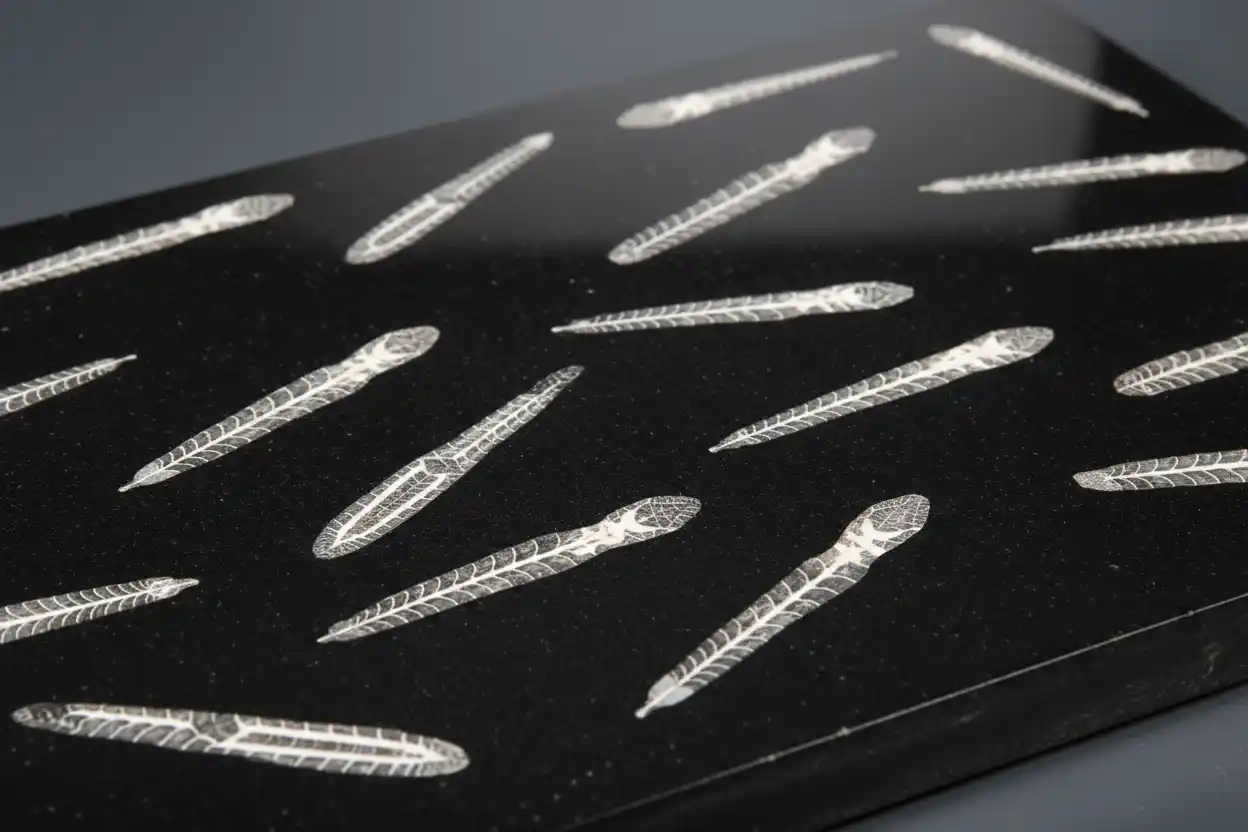
“Orthoceras fossil” is the commercial name widely used for polished black limestone containing straight or gently curved nautiloid cephalopod fossils. Many familiar specimens come from Morocco and show white-to-gray chambered shells against a dark carbonate matrix.
The trade name is broader than the scientific genus. True Orthoceras is restricted principally to Middle Ordovician rocks of the Baltic region, while many Moroccan pieces are different Silurian or Devonian orthoconic nautiloids whose exact genus is rarely established before commercial cutting.
Orthoceras Fossil at a Glance
| Property | Commercial Orthoceras fossil material |
|---|---|
| Material type | Fossil-bearing sedimentary rock and lapidary trade material |
| Biological identity | Straight-shelled or slightly curved nautiloid cephalopods, often not true Orthoceras |
| Typical matrix | Dark gray to black limestone or other carbonate-rich sedimentary rock |
| Fossil composition | Commonly calcite-filled, calcite-replaced, or preserved carbonate shell structures |
| Common colors | Black, charcoal gray, brown-gray, white, cream, beige, and occasional rusty or golden mineral staining |
| Crystal system | No single system applies to the fossil-bearing rock; much carbonate material is calcite |
| Texture | Fossiliferous, chambered, fine-grained, massive, veined, polished, or assembled |
| Luster | Dull when rough; waxy to vitreous after polishing |
| Transparency | Opaque |
| Mohs hardness | Commonly around 3 for calcite-rich material, but variable with mineral replacement and matrix |
| Cleavage | Variable at rock scale; calcite components have perfect rhombohedral cleavage |
| Tenacity | Brittle |
| Common uses | Fossil specimens, cabochons, pendants, bookends, towers, plates, bowls, tabletops, carvings, and educational displays |
| Main care concern | Acid etching, scratches, brittle repairs, black filler, composite construction, and inaccurate fossil identification |
The Name Orthoceras Requires Qualification
Orthoceras means straight horn and was historically applied to many fossil cephalopods with long conical shells.
As paleontologists studied internal structures more carefully, they recognized that straight shells evolved or persisted in numerous nautiloid lineages. The old name had become a catch-all category.
Modern Orthoceras in the strict scientific sense refers primarily to Orthoceras regulare and closely interpreted material from Middle Ordovician limestones of Baltoscandia.
Commercial Moroccan fossils usually come from younger Paleozoic rocks and can belong to several orthoconic nautiloid genera.
Therefore, “orthocone nautiloid fossil sold as Orthoceras” is often a more scientifically accurate description.
The exact tracker title remains appropriate for search behavior, but the article should not claim that every polished Moroccan fossil belongs to one confirmed genus.
What Was an Orthoconic Nautiloid?
Nautiloids are cephalopod mollusks related broadly to living Nautilus and more distantly to squids, cuttlefish, and octopuses.
The animals lived in a chambered external shell. The body occupied the large open chamber at the shell’s wider end.
Behind it, internal walls called septa divided the shell into a series of smaller chambers.
A tube called the siphuncle passed through the chambers. It helped the living animal regulate fluid and gas, contributing to buoyancy control.
The shell gradually widened as the animal grew. New, larger chambers formed at the open end while the older chambers remained behind.
Commercial slabs commonly expose longitudinal sections, showing a tapering cone divided by repeated septa. Cross-sections may appear circular, oval, or irregular depending on compression and cutting angle.
Orthocone, Orthocerid, and Orthoceras
Orthocone describes a straight or nearly straight conical shell shape. It is a morphological term rather than one genus.
Orthocerids are members of extinct nautiloid groups traditionally placed within or near the order Orthocerida. They share aspects of shell form and internal anatomy but include many separate genera.
Orthoceras is one specific genus name with a much narrower scientific application.
Consequently, an orthocone can be a nautiloid without being Orthoceras. Likewise, “Orthoceras marble” is a commercial stone name rather than a complete paleontological diagnosis.
This terminology matters because a polished fossil may remain genuine even when the retail genus label is inaccurate.
The Moroccan Fossil Trade Material
Most familiar black-and-white decorative pieces come from the Anti-Atlas region of Morocco, particularly the Tafilalt and areas around Erfoud, Alnif, and Taouz.
The region contains extensive Paleozoic marine rocks with abundant cephalopods, trilobites, brachiopods, crinoids, corals, and other fossils.
Many commercial straight-shelled nautiloids come from Silurian or Devonian strata. However, the age varies by quarry and bed, so one universal “400-million-year-old” claim should not be applied automatically.
The dark host rock is generally limestone or another carbonate-rich sedimentary material.
Local workshops saw, grind, polish, repair, and assemble the fossil-bearing rock into slabs, tables, bowls, towers, bookends, animals, boxes, sinks, and jewelry components.
This preparation supports a substantial regional craft industry. Nevertheless, heavy finishing can remove the original field context needed for exact taxonomic identification.
How the Fossils Formed
After an orthoconic cephalopod died, its shell settled on the seafloor or was transported by currents.
Soft tissues decayed, while sediment entered some chambers. Other spaces remained open long enough for mineral-rich water to circulate through them.
Calcite commonly precipitated inside the chambers. Meanwhile, the original shell could remain partly preserved, recrystallize, dissolve, or be replaced by new carbonate minerals.
Burial compacted and lithified the surrounding mud into limestone.
Over millions of years, uplift and erosion exposed the fossil-bearing beds. Quarrying then provided blocks suitable for preparation and polishing.
A white fossil within black limestone is therefore not simply the original shell. It can include recrystallized shell, mineral-filled chambers, sediment, and polished matrix.
Reading the Shell Structure
A useful specimen should show a tapering shell outline and repeated internal chambers.
The septa appear as transverse walls dividing the length of the fossil. Their spacing commonly increases toward the wider end as the animal grew.
The siphuncle may appear as a small tube or series of connected openings passing through the chambers. Its position is important for scientific classification.
Not every polished specimen exposes the siphuncle clearly. The cut may miss it, preparation may obscure it, or the fossil may be too incomplete.
The final body chamber is often missing because it was large, fragile, and more exposed to damage after death.
Several fossils may overlap in one slab. Fragments and cross-sections can also be mistaken for complete separate animals.
Is Orthoceras Fossil a Gemstone?
The material is better classified as a polished fossil-bearing rock than as a mineral crystal.
It fits within the organic and fossil-material category discussed in types of gemstones, where biological origin and later mineral replacement remain distinct.
The finished material can function as an ornamental stone because it accepts a polish and displays strong natural contrast.
However, the fossil animal is no longer organic tissue. Much of the preserved structure consists of calcite and sedimentary matrix.
A cabochon can therefore be worn as jewelry without becoming a conventional single-mineral gem.
The closest tracker comparisons are fossil coral and petrified wood, although each follows a different biological and mineralization history.
Orthoceras Fossil and Ammolite
Ammolite is iridescent fossil shell material from ammonites, particularly gem-quality material associated with the Bearpaw Formation in North America.
Ammonites usually had coiled shells with more complex sutures. Orthoconic nautiloids possessed straight or gently curved shells with simpler chamber divisions.
Ammolite’s value comes from preserved iridescent aragonite layers. Commercial Orthoceras material is generally valued for pale chambered fossils against dark limestone.
The two should not be treated as varieties of the same fossil gem.
Orthoceras Fossil and Ammonites
Orthoconic nautiloids and ammonites were both cephalopods, but they belonged to separate evolutionary groups.
Ammonites commonly had tightly coiled shells and highly complex suture patterns. They became especially abundant during the Mesozoic Era.
Straight-shelled nautiloids appeared much earlier and were diverse throughout large parts of the Paleozoic.
Some ammonoids independently evolved straight shells, including baculitids. These are not automatically Orthoceras either.
Shell shape alone is therefore insufficient for precise classification. Internal structure, suture style, siphuncle position, age, and locality all matter.
Calcite and the Fossil Matrix
Much commercial material consists mainly of calcite-rich limestone.
The calcite guide explains why these objects are relatively soft and acid sensitive.
Calcite has a Mohs hardness of 3. Therefore, quartz dust, metal edges, ceramic surfaces, and harder decorative stones can scratch the polish.
Vinegar, lemon juice, acidic drinks, descaling products, and many bathroom cleaners react with calcium carbonate and leave dull etched patches.
Some fossil sections may be dolomitized or silicified, creating harder local areas. One hardness value cannot describe every imported object perfectly.
How to Identify a Genuine Fossil Piece
Look for biologically plausible shell taper, repeated chambers, septa, and natural variation.
The fossil should integrate with the surrounding rock rather than sit as a flat printed design.
Magnification may reveal crystalline calcite, sediment-filled chambers, fine cracks, polishing marks, resin, and repaired matrix.
Cross-sections should vary naturally. Identical white cone shapes repeated at equal spacing can indicate an assembled mosaic or decorative reconstruction.
A genuine fossil may still contain restoration. Black filler, pale calcite paste, glue, and inserted fragments are common in heavily worked objects.
The testing framework in how to identify crystals helps distinguish natural material from a manufactured or restored product, although a paleontologist may be needed for genus-level identification.
Repairs, Reconstruction, and Composite Objects
Moroccan fossil-bearing limestone is commonly fractured during quarrying and fabrication. Repair is therefore widespread.
Black resin or cement may fill cracks in the matrix. Pale filler may restore incomplete shell outlines or join broken fossil sections.
Large plates and tables can be assembled from several slabs over a reinforced backing.
Carvings may contain genuine fossils but use extensive black filler to produce a smooth silhouette.
Some decorative pieces combine real fossil fragments in a manufactured matrix. These are composites rather than one naturally intact slab.
Restoration does not make an object worthless when it is disclosed. However, the degree of reconstruction should influence price and collector interpretation.
The construction methods described in gemstone treatments explained apply broadly, although fossil preparation follows its own specialist conventions.
Common Fakes and Misleading Claims
Complete artificial fossils can be cast from resin or cement. Mold repetition, uniform bubbles, paint, and an identical pattern across several items provide clues.
A more common problem is enhancement of genuine material. A real fossil fragment may be extended with filler to create a larger, cleaner shell.
Retailers may also call every straight Moroccan fossil Orthoceras without identifying its actual genus or age.
Claims of dinosaur origin are incorrect. Orthoconic nautiloids were marine cephalopods, not reptiles.
Likewise, “Orthoceras marble” is usually polished fossil limestone rather than metamorphic marble.
The warning signs in how to spot fake crystals remain relevant to resin, paint, assembly, and repeated molds.
Jewelry Suitability
Orthoceras fossil cabochons work best in pendants, earrings, brooches, cufflinks, and occasional-wear rings.
The dramatic black-and-white contrast suits elongated freeforms because the cutter can follow the shell’s natural taper.
Calcite-rich material scratches readily. Its position on the gemstone hardness chart makes it less suitable for exposed daily-wear rings.
The rock is also brittle, and matrix fractures or repairs can fail after impact. Gemstone toughness versus hardness explains why a polished surface does not guarantee resistance to breaking.
A bezel protects cabochon edges and supports repaired material. Drilled pendants should have enough stone around the hole to prevent chipping.
Large pieces can be heavy. Bails, chains, and earring findings should be chosen according to the finished weight.
Decorative Uses
Orthoceras-bearing limestone is carved into plates, bowls, bookends, towers, animals, boxes, tabletops, lamps, and architectural objects.
Large polished surfaces can display dozens of shell fragments and cross-sections. Their value lies partly in pattern and craftsmanship rather than scientific rarity.
Bowls and plates should be treated as decorative objects unless a manufacturer certifies them for food contact. Fillers, sealants, pigments, repairs, and porous carbonate surfaces may not be suitable for serving food.
Bathrooms and kitchens also expose the material to acids, standing water, detergents, and abrasive particles.
A table or sink requires a suitable protective finish and conservative cleaning. Even sealed calcite-rich stone can etch when the coating becomes worn.
The carving potential of fossil limestone relates to the materials discussed in the best gemstones for carving, although restoration and fossil preservation require additional care.
Current Orthoceras Fossil Asking Prices
The fossils themselves are common in commercial Moroccan material. Size, preparation, craftsmanship, restoration, and shipping therefore influence price more than taxonomic rarity.
| Orthoceras product | Broad retail asking range |
|---|---|
| Small polished fossil | About $5–$25 |
| Loose cabochon | About $5–$35 |
| Simple pendant or earrings | About $20–$100 |
| Small plate, freeform, or bookend | About $25–$120 |
| Bowl, box, or medium carving | About $50–$300 |
| Medium tower or multi-fossil display | About $75–$350 |
| Large floor tower or substantial slab | About $200–$1,000 or more |
| Furniture-scale table or exceptional display slab | About $1,000–$5,000 or more |
These figures represent broad current asking prices rather than appraisals or expected resale values.
A large object can be inexpensive relative to its size because the fossil-bearing limestone is abundant and labor costs vary. Shipping weight may contribute substantially to the final price.
What Gives Orthoceras Material Value?
Visible shell structure matters. Long tapering sections with clear chambers are generally more attractive than scattered fragments.
Contrast between the pale fossil and dark matrix improves display quality.
Preparation should expose the chambers without grinding away most of the shell or filling every irregularity artificially.
Condition includes cracks, chips, unstable repairs, dull polish, and separated backing.
Natural composition matters for collectors. A complete fossil in original matrix carries more scientific interest than an extensively assembled decorative mosaic.
Locality and stratigraphic data add value. A precise formation, quarry, or age provides far more information than “400 million years old, Morocco.”
Craftsmanship can dominate the price of bowls, tables, and carvings. Symmetry, finish, structural reinforcement, and design quality should be evaluated separately from fossil rarity.
Buying Orthoceras Fossil
Ask whether Orthoceras is being used as a trade name or a confirmed genus identification.
Request the locality and geological age. A responsible seller may state that the item contains Devonian Moroccan orthoconic nautiloids rather than promising true Orthoceras.
Inspect the back and edges for black filler, glue, backing, inserted fossil sections, and joined slabs.
Ask whether shell outlines have been reconstructed. Restoration may be acceptable, but it should not be concealed.
For jewelry, check the cabochon around the girdle and drill hole. Thin repaired sections are vulnerable to impact.
For large decorative objects, ask about weight, backing, sealant, repair, and appropriate cleaning.
Do not use a metaphysical certificate as proof of fossil identity. Paleontological labeling should rest on locality, anatomy, and preparation records.
Orthoceras fossil is indexed in the crystals beginning with O directory and the gemstones beginning with O directory, although it is a fossil-bearing rock rather than a crystal species.
Cleaning and Storage
Dust polished material with a soft cloth. Use a slightly damp cloth and mild soap only when deeper cleaning is necessary.
Dry the object promptly, particularly around cracks, backing, and repaired sections.
Avoid vinegar, lemon juice, acidic drinks, bathroom descalers, and acid-based stone cleaners. These products dissolve and dull carbonate surfaces.
The general water-safety guide provides context, but large repaired fossil objects should not be soaked.
Do not use ultrasonic or steam cleaning on jewelry. Vibration and heat can affect matrix cracks, calcite cleavage, glue, filler, and backing.
Store cabochons away from quartz and harder gems. Support large plates and towers from their base rather than lifting them by projecting fossil sections.
Orthoceras Fossil Meaning and Symbolism
Modern fossil symbolism commonly connects Orthoceras trade material with deep time, adaptation, continuity, and the changing history of life.
Its repeated chambers can represent growth through stages: the animal occupied a new chamber while earlier structures remained part of the complete shell.
The contrast between an extinct organism and a polished modern object also encourages reflection on preservation, impermanence, and how geological records survive selectively.
Because the commercial material includes several nautiloid groups and the modern crystal-market name is taxonomically imprecise, claims of one ancient Orthoceras healing tradition are not historically credible.
These meanings remain modern, personal, artistic, or spiritual interpretations. Scientific evidence does not show that Orthoceras fossil treats illness, increases intelligence, or guarantees emotional change.
Frequently Asked Questions
Are Moroccan Orthoceras fossils genuine?
Many contain genuine orthoconic nautiloid fossils. However, the genus name is often inaccurate, and restoration or composite construction may be present.
Is every straight-shelled fossil Orthoceras?
No. Orthocone describes the shell shape, while Orthoceras is a much narrower scientific genus.
Where is true Orthoceras found?
True Orthoceras is associated principally with Middle Ordovician limestones of the Baltic region, including Sweden and neighboring areas.
What are the Moroccan fossils?
They are commonly Silurian or Devonian straight-shelled nautiloids from the Anti-Atlas. Several genera may be represented.
What are the white lines inside the fossil?
They commonly mark septa separating the original shell chambers. Mineral-filled chambers and a siphuncle may also be visible.
Is Orthoceras fossil made from calcite?
Much commercial material is preserved or filled with calcite within calcite-rich limestone. Mineral composition can vary through replacement and matrix differences.
Is Orthoceras marble actually marble?
Usually not. The commercial objects are commonly polished fossiliferous limestone rather than metamorphic marble.
Are Orthoceras fossils rare?
The commercial Moroccan material is abundant. Exceptional completeness, scientific documentation, unusual species, and high-quality preparation are less common.
Are black areas natural?
Much of the dark limestone matrix is natural, but black filler, cement, resin, paint, or reconstructed outlines may also occur.
Can Orthoceras fossil be worn in a ring?
It can be used in a protected occasional-wear ring, but calcite-rich material scratches easily and repaired matrix can break.
Can an Orthoceras plate be used for food?
Treat commercial plates as decorative unless the manufacturer has certified the surface, fillers, sealants, and construction for food contact.
How should Orthoceras fossil be cleaned?
Use a soft cloth and, when necessary, brief cleaning with mild soap and water. Avoid acids, soaking, steam, ultrasonic vibration, and abrasive cleaners.
Commercial Orthoceras material becomes more scientifically meaningful when buyers distinguish the genuine fossil from its broad trade name, polished limestone matrix, and any restoration. Its closest site comparison is fossil coral, another biological structure whose modern mineral composition differs substantially from the living organism that produced it.
Cutting or grinding fossil limestone can release fine carbonate, silica-bearing, and unknown mineral dust, while commercial pieces may contain resin, pigment, or repair compounds. Use wet methods, effective extraction, eye protection, and suitable respiratory protection. Do not ingest the material or use uncertified decorative objects for food preparation.