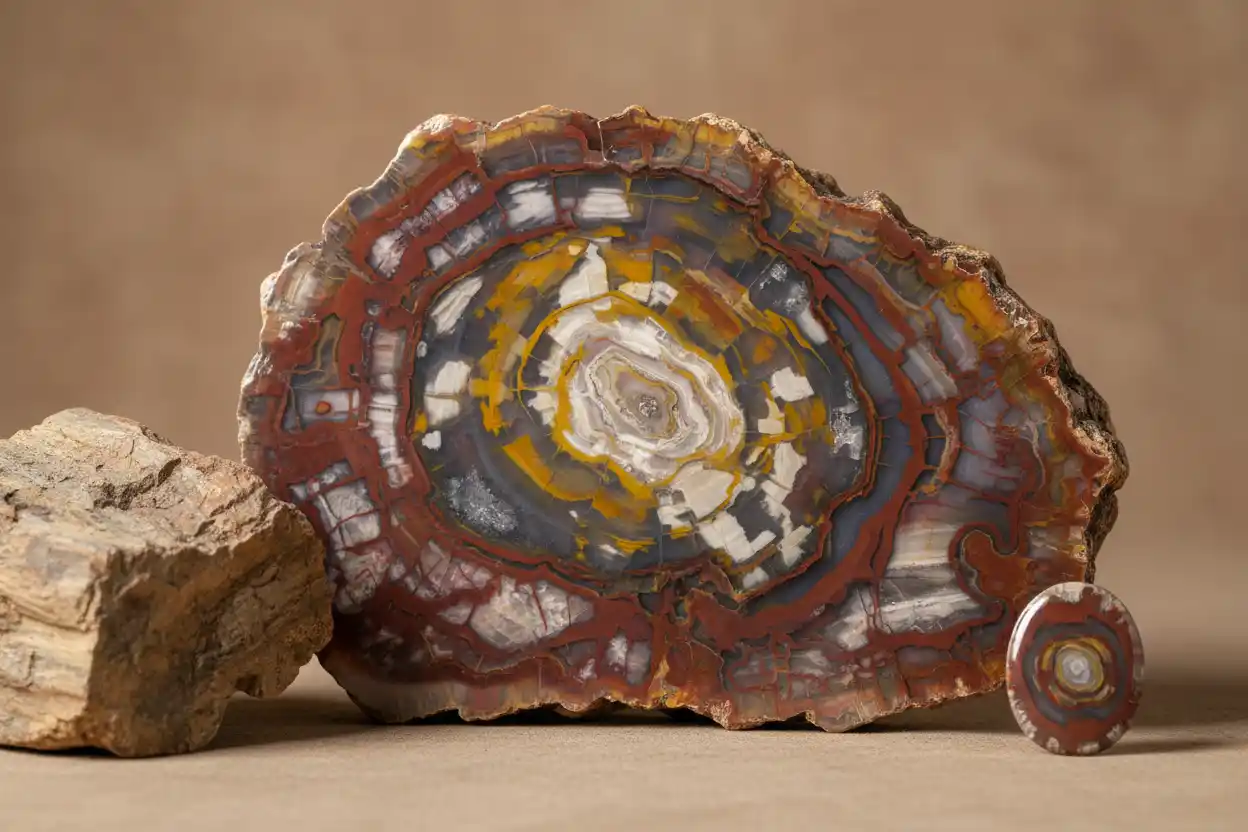
Petrified Wood: Meaning, Properties & Uses
Petrified wood is fossil plant material whose pores, cells, and tissues have been filled, replaced, or both by minerals. Many familiar specimens consist mainly of chalcedony and quartz while preserving growth rings, bark texture, vessels, tracheids, knots, rot pockets, and other anatomical features of the original tree.
It is a fossil-bearing mineralized material rather than one crystal species. Its composition, hardness, color, age, and durability depend on the tree, burial environment, groundwater chemistry, mineralizing phases, and later geological history.
Petrified Wood at a Glance
| Property | Petrified wood |
|---|---|
| Material type | Mineralized plant fossil and fossil-bearing ornamental material |
| Common mineral composition | Chalcedony, microcrystalline quartz, macrocrystalline quartz, opal, calcite, pyrite, hematite, goethite, manganese minerals, and variable host material |
| Common colors | White, cream, gray, black, brown, tan, yellow, orange, red, pink, purple, green, and blue-green |
| Crystal system | No single system applies; quartz is trigonal, calcite is trigonal, and opal is amorphous |
| Typical texture | Wood grain, growth rings, vessels, tracheids, rays, knots, bark, cellular structures, cavities, fractures, and mineral-filled rot pockets |
| Luster | Dull when rough; waxy to vitreous after polishing |
| Transparency | Usually opaque, with translucent silica-filled areas |
| Mohs hardness | Commonly about 6.5–7 when strongly silicified; lower where opal, calcite, matrix, or altered minerals dominate |
| Cleavage | None for the complete fossil; individual minerals retain their own properties |
| Tenacity | Brittle |
| Fracture | Commonly conchoidal to uneven in silicified areas |
| Common uses | Fossil specimens, slabs, cabochons, beads, spheres, bookends, tabletops, furniture, carvings, inlay, and architectural decoration |
| Main care concern | Fractures, variable mineral composition, resin or dye, legal provenance, heavy weight, edge chipping, and silica-rich cutting dust |
Petrified Wood Is a Fossil, Not One Mineral
Petrified wood belongs to the organic and fossil category within types of gemstones.
The original tree supplied the structure. Mineral-bearing groundwater then preserved that structure through permineralization, replacement, or a combination of processes.
Consequently, a polished slice can preserve biological anatomy while consisting almost entirely of inorganic minerals.
The word wood describes origin and structure rather than the current physical substance. A highly silicified specimen behaves more like quartz-rich ornamental stone than modern timber.
Not every piece contains the same minerals. One deposit may consist mainly of chalcedony, while another includes opal, calcite, pyrite, barite, fluorite, or iron-rich phases.
Assigning every petrified-wood object the formula SiO₂ is therefore an approximation, not a universal identification.
Permineralization and Replacement
Permineralization occurs when dissolved minerals enter pores and empty spaces inside buried wood and crystallize there.
The original cell walls may remain partly intact while minerals fill vessels, tracheids, cracks, and cavities.
Replacement occurs when the original organic material dissolves gradually and mineral matter occupies its position.
The process can preserve microscopic shape even though the chemistry changes completely.
Many specimens record both mechanisms. Silica first fills open spaces, while later replacement removes much of the remaining organic tissue.
The boundary between permineralized and replaced wood is therefore not always visible without microscopy and chemical analysis.
A mineralized log can still retain small amounts of carbon or original woody material. Complete replacement is not required for the object to qualify as petrified wood.
Conditions Needed for Petrification
Rapid burial slows decay by limiting oxygen and reducing access by scavengers, fungi, insects, and bacteria.
Flood sediment, volcanic ash, lake deposits, river channels, mudflows, and debris flows can cover fallen trees before their structure collapses.
Groundwater must then carry minerals through the buried wood. Silica commonly comes from volcanic ash, volcanic glass, or silica-rich sediment, although carbonate- and sulfide-bearing fluids can create different mineralization.
Pores within the wood provide pathways and nucleation sites. Minerals crystallize repeatedly as water chemistry changes.
The process takes place over geological time rather than through one instant transformation.
Later burial, compaction, faulting, heating, weathering, and erosion may fracture the mineralized log or expose it at the surface.
How Wood Structure Survives
Wood contains a highly organized network of cells.
Conifers contain long tracheids that transport water and support the tree. Flowering plants contain vessels, fibers, parenchyma, and other specialized cells.
Growth rings record seasonal changes in cell size and density. Rays extend across the trunk and transport nutrients laterally.
Silica can fill these microscopic spaces before the biological structure disappears completely.
As the organic walls decay, additional mineral deposition can preserve their boundaries. This process creates a mineral replica detailed enough for paleobotanists to examine under thin-section microscopy.
The rings visible in a polished slab may therefore be true growth structures, but they do not always represent one year each in every climate or plant.
Cracks, mineral bands, and polishing patterns can also resemble growth rings. Anatomical interpretation requires more than a decorative surface view.
Quartz, Chalcedony, and Opal Replacement
Much gem-quality petrified wood consists mainly of silica.
Quartz may form large crystals in open cavities and fractures. Clear, smoky, amethyst-colored, or citrine-like crystals can line spaces inside a log.
Chalcedony fills fine pores and reproduces microscopic wood anatomy through intergrown quartz and moganite-rich silica.
Opal can appear as an earlier or less crystalline silica phase. Over time, some opal reorganizes into chalcedony and quartz.
The parent opal guide explains why amorphous hydrated silica behaves differently from crystalline quartz.
A single fossil can contain opal, chalcedony, and macrocrystalline quartz in different areas. These phases may represent separate episodes of mineralization.
Silicified wood commonly approaches Mohs hardness 7 and accepts a strong polish, making it practical for lapidary work.
Calcified and Pyritized Wood
Not every fossil tree is silicified.
Calcite-bearing groundwater can fill or replace woody tissue with calcium carbonate. Such material is softer and more acid sensitive than quartz-rich petrified wood.
The parent calcite guide explains why a carbonate-replaced specimen may scratch and etch easily.
Pyrite and marcasite can preserve wood in oxygen-poor, sulfur-rich environments. Metallic replacement may reproduce cell structure or form bright crystals within cavities.
Pyritized wood requires careful storage because unstable iron sulfides can oxidize, expand, produce acidic products, and damage the specimen.
Other minerals—including siderite, hematite, goethite, barite, fluorite, and copper-bearing phases—may occur locally.
Therefore, care should follow the actual mineral composition rather than the word petrified alone.
What Creates Petrified Wood Colors?
Pure quartz and chalcedony are colorless to white. Most vivid colors come from impurities, inclusions, staining, and separate mineral phases.
Hematite commonly produces red, brick-red, pink, and reddish-brown.
Goethite and related iron-weathering products contribute yellow, golden, ochre, orange, and brown.
Manganese oxides create black, dark gray, and occasionally purple-toned areas.
Residual carbon and organic matter can produce gray or black.
Copper-, chromium-, or iron-bearing minerals may create green or blue-green colors in certain deposits, although these hues are less common.
White zones can represent cleaner silica, calcite, bleached wood structure, or open cavities filled by later quartz.
One slab may contain several colors because groundwater chemistry changed repeatedly during mineralization and weathering.
Important Petrified Wood Localities
Arizona’s Petrified Forest region is famous for Upper Triassic logs preserved in the Chinle Formation. Red, yellow, white, black, and purple colors occur in strongly silicified wood.
Material sold legally by rock shops comes from private land outside the national park, not from protected park resources.
Madagascar supplies colorful fossil conifer wood, often marketed as Araucaria, in rounds, slabs, bookends, and spheres.
Indonesia supplies tropical petrified wood, palm-like material, root patterns, tables, sinks, bowls, and large architectural objects.
Oregon, Washington, Wyoming, Nevada, Utah, Texas, Colorado, and several other United States regions produce distinctive fossil wood assemblages.
Argentina contains a major Jurassic petrified forest in Patagonia, while Brazil is known for silicified tree ferns and other fossil plants.
Australia supplies several notable materials, including peanut wood from Western Australia. Despite the name, peanut wood did not come from a peanut plant; many pale spots represent ancient marine-borer cavities later filled with sediment and microfossil-rich material.
Locality names should be supported by geological records or a traceable supplier rather than inferred from color alone.
Petrified Palm Wood and Palm Root
Petrified palm wood preserves the vascular-bundle structure of ancient palms and palm-like plants.
A polished cross-section commonly shows dots or eyes where bundles were cut across. Longitudinal cuts produce streaks or elongated rice-grain shapes.
Commercial petrified palm root can display more irregular radiating, cellular, or branching patterns.
However, retail names are not always anatomically precise. Some products called palm root may be fossil wood, root-like silica material, or another patterned lapidary stone.
A seller should distinguish scientific identification from a visual commercial name.
Fine anatomical preservation and documented locality add more information than a generic fossil palm label.
Petrified Wood and Fossil Coral
Fossil Coral preserves the skeletal structure of colonial marine animals.
Its repeated star, flower, honeycomb, or tube patterns represent coral corallites rather than plant cells and growth rings.
Petrified wood can also display circular vessels or bundles, especially in palm material, creating visual confusion in small cabochons.
Magnification, pattern continuity, and biological anatomy help separate them.
Both can be silicified and reach similar hardness, so composition alone may not resolve the original organism.
Petrified Wood and Orthoceras Fossil
Orthoceras Fossil is the trade name commonly applied to straight-shelled nautiloid fossils preserved in dark limestone.
Those specimens show chambered marine shells rather than plant anatomy.
They are also commonly calcite rich and much softer than strongly silicified petrified wood.
Both materials can be cut into slabs, bookends, tables, and cabochons, but their care requirements differ because carbonate limestone reacts readily with acids.
Petrified Wood, Amber, and Jet
Amber is fossilized plant resin rather than fossil wood. It is organic, lightweight, soft, and commonly transparent to opaque.
Jet is compact fossilized wood transformed under burial conditions into an organic-rich, coal-like material.
Petrified wood is mineralized and often contains little original organic matter. Silicified specimens are much harder and denser than amber or jet.
All three originate from plants, but they preserve different plant substances through different geological processes.
A black polished object should not be identified as jet merely because wood contributed to its origin.
Is Petrified Wood a Gemstone?
Petrified wood can function as an ornamental gemstone when it accepts a polish and displays attractive color, anatomy, or pattern.
Cabochons, beads, matched pairs, inlay, and carved objects are common.
However, it is more precisely a fossil-bearing lapidary material than a conventional single-mineral gemstone.
Scientific specimens may have greater value uncut because their exterior, sedimentary context, bark, cellular structure, and collection data remain intact.
A large trunk section may serve as a geological specimen, tabletop, or architectural object rather than jewelry rough.
Cutting should balance visual use with the preservation of uncommon fossil information.
How to Identify Petrified Wood
Look first for plausible biological structures: growth rings, bark boundaries, rays, vessels, tracheids, knots, root textures, or cellular bundles.
Natural anatomy should continue into the stone rather than appearing as paint or a surface print.
Magnification may reveal microcrystalline silica, mineral-filled cells, quartz-lined cavities, iron-rich staining, resin, dye, polishing marks, and repaired fractures.
Hardness helps describe mineralization. Quartz-rich areas resist steel and scratch ordinary glass, while calcite-rich material is much softer.
A specimen’s density should resemble stone rather than dry wood or lightweight plastic.
Ultraviolet response varies according to mineral composition and treatment and does not prove wood origin.
Laboratories and paleobotanists may use thin-section microscopy, X-ray diffraction, Raman spectroscopy, chemical analysis, and anatomical comparison.
The broader sequence in how to identify crystals helps separate material testing from fossil identification.
Treatments, Repairs, and Composite Pieces
Polishing is the most common enhancement. A smooth surface reveals cellular structure and strengthens color contrast.
Resin stabilization can reinforce fractured, porous, or brecciated material. Large furniture pieces may also use epoxy to fill cavities and level surfaces.
Dye can intensify red, blue, green, purple, or black. Pigment may collect in fractures, pores, and drill holes.
Oil and wax can deepen color temporarily. Clear coatings create gloss but may scratch, yellow, or separate from the stone.
Large slabs and tabletops may be assembled from several pieces over a reinforced backing.
Composite carvings can combine genuine petrified-wood fragments with resin, cement, or another matrix.
Repairs are understandable in heavy fractured fossils, but extensive reconstruction should be disclosed.
The relevant methods are explained in gemstone treatments.
Fakes and Misleading Labels
Resin, concrete, ceramic, printed stone, and molded composites can imitate wood grain.
Modern wood impregnated with resin may be sold through decorative terminology that sounds similar to petrified wood without representing a geological fossil.
Ordinary jasper, agate, rhyolite, or banded stone may receive a petrified-wood label because its pattern resembles grain.
A real fossil can also be assigned an unsupported plant name. Precise claims such as ancient oak, sequoia, palm root, or Araucaria require anatomical and geological evidence.
Artificially repeated grain, round bubbles, mold seams, surface-only color, low weight, and identical patterns across several products provide warning signs.
The broader fraud indicators appear in how to spot fake crystals.
Durability and Jewelry Suitability
Strongly silicified petrified wood commonly reaches approximately 6.5–7 on the Mohs scale.
Its scratch resistance can be compared through the gemstone hardness chart.
Nevertheless, it remains brittle. Natural cracks, former rot cavities, mineral boundaries, and repaired seams can break after impact.
The difference between hardness and resistance to fracture is explained in gemstone toughness versus hardness.
Cabochons work well in pendants, earrings, brooches, cufflinks, bracelets, and protected rings.
A bezel protects edges and can support a thin fossil slice. Sharp corners, open cavities, and long unsupported shapes increase risk.
Beads require smooth drill holes without radial cracks. Large bracelet beads can chip when they strike metal spacers or hard surfaces repeatedly.
Calcified or pyritized wood requires different care and may be unsuitable for ordinary jewelry.
Decorative and Architectural Uses
Petrified wood is cut into bookends, bowls, spheres, tables, stools, sinks, countertops, tiles, sculpture, and wall panels.
Large Indonesian material is especially visible in furniture and architectural markets.
Weight becomes a practical concern. Mineralized wood is far heavier than modern timber, and a large slab needs structural support.
Existing fractures can expand during transport or seasonal temperature changes. Furniture makers commonly reinforce slabs and fill cavities with resin.
Sinks and bathroom objects require particular caution. Acidic cleaners, standing water, fillers, and unknown mineral phases can create long-term problems.
Decorative serving boards and bowls should not be assumed food safe. Sealants, resin, dyes, mineral inclusions, and surface porosity require manufacturer certification.
The material’s broader cutting potential appears in the guide to gemstones for carving.
Current Petrified Wood Asking Prices
The market ranges from inexpensive Indonesian cabochons to scientifically documented slabs, rare plant species, and furniture-scale objects.
| Petrified-wood product | Broad July 2026 retail asking range |
|---|---|
| Small tumbled or pocket stone | About $3–$15 |
| Standard cabochon | About $5–$40 |
| Fine locality or strongly patterned cabochon | About $30–$150 |
| Small rough or polished slab | About $10–$75 |
| Medium display slab or round | About $50–$300 |
| Small sphere or egg | About $20–$125 |
| Medium-to-large polished sphere | About $100–$600 or more |
| Bookend pair | About $75–$500 |
| Large documented collector slab | About $200–$1,500 or more |
| Bowl, stool, side table, or substantial carving | About $300–$3,000 |
| Dining table, exceptional trunk section, or architectural installation | Several thousand dollars to substantially more |
These figures represent broad asking prices rather than appraisals, paleontological valuations, or resale guarantees.
Size alone does not establish value. A small slab preserving rare anatomy and complete provenance may be more important than a large generic table.
What Gives Petrified Wood Value?
Anatomical preservation comes first for scientific specimens. Clear cells, growth rings, bark, vessels, rays, knots, insect borings, fungal decay, and other structures increase information.
Color and contrast drive much of the decorative market. Red, yellow, purple, black, green, and white combinations can command premiums when natural.
Polish should reveal structure without deep scratches, flat spots, resin pools, or excessive undercutting.
Structural condition matters. Large open fractures, detached sections, unstable pyrite, and crumbly matrix reduce usability.
Plant identification adds value when supported by anatomical study rather than guesswork.
Locality and geological age contribute collector context. Precise formation and site data are more useful than a country name alone.
Unusual replacement minerals can increase scientific interest, although they may also complicate care.
Historic labels, legal collection records, and documented private-land provenance improve confidence.
Craftsmanship dominates some finished objects. A professionally designed table or sculpture can be valued more for labor and construction than fossil rarity.
Legal and Ethical Provenance
Removing petrified wood from a national park is prohibited. Protected fossil resources should remain where they occur.
Legitimate commercial material can come from private land where the owner has the right to collect and sell it.
Rules on other public lands vary by country, state, agency, fossil type, amount, method, and whether collection is personal or commercial.
A legal collecting allowance in one jurisdiction does not apply automatically elsewhere.
Buyers should ask for locality and provenance when purchasing rare, scientifically significant, or expensive material.
Vague claims that a slab came from a famous protected park create an ethical and legal concern rather than a value premium.
Scientific specimens with useful locality data should remain accompanied by their labels throughout resale and collection transfer.
Buying Petrified Wood
Determine whether the item is quartz-rich petrified wood, opalized wood, calcified wood, pyritized wood, palm material, root material, or a composite product.
Ask for the locality and whether the specimen came from private land, an old legal collection, or another documented source.
Inspect photographs of the front, back, sides, and fractures. A polished face can conceal resin, backing, or a weak matrix.
Request magnified views of the anatomy when the plant identification affects value.
Ask about dye, coating, stabilization, repair, assembly, and resin-filled cavities.
For tables and large objects, confirm weight, shipping method, base strength, finish, backing, crack history, and cleaning requirements.
Treat claims of dinosaur wood, national-park wood, ancient oak, or museum grade cautiously unless the seller provides evidence.
Petrified wood appears in the crystals beginning with P directory and the gemstones beginning with P directory, although its correct classification remains a mineralized plant fossil.
Cleaning and Storage
Dust polished petrified wood with a soft cloth.
For quartz-rich material, use lukewarm water, mild soap, and a soft brush when deeper cleaning is necessary.
Keep water contact brief when the object contains fractures, resin, dye, glue, backing, matrix, pyrite, or calcite.
The general water-safety guide provides context, but the variable mineral composition of petrified wood requires specimen-specific care.
Avoid steam and ultrasonic cleaning on jewelry, thin slices, filled cavities, and repaired pieces.
Do not use vinegar, bleach, abrasive powder, acid-based stone cleaner, or bathroom descaler.
Store cabochons separately from harder gems. Support large slabs from beneath rather than lifting them by thin edges or projecting bark.
Pyritized specimens require low, stable humidity and specialist monitoring for oxidation. Calcite-rich fossils require strict protection from acids.
Furniture should rest on a stable base capable of supporting its weight without flexing the slab.
Petrified Wood Meaning and Symbolism
Modern symbolism commonly associates petrified wood with continuity, memory, patience, adaptation, and the relationship between biological life and geological time.
Preserved growth rings can represent accumulated experience rather than instant change.
Mineral replacement offers another metaphor: identity can persist through major changes in substance and circumstance.
A tree that became stone also inspires themes of stability, ancestry, land, and the long consequences of environmental conditions.
These ideas should not override the cultural significance of fossil landscapes and protected sites to local and Indigenous communities.
Petrified wood has been used for tools and objects in many regions, but its meaning cannot be reduced to one universal spiritual tradition.
These interpretations remain personal, artistic, cultural, or spiritual. Scientific evidence does not show that petrified wood treats illness, improves longevity, or guarantees emotional stability.
Frequently Asked Questions
Is petrified wood still real wood?
It preserves the structure of real wood, but most of its present substance has been filled or replaced by minerals.
How long does wood take to become petrified?
The process occurs over geological timescales, but no single duration applies. Burial conditions, groundwater chemistry, temperature, and mineral supply control the rate.
What minerals make up petrified wood?
Many examples contain chalcedony and quartz. Opal, calcite, pyrite, hematite, goethite, manganese minerals, and other phases can also occur.
Why is petrified wood red, yellow, black, or purple?
Iron oxides create many red, yellow, and brown colors, while manganese minerals and carbon can produce black or purple-toned areas.
Are the visible growth rings original?
Many are preserved biological growth structures. Mineral bands, fractures, and polishing patterns can also resemble rings, so expert study may be needed.
How old is petrified wood?
Its age depends entirely on the deposit. Commercial material can range from millions to more than 200 million years old.
Is petrified wood a crystal?
No. It is mineralized plant fossil material containing one or more minerals. Individual quartz crystals may occur inside cavities.
How hard is petrified wood?
Strongly silicified material is commonly about 6.5–7 on the Mohs scale. Opalized, calcified, altered, or mixed material may be softer.
Can petrified wood go in water?
Brief washing is usually acceptable for sound quartz-rich material. Avoid soaking pieces with resin, dye, glue, fractures, pyrite, calcite, or porous matrix.
Is it legal to collect petrified wood?
It depends on land ownership and local law. Removal from national parks is prohibited, while properly authorized private-land material can enter legal commerce.
How can I recognize fake petrified wood?
Look for implausible repeated grain, mold seams, bubbles, surface-only printing, low weight, obvious resin, and anatomy that does not continue through the object.
What makes petrified wood valuable?
Anatomical preservation, mineral color, plant rarity, locality, age, size, polish, condition, unusual replacement minerals, legal provenance, and craftsmanship all influence value.
Petrified wood connects mineral formation with biological anatomy more directly than most ornamental materials. Its closest fossil comparison within the site is fossil coral, whose preserved animal colonies reveal a completely different original structure despite similar silica replacement.
Cutting, drilling, grinding, or sanding silicified petrified wood can release respirable crystalline-silica dust, while unknown replacement minerals may add further hazards. Use wet methods, effective local extraction, eye protection, and suitable respiratory protection. Never remove fossil material from protected land or use uncertified decorative pieces for food preparation.