Shungite: Meaning, Properties & Symbolism
Shungite is a carbon-rich material found primarily in Paleoproterozoic rocks around Lake Onega in Karelia, Russia. The name may describe the solid carbonaceous substance itself or the metamorphosed rocks that contain it, producing material that ranges from dull grey-black stone with mineral inclusions to fragile, metallic-looking high-carbon fragments.
Unlike a mineral with one fixed formula and crystal structure, shungite is compositionally variable. Its scientific interest comes from its ancient carbon, poorly ordered graphitic structure, complex geological origin, and adsorption behavior—not from claims that every polished object provides medical or electromagnetic protection.
Shungite at a Glance
| Property | Shungite |
|---|---|
| Composition | Variable carbonaceous material with silicates, oxides, carbonates, and sulfides |
| Group or type | Carbon-rich metamorphosed rock and solid bitumen-derived mineraloid material |
| Color | Grey, black, charcoal black, silver-black |
| Crystal system or texture | Noncrystalline to poorly ordered carbon within a mixed rock |
| Habit | Massive, layered, vein-like, brecciated, granular, or irregular |
| Luster | Dull, earthy, submetallic, metallic, or glassy |
| Transparency | Opaque |
| Mohs hardness | Variable, commonly about 3.5–4 |
| Cleavage | None as a uniform material; fractures depend on rock composition |
| Tenacity | Brittle, crumbly, splintery, or compact |
| Common uses | Decorative carvings, polished objects, pigments, fillers, adsorbent research, collector specimens |
| Primary care concern | Carbon residue, brittleness, pyrite and metal-bearing inclusions, dust, and unsafe drinking-water claims |
What Is Shungite?
Shungite does not fit neatly into the definition of a conventional mineral. It lacks one fixed composition and consists of carbonaceous matter mixed in varying proportions with other minerals.
Geologists use the term for a diverse group of ancient metamorphosed carbon-bearing rocks and for the solid carbon-rich material within them. The material has also been described as a form of metamorphosed bitumen or pyrobitumen.
Commercial products simplify this complexity. Sellers may label almost every black Karelian rock as shungite, even though carbon content, density, conductivity, mineral inclusions, and surface appearance vary greatly.
Shungite therefore belongs among unusual mineraloids and rocks in the types of gemstones guide rather than beside minerals with a single chemical formula.
It is also included in the crystals that start with S and gemstones that start with S directories.
Composition and Carbon Structure
Shungite contains predominantly carbon in its highest-carbon forms, but ordinary shungite-bearing rock can contain substantial silica, aluminosilicates, carbonates, iron oxides, pyrite, and other minerals.
The carbon is not arranged as large, perfectly ordered graphite crystals. Research describes it as poorly ordered, amorphous-to-graphitic carbon with curved or fragmented carbon layers at very small scales.
Some studies have detected fullerene molecules in shungite. However, the concentrations reported are generally trace-level, and fullerenes are not present in amounts that justify broad medical claims.
The terms graphene, graphene oxide, fullerene, amorphous carbon, and graphite-like carbon are not interchangeable. They describe different structures or analytical interpretations.
Electrical conductivity generally increases with carbon content and connectivity. Nevertheless, two pieces sold under the same trade label may give very different conductivity readings because their composition and internal structure differ.
How Shungite Formed
The principal shungite-bearing sequence around Lake Onega formed roughly two billion years ago during the Paleoproterozoic Era.
Organic-rich sediments accumulated in a basin influenced by volcanic activity, rifting, biological productivity, and changing water chemistry. Some carbonaceous material remained within sedimentary layers, while part may have migrated through the rocks as petroleum-like fluids.
Burial, heating, deformation, and metamorphism transformed the original organic matter. The process removed volatile components and concentrated poorly ordered carbon into layers, veins, breccia cement, and irregular masses.
Several formation pathways may therefore occur within one regional sequence. Layered carbon-rich rock, migrated carbonaceous veins, and shungite-filled breccias do not necessarily share an identical history.
The best-known commercial deposits occur in Karelia, especially near Lake Onega. The Zazhoginsky deposit supplies much ordinary polished material, while high-carbon metallic fragments are extracted in smaller quantities from specific zones.
Types and Commercial Grades
Retailers commonly divide shungite into regular and elite or noble material. Scientific and industrial classification systems may use carbon-percentage categories rather than the same marketing terms.
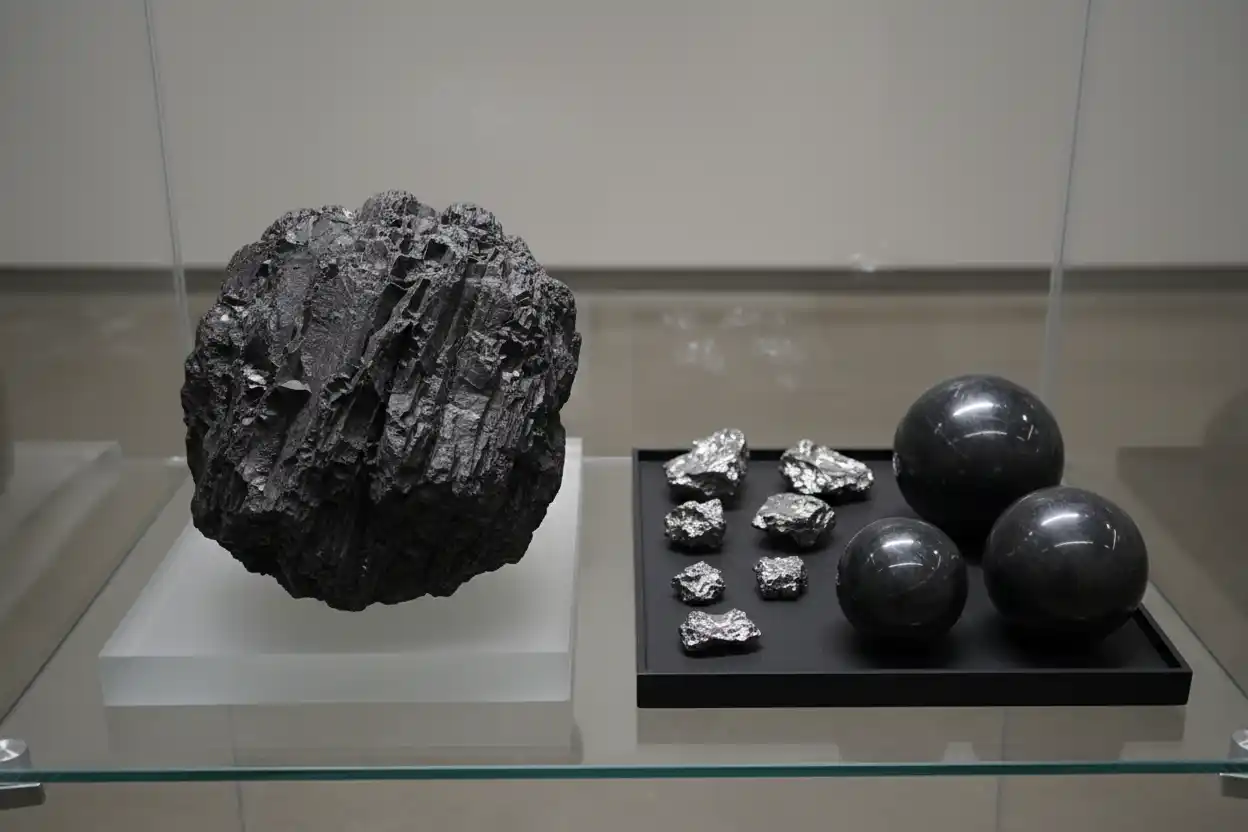
Regular shungite is usually dark grey or black, comparatively dense, and suitable for carving or polishing. Much of the object market—spheres, pyramids, tiles, beads, and pocket stones—uses this material.
Elite or noble shungite is typically silver-black, lightweight, brittle, and strongly reflective. Its higher carbon content makes it more conductive and more expensive, but its fragility limits polishing and carving.
Intermediate material may show black surfaces with metallic patches, quartz veins, pyrite, or brown iron staining. Marketing categories can overlap, so appearance alone does not establish a precise carbon percentage.
Detailed grade and variety distinctions belong on the dedicated types of shungite page.
Fullerenes and Scientific Claims
Fullerenes are carbon molecules with closed cage-like structures. Their identification in natural shungite generated substantial scientific and commercial interest.
The presence of trace fullerenes does not mean a whole rock behaves like purified fullerene material used in a laboratory. Shungite also contains other carbon structures and numerous mineral impurities.
Studies of powdered or chemically processed shungite cannot automatically predict the effect of wearing a polished pendant or placing a raw rock beside an electronic device.
Similarly, antioxidant activity measured in an extract or laboratory system does not prove a medical benefit in humans. Concentration, preparation, exposure route, dose, contaminants, and biological context all matter.
Responsible descriptions should separate documented composition and laboratory research from wellness advertising.
Can Shungite Block EMF?
Carbon-rich shungite can conduct electricity and interact with electromagnetic energy. Conductive carbon materials can also contribute to engineered shielding systems when their thickness, geometry, frequency response, grounding, and placement have been designed and measured.
A small loose stone is not equivalent to an engineered electromagnetic shield. Its presence beside a phone, router, or laptop does not demonstrate meaningful reduction in personal exposure.
Conductivity tests, such as completing a low-voltage circuit, may support a carbon-rich identification. They do not prove protection from Wi-Fi, 5G, power lines, or all electromagnetic frequencies.
People concerned about exposure should rely on device settings, distance, usage reduction, building design, and professionally tested shielding products rather than an unverified mineral claim.
Shungite and Water Purification
Shungite has adsorption properties, and researchers have examined it for removing some contaminants from water. Carbon-rich surfaces and associated minerals can interact with organic compounds, microorganisms, and dissolved ions.
However, untreated natural shungite is not the same as a regulated drinking-water filter. Scientific testing has found that nickel, copper, lead, cadmium, chromium, arsenic, and other elements may leach from some samples.
Results depend on deposit, grain size, preparation, contact time, water chemistry, and the minerals present in the rock. A piece that removes one contaminant may introduce another.
For household drinking water, use certified filtration media and follow public-health guidance. Do not assume that boiling, rinsing, or buying “elite” material eliminates the need for contaminant testing.
The general crystals you can put in water guide covers physical contact with water, but it should not be interpreted as approval for preparing beverages.
Appearance and Internal Features
Ordinary shungite is typically matte, dull, or softly reflective. Freshly broken surfaces may show a glassy-to-submetallic luster and an uneven or conchoidal-looking fracture.
Polished material can reveal pale quartz veins, brassy pyrite grains, rusty iron oxides, grey silicate patches, cracks, and pits.
Elite material usually has a brighter silver-black surface and a more brittle, irregular shape. It may leave dark carbon residue on fingers or fabric.
Not every metallic-looking piece is elite shungite. Graphite coatings, metallic paint, silicon carbide, slag, and other carbonaceous materials can produce a similar shine.
Important Localities
The Lake Onega region of Karelia remains the defining locality for shungite. The name originated near the village of Shunga.
The Zazhoginsky deposit is a major commercial source of ordinary shungite used for polished objects, aggregate, and industrial applications.
Other Karelian occurrences include layered carbon-rich rocks, veins, breccias, and high-carbon zones around the wider Onega basin.
Carbonaceous rocks from other parts of the world may resemble shungite scientifically, yet the established commercial and geological meaning remains strongly tied to Karelia.
A credible seller should identify the deposit or at least the Karelian source rather than rely only on phrases such as “Russian stone” or “ancient carbon crystal.”
Shungite Lookalikes
Jet is fossilized wood transformed into an organic gemstone. It is generally lighter, less conductive, and compositionally different from shungite.
Coal and anthracite can resemble dull or glossy shungite. Their geological origin, density, ash content, fracture, and conductivity differ.
Graphite may look metallic and leave a dark streak. It is much softer and usually has a more slippery, flaky texture.
Black obsidian is volcanic glass with vitreous luster and sharp conchoidal fracture. It is harder, usually less conductive, and lacks shungite’s carbonaceous composition.
Hematite feels heavier and produces a reddish-brown streak. It is an iron oxide rather than carbon-rich rock.
Industrial slag, silicon carbide, dyed concrete, resin, and graphite-coated stone can imitate shungite products.
How to Identify Shungite
No single home test establishes authenticity or carbon grade.
A genuine piece should be opaque black to silver-black and may leave a dark residue. Ordinary material often contains natural veins, pits, fractures, or mineral grains.
Electrical conductivity can support identification because carbon-rich shungite may complete a simple low-voltage circuit. Lower-carbon material may conduct weakly or inconsistently.
Conductivity does not prove Karelian origin, exact carbon percentage, or elite grade. Graphite, metal-bearing slag, and manufactured carbon composites can also conduct.
Specific gravity and hardness vary because shungite is a mixed material. Those tests are therefore less definitive than they would be for a pure mineral.
Raman spectroscopy, elemental analysis, ash-content testing, microscopy, and geological provenance offer better evidence. The dedicated real vs fake shungite guide owns the detailed authentication intent.
Treatments and Manufactured Products
Ordinary shungite may be polished, waxed, oiled, sealed, or impregnated with resin. These processes improve luster, control black residue, fill pores, or strengthen carvings.
Pyramids, spheres, tiles, beads, and plates may be cut from solid rock. Other products can be reconstructed from shungite powder mixed with resin or cement.
A graphite coating can increase surface conductivity and create a darker metallic appearance. Paint or pigment may also hide pale matrix.
Elite-looking fragments can be coated or substituted with industrial carbon material. Conversely, genuine high-carbon material may have iron-oxide staining or pale mineral inclusions.
The dedicated treated shungite guide covers coatings, composites, synthetic substitutes, and stabilization in greater depth.
General terminology is explained in gemstone treatments explained.
Is Synthetic Shungite Real?
The phrase “synthetic shungite” is problematic because shungite’s identity includes its natural geological origin and complex carbon-mineral mixture.
Manufacturers can produce carbon composites, fullerene-containing materials, graphite-rich ceramics, and shungite-powder products. These may have industrial uses but are not naturally formed Karelian shungite.
A reconstructed product containing real shungite powder should be labeled as a composite. The presence of some genuine powder does not make it a solid natural stone.
The broader lab-grown vs natural gemstones guide explains why an engineered substitute and a laboratory-grown crystal are different concepts.
Cutting and Polishing Behavior
Ordinary compact shungite can be shaped into spheres, pyramids, cabochons, beads, tiles, and carvings.
The material may grind unevenly because carbon-rich zones, quartz veins, sulfides, and silicate matrix have different hardness and fracture behavior.
Fine black residue forms during cutting. Wet methods reduce airborne dust, but wastewater and sludge still require controlled disposal.
Pyrite inclusions can tear out or leave pits during polishing. Open fractures may also expand as the piece is drilled.
Elite material is usually left raw because it is brittle, flaky, and difficult to polish without losing substantial weight.
Durability and Jewelry Suitability
Shungite has variable durability. Ordinary compact material can survive as a pendant or bead, but it scratches and chips more readily than quartz.
Elite material is particularly fragile. Thin projections break easily, while natural surfaces may shed carbon particles.
Pendants and earrings are more practical than rings or bracelets. Repeated rubbing against skin, metal, desks, and clothing can dull the finish or transfer black residue.
Coated or resin-treated pieces require protection from heat, solvents, perfume, and ultrasonic vibration.
Jewelry advertised specifically for electromagnetic protection should still be evaluated as decorative jewelry. The claim does not improve physical durability or prove shielding performance.
Shungite Value and July 2026 Asking Prices
The market separates ordinary polished rock from high-carbon elite material.
As of July 2026, small ordinary pocket stones and worry stones commonly carry asking prices around $4–$10. Small polished spheres of approximately 1.5–2 inches often appear around $15–$30.
Larger ordinary spheres near 4 inches may ask approximately $60–$100, depending on weight, polish, cracks, and shipping cost. Pyramids, tiles, bracelets, and carvings commonly range from $10 to $100.
Small elite fragments may begin around $10–$25. Current 30–50 gram pieces commonly appear near $30–$45, while 50–100 gram specimens may ask roughly $55–$75.
Elite pendants often range from $18 to $55, depending on weight and mounting. Exceptional large high-carbon fragments, documented specimens, or designer jewelry can cost more.
Carbon content, provenance, construction, and treatment matter more than a spiritual grade such as “AAA.” Detailed seller and product evaluation belongs on the dedicated where to buy shungite page.
Buying Shungite
Ask whether the product is ordinary, elite, solid, reconstructed, coated, waxed, resin-bound, or made from shungite powder.
A seller should identify the Karelian deposit or provide credible sourcing documentation. Generic “Russian origin” language gives limited assurance.
Inspect the back and edges of polished objects. Seams, mold lines, uniform resin texture, repeated shapes, or exposed aggregate can reveal a composite.
For elite material, look for natural irregular fracture, metallic silver-black luster, low weight, brittleness, and variable surface structure. No single feature proves authenticity.
Do not pay a premium for unverified claims about a precise fullerene percentage, universal EMF protection, medical treatment, or guaranteed water purification.
The how to buy gemstones online guide provides the general framework for photographs, returns, measurements, seller evidence, and independent testing.
Cleaning, Cleansing, and Storage
Wipe polished shungite with a soft dry or slightly damp cloth. A brief rinse may remove loose carbon residue, but dry the piece immediately.
Avoid prolonged soaking, acidic cleaners, bleach, alcohol, abrasive compounds, and household jewelry dips. These substances can affect coatings, mineral inclusions, and reconstructed binders.
Steam and ultrasonic cleaning are unsuitable for fractured, pyrite-bearing, coated, or composite pieces.
Raw elite shungite should be handled over a soft surface because it can chip or crumble. Store it in a small padded box away from pale fabric.
The dedicated how to cleanse shungite page owns spiritual-cleansing methods and their physical safety limits.
Shungite Meaning and Symbolism
Shungite has a regional history connected with Karelia, where local traditions developed around its unusual black appearance and use in water-related practices.
Modern crystal communities commonly associate it with grounding, boundaries, resilience, purification, and protection. Its ancient carbon content may symbolize endurance and continuity across deep geological time.
The contrast between dull ordinary material and metallic elite fragments also inspires themes of hidden structure, transformation, and discovering value beneath an unremarkable surface.
Claims that shungite heals disease, neutralizes all radiation, detoxifies organs, or guarantees safe drinking water extend beyond symbolic interpretation and are not scientifically established.
A person may still value it as a cultural object, geological specimen, meditation aid, decorative carving, or reminder to create practical boundaries.
Frequently Asked Questions
1. Is shungite a mineral?
Not in the strict sense. It is a variable carbonaceous material and group of metamorphosed carbon-rich rocks rather than one crystalline species.
2. How old is shungite?
The principal Karelian shungite-bearing sequence formed during the Paleoproterozoic, roughly two billion years ago.
3. Does all shungite contain 98% carbon?
No. Ordinary shungite-bearing rock can contain much less carbon; percentages near 95–98% apply only to rare high-carbon material.
4. What is elite or noble shungite?
It is a commercial term for fragile silver-black shungite with much higher carbon content than ordinary carving material.
5. Does shungite contain fullerenes?
Trace fullerenes have been reported in some samples, but their presence does not validate broad medical or wellness claims.
6. Can shungite block 5G or Wi-Fi?
A loose stone has not been shown to provide reliable personal shielding. Effective shielding requires engineered and measured materials.
7. Is shungite safe for drinking water?
Untreated natural shungite should not be assumed safe because some samples can leach heavy metals and other elements.
8. Why does shungite conduct electricity?
Its interconnected carbon-rich structure can carry electrical current, especially in higher-carbon varieties.
9. How can shungite be separated from obsidian?
Obsidian is harder volcanic glass with a more consistently vitreous fracture and usually little electrical conductivity.
10. Is polished shungite treated?
It may be waxed, oiled, resin-sealed, coated, or reconstructed, so sellers should disclose processing.
11. Why does shungite leave black marks?
Loose carbon-rich particles can transfer from raw or incompletely sealed surfaces onto skin, fabric, and paper.
12. What information should a genuine shungite seller provide?
The seller should state origin, deposit when known, product type, approximate carbon grade, construction, treatments, weight, dimensions, and return terms.
Shungite is most credible when presented as an ancient and scientifically interesting carbonaceous material. Its geology does not need exaggerated health or technology claims to make it remarkable.
Do not ingest shungite, use untested stones to prepare drinking water, or inhale its cutting dust. Research has found that some samples can leach nickel, copper, lead, cadmium, chromium, arsenic, and other elements. Use certified drinking-water filtration products, and apply wet cutting, local exhaust, eye protection, suitable respiratory protection, and controlled sludge disposal during lapidary work.