Where to Buy Real Shungite and Avoid Carbon or Resin Fakes
Real Shungite is a carbon-rich geological material best known from the Lake Onega region of Karelia in northwestern Russia. It ranges from dull, rock-like material containing substantial silicate minerals to rare brittle, lustrous pieces with very high carbon content.
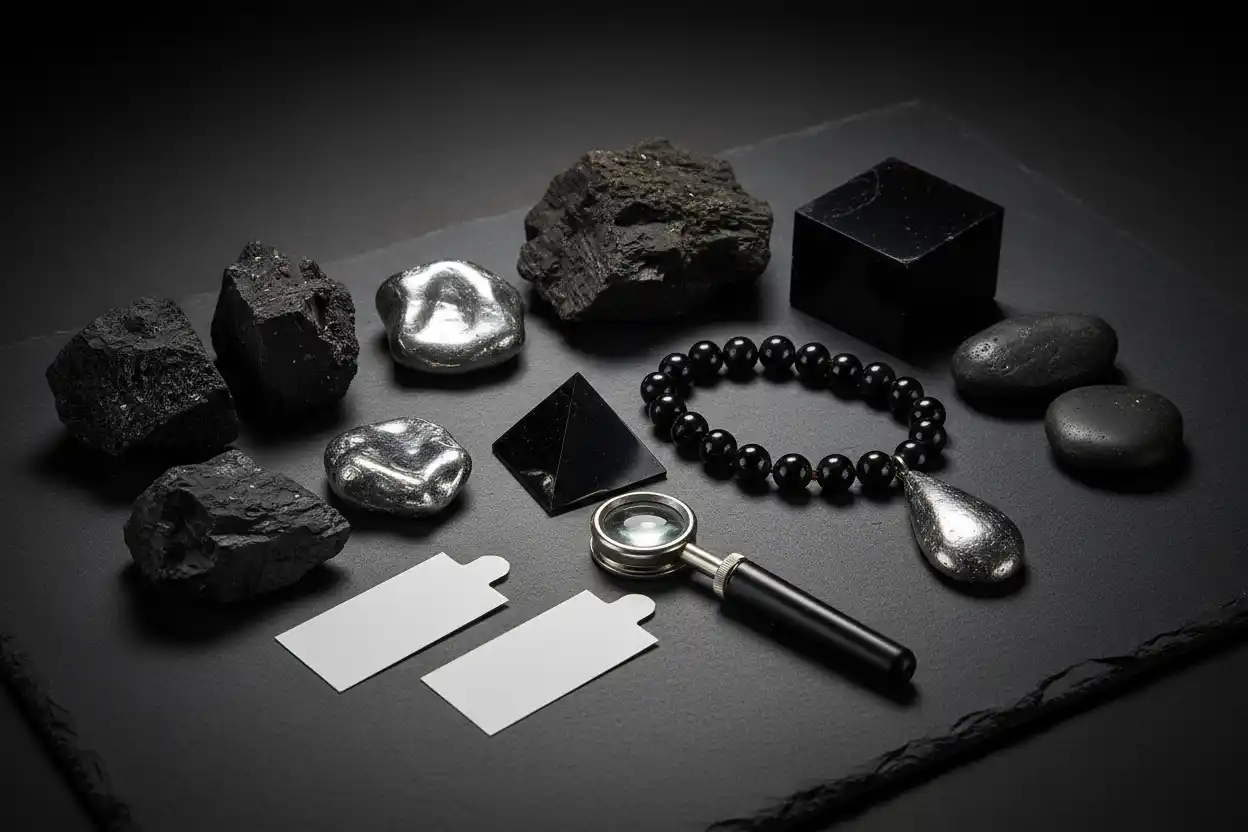
The retail name covers more than one visually consistent product. Ordinary Shungite may be matte, gray-black, granular and crossed by mineral veins, while material sold as elite or noble Shungite can look silvery black, glassy and strongly reflective.
Most buying problems involve unsupported Karelian provenance, low-carbon rock sold as elite material, coal or carbonaceous shale, painted ordinary stone, black resin and composite products. Unsupported claims about fullerenes, electromagnetic protection and drinking-water purification can also inflate prices far beyond the material’s geological value.
The Shungite meaning and properties guide covers its identity and traditional symbolism. This buying guide focuses on source, carbon-rich varieties, construction, seller evidence and realistic safety.
Shungite Is a Carbon-Rich Rock and Mineraloid
The Shungite name is used in two related ways.
In narrow mineralogical usage, it can refer to unusual noncrystalline carbonaceous material occurring in Karelian rocks. In commercial usage, it commonly refers to the wider carbon-bearing rock containing that material together with Quartz, mica, chlorite, feldspar, sulfides and other mineral phases.
Consequently, ordinary Shungite does not have one fixed chemical formula or carbon percentage.
The types of Shungite guide explains the practical trade categories and why seller terminology differs. Numbered classifications, labels such as Type I or Type III, and words such as elite, noble and regular are not applied consistently by every dealer.
A buyer should therefore request an actual carbon analysis or a precise supplier specification when carbon content affects the price.
Karelian Provenance Matters
Shungite takes its name from the Shunga area near Lake Onega in Karelia, Russia.
Major commercial material is associated with deposits and occurrences in the wider Zaonezhye region, including the Zazhoginskoye area. Carbon-rich rocks occur within an ancient Paleoproterozoic geological sequence.
A seller charging a Karelian premium should provide more than a generic Russian flag or marketing paragraph. Useful evidence can include:
- The mine or deposit
- A Russian exporter
- Original wholesale invoices
- Parcel labels
- Photographs of the unprocessed shipment
- Independent carbon or mineral analysis
- A traceable chain from rough to finished product
Appearance alone cannot establish a deposit. Black carbon-rich rocks occur in other regions, and ordinary coal can resemble low-grade Shungite.
Choose the Product Form Before Shopping
| Shungite product | Best source | Main buying concern |
|---|---|---|
| Ordinary rough | Karelian geological supplier | Carbon content, source and mixed mineral veins |
| Elite or noble rough | Specialist Shungite dealer | Genuine high-carbon material and inflated grading |
| Polished stone | Established mineral retailer | Coating, resin and whether the core is Shungite |
| Pyramid or cube | Lapidary seller with provenance | Composite construction and artificial polish |
| Bead strand | Reputable jewelry supplier | Black glass, Jet, resin and drill-hole fractures |
| Pendant | Jeweler with treatment disclosure | Backing, glue and metallic coating |
| Sphere | Experienced carving retailer | Assembly seam, filler and low-carbon core |
| Powder | Industrial or analytical supplier | Contamination, particle size and unsuitable wellness use |
| Water-treatment media | Certified filtration supplier | Heavy-metal release and lack of drinking-water certification |
| Collector specimen | Mineral dealer | Natural form, carbon content and locality documentation |
A decorative pyramid requires different evidence from industrial filtration media. The word Shungite alone does not establish that an object is suitable for contact with drinking water.
Where to Buy Genuine Shungite
Established Karelian suppliers
A direct or traceable Karelian source is preferable for rough and bulk material.
Ask whether the supplier mines the material, purchases it from a named operator or sources it through a distributor. Request a carbon-content range for the exact grade.
An honest supplier should acknowledge that carbon content varies within a deposit and even across one parcel.
The strongest listings separate geological grade from metaphysical marketing.
Mineral and geological dealers
Mineral dealers are suitable for representative rock specimens and unusual high-carbon pieces.
Request photographs under ordinary neutral light. Elite material can appear dramatically silver under direct illumination and almost black from another angle.
Ask whether reflective surfaces are natural fractures, polished areas or metallic coatings.
A dealer should also identify pale Quartz veins, sulfides and host-rock components rather than presenting every nonblack area as proof of fakery.
Gem and mineral shows
Shows allow comparison with Jet, coal, Anthracite, Graphite-rich rock, Black Obsidian, Hematite and resin.
Handle rough material over a clean surface because high-carbon pieces can be brittle and may leave black residue.
Use a loupe to inspect pores, veins, coating and fracture texture.
Do not perform destructive burning or powder tests. Heating unknown carbon-rich rock can release irritating or hazardous fumes.
Established online sellers
The online gemstone buying guide explains payment protection, seller identity and return rights.
Request photographs of the exact product rather than a representative grade sample. Elite fragments vary greatly in luster and size.
For carvings, request a complete rotation and a close-up of any chips. A broken edge may reveal resin, pale filler or a different core material.
Ask whether the product has been waxed, lacquered, dyed, stabilized or reconstructed.
Ordinary Shungite
Most affordable Shungite products are made from relatively low-to-moderate-carbon rock.
This material commonly appears:
- Matte black
- Dark gray
- Granular
- Slightly porous
- Crossed by pale mineral veins
- Unevenly conductive
- Heavier than highly carbon-rich elite fragments
- Less reflective than noble material
Variation does not necessarily indicate a fake. Ordinary Shungite is a heterogeneous rock rather than pure carbon.
A seller should not promise a precise carbon percentage without analytical data. Visual grading can provide a rough category but cannot replace laboratory measurement.
Ordinary material is commonly used for carvings because it is less brittle and easier to shape than the highest-carbon variety.
Elite or Noble Shungite
Elite, noble or silver Shungite refers commercially to rare, highly carbon-rich material with a bright metallic-to-glassy luster.
Typical features include:
- Strong silvery-black reflections
- Curved or conchoidal fracture
- Low apparent density
- Brittleness
- Thin irregular fragments
- Limited carving suitability
- Greater electrical conductivity than ordinary material
Natural elite pieces often have uneven sharp edges and occur as relatively small fragments. Large flawless spheres, thick bracelets and perfect pyramids advertised as solid elite Shungite deserve close scrutiny.
The highest-carbon material is brittle, so large calibrated objects may be ordinary Shungite, composites or pieces with substantial resin.
A seller should not call a polished dark ordinary stone elite merely because its surface is shiny.
Shungite Versus Jet
Jet is lightweight organic gem material formed from ancient wood.
Both materials are black and can leave marks, but Jet commonly feels lighter and has a different organic texture.
The completed guide to buying genuine Jet covers coal, vulcanite, black glass and bog-oak substitutes.
Neither a low weight nor a black streak establishes Shungite. Provenance and carbonaceous rock texture remain essential.
Shungite Versus Coal and Anthracite
Coal can appear matte black, glossy or strongly banded.
Anthracite may have bright metallic luster and conchoidal fracture, making it a convincing elite-Shungite substitute.
Coal generally has a different geological context and internal banding. However, visual distinction can become difficult in small polished fragments.
Raman spectroscopy, elemental analysis and carbon-structure testing can help, but locality documentation remains important.
A seller should not present an electrical-conductivity reading as proof that black carbonaceous material came from Karelia.
Shungite Versus Black Obsidian
Black Obsidian is natural volcanic glass.
It usually has a smoother glassy fracture and lacks the heterogeneous carbon-and-mineral structure of ordinary Shungite.
The completed guide to buying Black Obsidian addresses glass, slag and resin.
Elite Shungite can also have curved glass-like fracture, so a polished black fragment may require analytical testing.
Shungite Versus Hematite
Hematite is an iron oxide with metallic gray-to-black appearance.
It feels substantially denser than most Shungite and commonly produces a reddish-brown streak on an appropriate sacrificial test surface.
The completed guide to buying genuine Hematite covers magnetic ferrite and manufactured beads.
Do not streak or scratch a finished product without the owner’s permission.
Shungite Versus Black Resin
Resin can be colored black and filled with carbon powder, stone fragments or metallic pigment.
Warning signs include:
- Mold seams
- Numerous round bubbles
- Soft scratches
- Identical repeated shapes
- A plastic-looking chipped edge
- Strong chemical odor
- Uniform metallic flakes
- No natural mineral veins
A resin composite may contain real Shungite powder. However, it is not one solid natural rock and should be labeled accordingly.
The fake-crystal buyer’s guide provides broader composite checks.
Painted and Coated Stone
Ordinary rock, concrete or low-grade Shungite can receive black paint, lacquer or metallic coating.
Inspect scratches, corners and drill holes for peeling or a contrasting core.
A clear sealant may be used legitimately to reduce dusting or improve the polish of a carving. The treatment should still be disclosed.
Metallic silver paint is not equivalent to elite Shungite’s natural luster.
The treated-Shungite guide owns the detailed treatment and synthetic-product workflow.
Reconstructed Shungite
Fragments and powder can be mixed with polymer and molded into spheres, pyramids and beads.
Such products may offer consistent shapes and less chipping. Nevertheless, their conductivity, carbon content and chemical behavior can differ from solid rock.
Inspect exposed chips and drill holes for binder.
A reconstructed product should disclose:
- The percentage of Shungite
- The binder
- Any pigment
- Whether the material was pressed or cast
- Its intended use
- Its limitations around heat and water
Does Conductivity Prove Authenticity?
High-carbon Shungite can conduct electricity, while lower-carbon rock may conduct weakly or inconsistently.
A multimeter can therefore provide supporting information, but it is not a complete authentication test.
Conductive paint, Graphite, metal-filled resin, Hematite and other materials can also complete an electrical circuit.
Furthermore, contact pressure, moisture, surface coating and probe spacing influence the reading.
The real-versus-fake Shungite guide provides the complete diagnostic workflow. Use conductivity as one observation alongside geological texture, density, spectroscopy and provenance.
Carbon Content and Seller Grades
Commercial suppliers often divide Shungite into numbered types or three broad tiers.
Unfortunately, those systems are not fully standardized. One seller’s Type II may overlap another seller’s regular or petrovsky grade.
Request carbon-content ranges instead of relying on the grade name alone.
For a premium purchase, ask:
- Was carbon measured?
- Which method was used?
- Was the tested sample taken from this parcel?
- Is the result total carbon or elemental carbon?
- Does the report identify mineral impurities?
- Can the seller provide the laboratory name and date?
A generic certificate copied across every listing offers limited value.
Fullerene Claims
Fullerenes have been reported in Shungite-related research, but retail claims often exaggerate their concentration and practical significance.
A seller should not imply that every Shungite object contains a large, standardized or medically effective amount of C60.
Likewise, the presence of unusual carbon nanostructures does not establish that wearing a stone treats disease or protects the body from environmental exposure.
Do not pay a premium based solely on phrases such as “fullerene charged,” “quantum carbon” or “highest C60 frequency.”
Electromagnetic-Protection Claims
Carbon-rich materials can interact with electromagnetic fields under engineered conditions. Their performance depends on conductivity, thickness, frequency, geometry, grounding and the complete construction of a shielding system.
A small pendant or pyramid is not equivalent to tested shielding material installed according to an engineering specification.
Retail demonstrations that place a stone near a phone meter can be misleading because position, orientation and the user’s body affect the reading.
Purchase Shungite as a geological or decorative material rather than as a substitute for evidence-based electrical-safety measures.
Shungite and Drinking Water
Some sellers promote loose Shungite stones for preparing drinking water.
However, natural Shungite is heterogeneous and can contain metal-bearing minerals. Research has found that commercial samples can release nickel, lead, cadmium, arsenic and other elements into water, even while adsorbing certain contaminants.
Therefore, decorative Shungite should not be assumed safe for drinking-water contact.
A household water filter must be certified for its specific purpose, flow conditions and contaminant claims. Loose stones are not an adequate substitute.
The crystals-in-water guide offers broader material-safety context but does not override certified water-treatment guidance.
How to Evaluate Rough Shungite
Begin with provenance and the seller’s grade definition.
Examine the material under neutral light. Ordinary Shungite should show a natural heterogeneous rock texture, while elite material may have a brighter curved fracture.
Look for pale veins, mica, Quartz and sulfide grains. These features can be natural.
Compare several pieces from the parcel. Identical surfaces suggest molding or heavy coating.
Handle high-carbon fragments carefully because they can chip and shed small particles.
How to Judge Pyramids, Cubes and Spheres
Request a complete rotation.
Inspect every corner and edge for filler, paint and a contrasting core.
A sphere should not contain a straight equatorial assembly seam.
Sharp pyramid tips can be repaired. Ask whether color-matched resin was used.
Large carvings made from ordinary Shungite are plausible. Large solid elite-Shungite carvings are much less credible because elite material is rare and brittle.
Buying Beads and Bracelets
Natural Shungite beads can show gray-black variation, pale veins and slight surface irregularities.
Inspect drill holes for resin, glass, coating and radial cracks.
Perfectly uniform mirror-black beads may be glass, resin, Obsidian or heavily coated material.
Shungite can leave dark residue on skin or clothing, particularly when newly polished or unsealed. Ask whether the beads have been waxed or lacquered.
The gemstone hardness chart and gemstone toughness-versus-hardness guide explain why carbon content, mineral veins and construction create variable durability.
Buying Shungite Jewelry
Pendants and earrings experience less abrasion than bracelets and rings.
A jeweler should disclose whether the stone is:
- Solid ordinary Shungite
- Elite Shungite
- Backed Shungite
- Shungite powder in resin
- Coated rock
- A mixed black-stone assemblage
Closed settings can hide a resin backing or thin Shungite layer. Request photographs before mounting.
Avoid exposing Shungite jewelry to perfume, hairspray and household chemicals, especially when it is coated or filled.
Price and Value
Ordinary Shungite is generally affordable. Elite material costs more because high-carbon lustrous fragments are less abundant and difficult to shape.
Value factors include:
- Credible Karelian provenance
- Carbon content
- Natural luster
- Solid construction
- Size
- Low fracture damage
- Treatment disclosure
- Cutting quality
- Original labels
- Laboratory evidence
A small natural elite fragment can cost more than a large ordinary carving.
However, large markups based on EMF, detoxification or medical claims do not reflect conventional mineral value.
The gemstone pricing guide explains how rarity, evidence and workmanship influence retail price.
Questions to Ask the Seller
Ask where the Shungite was mined and how the seller verified the source.
Request the carbon-content range and the method used to establish it.
Ask whether elite, noble or numbered grades follow a published standard or the seller’s own system.
Confirm paint, lacquer, wax, resin, reconstruction and backing.
For carvings, request every side and close-ups of chips. For beads, request drill-hole views.
Ask whether the product is certified for drinking-water contact. If it is not, do not use it as filtration media.
Finally, confirm a return policy that allows professional material testing.
Professional Identification
Raman spectroscopy can characterize carbon structure and identify several mineral components.
X-ray diffraction can reveal Quartz, mica, sulfides and other crystalline phases, although the carbonaceous portion may produce broad or diffuse patterns.
Elemental and thermal analysis can estimate carbon content.
Microscopy can identify coatings, resin and heterogeneous rock texture.
A laboratory may confirm carbon-rich Shungite material without being able to prove one mine unless comparative provenance data and records are available.
Cleaning and Storage
Use a soft dry cloth or brush for routine cleaning.
A lightly damp cloth can be used on sound solid material, followed by immediate drying. Avoid soaking, particularly when sulfides, resin, glue or coating are present.
The Shungite cleansing and charging guide offers non-destructive options for traditional practices.
Store elite fragments in padded individual boxes because brittle edges can chip.
Keep unsealed material away from pale fabrics and porous surfaces that may pick up black residue.
Frequently Asked Questions
1. Is Shungite a mineral?
Shungite is better described as carbonaceous mineraloid material and the carbon-rich rocks that contain it, rather than one approved crystalline mineral species.
2. Where does genuine Shungite come from?
The classic and primary commercial source is the Lake Onega region of Karelia in northwestern Russia.
3. What is elite Shungite?
Elite or noble Shungite is a commercial term for rare, highly carbon-rich, lustrous and brittle material.
4. Is ordinary Shungite fake because it contains gray veins?
No. Ordinary Shungite is a heterogeneous rock and can naturally contain Quartz, mica, silicates and sulfides.
5. Does conductivity prove authenticity?
No. Conductivity can support identification, but Graphite, metal-filled resin and other materials can also conduct electricity.
6. Can coal imitate Shungite?
Yes. Anthracite and other carbon-rich rocks can resemble both ordinary and lustrous Shungite.
7. Can Shungite be reconstructed with resin?
Yes. Powder and fragments can be pressed or molded with polymer into beads, spheres and pyramids.
8. Does all Shungite contain a large amount of fullerenes?
No. Fullerene content is not standardized, and retail claims frequently exaggerate its concentration and significance.
9. Does a Shungite pendant block harmful electromagnetic radiation?
A small decorative stone is not a certified engineered shielding system, and broad health-protection claims are unsupported.
10. Is Shungite safe to place in drinking water?
Do not assume it is safe. Research has found that some samples release heavy metals, so only properly certified filtration products should contact drinking water.
11. Do ordinary pieces need laboratory reports?
Usually not. Reports become more useful for expensive elite material, carbon-content claims and disputed composites.
12. What is the biggest warning sign in a listing?
Be cautious when a seller promises medical treatment, complete EMF protection or safe water purification but provides no mine, carbon analysis or product certification.
Buy the Carbon-Rich Geological Material, Not the Wellness Promise
Shungite can be an unusual and attractive Karelian material without treating it as a universal health device. A credible purchase rests on provenance, realistic grading, solid construction and transparent treatment disclosure.
The black crystals guide, black gemstones guide, S crystal directory and S gemstone directory provide wider comparisons. Choose the seller who can explain the rock before making claims about what it supposedly does.
Safety note: Do not ingest Shungite, prepare drinking water with uncertified loose stones or inhale its dust. Shungite-bearing rock can contain metal-bearing minerals and may release potentially harmful elements. Cutting and grinding require wet methods, effective extraction and suitable respiratory and eye protection.