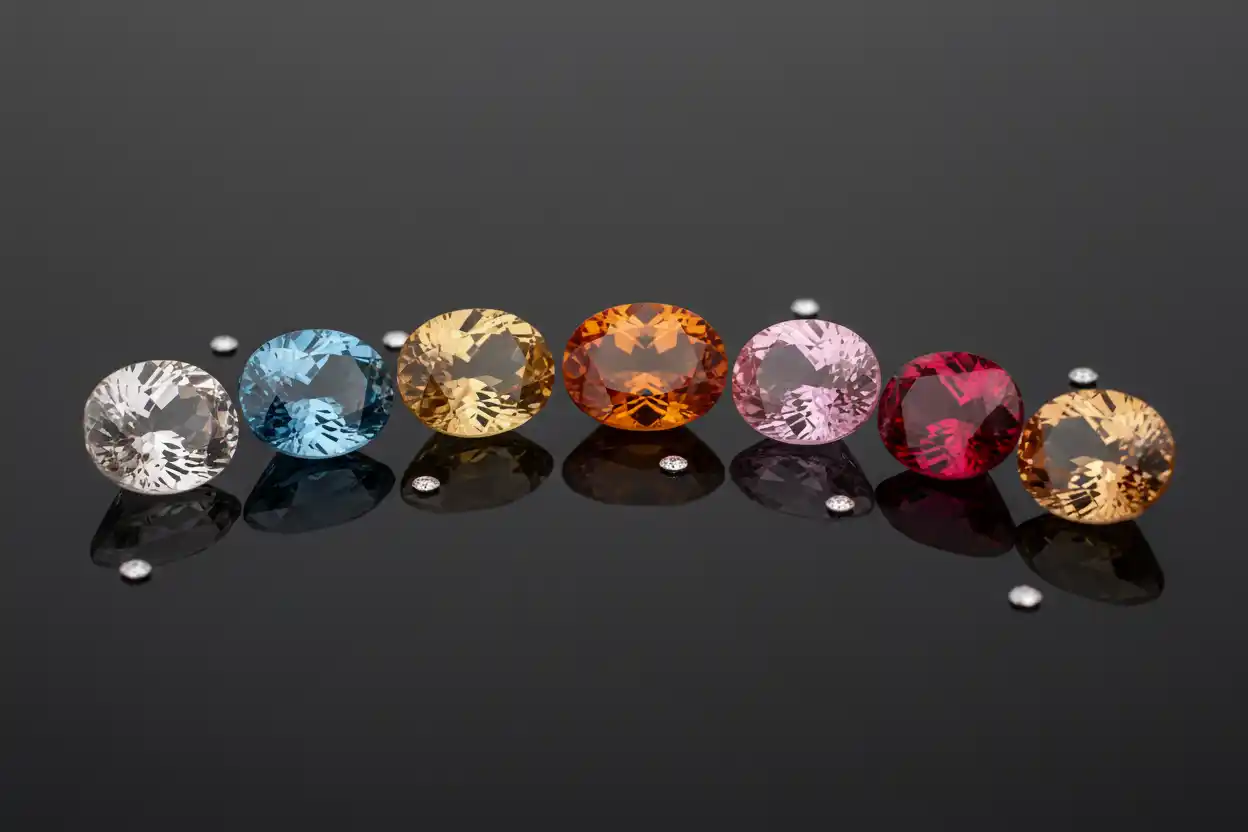
Topaz Color Meaning: Blue, Yellow, Pink, White & More
Topaz has one of the widest color ranges among familiar transparent gemstones. It can be colorless, blue, yellow, golden, orange, brown, pink, red, violet and, much more rarely, greenish. Some colors develop naturally from trace elements or defects within the crystal structure, while others—especially much of the blue topaz in today’s jewelry market—commonly result from treatment.
Color also changes the symbolism people attach to topaz. Blue is commonly associated with communication and calm, golden and yellow stones with optimism, orange and Imperial topaz with vitality, pink and red with affection or passion, and colorless topaz with clarity. These meanings are cultural and modern symbolic interpretations rather than physical effects created by the gem’s color.
Topaz Colors at a Glance
| Topaz Color | Gemological Context | Common Modern Symbolism |
|---|---|---|
| Colorless / white | Naturally abundant | Clarity, simplicity, intention |
| Sky blue | Usually treated | Calm, openness, communication |
| Swiss blue | Usually treated | Confidence, expression, brightness |
| London blue | Usually treated | Depth, composure, reflection |
| Yellow | Can occur naturally | Optimism, confidence, warmth |
| Golden | Natural or treatment-dependent material | Success, abundance symbolism |
| Orange | Includes valuable natural material | Vitality, creativity |
| Imperial | Trade term for prized warm colors | Leadership, confidence, purpose |
| Pink | Rare naturally; treatment may occur | Affection, gentleness |
| Red | Extremely rare | Passion, courage, commitment |
| Brown / sherry | Natural color occurs | Stability, warmth |
| Purple / violet | Rare natural material exists | Reflection, individuality |
| Mystic / rainbow | Surface-coated topaz | Transformation, creativity |
This support page concentrates specifically on what different topaz colors mean. The completed Types of Topaz guide owns detailed variety classification, while Topaz: Meaning, Properties & Symbolism remains the parent mineral profile.
Why Does Topaz Have Different Colors?
Pure topaz would be colorless.
Its many colors arise from trace elements, defects in the crystal lattice, natural irradiation and, in commercial material, human treatments.
GIA identifies topaz as allochromatic, meaning its color is not caused by an essential coloring element required by the basic chemical formula.
Chromium contributes to natural pink, red and violet-to-purple topaz.
Structural defects can produce yellow, brown and blue.
Treatment can alter these color centers as well.
Consequently, two pieces of topaz can have the same mineral identity yet dramatically different appearances and market values.
Colorless or White Topaz Meaning
Colorless topaz is transparent topaz without strong visible bodycolor.
It is naturally abundant compared with rare pink, red and fine orange material.
In modern symbolism, white or colorless stones commonly represent:
clarity, simplicity, honesty and fresh intention.
Those associations come mainly from visual transparency.
A grounded use could be to treat white topaz as a reminder to define a situation clearly before making assumptions.
For example:
What facts do I actually have?
The completed White Topaz: Meaning, Properties & Symbolism owns the complete variety profile.
Is White Topaz the Same as Diamond?
No.
Colorless topaz can imitate aspects of diamond visually, but topaz and diamond have completely different composition, optical performance and durability.
Topaz is Mohs 8 and has perfect basal cleavage.
Diamond is Mohs 10 with much stronger brilliance and dispersion under normal cutting conditions.
White topaz is a legitimate gemstone in its own right rather than a form of diamond.
Its symbolic meaning should therefore be tied to topaz rather than to claims borrowed from diamond.
Blue Topaz Meaning
Blue is probably the color most consumers associate with topaz today.
However, strong blue topaz is rarely natural.
Most commercial blue material begins as colorless topaz and receives irradiation followed by controlled heating or related processing to produce stable blue colors.
Modern symbolism generally connects blue topaz with:
communication, calm, mental clarity and self-expression.
The meaning often changes slightly according to shade.
Sky Blue Topaz Meaning
Sky blue topaz is usually the palest major commercial blue.
Its light, open appearance encourages symbolism involving:
ease, calm communication and mental spaciousness.
Rather than claiming that a gemstone scientifically improves communication, someone could use sky blue as a reminder to slow down and explain something clearly.
The pale shade creates a softer symbolic impression than darker London blue.
Swiss Blue Topaz Meaning
Swiss blue is brighter and more saturated.
It often has a vivid medium to medium-light blue appearance that stands out clearly in jewelry.
Modern symbolic interpretations commonly emphasize:
confidence, expression, optimism and social openness.
Because Swiss blue is a trade color rather than a separate mineral species, exact shade standards can vary between sellers.
A stone should therefore be judged by its actual appearance rather than the label alone.
London Blue Topaz Meaning
London blue usually represents the darkest mainstream treated-blue topaz.
Its tone can range toward grayish or greenish blue depending on material and commercial usage.
The darker color naturally attracts symbolism involving:
depth, reflection, composure and deliberate communication.
The completed London Blue Topaz: Meaning, Properties & Symbolism owns this variety’s full profile.
A darker name does not indicate a different mineral composition; London blue remains topaz.
Yellow Topaz Meaning
Natural yellow topaz ranges from pale lemon through honey and golden shades.
Modern symbolism commonly associates yellow with:
optimism, confidence, learning and warmth.
These themes overlap with broader yellow-crystal symbolism.
However, yellow topaz should not be confused with citrine merely because both can have warm yellow colors.
Historically, yellow quartz was sometimes incorrectly sold under names such as “topaz quartz.”
The completed Yellow Topaz: Meaning, Properties & Symbolism preserves the yellow variety’s separate mineral profile.
Golden Topaz Meaning
Golden topaz sits toward richer yellow-orange colors.
Symbolically, gold-colored gemstones are often connected with:
achievement, abundance, confidence and purpose.
These associations can be interpreted without suggesting that the stone attracts money.
A more grounded meaning might be:
Use what you already have well.
That turns abundance from a promise of financial gain into a theme of stewardship and recognizing available resources.
Orange Topaz Meaning
Orange is one of topaz’s most important natural warm colors.
Fine orange material can be substantially more valuable than mass-market blue topaz.
Its symbolism commonly includes:
creativity, enthusiasm, vitality and active confidence.
Orange works especially well as a symbolic bridge between yellow’s optimism and red’s intensity.
Someone could therefore use orange topaz as a reminder to turn an idea into action rather than simply enjoying the initial excitement.
Imperial Topaz Meaning
Imperial topaz is one of the most prestigious warm-color categories.
However, there is no single universally enforced gemological color standard for the term.
GIA notes that dealers use “Imperial” differently, with descriptions ranging through orange, pink, red and purple-toned material.
The important feature is the actual color rather than the title.
Modern symbolism naturally connects Imperial topaz with:
confidence, leadership, purpose, achievement and personal authority.
These are symbolic associations, not evidence that the gemstone changes status or power.
The completed Imperial Topaz: Meaning, Properties & Symbolism owns the full variety intent.
Pink Topaz Meaning
Natural pink topaz is rare.
Chromium can produce pink, red and violet-purple colors in natural topaz.
Pink stones may also enter the market through treatment, so significant purchases deserve clear disclosure.
Modern pink-topaz symbolism usually centers on:
affection, gentleness, emotional openness and appreciation.
A grounded interpretation focuses on how affection is expressed rather than expecting the gemstone to create a relationship.
For example:
Have I actually communicated appreciation rather than assuming it is understood?
Red Topaz Meaning
Red is among the rarest and most valuable topaz colors.
GIA notes that red represents less than a tiny fraction of facet-grade topaz material.
Its visual rarity naturally reinforces symbolism involving:
passion, courage, commitment and strong intention.
Because red topaz is uncommon, unusually valuable stones deserve careful identification and treatment disclosure.
The symbolism should not obscure the gemological reality that color rarity is a major part of the market value.
Brown Topaz Meaning
Brown is a naturally occurring and relatively common topaz color.
It ranges from pale champagne-like tones through sherry brown and deeper warm shades.
Modern symbolism commonly associates brown gemstones with:
stability, practicality, patience and connection with ordinary routines.
GIA uses sherry topaz for yellowish-brown to brownish-yellow or orange material named after sherry wine.
Trade names vary, so the actual color remains more useful than the marketing term.
Purple and Violet Topaz Meaning
Natural violet-to-purple topaz can occur and is associated with chromium-related coloration.
Fine material is unusual.
Modern symbolism commonly connects purple with:
reflection, individuality, imagination and spiritual awareness.
These meanings are general color traditions rather than historically standardized topaz correspondences.
Purple should also not be confused automatically with Mystic Topaz, which is a coated product with an iridescent multicolor surface.
Mystic Topaz Meaning
Mystic Topaz begins with real topaz, typically colorless material, and receives a thin surface coating that creates rainbow or multicolored interference effects.
Therefore, its spectacular appearance does not represent a naturally grown rainbow bodycolor.
Modern symbolism often focuses on:
adaptability, creativity and embracing complexity.
The completed Mystic Topaz: What It Is, Meaning & Uses explains the coated material in detail.
Because the color depends on a surface treatment, care should be gentler than for uncoated topaz.
Green Topaz
Topaz can occur with greenish appearance, although true attractive green is much less familiar in mainstream jewelry than blue, yellow or warm Imperial colors.
Green-toned topaz may carry modern symbolism involving:
growth, renewal and balance.
However, buyers should be cautious with unusual saturated green claims.
Identification and treatment disclosure matter because similar-looking green gemstones and coated products exist.
Green is better treated as a rare color occurrence rather than one of topaz’s main standardized commercial categories.
What Color Topaz Is Most Valuable?
Color dominates topaz value.
GIA identifies fine red among the rarest colors and notes that highly prized Imperial colors can command significant premiums.
Fine pink, reddish-orange and orange-red material can also be valuable.
Blue topaz, in contrast, is widely available because treatment has created an enormous commercial supply.
That does not make blue topaz unattractive.
It simply means rarity and price should not be inferred from visual saturation alone.
The completed Topaz Price Guide owns the valuation details.
Does Treatment Change Topaz Meaning?
Treatment changes how the color formed, not the mineral species.
A treated blue topaz remains topaz.
Someone interested in symbolism can still attach personal meaning to it.
However, natural-origin symbolism should not be used to hide treatment.
A seller should not imply that an intense blue grew naturally when the color was created through irradiation and heat.
The completed How to Spot Treated or Synthetic Topaz owns the treatment-identification workflow.
Choosing Topaz by Color
Choose the color you actually enjoy before worrying about which symbolism is supposedly strongest.
White topaz works for minimalist styling.
Blue provides abundant cool-color options.
Yellow and golden stones create warmer jewelry.
Imperial orange-to-red colors occupy a much rarer fine-gem category.
Pink and red suit buyers seeking less common material.
The completed Topaz Buying Guide covers gemstone-quality selection, while Real vs Fake Topaz addresses authenticity.
Symbolism can then be added as a personal layer rather than replacing gemological evaluation.
Frequently Asked Questions
1. What does blue topaz symbolize?
Modern traditions commonly associate blue topaz with communication, calm, clarity and self-expression.
2. Is blue topaz naturally blue?
Natural blue occurs but is generally pale and uncommon. Most strongly colored commercial blue topaz is produced by treating colorless topaz, commonly with irradiation and heat.
3. What does yellow topaz symbolize?
Yellow topaz is commonly associated symbolically with optimism, confidence, learning and warmth.
4. What does Imperial topaz symbolize?
Modern interpretations often connect Imperial topaz with confidence, leadership, purpose and achievement.
5. What color is Imperial topaz?
There is no universally enforced definition. The trade commonly applies the name to prized warm colors within orange, reddish-orange, pinkish, red or related ranges.
6. What does pink topaz mean?
Pink topaz is commonly associated with affection, gentleness, appreciation and emotional openness.
7. What does white topaz symbolize?
Colorless or white topaz commonly symbolizes clarity, simplicity and clear intention in modern gemstone symbolism.
8. What does red topaz symbolize?
Red topaz is commonly connected with courage, passion and commitment. It is also one of the rarest natural topaz colors.
9. What does brown topaz mean?
Brown and sherry-colored topaz are often associated symbolically with stability, practicality and warmth.
10. Is Mystic Topaz naturally rainbow colored?
No. Mystic Topaz is genuine topaz whose surface has been coated to produce its multicolored appearance.
11. Which topaz color is rarest?
Fine natural red is among the rarest, while exceptional pink, reddish and Imperial-quality warm colors are also scarce.
12. Does topaz color have scientifically proven spiritual effects?
No. Color meanings and metaphysical associations are cultural or personal symbolism rather than scientifically demonstrated effects.
Conclusion
Topaz color is more than a decorative difference because it can reveal genuine differences in rarity, color origin and treatment.
Colorless topaz is abundant. Blue dominates modern jewelry largely because treatment makes attractive saturated colors widely available. Yellow, orange and Imperial material move toward rarer natural warm colors, while fine pink and especially red topaz can be substantially less common.
Symbolically, those colors create a second layer.
Blue can represent communication, yellow optimism, orange creativity, pink affection and white clarity.
Those meanings can make a gemstone personally significant, but they should remain separate from the gemological question of how the color actually formed.
The strongest approach is therefore to understand both layers: identify the color accurately and disclose treatment honestly, then use symbolism as a personal interpretation rather than as proof of a physical or supernatural effect.
Disclaimer: Topaz color symbolism and metaphysical meanings are cultural, spiritual or personal interpretations rather than scientifically established medical, psychological, financial or energetic effects.