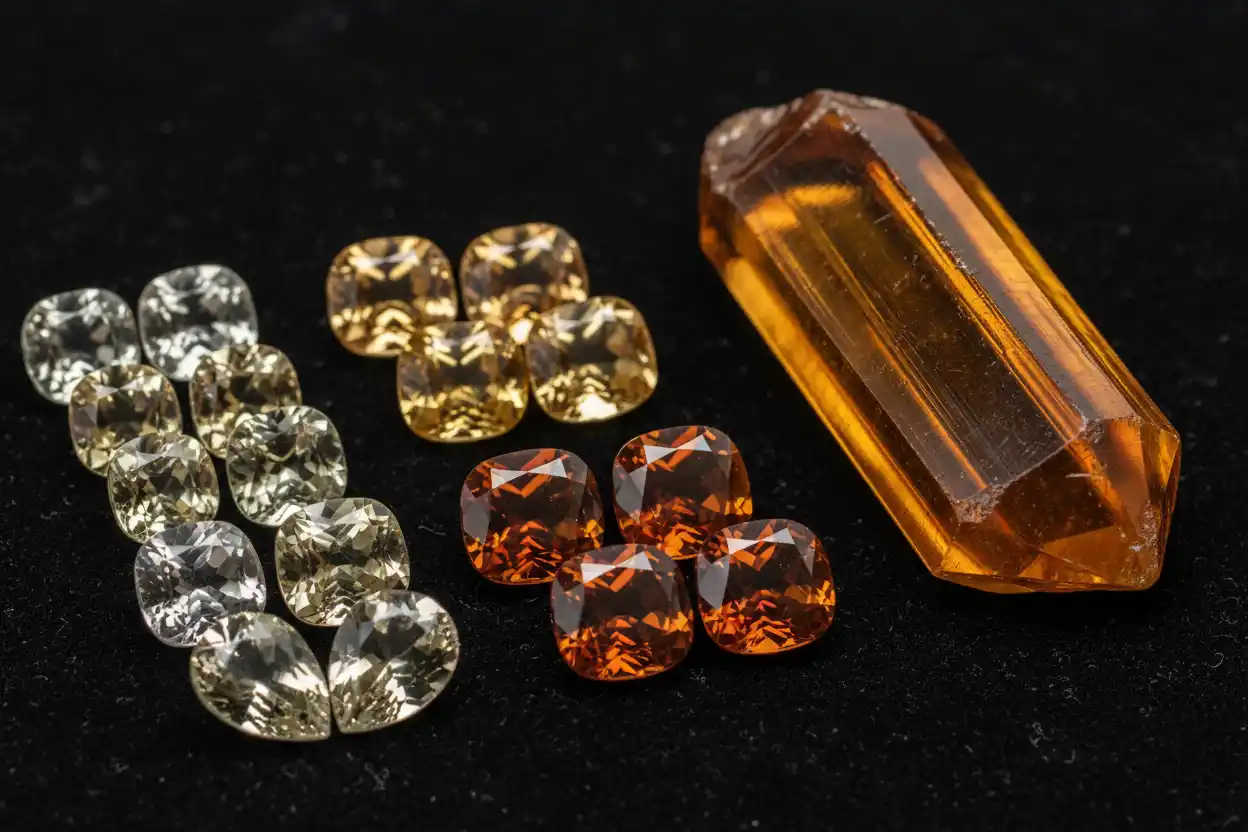
Yellow Topaz Meaning, Properties, Value and Identification
Yellow topaz is natural or treated topaz whose dominant color ranges from pale straw and lemon to golden yellow, yellow-brown and warm sherry. It is more abundant and less valuable than Imperial Topaz, which requires prized orange-to-red color characteristics rather than yellow color alone.
Its hardness of 8 supports many jewelry uses, but perfect basal cleavage means that a sharp blow can split an otherwise clean stone. Correct identification is also important because citrine, yellow glass and quartz have historically been sold under misleading topaz names.
Yellow Topaz at a Glance
| Property | Yellow Topaz |
|---|---|
| Mineral species | Topaz |
| Chemical formula | Al₂SiO₄(F,OH)₂ |
| Mineral class | Nesosilicate |
| Typical colors | Pale straw, lemon, golden yellow, yellow-brown, honey and sherry |
| Major color cause | Atomic-scale defects and color centers; trace chemistry and treatment may modify color |
| Crystal system | Orthorhombic |
| Common habit | Elongated prismatic crystals with striated faces and complex terminations |
| Luster | Vitreous |
| Transparency | Transparent to opaque, though gem material is transparent |
| Refractive indices | Approximately 1.609–1.643 |
| Birefringence | Approximately 0.008–0.011 |
| Optical character | Biaxial positive |
| Specific gravity | Approximately 3.49–3.57 |
| Mohs hardness | 8 |
| Cleavage | Perfect basal cleavage |
| Tenacity | Brittle |
| Common cuts | Oval, pear, cushion, emerald, round, marquise and fantasy cuts |
| Main buying concern | Citrine confusion, unsupported Imperial Topaz claims, irradiation and cleavage damage |
What Is Yellow Topaz?
Yellow topaz is a color variety of the mineral topaz.
The ideal mineral contains aluminum, silicon, oxygen, fluorine and hydroxyl.
Pure topaz can be colorless. Atomic-level imperfections and trace elements create yellow, brown, blue, pink, red and other colors.
Yellow topaz does not have a separate chemical formula from colorless or blue topaz.
The parent topaz guide owns family-level mineralogy and history.
The broader variety classification remains with Types of Topaz, while Topaz Color Meaning and Symbolism compares the traditional associations assigned to different colors.
This page focuses on ordinary yellow, golden and yellow-brown topaz without absorbing Imperial Topaz’s distinct high-value intent.
Yellow Topaz Color Range
Pale Straw Topaz
Pale material has low saturation and can appear nearly colorless under cool lighting.
It is abundant and generally affordable.
Good cutting becomes especially important because weak color cannot hide a broad window or dull facets.
Lemon Yellow Topaz
Lemon-yellow topaz has a cleaner, cooler yellow than golden or sherry material.
The term lemon is descriptive rather than a formal variety.
Transparent lemon topaz can resemble citrine, yellow sapphire and treated lemon quartz.
Golden Yellow Topaz
Golden topaz displays a warm, moderately saturated yellow.
Some sellers use golden topaz as though it were synonymous with Imperial Topaz. That usage is inaccurate when red, pink or distinctly orange characteristics are absent.
Golden topaz is more abundant and normally less expensive than true Imperial material.
Yellow-Brown Topaz
Yellow-brown stones range from honey and cognac to deeper brownish gold.
GIA notes that dealers often use sherry topaz for brownish-yellow, yellowish-brown and orange topaz resembling sherry wine.
Sherry is a trade description rather than a separate mineral species.
Orangy-Yellow Topaz
Orangy-yellow material approaches the Imperial Topaz category.
A warm orange modifier can raise value, especially when the stone shows reddish pleochroism.
However, not every yellow-orange topaz should receive the Imperial label.
Yellow Topaz Versus Imperial Topaz
Imperial Topaz occupies the premium orange-to-pinkish-orange, reddish-orange and red end of the topaz market.
Many dealers require visible reddish pleochroism before using the term Imperial.
This reddish component may appear along the ends of an oval or pear-shaped stone.
Ordinary golden or yellow topaz lacks the valued red overtones and is more abundant.
The Imperial name has no single universally enforced laboratory boundary, so reports often describe color directly rather than certify a marketing grade.
A seller should not charge an Imperial premium for a plainly yellow stone supported only by a commercial certificate.
Yellow Topaz Versus Precious Topaz
Precious topaz is an older trade expression applied to natural yellow, golden, orange or sherry-colored topaz.
The term helped separate genuine topaz from citrine, which was historically called quartz topaz or topaz quartz.
Precious topaz does not mean that the stone belongs to a separate mineral species.
Modern descriptions should use topaz plus an observed color, treatment and origin.
The word precious should not substitute for a recognized laboratory report or objective quality information.
What Causes Yellow Topaz Color?
Topaz is allochromatic, meaning its color comes from impurities or structural defects rather than its essential chemical components.
Atomic-scale imperfections can cause yellow, brown and blue colors.
Natural radiation can influence defect-related color over geological time.
Heating and irradiation can change the electronic state of those defects and alter the apparent color.
The exact mechanism varies among deposits and treatments.
Yellow color should therefore not be attributed automatically to one trace element.
Chromium is more strongly associated with natural pink, red and violet-purple topaz than with ordinary yellow material.
Natural Yellow Topaz
Natural yellow and yellow-brown topaz occur in pegmatites, rhyolitic cavities and alluvial deposits.
Untreated stones can range from pale straw to rich sherry.
Natural color may show zoning within the original crystal.
Some rough contains colorless sections beside yellow or brown areas.
Large transparent crystals are possible because topaz can grow to substantial sizes.
Natural origin does not guarantee rarity. Pale yellow topaz can remain plentiful even when untreated.
Color, clarity, cut, locality and the presence of valued orange or red overtones determine whether a premium is justified.
Irradiated Yellow Topaz
Irradiation can change color centers within topaz.
The treatment is most famous for creating blue topaz from colorless starting material, usually followed by heating.
Irradiation can also produce brown, yellow, greenish or other intermediate colors depending on the starting material and process.
Some irradiated colors are unstable and may fade or change during heat or strong light exposure.
Commercial yellow topaz listings sometimes disclose irradiation, particularly when the color is unusually vivid or the stone is exceptionally large and inexpensive.
A treated natural topaz remains natural mineral material, but treatment must be disclosed.
Regulated irradiation facilities hold treated gemstones until induced radioactivity falls within permitted safety limits before release.
Heat Treatment
Heat can lighten, remove or modify defect-related colors.
Brown topaz may become colorless or contribute to later treatment pathways.
Certain chromium-bearing yellow-orange or brownish material can become pink after heating, creating a more valuable color.
Ordinary yellow topaz is not routinely heated under one standardized process comparable with blue topaz treatment.
A seller should state known heating rather than assume that every yellow stone is untreated.
The complete treatment-detection intent remains with How to Spot Treated or Synthetic Topaz and Gemstone Treatments Explained.
Coated Yellow Topaz
A thin metallic or dielectric coating can create yellow, pink, green, blue or rainbow colors.
Coated multicolored material is often sold as Mystic Topaz.
A yellow coating may make colorless topaz appear uniformly golden.
Surface color can scratch, peel or wear at facet junctions and girdles.
The coating may also be damaged during jewelry repair or repolishing.
A coated stone should not be sold as naturally yellow topaz.
How Yellow Topaz Forms
Topaz forms in fluorine-rich geological environments associated with evolved igneous activity.
Granitic pegmatites concentrate fluorine and other elements during the final stages of magma crystallization.
Topaz can grow beside quartz, feldspar, mica, tourmaline, beryl, cassiterite and fluorite.
It also forms in cavities within rhyolite, where gas-rich volcanic processes leave spaces for crystals.
Hydrothermal fluids can alter suitable rock and deposit topaz along veins.
Weathering releases crystals from the host rock. Streams transport and round them into alluvial gravels.
The fluorine-to-hydroxyl ratio, structural defects and later radiation influence physical properties and color.
Important Yellow Topaz Sources
Brazil
Minas Gerais is the dominant modern source of topaz.
Brazil produces colorless, yellow, brown, blue-treatment rough and valuable Imperial colors.
Ouro Preto is the classic commercial source of Imperial Topaz.
Ordinary yellow Brazilian material should not be assigned an Imperial label merely because it comes from the same state or country.
Pakistan
Pegmatites in Katlang, Skardu and surrounding northern regions produce colorless, pale yellow, golden, pink and included topaz.
Some yellow Pakistani material occurs as well-formed collector crystals on white albite.
Nigeria
Nigeria supplies large transparent topaz crystals, including colorless, pale yellow and brown material.
Sri Lanka
Alluvial deposits produce waterworn topaz in colorless, yellow, brown and blue tones.
Russia and Ukraine
Historic Russian deposits produced colorless, blue, yellow and pink topaz.
Ukraine’s Volyn pegmatite has yielded large etched topaz crystals and gem rough.
United States
Utah produces colorless-to-sherry topaz from rhyolitic cavities and recognizes topaz as its state gem.
Texas is also known for naturally colorless and pale topaz.
Additional Sources
Mexico, Namibia, Madagascar and Myanmar contain yellow or yellow-brown topaz occurrences.
Inclusions and Internal Features
Gem-quality yellow topaz is commonly eye-clean.
Natural inclusions may include fluid cavities, healed fractures, mineral crystals and growth tubes.
Long channels can align with the crystal’s growth direction.
Two-phase inclusions may contain liquid and a movable gas bubble.
Cleavage planes appear as broad flat reflective features.
Included rutile-like needles may be marketed as rutile topaz, although some supposed rutile inclusions consist of other minerals or internal channels.
An unusual inclusion can add collector interest when correctly identified.
Gas bubbles, mold marks and curved flow lines suggest glass or resin rather than natural topaz.
Yellow Topaz Versus Citrine
Citrine is yellow quartz and has hardness 7.
Topaz measures 8 and has much greater density.
Topaz possesses perfect basal cleavage, whereas quartz has no cleavage.
Their refractive indices and optical behavior differ.
Citrine is more abundant and normally less expensive.
Historic names such as Madeira topaz, Spanish topaz and smoky topaz have frequently referred to quartz rather than topaz.
The complete comparison appears in Citrine vs Yellow Topaz.
Yellow Topaz Versus Yellow Sapphire
Yellow sapphire is harder, denser and generally more expensive.
Sapphire has no true cleavage and offers better resistance to impact in daily jewelry.
Topaz is available in larger sizes at lower cost.
Both can be heat treated, irradiated or laboratory grown in some form, so appearance alone does not establish identity.
Refractive index and specific gravity separate them readily.
Yellow Topaz Versus Yellow Quartz
Yellow quartz is an umbrella term that can include citrine, heated amethyst, lemon quartz and iron-stained quartz.
Topaz has a different composition, higher density and perfect cleavage.
The revised Yellow Quartz Explained page owns the distinctions among natural quartz color, treatment and surface staining.
Yellow Topaz Versus Yellow Fluorite
Yellow Fluorite has hardness 4 and perfect octahedral cleavage.
Topaz is much harder and normally more suitable for jewelry.
Fluorite commonly forms cubes, while topaz forms elongated orthorhombic prisms.
Faceted fluorite has a lower refractive index and softer brilliance.
Identifying Real Yellow Topaz
A gemologist expects refractive indices around 1.609–1.643.
Specific gravity near 3.5 makes topaz heavier than quartz but lighter than sapphire.
Topaz is biaxial positive and moderately birefringent.
Perfect basal cleavage may appear as a flat internal feature, although it should never be tested deliberately.
Raman spectroscopy confirms mineral identity.
Ultraviolet-visible and infrared spectroscopy can provide information about color centers and treatment.
Microscopy examines inclusions, fractures and coatings.
The consumer checklist appears in Real vs Fake Topaz and How to Identify Crystals.
Synthetic Topaz and Simulants
Synthetic topaz has been produced for research, but it is not a major commercial jewelry category.
The low price and abundant supply of natural colorless and pale topaz reduce the incentive for large-scale synthetic production.
Most imitations are yellow glass, citrine, synthetic spinel, synthetic sapphire or cubic zirconia.
A synthetic sapphire is laboratory-grown corundum, not synthetic topaz.
A simulant may resemble yellow topaz while having entirely different chemistry.
The terminology appears in Lab-Grown vs Natural Gemstones.
Cutting and Polishing
Topaz crystals are commonly elongated, so ovals and pears preserve rough efficiently.
Emerald cuts can deepen yellow or sherry color while retaining weight.
Brilliant and mixed cuts increase sparkle in pale material.
Fantasy cutting is practical because large clean rough is available.
The lapidary must orient perfect basal cleavage away from damaging pressure.
Excessive force during sawing, preforming, polishing or setting can split the stone.
A shallow pavilion produces a broad window.
An overly deep pavilion hides weight below the setting.
Color zoning should be positioned to create an even face-up yellow rather than one dark end.
Hardness, Cleavage and Jewelry Suitability
Topaz measures 8 on the gemstone hardness chart.
It resists ordinary scratching better than quartz, feldspar and opal.
However, perfect basal cleavage creates a serious impact risk.
The difference between hardness and resistance to breaking is explained in Gemstone Toughness vs Hardness.
The cleavage mechanism appears in Gemstone Cleavage Explained.
Yellow topaz works well in pendants, earrings and brooches.
Rings can be worn when the setting protects the stone and the wearer avoids hard impacts.
Yellow Topaz Jewelry
A topaz ring should use a low profile, protective setting and rounded rather than exposed sharp corners.
Topaz necklaces allow large golden stones with less impact risk.
Topaz earrings can use matched calibrated stones because pale yellow topaz is available in quantity.
Topaz bracelets face repeated knocks and require secure settings.
Topaz is recognized in the November birthstone guide alongside citrine.
Yellow Topaz Prices in 2026
Ordinary yellow topaz is affordable compared with Imperial Topaz.
Pale commercial material commonly retails for approximately $5–$20 per carat.
Better transparent golden or yellow stones commonly range from $20–$75 per carat.
Current untreated very light golden-brown topaz listings sit near approximately $20–$25 per carat.
Fine sherry-colored or unusually attractive natural yellow-orange stones may range from $75–$200 per carat.
Large irradiated yellow stones can sell for less per carat because size is not rare and treatment reduces the premium.
True Imperial Topaz with prized orange, pinkish or red overtones belongs to a separate market and may begin around several hundred dollars per carat.
The complete family-level framework remains with the Topaz Price Guide.
What Determines Value?
Color category comes first.
Plain pale yellow material is abundant, while orangy, pinkish or reddish topaz becomes progressively rarer.
A visible red pleochroic component can move a stone toward the Imperial market.
Natural versus treated color affects rarity.
Clarity is expected to be high because clean topaz is widely available.
Cut quality determines whether a pale stone looks bright or glassy.
Large size adds less value per carat than it would in sapphire because topaz commonly forms large crystals.
Cleavage fractures, chips and abraded facets reduce value.
Documented locality and complete crystal form can add specimen value independently of faceted-gem pricing.
Buying Guidance
Use the complete Topaz Buying Guide for seller and documentation checks.
Ask the seller to describe the color directly rather than relying only on golden, precious, sherry or Imperial.
Request disclosure of irradiation, heat, coating and filling.
Do not accept citrine or yellow quartz sold under historical topaz-like names.
Inspect the stone under neutral daylight-equivalent and warm lighting.
Check for a brown or gray modifier hidden by photography.
Compare face-up dimensions with carat weight.
Inspect the girdle and corners for cleavage chips.
An independent report is appropriate when the seller requests an Imperial or untreated premium.
Cleaning, Light and Storage
Clean yellow topaz with warm water, mild soap and a soft brush.
The complete process appears in How to Clean Topaz Jewelry.
Avoid steam and sudden temperature changes.
Ultrasonic cleaning should be avoided when fractures, coatings or uncertain treatments are present.
Strong heat can alter color and activate cleavage-related damage.
Some defect-related topaz colors may fade under prolonged strong light.
Store valuable yellow and sherry topaz away from hot windows and intense ultraviolet display.
Keep topaz separate from sapphire and diamond, which can scratch it.
Also separate it from softer gems because topaz can scratch quartz, feldspar and opal.
Meaning and Symbolism
Yellow topaz has been associated historically with sunlight, warmth, protection and abundance, although older references sometimes confused topaz with yellow quartz and other gems.
Modern crystal traditions connect it with optimism, confidence, communication and recognizing practical opportunities.
Golden colors encourage symbolism involving generosity and responsible prosperity.
The mineral’s perfect cleavage can offer a personal metaphor: apparent hardness does not eliminate hidden structural vulnerabilities.
These meanings are cultural, spiritual or personal rather than scientifically demonstrated effects.
Yellow topaz appears among yellow crystals and yellow gemstones.
Frequently Asked Questions
1. Is yellow topaz naturally occurring?
Yes. Natural pale yellow, golden, yellow-brown and sherry-colored topaz occurs in several deposits.
2. Is yellow topaz the same as Imperial Topaz?
No. Imperial Topaz normally requires prized orange, pinkish or red characteristics rather than ordinary yellow color alone.
3. What is sherry topaz?
Sherry topaz is a trade description for yellowish-brown, brownish-yellow or orange topaz resembling sherry wine.
4. What causes topaz to become yellow?
Atomic-scale defects and color centers create yellow and brown colors. Radiation, heat and trace chemistry can influence them.
5. Is yellow topaz irradiated?
Some material is irradiated, but natural untreated yellow topaz also exists. Treatment should be disclosed.
6. Is yellow topaz the same as citrine?
No. Citrine is quartz, while topaz is an aluminum fluorosilicate with greater density and perfect cleavage.
7. How can yellow topaz be distinguished from yellow sapphire?
Sapphire is harder, denser and has different optical properties. Gemological testing separates them readily.
8. Can yellow topaz fade in sunlight?
Some defect-related or treated colors can fade under prolonged strong light or heat, so conservative storage is advisable.
9. Is yellow topaz suitable for a ring?
It can be worn in a protective setting, but sharp impacts must be avoided because of perfect cleavage.
10. Can yellow topaz go in an ultrasonic cleaner?
Warm soapy water is safer. Avoid ultrasonic cleaning when fractures, coatings or treatment are present.
11. How much is yellow topaz worth?
Ordinary stones commonly cost $5–$75 per carat, while fine sherry-colored material may reach $75–$200 per carat. Imperial Topaz belongs to a higher-value category.
12. Does yellow topaz have scientifically proven healing properties?
No. Its symbolism may hold personal meaning, but scientific evidence does not establish healing effects.
Yellow topaz deserves to be identified without borrowing rarity from Imperial Topaz or historical quartz trade names. A well-cut natural golden stone can be attractive and durable enough for careful jewelry use, but its price should reflect ordinary yellow color, treatment and the ever-present risk of basal cleavage.
Yellow topaz appears in Crystals That Start With Y and Gemstones That Start With Y.