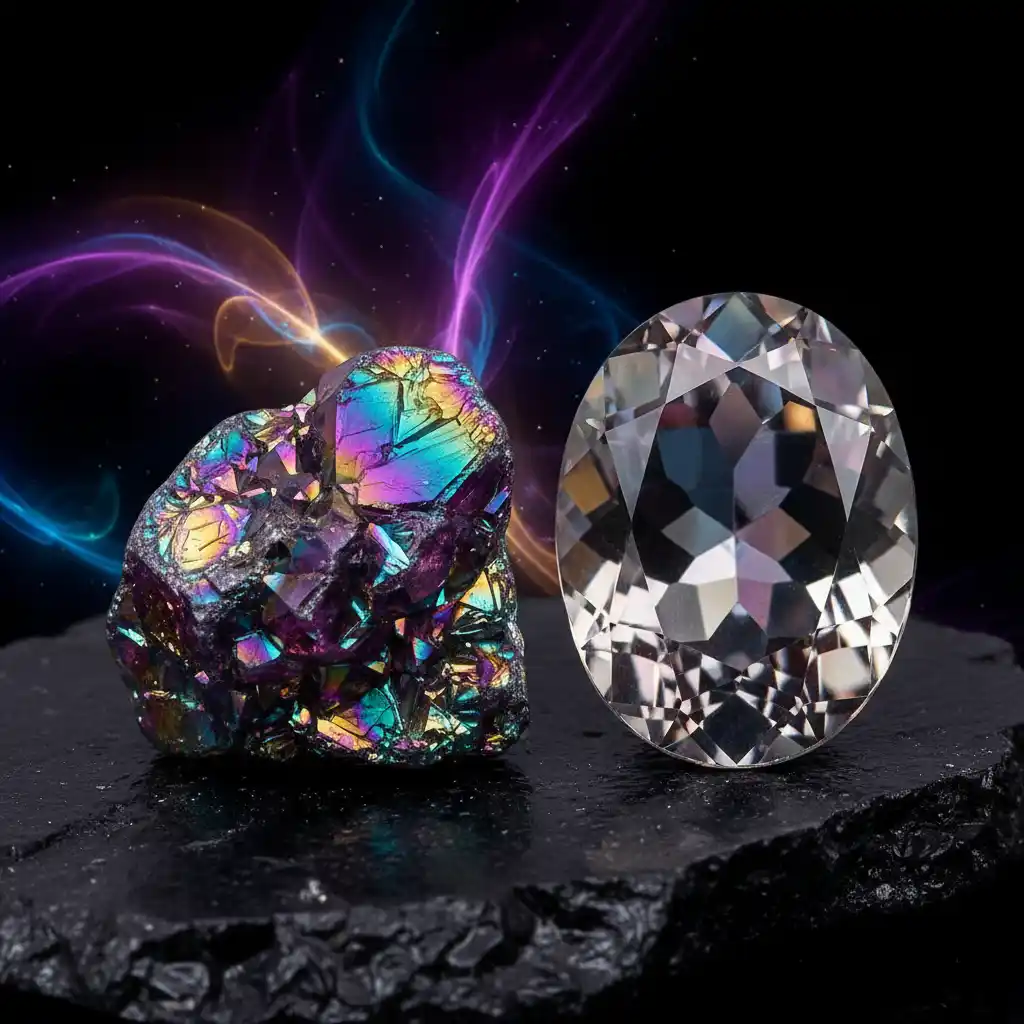
Mystic Topaz: What It Is, Meaning & Uses
Mystic topaz is a treated gemstone created by applying a microscopically thin artificial coating to faceted, usually colorless topaz. The coating produces shifting flashes of purple, green, blue, pink, gold, red, and bronze through optical interference.
The underlying gem can be natural topaz, but the rainbow color is not natural. Therefore, mystic topaz is best described as coated topaz, not as a naturally occurring topaz variety, a mined rainbow crystal, or automatically a synthetic gemstone.
Mystic Topaz at a Glance
| Property | Mystic topaz |
|---|---|
| Material type | Surface-coated topaz and commercial trade product |
| Core gemstone | Usually natural colorless or pale topaz |
| Core composition | Al₂SiO₄(F,OH)₂ |
| Color source | Artificial thin-film coating, commonly made with metallic oxide compounds |
| Displayed colors | Purple, green, blue, pink, yellow, orange, gold, bronze, and multicolored rainbow flashes |
| Crystal system | Orthorhombic for the topaz core |
| Typical form | Faceted gemstones, fantasy cuts, calibrated stones, and finished jewelry |
| Luster | Vitreous with metallic or iridescent surface effects |
| Transparency | Transparent |
| Mohs hardness | 8 for topaz; the coating is less scratch resistant |
| Cleavage | Perfect basal cleavage in the topaz core |
| Tenacity | Brittle with poor toughness because of cleavage |
| Common uses | Rings, earrings, pendants, bracelets, brooches, and fashion jewelry |
| Main care concern | Scratching or removing the coating, cleavage damage, heat, buffing, steam, and ultrasonic cleaning |
Mystic Topaz Is Treated Topaz
Topaz is a natural aluminum fluorosilicate mineral whose general properties belong on the parent topaz guide.
Most topaz in nature is colorless or lightly colored. Manufacturers use this plentiful material as the base for mystic topaz because a transparent neutral stone allows the applied film to create a strong multicolored effect.
The treatment alters only a very thin surface region. The body of the stone does not become naturally purple, green, and gold throughout.
Accordingly, grinding through the coating reveals colorless or pale topaz beneath it. Recutting, repolishing, or heavily abrading the surface can remove the rainbow appearance.
Mystic topaz should not be categorized as a laboratory-grown topaz unless the core itself was grown in a laboratory. Most commercial examples are treated natural topaz.
The distinction among natural, laboratory-created, treated, and imitation gems is explained in lab-grown versus natural gemstones.
How the Rainbow Coating Is Created
Manufacturers first cut and polish colorless or lightly colored topaz. A thin film is then deposited onto selected surfaces through a controlled coating process.
Metallic oxide compounds are commonly used. The precise material, film thickness, deposition equipment, and commercial formula can vary between manufacturers.
Some coatings cover the pavilion—the lower portion of the stone—so the color reflects through the crown. Other processes may coat a larger part of the surface.
The film is much thinner than an ordinary layer of paint. Light reflects both from the top and bottom boundaries of the coating, and the reflected waves interact.
Certain wavelengths reinforce one another while others cancel. This thin-film interference creates the shifting rainbow colors associated with mystic topaz.
Minute changes in thickness produce different colors. Consequently, one stone may emphasize green and violet while another shows more gold, blue, or magenta.
Is Mystic Topaz Natural?
The topaz core may be natural. However, the multicolored mystic effect is artificially created after mining and cutting.
Describing the entire product as “100% natural mystic topaz” without disclosing the coating is misleading because no mine produces faceted topaz with that commercial surface effect.
The most accurate description is “natural topaz with an artificial color coating” when the core has been confirmed as natural.
If the core has not been tested, “coated material sold as mystic topaz” is safer than making an unsupported natural-origin claim.
The dedicated guide to treated or synthetic topaz owns the wider treatment market, including irradiation, heating, coating, synthetic counterparts, and misleading disclosure.
Mystic Topaz and Natural Topaz Colors
Natural topaz occurs in colorless, yellow, brown, orange, pink, red, violet, blue, and pale green tones. Strongly colored natural material is much less common than colorless topaz.
White topaz is transparent colorless topaz without the mystic rainbow coating. It can look bright and diamond-like but does not show the same metallic interference colors.
Imperial topaz is valued for naturally occurring or accepted orange, pinkish-orange, reddish-orange, and related warm colors. Its market value depends on body color rather than a removable surface film.
London Blue topaz usually gains its deep blue color through irradiation and heating. That color treatment penetrates differently from a surface coating and has separate durability considerations.
The broader types of topaz guide separates color varieties, treatment-based products, and trade names without presenting mystic topaz as a naturally mined rainbow species.
Mystic Topaz and “Rainbow Topaz”
Rainbow topaz is commonly another name for mystic topaz or a closely related coated product. The term does not prove one standardized manufacturer, color sequence, or coating formula.
“Azotic topaz” refers to a branded or trade-associated coated topaz product, although sellers sometimes use the word azotic loosely for any metallic rainbow coating.
“Mercury mist,” “Caribbean,” “fire,” “neptune,” and other commercial names may describe variations in coating color. Those labels are marketing categories rather than mineral varieties.
A product name should never replace treatment disclosure. Whether the seller calls the stone mystic, rainbow, peacock, aurora, or azotic, buyers should ask what the core is and how the color was created.
How to Identify Mystic Topaz
The strongest clue is an iridescent rainbow effect that changes across facet surfaces rather than a uniform body color inside the stone.
Under magnification, a worn coating may show fine scratches, lighter facet edges, chipped patches, uneven color, or areas where the film has been removed.
Facet junctions and exposed girdle sections receive the most abrasion. A previously worn ring may therefore look paler around the edges than in protected pavilion areas.
The color may appear strongest when viewed through the crown because light reflects from a pavilion coating. However, coating placement varies, so this feature is not universal.
A skilled gemologist can identify topaz through refractive index, birefringence, density, optic properties, and spectroscopy. Magnification can then reveal whether the color is confined to a surface film.
The systematic approach in how to identify crystals helps separate a material’s core identity from a coating or other treatment.
The dedicated real versus fake topaz guide covers glass, cubic zirconia, quartz, synthetic materials, assembled stones, and fraudulent labels in greater detail.
Common Mystic Topaz Imitations
Coated glass can reproduce bright rainbow colors at very low cost. Round bubbles, mold marks, low durability, and different optical properties may reveal it.
Coated cubic zirconia offers high brilliance and dispersion. It is denser than topaz and lacks topaz’s characteristic optical measurements.
Coated quartz may also imitate mystic topaz. Quartz is softer and has a different refractive index, density, and crystal structure.
A glass triplet can place a colored or iridescent layer between transparent components. Junction lines, glue, bubbles, and separation may appear under magnification.
Synthetic spinel and other colorless laboratory-grown gems can receive similar coatings. Therefore, the presence of a rainbow film proves treatment but does not prove a topaz core.
General signs of assembled, coated, and renamed materials appear in how to spot fake crystals.
Durability and Jewelry Suitability
Topaz ranks 8 on the Mohs scale, so its uncoated surface resists ordinary scratches better than quartz and many common gemstones.
However, topaz has perfect basal cleavage and poor toughness. A strong blow, excessive pressure, or sudden temperature change can split the gem.
The coating adds another vulnerability. It is softer and less securely bonded than the topaz beneath it, particularly at sharp facet edges.
A mystic topaz ring can be worn, but it should not be treated like sapphire or diamond. A protective setting and occasional use will preserve the finish better than daily exposure.
Earrings and pendants are safer because they receive less abrasion. Brooches and dress jewelry also suit the material well.
Bracelets present greater risk because stones repeatedly contact desks, metal, clothing fasteners, and surrounding objects.
The gemstone hardness chart explains topaz’s scratch resistance, while gemstone toughness versus hardness clarifies why cleavage remains important.
Cuts and Optical Performance
Mystic topaz appears in rounds, ovals, pears, cushions, trillions, hearts, marquises, emerald cuts, and elaborate fantasy shapes.
Facets increase the number of reflections passing through or interacting with the coating. Consequently, complex cuts often show a more fragmented rainbow effect than simple step cuts.
Large stones are common because colorless topaz rough is available in substantial sizes. However, size alone does not make mystic topaz rare or exceptionally valuable.
A well-cut stone should return light evenly without a large transparent window through the center. Its colors should remain balanced rather than disappearing from most viewing angles.
Fantasy cuts can create dramatic appearance, although difficult outlines increase replacement and setting costs.
The coating process usually occurs after final polishing. Recutting the stone therefore requires recoating if the mystic effect is to be restored.
Treatments and Disclosure
Coating is the defining treatment. Sellers should disclose it clearly before purchase rather than hiding the information in a care leaflet or invoice.
The topaz core may also have undergone irradiation or heat treatment before coating, particularly if it began as pale blue rather than completely colorless material.
A coated stone can receive an additional protective film, although such layers do not make it immune to wear.
Jewelry repair presents a special risk. Buffing compounds, polishing wheels, heat from a torch, pickling solutions, and ultrasonic cleaning can damage or remove the coating.
A jeweler should know that the stone is coated before resizing, retipping prongs, polishing metal, or repairing a chain.
The parent gemstone treatment guide explains why treatment durability and disclosure are separate from whether a product is attractive.
Current Mystic Topaz Asking Prices
Mystic topaz is generally an affordable fashion gemstone. Finished jewelry prices often reflect silver, gold, design, and labor more than the loose stone.
| Mystic topaz product | Broad retail asking range |
|---|---|
| Small loose stone below about 3 ct | About $5–$25 |
| Loose stone around 3–10 ct | About $15–$60 |
| Large or fantasy-cut loose stone | About $25–$120 |
| Simple sterling-silver earrings or pendant | About $30–$150 |
| Sterling-silver ring or bracelet | About $60–$300 |
| Simple gold jewelry | About $250–$1,500 or more |
| Designer or elaborate custom jewelry | Highly variable according to metalwork and brand |
These figures represent broad July 2026 retail asking prices, not appraisals or expected resale values.
The dedicated topaz price guide should own wider comparisons among colorless, blue, yellow, pink, imperial, and treated topaz.
A seller should not price mystic topaz as though the rainbow effect were a rare natural color. The treatment creates beauty and design appeal, but not geological color rarity.
What Gives Mystic Topaz Value?
Cut quality affects brightness, face-up color balance, and the visibility of windowing or extinction.
Coating quality determines whether the rainbow effect looks smooth and intentional. Patchy color, bare edges, scratches, and peeling reduce value.
Condition matters more than age. A new inexpensive stone with an intact coating may look better than a previously worn high-priced stone whose surface has been buffed.
Size influences price modestly because large colorless topaz is available. An unusual fantasy cut can add more value than carat weight alone.
Setting metal often dominates the final jewelry price. Gold, platinum, diamonds, hand engraving, and designer workmanship can far exceed the value of the coated topaz.
Treatment disclosure supports confidence. An accurately represented coated stone is more desirable than an ambiguously labeled “natural rainbow gem.”
Buying Mystic Topaz
Ask the seller to state the core material and treatment in writing. “Mystic topaz” alone is not a complete disclosure.
Inspect magnified photographs of the crown, pavilion, girdle, and facet junctions. Look for scratches, pale borders, chips, coating gaps, and polishing damage.
Compare dimensions rather than only carat weight. Topaz is dense, and deep cuts can retain weight without giving a large face-up appearance.
Review the return policy before choosing a large fantasy shape. Replacement stones with matching dimensions and color effects may be difficult to find.
Ask whether the jewelry has been resized, retipped, polished, or repaired. Heat and buffing during earlier work may have affected the film.
The dedicated topaz buying guide owns general cut, seller, origin, and quality evaluation without repeating the treatment-specific focus of this page.
Mystic topaz appears in both the crystals beginning with M directory and the gemstones beginning with M directory.
Cleaning and Storage
Clean mystic topaz with lukewarm water, a small amount of mild soap, and an exceptionally soft cloth or brush.
Do not scrub facet edges aggressively. Residue beneath the setting should be loosened gently rather than attacked with an abrasive tool.
Avoid toothpaste, baking soda, scouring powders, polishing cloths containing abrasive compounds, silver dip, acetone, alcohol, and harsh jewelry cleaners.
Steam and ultrasonic cleaning are unsuitable. Heat and vibration threaten the topaz cleavage, while cleaning action can damage the coating or loosen the setting.
Remove mystic topaz jewelry before swimming, bathing, cleaning, exercising, gardening, or applying perfume and hairspray.
Store it in a separate soft pouch. Contact with diamond, sapphire, ruby, topaz, or abrasive dust can scratch the thin film.
Detailed setting-by-setting instructions are provided in how to clean topaz jewelry.
Mystic Topaz Meaning and Symbolism
Mystic topaz is a modern treated gem, so claims of ancient traditions specifically involving its rainbow coating are historically implausible.
Contemporary symbolism commonly connects its changing colors with creativity, adaptability, self-expression, optimism, and seeing a situation from several perspectives.
The transformation of plain colorless topaz into a multicolored fashion gem also inspires associations with reinvention and deliberate personal style.
Some people connect each visible color with a different symbolic theme, although the hues result from one optical coating rather than separate natural color zones.
These meanings remain modern, artistic, spiritual, or personal interpretations. Scientific evidence does not show that mystic topaz heals illness, balances energy centers, or causes guaranteed emotional effects.
Frequently Asked Questions
Is mystic topaz a natural gemstone?
The underlying topaz may be natural, but the rainbow color is produced by an artificial surface coating.
Is mystic topaz synthetic topaz?
Not usually. Most mystic topaz is treated natural colorless topaz rather than laboratory-grown topaz.
What creates the rainbow colors?
A microscopically thin coating produces optical interference that reinforces different wavelengths of light.
Is mystic topaz the same as rainbow topaz?
The names are often used for the same or closely related coated topaz products, although coating formulas and color patterns can vary.
Can the mystic coating wear off?
Yes. Scratches, polishing wheels, abrasive cleaners, repeated friction, or recutting can remove or damage the film.
Is mystic topaz hard enough for a ring?
The topaz core is hard, but its perfect cleavage and delicate coating make a protected occasional-wear ring preferable to rough daily use.
How can I tell if mystic topaz has been damaged?
Look for pale facet edges, missing color patches, scratches, uneven iridescence, or exposed colorless areas.
Can mystic topaz be repolished?
Repolishing will remove some or all of the coating. The stone would need a new compatible coating to restore the effect.
Is mystic topaz expensive?
Loose stones are generally affordable. Precious metal, craftsmanship, designer branding, and additional gems usually determine most of a jewelry piece’s price.
Does mystic topaz occur in mines?
Mines produce the topaz core, not the commercial rainbow coating. The mystic effect is created after cutting.
Can mystic topaz go in an ultrasonic cleaner?
No. Ultrasonic vibration can threaten topaz’s cleavage and may damage the coating or setting.
Is mystic topaz a November birthstone?
Topaz is a November birthstone, so coated mystic topaz may be sold as a modern November option. Its treatment should still be disclosed clearly.
Mystic topaz suits buyers who enjoy deliberate color treatment and fashion-oriented brilliance rather than natural-color rarity. Readers comparing its rainbow appearance with other topaz options can use the dedicated topaz color guide to keep natural, irradiation-produced, heated, and coated colors distinct.