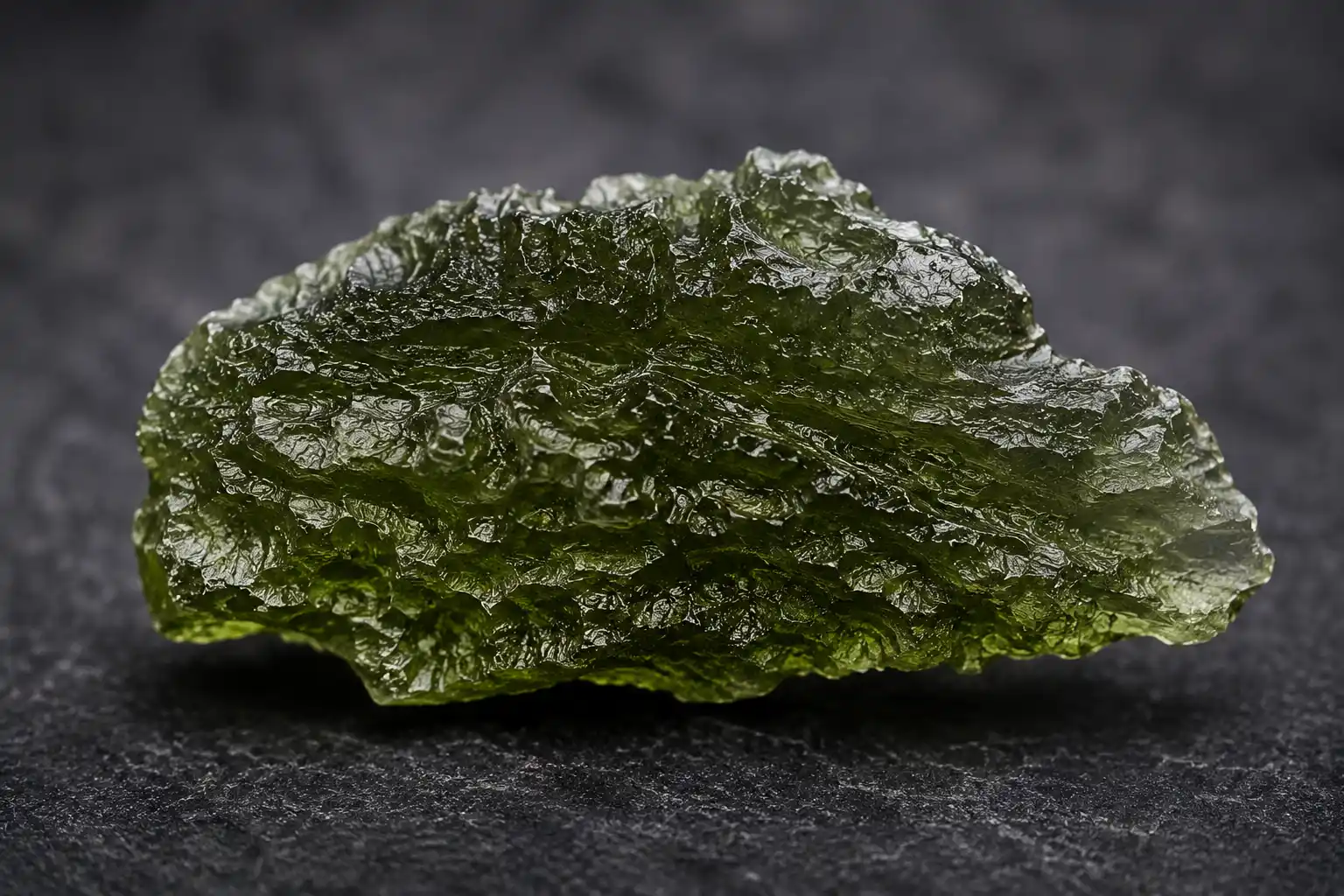
Real Moldavite: Natural Properties, Origin and Authentic Material
Real Moldavite is a natural green tektite glass associated with the Ries meteorite-impact event in southern Germany. Material ejected during the impact traveled into parts of Central Europe, where droplets and irregular masses cooled into silica-rich glass and were later deposited principally across areas of the Czech Republic.
This page defines what genuine natural Moldavite is: its formation, composition, geographic distribution, natural forms, internal structures and provenance. It does not duplicate the step-by-step post-purchase diagnostic owned by Is My Moldavite Real?, the direct side-by-side workflow in real versus fake Moldavite, or the alteration boundary in treated Moldavite.
Knowing the natural material remains the foundation of authentication. No single bubble, color, surface pit or seller story proves that an object is Moldavite.
Genuine Moldavite at a Glance
| Property | Genuine natural Moldavite |
|---|---|
| Material type | Natural tektite glass |
| Formation | Terrestrial material melted and ejected during a meteorite impact |
| Associated impact | Nördlinger Ries impact structure in southern Germany |
| Approximate age | About 14.5–15 million years |
| Main distribution | Czech Republic, with limited related occurrences in surrounding Central European regions |
| Common color | Olive green, bottle green, yellow-green, brown-green and uncommon blue-green |
| Transparency | Transparent to translucent; thick pieces may appear dark |
| Structure | Amorphous natural glass rather than a mineral crystal |
| Typical specific gravity | Approximately 2.32–2.38 |
| Typical refractive behavior | Singly refractive, isotropic glass response |
| Common internal features | Flow structure, elongated or irregular bubbles, lechatelierite and compositional variation |
| Common natural forms | Drops, disks, splashes, fragments and abraded or deeply sculpted pieces |
| Mohs hardness | Commonly around 5–5.5 |
| Main durability concern | Brittle glass fracture, thin edges and surface sculpture |
| Main market risk | Manufactured green glass, misleading provenance and artificially altered surfaces |
What Is Moldavite?
Moldavite is a member of the tektite group. Tektites are natural glasses produced when a hypervelocity impact melts terrestrial surface material and ejects part of the melt away from the crater.
The melted material travels through the atmosphere, cools rapidly and lands within a distribution area called a strewn field.
Moldavite is unusual among tektites because its green color and relative transparency make it attractive as a gemstone, collector specimen and lapidary material.
It is not a meteorite fragment. The impactor supplied the energy, but Moldavite consists predominantly of melted terrestrial material.
The broader tektite meaning guide owns the full tektite family, including Australasian and other dark impact glasses.
The Ries Impact Connection
The accepted formation model connects Moldavite with the Nördlinger Ries impact in southern Germany.
Approximately 14.5–15 million years ago, an asteroid or cometary body struck the region, creating the Ries crater and producing enormous heat and pressure.
Near-surface target material melted and was launched outward. Part of that molten material traveled hundreds of kilometers into what is now the Czech Republic.
The relationship is supported by matching age, geographical distribution, geochemistry and impact modeling. Moldavite is therefore not simply “volcanic glass” and did not crystallize in an ordinary lava flow.
Why Moldavite Is Green
Moldavite commonly appears olive, bottle green, yellow-green or brownish green. Some pieces show cooler green or blue-green appearances, although highly saturated bright emerald color deserves scrutiny.
Its color relates principally to iron oxidation states and the composition of the target material melted during impact.
Thickness influences appearance. A thin edge may transmit bright green light, while the center of a thick specimen appears dark olive or nearly black.
Lighting also changes perception. Strong backlighting can reveal transparency and internal structure that remain hidden under ordinary reflected light.
Color alone cannot distinguish Moldavite from bottle glass or intentionally manufactured green glass.
Moldavite Is Glass, Not a Crystal Mineral
Moldavite lacks the orderly repeating atomic structure required for a mineral crystal.
It cooled too rapidly for large mineral crystals to form, leaving an amorphous glass. Retail phrases such as Moldavite crystal are common, but natural impact glass is the more accurate material description.
Its surfaces may form points, ridges and deep channels, yet those structures are not crystal faces. They result from original flight shapes, breakage, transport, weathering and chemical etching.
The distinction does not reduce its geological importance. Natural glasses such as Moldavite, obsidian and Libyan Desert Glass record different high-temperature events and environments.
Moldavite Composition
Moldavite is silica-rich glass containing aluminum, potassium, calcium, iron, magnesium and other elements in proportions linked to the impact target.
Composition varies among pieces and localities. It should not be reduced to pure silica or described as one uniform formula.
Volatile components were depleted during impact melting and flight. Internal variations may remain because the melt was heterogeneous and cooled rapidly.
Laboratories can compare major and trace elements with known Moldavite and manufactured-glass reference samples. This chemical fingerprint is more reliable than retail claims based on surface appearance alone.
Where Genuine Moldavite Is Found
The best-known Moldavite deposits occur in the Czech Republic, especially in southern Bohemia and western Moravia.
Bohemian localities are associated with areas such as the České Budějovice and Třeboň basins. Moravian material occurs farther east in a separate part of the strewn field.
Moldavites have also been reported from limited neighboring areas connected to the wider impact distribution, but commercial provenance claims should be specific and credible.
The term Moldavite should not be applied to every green tektite or impact glass. Material from unrelated strewn fields belongs to other tektite groups.
The where-to-buy-real-tektite guide provides broader seller checks for tektites without replacing Moldavite-specific provenance.
Bohemian Moldavite
South Bohemian Moldavite includes a wide range of forms, colors and surface textures.
Some pieces are deeply sculpted with sharp ridges and channels. Others are smoother because they were transported in sediment, abraded or recovered from deposits where chemical etching differed.
Besednice material is especially famous for dramatic spiky sculpture. The name is associated with a locality style, not a universal standard that every genuine piece must resemble.
Highly sculpted specimens can be fragile. Thin projections may break during mining, cleaning, shipping or setting.
A smoother genuine piece should not be rejected merely because it lacks the most dramatic collector surface.
Moravian Moldavite
Moravian Moldavites are often described as more rounded, thicker or differently colored than classic deeply sculpted South Bohemian specimens.
Some show brown-green, olive or darker appearances. Surface texture and shape reflect locality, transport and weathering history.
These are tendencies rather than rigid rules. A visual style cannot prove Moravian origin by itself.
Geographic provenance should come from documented collection history, a trustworthy dealer or an established specimen label—not from color alone.
Natural Moldavite Shapes
Primary flight shapes may include droplets, disks, flattened splashes and elongated forms.
Many surviving pieces are fragments rather than complete original droplets. Impact during landing, sediment transport, weathering and mining can break thin glass.
Natural rough may show grooves, pits, ridges, wrinkles and etched channels. Their depth and distribution vary considerably.
A faceted or polished Moldavite has intentionally lost most external surface evidence. It can still be genuine natural impact glass.
The comparison between natural rough and lapidary forms is covered in raw versus polished crystals.
Surface Sculpture
Moldavite’s famous sculpture developed after formation through a combination of original aerodynamic form, breakage, burial and chemical corrosion.
Acidic groundwater and soil conditions can etch the glass along compositional and structural variations. Protected pieces may develop deep channels and sharp ridges.
Transported specimens may become rounded or frosted. Freshly broken areas may look smoother and glossier than weathered external surfaces.
Surface sculpture is therefore not one repeatable fingerprint. Manufactured glass can also be molded, carved or acid-etched to imitate natural texture.
The dedicated comparison page should own the detailed fake-surface workflow.
Internal Flow Structure
Rapid movement and cooling stretched the molten glass, creating internal flow lines and compositional swirls.
Under magnification, these may appear as curved, layered, ropy or irregular structures. Their appearance changes with lighting and viewing direction.
Natural flow structure is not identical in every specimen. Faceted stones may reveal it more clearly than thick rough.
Manufactured glass also develops flow lines. Consequently, flow alone cannot prove Moldavite, but its character can contribute to a larger set of evidence.
Gas Bubbles
Moldavite may contain bubbles produced during impact melting and rapid cooling.
Many natural bubbles are elongated, stretched, flattened or irregular because the glass moved while still molten. Small rounded bubbles may also occur.
A popular oversimplification claims that every round bubble proves fake glass. That is incorrect. Bubble shape, distribution and relationship with flow structure must be evaluated together.
Conversely, manufactured glass can contain both round and distorted bubbles. One bubble is never a complete identification.
Lechatelierite
Lechatelierite is natural silica glass formed when quartz-rich material experiences extreme heat.
Fine lechatelierite threads, particles or inclusions may occur within Moldavite and support its high-temperature impact origin.
These features are usually microscopic and require appropriate observation. Their absence in one field of view does not disprove a specimen.
A seller’s photograph of a white thread should not be accepted automatically as confirmed lechatelierite. Fibers, scratches, fractures and manufactured inclusions can look similar without testing.
Refractive Index and Specific Gravity
Moldavite is isotropic natural glass and produces a single refractive-index response rather than the double refraction of crystalline gemstones such as peridot.
Specific gravity commonly falls around 2.32–2.38, although composition and internal bubbles create variation.
Common soda-lime bottle glass may have a higher density and different optical or spectroscopic behavior. However, overlap among manufactured glasses means that one basic measurement may not settle every case.
Mounted specimens, inaccurate scales, trapped bubbles and calculation errors can distort home density tests.
Professional identification combines measurements rather than treating a single number as absolute proof.
Moldavite Hardness and Durability
Moldavite commonly measures around 5–5.5 on the Mohs scale.
It scratches more easily than quartz, tourmaline, sapphire and diamond. Because it is brittle glass, a hard blow can chip thin edges or fracture the entire piece.
Deeply sculpted rough is particularly vulnerable. The same ridges that increase collector interest can break under pressure from wire wrapping or tight prongs.
Faceted Moldavite jewelry should be removed during exercise, cleaning, sleep and mechanical work.
Genuine Faceted Moldavite
Faceting natural Moldavite creates a transparent green gemstone with a glassy luster.
The finished stone may resemble tourmaline, peridot or ordinary green glass. Most external sculpture is removed, so internal features and laboratory properties become more important.
A faceted Moldavite does not need to contain obvious bubbles visible without magnification. Clean areas can occur.
Cutting quality varies. Windowing, shallow pavilions and chipped girdles reduce appearance and durability.
Faceted stones should be valued through color, transparency, cutting, weight, documentation and natural identity rather than metaphysical claims.
Genuine Moldavite Jewelry
Moldavite appears in pendants, earrings, rings, bracelets and wire-wrapped rough.
Pendants and earrings provide safer wear because they face less impact. Rings require protective settings and deliberate use.
An open wire wrap can display natural sculpture but may place pressure on fragile ridges. Adhesive-set specimens need clear disclosure and careful inspection.
The Moldavite buying guide owns construction, seller and quality decisions.
Provenance Matters
Moldavite’s market value depends partly on where and how a specimen was obtained.
An old collection label, locality record, excavation documentation or traceable dealer history can support provenance. It does not replace scientific identification, but it strengthens the ownership history.
Vague statements such as found in Europe, Czech energy stone or direct from miner carry little weight without details.
High-value locality claims should be supported by documentation. A dramatic Besednice-style surface alone cannot prove Besednice origin.
Real Moldavite Versus Ordinary Tektite
All Moldavite is tektite, but not every tektite is Moldavite.
Australasian tektites are commonly dark brown to black and belong to a different strewn field. Philippinites, indochinites and australites have their own distributions and forms.
Moldavite is distinguished by its Central European origin, Ries association and characteristic green silica-rich glass.
A seller should not dye or backlight a dark tektite and market it as Czech Moldavite.
Moldavite Versus Libyan Desert Glass
Libyan Desert Glass is a pale yellow to greenish-yellow natural silica glass found in the Great Sand Sea region of Egypt and Libya.
It contains much more silica than typical Moldavite and belongs to a different impact-related geological history.
Moldavite is normally green, while Libyan Desert Glass is commonly pale yellow, cream or nearly colorless.
Both can contain high-temperature features, but they are not varieties of the same tektite and should not share provenance claims.
Does Synthetic Moldavite Exist?
Moldavite is defined by natural formation during the Ries impact. A manufactured product cannot reproduce that geological origin.
Laboratories and factories can produce green glass with a similar color, density or internal appearance. Such material is an imitation, not true laboratory-grown Moldavite.
The phrase synthetic Moldavite is therefore misleading when used as though it describes a recognized lab-grown counterpart comparable with synthetic sapphire or emerald.
The completed treated-Moldavite guide owns polishing, tumbling, faceting, coating, artificial etching, repairs and the misuse of synthetic terminology.
The broader gemstone treatments guide explains why treatment and imitation are different categories.
Why Visual Authentication Is Difficult
Manufactured glass can reproduce green color, bubbles, flow lines and surface texture.
Natural Moldavite also varies enough that rigid visual rules produce false conclusions. A smooth genuine specimen may be rejected, while convincing artificial glass may be accepted.
Photographs introduce additional problems. Backlighting, saturation, white balance and compression can change color and conceal surface evidence.
The correct conclusion may require density, refractive behavior, microscopy, FTIR spectroscopy or chemical analysis.
Use the crystal identification guide as a starting point, not a substitute for laboratory work.
Laboratory Reports
Routine inexpensive specimens may not justify full laboratory testing. Important faceted stones, costly collector pieces or disputed material may.
A report should identify the object as natural glass or Moldavite when the laboratory’s methods support that conclusion. It may not prove an exact village or field locality.
The gemstone certification guide explains report scope. The gem-lab-report guide helps distinguish identification from seller appraisal.
Paperwork should match the specimen through weight, dimensions and photographs or distinguishing features.
Market Value
Moldavite cost depends on weight, transparency, color, surface sculpture, condition, locality documentation, cutting and demand.
Thin deeply sculpted pieces may command strong collector premiums despite lower weight. Large intact specimens become increasingly scarce because glass fractures during transport and recovery.
Faceted stones are valued differently from natural rough. Cutting can improve transparency but removes collector surface features.
The Moldavite price guide retains current value ranges and locality premiums.
An expensive price does not authenticate the material, while a low price does not prove every small included piece is fake.
Buying Genuine Moldavite
The seller should identify the material as natural Moldavite, state its weight and disclose polishing, repairs, coatings or other alterations.
Request photographs in reflected and transmitted light. For rough, inspect the complete surface rather than one dramatic angle.
Ask for provenance without treating a seller’s personal story as laboratory evidence.
The Moldavite buying guide owns the full transaction workflow. Broad tektite seller checks remain within where to buy real tektite.
Cleaning Genuine Moldavite
Use lukewarm water, mild soap and a soft brush only when the piece, setting and repairs can tolerate moisture.
Support delicate sculpture rather than gripping sharp ridges. Dry the specimen carefully.
Avoid ultrasonic and steam cleaners. Heat, vibration and existing fractures can damage natural glass.
The Moldavite cleansing and charging guide owns spiritual-practice methods and should not be confused with removal of physical dirt.
Review the crystal water-safety guide before soaking mixed-mineral jewelry or unknown treated specimens.
Sunlight and Storage
Ordinary brief light does not transform genuine Moldavite into imitation glass. Nevertheless, prolonged intense sunlight can heat a specimen and its setting unnecessarily.
Store natural rough in a padded compartment where ridges do not contact harder stones.
Faceted Moldavite should be separated from quartz, sapphire, diamond and other materials that can scratch it.
The sunlight-sensitive crystal guide provides wider display guidance.
Moldavite Meaning and Spiritual Claims
The Moldavite meaning guide owns historical symbolism, contemporary healing beliefs and the popular idea of rapid personal transformation.
Those beliefs do not authenticate a specimen. A strong sensation, dream, emotional response or so-called Moldavite flush is not a gemological test.
Manufactured glass can produce an emotional reaction, while genuine Moldavite may produce no unusual sensation.
Material identity must be established through provenance and physical evidence rather than metaphysical experience.
Frequently Asked Questions
1. What is real Moldavite?
Real Moldavite is natural green tektite glass associated with the Ries meteorite-impact event and deposited mainly in the Czech Republic.
2. Is Moldavite a meteorite?
No. It consists primarily of terrestrial material melted and ejected by a meteorite impact.
3. Is Moldavite a crystal?
It is natural amorphous glass rather than a mineral crystal, although crystal is commonly used informally in retail and spiritual contexts.
4. Where is genuine Moldavite found?
The principal deposits occur in southern Bohemia and western Moravia in the Czech Republic, with limited associated Central European occurrences.
5. Must real Moldavite have a deeply sculpted surface?
No. Genuine pieces range from sharply etched to smooth, abraded, broken, polished and faceted forms.
6. Do round bubbles prove Moldavite is fake?
No. Genuine Moldavite can contain bubbles of several shapes. Bubble form must be interpreted with flow structure and other evidence.
7. Does every genuine Moldavite contain visible lechatelierite?
No. Lechatelierite may support identification when properly observed, but it is not guaranteed to be obvious in every viewing area.
8. Is bright green Moldavite always fake?
Not automatically, but unusually uniform neon or emerald-green color should be examined carefully because common imitations use bright manufactured glass.
9. Can Moldavite be laboratory-grown?
A factory can produce imitation green glass, but it cannot reproduce Moldavite’s natural Ries-impact origin. Lab-grown Moldavite is therefore misleading terminology.
10. Is faceted Moldavite genuine?
It can be. Faceting removes the natural surface but does not change genuine impact glass into another material.
11. Can a photograph prove Moldavite is real?
No. Photographs can support an initial assessment, but convincing glass imitations and natural variation limit remote certainty.
12. What is the most reliable way to authenticate expensive Moldavite?
Use traceable provenance and independent gemological testing that may include microscopy, density, optical measurements, FTIR spectroscopy and chemical analysis.
Real Moldavite is defined by a specific natural event, composition and Central European geological history—not by a spiritual sensation or one dramatic surface feature. Authentic material can be sharp or smooth, rough or faceted, light or dark. The strongest conclusion comes from several lines of evidence that agree: provenance, natural structure, appropriate physical properties and, when the value warrants it, laboratory analysis.
Moldavite is listed within Crystals That Start With M and Gemstones That Start With M.
Moldavite transformation, energy and healing claims belong to contemporary spiritual belief and are not authentication methods or medical facts. Moldavite does not diagnose, prevent or cure health conditions.