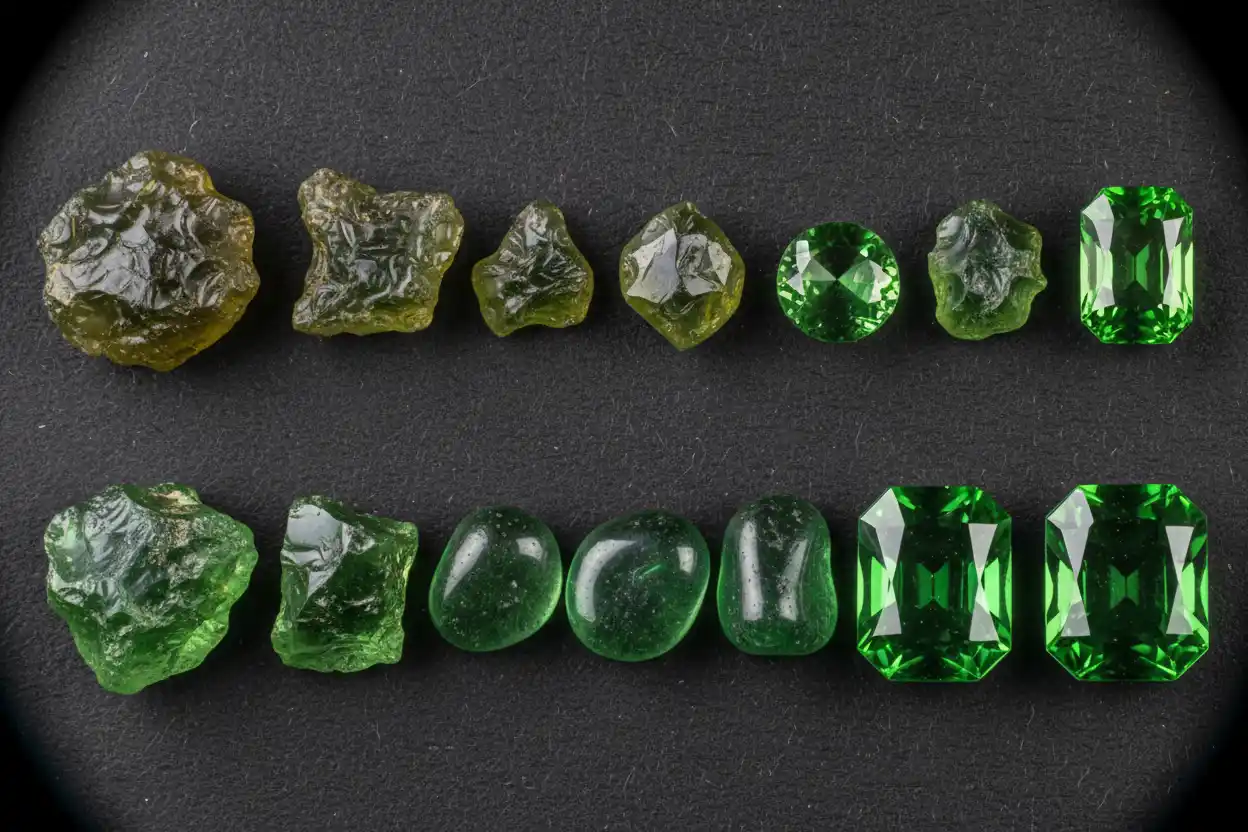
Real vs Fake Moldavite: Direct Comparison and Lab Tests
Genuine Moldavite is natural green tektite glass associated with the Ries impact event and the Central European Moldavite strewn field. Fake Moldavite is normally manufactured green glass shaped, molded, carved or etched to imitate natural rough or faceted impact glass.
Both materials are glass. Therefore, transparency, conchoidal fracture, gas bubbles and flow lines can appear in either category. A reliable comparison does not ask whether the object looks glassy; it asks whether its structure, density, chemistry and provenance match natural Moldavite rather than ordinary manufactured glass.
This page owns the direct side-by-side comparison and professional-test differences. The educational profile of authentic material remains in Real Moldavite. Owners checking one specific piece should follow Is My Moldavite Real?. Alteration, polishing, artificial etching and repair remain within treated Moldavite.
Genuine Moldavite vs Manufactured Glass
| Feature | Genuine natural Moldavite | Common manufactured-glass imitation |
|---|---|---|
| Origin | Natural tektite connected with the Ries impact | Melted and shaped in a factory or workshop |
| Main material | Silica-rich natural impact glass | Commonly soda-lime or another commercial glass |
| Typical color | Olive, bottle, yellow-green, brown-green and occasional cooler green | Any selected green, often vivid or highly uniform |
| Specific gravity | Commonly about 2.32–2.38 | Many soda-lime imitations are closer to about 2.5, although glass types vary |
| Refractive behavior | Isotropic natural glass; readings overlap some manufactured glass | Isotropic glass; refractive index alone may overlap |
| Bubbles | Elongated, flattened, irregular and sometimes rounded bubbles may occur | Round individual or clustered bubbles are common in many imitations |
| Flow structure | Complex laminar, ropy or stretched internal structures | Smooth swirls or ordinary manufacturing flow may occur |
| High-temperature inclusions | Lechatelierite and impact-related structures may occur | Not expected as genuine impact-derived inclusions |
| Natural rough surface | Irregular weathering, abrasion and chemical sculpture | Molded, carved, sandblasted or acid-etched texture |
| Pattern repetition | Natural surfaces vary continuously | Mold seams or repeated textures may occur |
| FTIR spectrum | Natural-glass pattern consistent with Moldavite | Commercial-glass absorptions can differ |
| Chemistry | Silica-rich, with relatively low sodium and calcium compared with ordinary soda-lime glass | Soda-lime glass is commonly richer in sodium and calcium |
| Strongest evidence | Provenance plus microscopy, density, FTIR and chemical analysis | Identification as commercial glass through the same tests |
None of these observations should be interpreted in isolation. A genuine specimen can be smooth, while a carefully etched imitation can be irregular.
The Three Categories Buyers Must Separate
A natural rough Moldavite retains some original fracture, transport or weathering surfaces.
A genuine fashioned Moldavite has been polished, tumbled, carved, drilled or faceted. It remains natural impact glass even though natural exterior evidence has been removed.
An imitation Moldavite is manufactured glass represented as natural impact glass.
Treatment and identity are different. Polishing a genuine piece does not make it fake, while acid-etching ordinary glass does not turn the imitation into Moldavite.
Color Comparison
Natural Moldavite commonly appears olive, bottle green, yellow-green, brown-green or dark green.
Thin edges transmit more light than thick centers. A specimen that looks almost black in reflected light may reveal olive green when backlit.
Manufactured glass can reproduce every one of these colors. It can also be blended to imitate uneven natural color.
Extremely bright emerald or neon green is a useful warning sign, particularly when several pieces share exactly the same saturation. It is not an automatic verdict.
White balance, phone-camera processing and strong backlighting can transform an ordinary piece dramatically. Evaluate color under daylight-equivalent and warm indoor light.
Rough-Surface Comparison
Natural Moldavite surfaces can contain pits, grooves, channels, ridges, rounded depressions and sharp projections.
Those forms developed through several processes rather than one universal texture. Primary splash shape, fragmentation, sediment transport, groundwater alteration and locality conditions all affect the surface.
Manufactured glass may be pressed in a mold, carved with rotary tools, sandblasted or acid-etched.
Molded imitations can reveal repeated depressions, seam lines and unnaturally consistent textures. Carving may leave directional tool marks, while acid etching can create a soft, uniformly frosted surface.
A genuine transported specimen may be smoother than an artificial deeply etched one. Surface roughness alone is therefore unreliable.
Repeated Texture
Natural rough pieces from one locality can share a general style, but they should not repeat the same pit, ridge and channel arrangement exactly.
Imitations produced in a mold may reproduce distinctive surface features across several pieces.
Compare photographs of multiple specimens from the same seller. Rotate them mentally and look for identical ridges or depressions.
Sequential glass castings can differ slightly because of bubbles and finishing, so absence of an exact duplicate does not prove natural origin.
Bubble Comparison
Both genuine Moldavite and manufactured glass can contain gas bubbles.
Natural bubbles are frequently elongated, flattened or irregular because the molten material stretched during flight and cooling. Rounded bubbles can also occur.
Many common imitations contain abundant smooth round bubbles, isolated spheres or clusters of similarly shaped bubbles.
The useful distinction lies in the entire population. Bubble shapes, sizes, distribution and relationship to flow structure should be examined together.
The claim that one round bubble proves fake Moldavite is incorrect. The opposite claim—that any elongated bubble proves genuine material—is equally unsafe.
Internal Flow Comparison
Natural Moldavite may show complex internal flow caused by rapid movement, mixing and cooling of impact melt.
Under suitable lighting, flow can appear as layered, ropy, curved or stretched structures. The pattern may interact with bubbles and compositional variation.
Manufactured glass also develops flow lines. Ordinary swirls produced during stirring or pouring can resemble natural features.
Natural-impact flow is interpreted through its full microscopic context and chemistry rather than through one photographed line.
A simple loupe can reveal obvious fake-glass swirls, but it cannot certify every convincing specimen.
Lechatelierite
Lechatelierite is natural silica glass formed when quartz-rich material experiences extreme heat.
Threads, particles or other structures interpreted as lechatelierite can occur in genuine Moldavite and support an impact origin.
They are not visible in every specimen or every field of view.
Scratches, fibers, fractures and deliberately added inclusions can imitate pale threads in photographs.
A seller’s arrow pointing to one white feature is not equivalent to laboratory confirmation.
Density Comparison
Genuine Moldavite commonly has a specific gravity around 2.32–2.38.
Many soda-lime imitations are denser and may measure near 2.5. The difference can be useful on a loose stone measured accurately.
Not every manufactured glass has the same density. Specialized formulations can fall closer to the Moldavite range, while bubbles and internal cavities lower apparent density.
Small specimens magnify weighing error. Attached wire, glue, matrix and metal make the result unusable.
Density should eliminate obvious candidates rather than serve as the final proof.
Refractive Index
Moldavite and common manufactured glasses have overlapping refractive-index ranges.
A reading can confirm that the object behaves as glass, but it may not determine whether the glass formed through an impact or a furnace.
This limitation is particularly important for faceted material, where ordinary glass and Moldavite can both produce clean single refractive-index readings.
Density, FTIR and chemical composition provide greater separation when refractive index overlaps.
Ultraviolet Response
Genuine and imitation glasses can be inert or show weak reactions under ultraviolet light.
The response depends on composition, impurities and colorants. There is no universal fluorescence color that proves Moldavite.
A chalky, bright or unusual reaction may justify further testing, but an inert specimen is not automatically genuine.
Ultraviolet examination is most useful as part of a comparative laboratory dataset.
FTIR Spectroscopy
FTIR examines how the glass absorbs infrared energy.
Manufactured glass and natural Moldavite produce distinguishable spectral patterns when compared with appropriate reference samples.
The method can separate specimens that look nearly identical under ordinary magnification.
FTIR is non-destructive in many laboratory configurations and is especially useful for faceted pieces whose exterior has been removed.
A retailer’s statement that a stone was “infrared tested” should name the laboratory and provide an actual report.
Chemical Composition
Moldavite is highly silica-rich and contains aluminum, iron, potassium, calcium, magnesium and other components inherited from the impact target.
Common soda-lime glass contains a different industrial balance, often with substantially greater sodium and calcium.
Techniques such as LA-ICP-MS, electron microprobe analysis or X-ray fluorescence can compare elemental composition with authenticated reference material.
Chemistry provides stronger origin evidence than surface appearance because carving and etching cannot reproduce the glass’s complete elemental signature easily.
Raman Spectroscopy
Raman spectroscopy confirms glass structure and can help characterize inclusions.
Because both Moldavite and its common imitations are glass, Raman alone may require comparison with additional FTIR and chemical information.
It remains useful for excluding crystalline green stones or identifying unexpected surface material.
The best laboratory conclusion usually comes from several compatible tests rather than one spectrum.
Faceted Moldavite Versus Faceted Green Glass
Faceting removes most natural exterior sculpture.
Both genuine Moldavite and ordinary glass may then appear transparent, green and singly refractive. Each can contain bubbles and flow structures.
Color and clarity become particularly weak indicators.
Density, FTIR and chemistry are more important for a faceted specimen than they are for rough material with credible provenance.
The completed raw-versus-polished crystal guide explains why fashioned form changes visible evidence without changing the natural origin of the base material.
Moldavite Versus Other Tektites
Moldavite belongs to the wider tektite family described in the tektite meaning guide.
Most Australasian tektites are dark brown or black rather than transparent green. They belong to a different strewn field.
Dyeing or backlighting a dark tektite does not turn it into Czech Moldavite.
The completed where-to-buy-real-tektite guide owns general tektite seller checks.
Moldavite Versus Libyan Desert Glass
Libyan Desert Glass is a separate natural impact-related silica glass.
It is usually pale yellow, cream or nearly colorless rather than classic Moldavite green. Its chemistry, source region and geological history differ.
Neither material should be sold as a color variety of the other.
A seller using the broad phrase impact glass should still identify the exact material and provenance.
Does “Synthetic Moldavite” Exist?
Moldavite is defined partly by its natural Ries-impact origin.
A factory can manufacture silicon-rich green glass that resembles Moldavite, but it cannot reproduce the historical impact event or Central European deposition.
Therefore, synthetic Moldavite is misleading terminology when applied as though the product were an accepted laboratory-grown counterpart.
The accurate description is imitation green glass unless the object is genuine Moldavite that received polishing, coating or another alteration.
The completed gemstone-treatments guide explains why laboratory growth, imitation and treatment are not interchangeable.
Provenance Comparison
A genuine piece may have a locality label, old collection record, mining documentation or a traceable chain through a specialist dealer.
Provenance is supporting evidence, not a replacement for testing.
A printed card can be produced for imitation glass as easily as for natural material. Statements such as Czech origin or direct from miner need details.
Claims of a specific locality, particularly a premium locality, deserve stronger records than a general assertion that the piece came from Europe.
Certificates and Reports
A seller-issued authenticity card carries only the credibility of the seller.
A meaningful laboratory report should identify natural Moldavite or natural tektite glass using methods appropriate to the material.
The report should correspond to the specimen through weight, dimensions and photographs or distinguishing characteristics.
The gemstone-certification guide explains report scope. Use how to read a gem-lab report to determine whether the laboratory tested origin or merely described green glass.
Tests That Do Not Work Reliably
A spiritual sensation, sudden warmth or so-called Moldavite flush cannot identify a material.
Scratch testing only demonstrates limited surface hardness and damages the specimen.
A hot needle can damage glass, coatings, glue and settings without distinguishing impact origin.
The color of a phone flashlight result depends on thickness, camera processing and white balance.
One bubble, one flow line or one dramatic surface pit cannot provide a complete conclusion.
A Direct Home Comparison Workflow
Begin with reflected and transmitted light. Compare color distribution through thin and thick regions.
Use a 10× loupe to inspect the full bubble population and flow structure.
Examine every rough surface for repeated molded features, seams, directional carving or uniform acid etching.
Compare weight and dimensions only when the piece is loose and the scale is sufficiently precise.
Review photographs of other specimens from the same seller for repeated texture.
Check provenance, invoice wording and return terms.
The completed crystal-identification guide provides the broader safe inspection sequence.
If the value is substantial or the evidence conflicts, stop at screening and obtain FTIR or chemical analysis.
Buying Genuine Moldavite
The completed Moldavite buying guide owns seller selection, specimen quality and transaction safeguards.
The Moldavite price guide explains weight, sculpture, condition, locality and fashioning premiums.
Request exact-item photographs in reflected and transmitted light.
The listing should disclose whether the piece is natural rough, polished, faceted, repaired, coated or otherwise altered.
Use how to buy gemstones online and avoid a transaction whose return window expires before independent inspection is possible.
Care After Authentication
A genuine result does not make Moldavite impact-resistant.
It remains brittle natural glass with thin edges and potential internal fractures.
The completed Moldavite cleansing guide owns belief-based practices and should avoid methods that threaten delicate surface sculpture.
Review the crystal water-safety guide and sunlight-sensitive crystal guide before applying environmental rituals to jewelry, glued pieces or unknown treatments.
Frequently Asked Questions
1. Can imitation glass contain elongated bubbles?
Yes. Manufactured glass can be stretched or shaped in ways that produce elongated bubbles, so bubble shape alone is insufficient.
2. Can genuine Moldavite contain round bubbles?
Yes. Rounded bubbles can occur naturally. The complete population and surrounding flow structure matter.
3. Does a smooth Moldavite surface prove it is fake?
No. Transport, abrasion, breakage, polishing and faceting can produce smooth genuine material.
4. Does a deeply etched surface prove Moldavite is genuine?
No. Ordinary glass can be acid-etched, carved, sandblasted or molded to imitate natural sculpture.
5. Can specific gravity authenticate Moldavite by itself?
No. It can reject many soda-lime imitations, but specialized glasses, bubbles and measurement errors create overlap.
6. Is refractive index enough to separate Moldavite from glass?
Usually not. Natural and manufactured glasses can overlap closely.
7. Can a fake piece contain flow lines?
Yes. Flow is a normal feature in many manufactured glasses. Its character must be assessed with bubbles, chemistry and spectra.
8. Is every bright-green specimen fake?
No, but uniform neon or emerald-green material deserves stronger verification.
9. Can faceted Moldavite still be genuine?
Yes. Faceting removes the natural surface but does not change genuine impact glass into imitation.
10. Can a coating turn ordinary glass into Moldavite?
No. Coating changes appearance but cannot create Moldavite’s natural impact origin or chemistry.
11. What laboratory test best separates convincing imitations?
FTIR combined with density, microscopy and chemical analysis provides a strong evidence set.
12. Does a Czech-origin card prove authenticity?
No. The issuer, specimen matching and evidence supporting the provenance must be evaluated.
Real Moldavite and fake Moldavite may both look like green glass because both are glass. The reliable difference lies deeper: natural impact history, silica-rich chemistry, density, microscopic structure and compatible provenance. Visual comparison can identify obvious molded or bubble-rich imitations, but an expensive faceted or expertly etched specimen deserves laboratory evidence rather than certainty based on one surface feature.
Moldavite appears in Crystals That Start With M and Gemstones That Start With M.
Physical sensations, dreams, warmth and spiritual experiences cannot authenticate Moldavite. They are personal experiences rather than gemological tests.