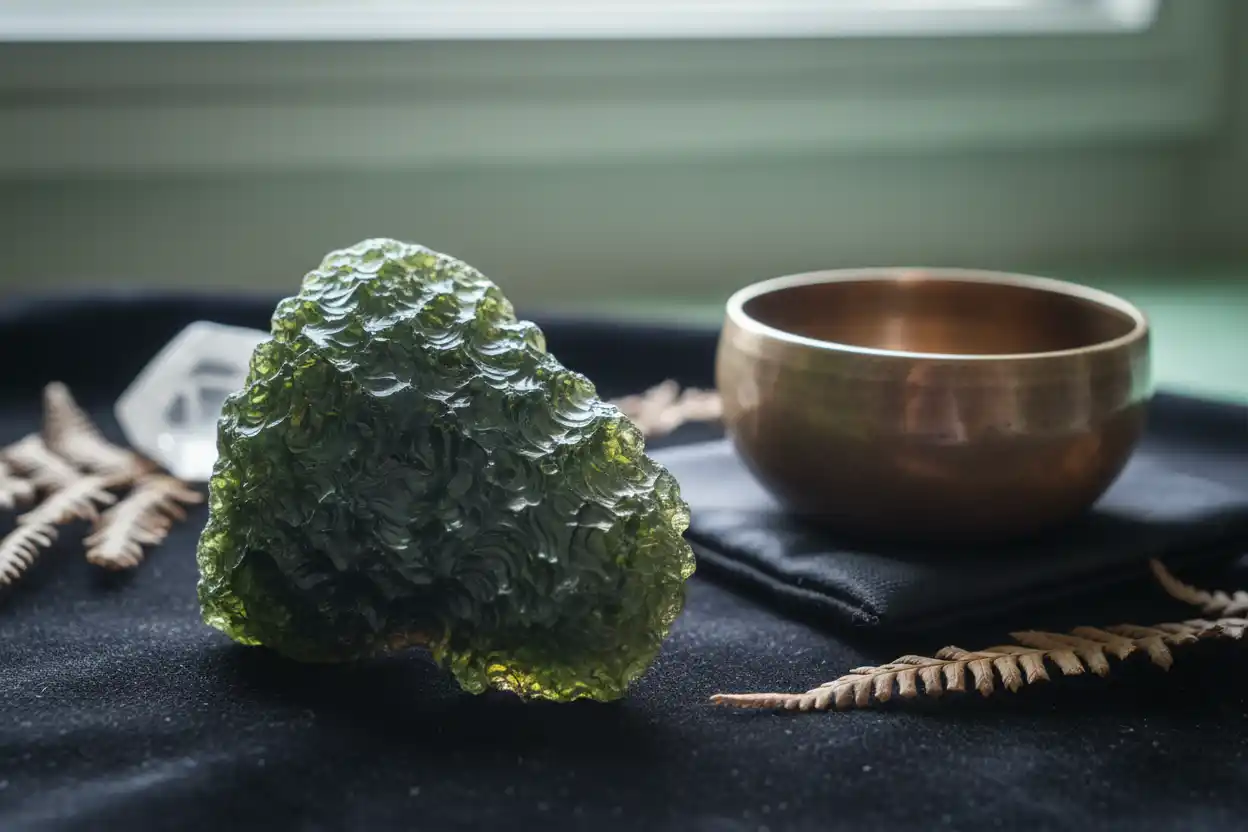
How to Cleanse and Charge Moldavite
The safest ways to cleanse and charge Moldavite are sound, intention, visualization, gentle breath, indirect indoor moonlight, a written dedication, and a brief lukewarm-water rinse when the piece is physically sound. These methods protect its brittle natural glass from impact, thermal shock, salt abrasion, trapped residue, ultrasonic vibration, and damaged settings.
Moldavite does not require cleansing because it came from an impact event or because it is believed to possess unusually strong energy. Cleansing and charging are personal rituals rather than physical requirements of the glass.
What Cleansing and Charging Mean
Cleansing is a spiritual or personal practice used to mark a fresh start, release an object’s previous associations, or prepare it for intentional use.
Charging generally means dedicating the piece to a value, transition, meditation practice, memory, or personal commitment.
Neither process changes Moldavite’s chemical composition, age, impact-glass origin, authenticity, or measurable physical energy.
The material’s formation, color, localities, historical context, and traditional symbolism belong to the broader Moldavite guide.
This page focuses strictly on ritual methods that preserve rough and polished Moldavite.
Moldavite Is Natural Impact Glass
Moldavite is a green tektite produced when a major impact melted terrestrial rock and ejected molten material into the atmosphere.
The droplets cooled into natural glass and fell across a central European strewn field associated with the Ries impact event.
Moldavite is therefore not a piece of the meteorite that caused the impact. It consists predominantly of terrestrial impact glass.
Its place within the broader natural-glass family belongs to the Tektite guide.
| Property | Ritual implication |
|---|---|
| Material type | Natural impact glass and tektite |
| Typical color | Pale green, olive green, bottle green, brownish green, or forest green |
| Mohs hardness | Commonly reported around 5.5 to 6 |
| Tenacity | Brittle |
| Cleavage | None |
| Fracture | Conchoidal, with potentially sharp edges |
| Common forms | Rough sculpted pieces, drops, chips, beads, cabochons, and faceted gems |
| Safest ritual methods | Sound, intention, visualization, breath, moonlight, and brief water contact |
| Main risks | Chipping, sharp edges, fractures, thermal shock, glue, settings, and abrasive residue |
The gemstone hardness chart explains why Quartz, Topaz, Sapphire, and many other gemstones can scratch Moldavite.
A lack of cleavage does not make the glass impact resistant. Its brittle tenacity and conchoidal fracture remain important.
The difference between scratch resistance and resistance to breaking appears in Gemstone Toughness vs Hardness. The reason glass does not need cleavage to chip is placed in context by Gemstone Cleavage Explained.
Natural Surface Texture Is Not Dirt
Rough Moldavite may display grooves, pits, ridges, wrinkles, channels, spines, rounded hollows, and other sculpted textures.
Some surfaces developed through atmospheric shaping, transport, sediment exposure, and chemical etching after deposition.
These features are part of the specimen and may contribute to its desirability.
Do not scrape dark material from a cavity, grind down a sharp ridge, or scrub the surface with a stiff brush.
Fine sediment or handling residue can be removed gently, but the natural sculpture should remain unchanged.
Inspect the Moldavite Before Beginning
Examine the piece beneath bright, indirect light.
Look for fresh chips, sharp newly exposed edges, open fractures, damaged drill holes, cloudy glue, loose wire wrapping, bent prongs, repaired breaks, and movement in a setting.
Natural internal bubbles, flow structures, schlieren, lechatelierite features, and elongated inclusions are not dirt.
Likewise, a matte or etched rough surface should not be polished unless the owner deliberately wants to alter the specimen.
When the glass contains a fresh crack, leave it on a padded support and use a non-contact ritual.
Physical Cleaning Is Separate
Symbolic cleansing does not remove skin oil, dust, polishing compound, or dirt trapped inside a setting.
A sound loose Moldavite can be rinsed briefly in lukewarm water and cleaned with mild liquid soap and a very soft brush.
Use minimal pressure around ridges, thin projections, holes, and natural cavities.
Steam and ultrasonic equipment should be avoided because vibration, heat, fractures, glue, and settings may create risks.
The broader equipment boundary belongs to Which Gemstones Can Go in an Ultrasonic Cleaner?.
Dry the glass completely before beginning a symbolic ritual.
Method 1: Cleanse Moldavite with Sound
Place the Moldavite on a thick folded cloth or padded tray.
Ring a bell, chime, tuning fork, or singing bowl nearby. You may also hum, chant, clap softly, or play calm music.
Do not place Moldavite directly inside a hard metal bowl while striking it.
Concentrated vibration and contact may chip a thin edge or sharp natural projection.
Several gentle tones are sufficient.
Sound works well for rough specimens, faceted gems, wire-wrapped pendants, glued pieces, and valuable material because it requires no chemical exposure.
Method 2: Use Intention
Leave the Moldavite on its padded support or hold a smooth piece loosely above a cloth.
Choose one clear purpose. It might represent beginning a new stage, releasing an outdated commitment, following through on a difficult decision, or approaching a major change deliberately.
State the intention silently or aloud.
The ritual does not require intense physical sensations, dramatic claims, or prolonged handling.
Moldavite’s impact origin can provide a personal metaphor for change without demonstrating that the glass causes transformation scientifically.
Method 3: Use Visualization
Place the Moldavite where it cannot roll, fall, or catch on fabric.
Imagine previous associations fading while the green glass becomes connected with the new purpose.
Some practitioners visualize green, white, gold, or neutral light. Others imagine the impact event and cooling process as symbols of rapid change becoming stable form.
The image is symbolic rather than a physical alteration of the glass.
Continue for several breaths or a few minutes.
Visualization is particularly suitable for spiny, valuable, repaired, or sharply textured Moldavite because no contact is required.
Method 4: Use Gentle Breath
Keep the piece on a padded cloth.
Take several slow breaths and exhale gently toward it once or twice.
Avoid visible condensation inside pits, drill holes, fractures, or settings.
Do not grip a sharp rough piece tightly. Leave it resting while performing the ritual.
State the intention afterward.
Breath directed toward the space above the specimen is enough.
Method 5: Use Indirect Moonlight Indoors
Place Moldavite indoors near a window on a padded tray or inside an open display box.
An hour, an evening, or overnight indoor placement may be used according to personal preference.
Ordinary light is not generally considered a major Moldavite color risk. Indoor moonlight remains preferable because it prevents rain, dew, dirt, animals, theft, and impact.
The moon phase affects the chosen symbolism rather than the natural glass’s physical properties.
The wider light-exposure framework appears in Which Crystals Can and Can’t Go in the Sun.
Method 6: Use a Brief Water Ritual
A sound loose or securely mounted Moldavite can receive a brief rinse in clean lukewarm water.
Hold it over a padded bowl rather than an open drain. Water can make a small glass fragment difficult to grip.
Use a very soft brush only when dirt occupies a natural cavity. Rinse away all soap and blot gently.
Do not soak the piece for hours or overnight.
Avoid water for glued jewelry, damaged drill holes, wire containing corrosion, antique settings, repaired breaks, or pieces combined with water-sensitive materials.
The broader comparison belongs to Which Crystals Can and Can’t Go in Water.
Method 7: Use a Written Dedication
Write one concise statement and place it beside the Moldavite.
The statement might identify a transition you have chosen, a commitment you intend to complete, or a habit you are deliberately leaving behind.
Keep pens, clips, staples, and metal objects away from sharp or thin glass edges.
Leave the arrangement for several minutes or an evening.
A written method provides structure without adding salt, smoke, water, or heat.
Method 8: Use a Companion Object with Separation
Some practitioners place Moldavite near another tektite, Clear Quartz, Selenite, a meteorite specimen, a photograph, or a written intention.
Use separate padded supports.
Quartz is harder and may scratch Moldavite. Metal meteorites, chains, prongs, and sharp crystal points may chip the glass.
Direct contact is unnecessary for symbolic charging.
The general method-selection framework belongs to How to Cleanse Crystals.
Avoid Direct Salt Burial
Salt grains can become trapped inside Moldavite’s etched pits, grooves, and fractures.
Coarse crystals may abrade protruding ridges or hold harder contaminating grit against the glass.
Saltwater adds prolonged moisture and can affect metal, glue, wire, solder, and companion materials.
Do not press a delicate sculpted piece into coarse salt.
When salt carries symbolic importance, keep it in a separate bowl while the Moldavite remains on a lined dish nearby.
Avoid Soil Burial
Soil contains Quartz grains, moisture, fertilizers, microorganisms, organic acids, and mineral debris.
These materials can scratch Moldavite and become lodged deeply in natural cavities.
Outdoor burial also creates risks of loss, breakage, and confusion with ordinary glass or stones.
A safer earth-related ritual places the piece near soil or a potted plant while keeping it on a separate padded support.
Avoid Flame, Steam, and Thermal Shock
Moldavite formed through extreme heat, but that geological origin does not make a finished specimen safe around household flame or sudden temperature change.
Natural glass can crack after uneven heating or thermal shock.
Keep the piece away from candles, incense coals, fireplaces, boiling water, steam cleaners, heated bowls, radiators, and direct repair heat.
Do not heat Moldavite as an authenticity test.
A genuine piece and an imitation glass may both fracture.
Use Smoke Conservatively
A brief cool-smoke ritual may be used cautiously in traditions that include it.
Keep the Moldavite away from flame, hot ash, incense coal, and heated containers.
Smoke can leave soot or oil inside etched cavities. Removing that residue may require additional washing and brushing.
Sound, intention, and visualization provide cleaner alternatives.
Do Not Polish Rough Moldavite During Cleansing
A rough piece’s surface texture is one of its defining visual characteristics.
Do not use toothpaste, polishing paste, sandpaper, a rotary tool, metal polish, or abrasive cloth to “restore” its energy or shine.
Polishing permanently removes natural surface sculpture and changes the specimen’s appearance and value.
Faceted or polished Moldavite can be wiped with a soft cloth, but rough pieces should retain their existing texture.
Moldavite Is Not a Meteorite Fragment
Moldavite formed because of a meteorite impact, but the glass itself consists predominantly of melted terrestrial material.
Calling it “meteorite glass” can be misleading when interpreted to mean that it is melted extraterrestrial metal or rock.
The broader impact-glass context belongs to the Tektite guide.
This distinction does not reduce Moldavite’s geological importance. It clarifies what the object physically is.
Keep Authentication Intent Separate
Cleansing cannot establish whether a piece is genuine.
Someone examining a specific piece already owned should use Is My Moldavite Real? for an owner-focused diagnostic workflow.
The genuine natural Moldavite profile explains formation, composition, locality, physical properties, natural forms, and provenance.
A concise side-by-side comparison of natural material and manufactured glass belongs to Real vs Fake Moldavite.
Treatment, polishing, oiling, coatings, artificial etching, repairs, and disclosure belong to How to Spot Treated or Synthetic Moldavite.
None of those questions should be tested through salt, flame, scratching, sunlight, or ritual exposure.
Buying, Price, and Tektite Context
The Moldavite buying guide covers provenance, locality, surface texture, internal features, weight, damage, treatment, and seller credibility.
Market factors belong to the Moldavite price guide.
Collectors interested in related natural impact glasses can use Where to Buy Real Tektite.
Cleansing cannot improve provenance, restore a chipped sculpture, or turn ordinary green manufactured glass into Moldavite.
Safe Handling During Ritual Use
Moldavite is not normally considered chemically hazardous during ordinary intact handling.
However, sharp chips and freshly broken edges can cut skin.
Do not lick, grind, burn, intentionally fracture, or place Moldavite directly in drinking water. Commercial pieces may also contain glue, metal, coatings, polishing residue, or contamination.
The broader distinction between intact handling and unsafe ingestion or dust exposure belongs to the Toxic Crystals safety list.
Frequently Asked Questions
1. What is the safest way to cleanse Moldavite?
Sound, intention, visualization, gentle breath, a written dedication, and indirect indoor moonlight are the safest methods.
2. Can Moldavite be cleansed in water?
A sound piece can be rinsed briefly in lukewarm water. Avoid prolonged soaking and water exposure for glued, fractured, repaired, or delicate settings.
3. Can Moldavite be left in moonlight overnight?
Yes, when kept indoors on a stable padded surface.
4. Can Moldavite be charged in sunlight?
Brief ordinary light is generally not a major color concern, but hot windowsills and prolonged outdoor exposure add unnecessary thermal and handling risks.
5. Can Moldavite be cleansed with salt?
Direct salt contact is not recommended because grains can lodge inside etched cavities and abrade delicate projections.
6. Can Moldavite be cleansed with smoke?
A brief cool-smoke ritual is possible, but soot may collect inside grooves and pits.
7. Can Clear Quartz charge Moldavite?
Some practitioners use it symbolically. Keep the stones separated because Quartz is harder and can scratch Moldavite.
8. Does Moldavite need cleansing because it has powerful energy?
There is no objective or gemological requirement to cleanse it. Any ritual schedule is a matter of personal belief.
9. Is Moldavite a meteorite?
No. It is terrestrial impact glass formed during a meteorite impact event.
10. Can rough Moldavite be polished during cleansing?
No. Polishing permanently removes natural surface texture and changes the specimen.
11. How long should Moldavite charge?
A few minutes or an evening is sufficient. There is no scientifically required duration.
12. Does cleansing change Moldavite scientifically?
No established evidence shows that cleansing changes its composition, authenticity, geological origin, health effects, or measurable physical energy.
Conclusion
Moldavite’s significance comes from a rare impact event recorded in natural green glass, not from a need for dramatic cleansing. Sound, intention, visualization, protected moonlight, and brief controlled water contact preserve its etched surface and brittle edges. A responsible ritual should clarify the transition or commitment associated with the object while leaving its geological texture, provenance, and physical condition intact.
Crystal cleansing and charging are spiritual or personal practices, not scientifically established methods for changing health, energy, or the physical properties of Moldavite.