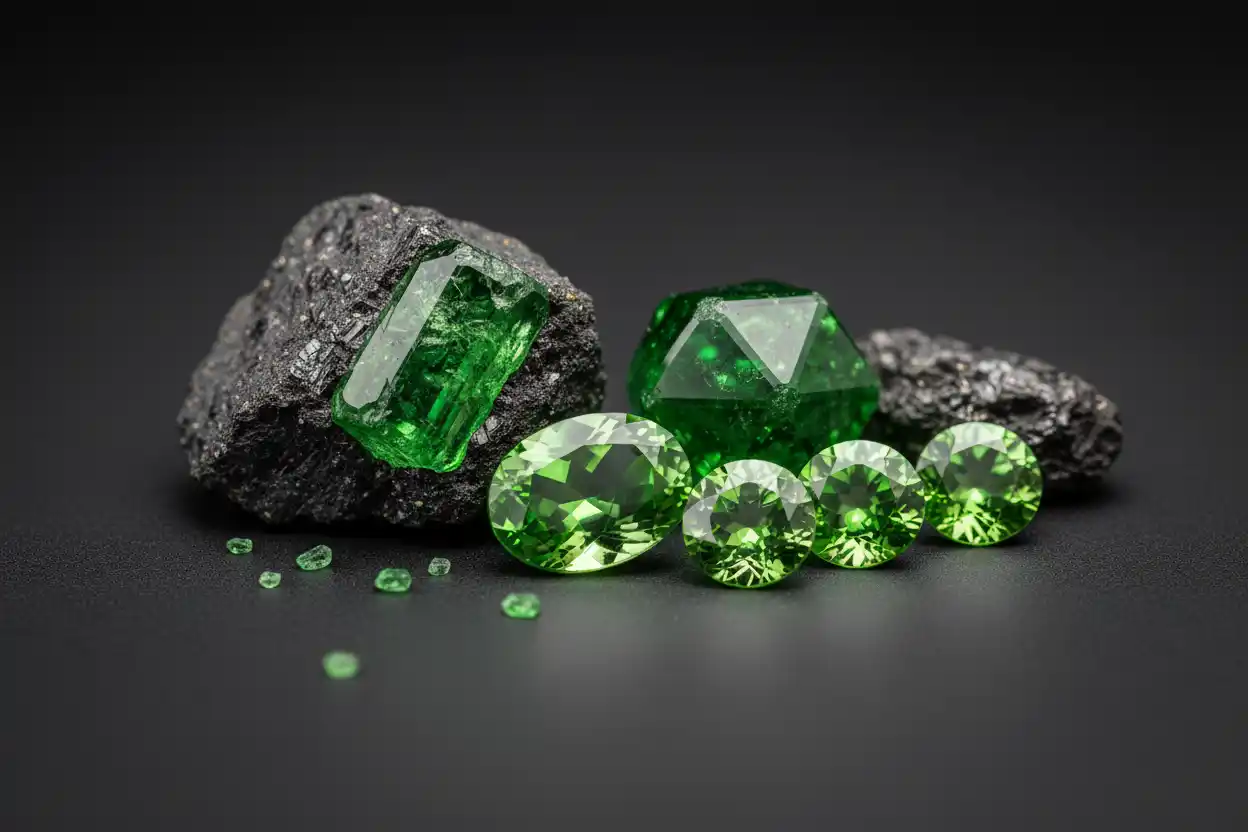
Tsavorite Garnet: Meaning, Properties & Symbolism
Tsavorite garnet is the vivid green variety of grossular garnet, prized for its saturated color, high brilliance, excellent transparency, and relative rarity in larger sizes. Its green comes mainly from trace vanadium and chromium within a calcium-aluminum silicate crystal structure.
Unlike emerald, tsavorite generally reaches the market without routine color enhancement, while its refractive properties give well-cut stones a bright, lively appearance. In modern crystal traditions, tsavorite is associated symbolically with growth, vitality, prosperity, confidence, and emotional renewal, although these interpretations are spiritual beliefs rather than scientifically established effects.
Tsavorite Garnet at a Glance
| Property | Tsavorite Garnet |
|---|---|
| Mineral group | Garnet |
| Species | Grossular |
| Variety | Tsavorite |
| Composition | Ca₃Al₂(SiO₄)₃ |
| Main color | Green |
| Color causes | Primarily vanadium and chromium |
| Crystal system | Cubic |
| Refractive index | About 1.73–1.75 |
| Specific gravity | Around 3.6 |
| Mohs hardness | About 7–7.5 |
| Luster | Vitreous |
| Transparency | Transparent to translucent |
| Birefringence | None; normally singly refractive |
| Cleavage | None |
| Toughness | Fair to good |
| Main sources | Kenya and Tanzania; additional East African occurrences |
| Typical treatment | Usually untreated; fracture filling is rare |
| Main use | Fine jewelry and gem collecting |
| Birthstone association | Garnet family — January |
| Main care concern | Scratching, hard impacts, fractured stones |
Tsavorite belongs to the broader Garnet family, while its mineral species is covered more specifically in the Grossular Garnet guide.
What Is Tsavorite Garnet?
Tsavorite is a green gem variety of grossular, one of the principal garnet species.
Ideal grossular has the chemical formula:
Ca₃Al₂(SiO₄)₃
Pure grossular can be colorless. However, substitutions of trace elements within its crystal structure produce a wide range of colors.
In tsavorite, vanadium and chromium are the most important green-producing elements. Their concentrations and proportions help influence whether a stone appears yellowish green, pure green, bluish green, pale mint, or intensely saturated forest green.
Tsavorite is therefore not a separate mineral species from grossular. Instead, it is an important gemological variety of green grossular.
This distinction separates it from other garnets such as almandine, pyrope, spessartine, and andradite.
Why Is It Called Tsavorite?
Tsavorite takes its name from the Tsavo region of Kenya.
Gemologist and geologist Campbell Bridges first discovered gem-quality green grossular near Komolo in Tanzania in 1967. A few years later, he found additional deposits in Kenya’s Taita-Taveta area near Tsavo National Park.
Tiffany & Co. helped introduce the gemstone internationally during the 1970s.
The name tsavorite was associated with Tsavo rather than with grossular’s mineralogical terminology because it created a distinctive identity for the intensely green gem variety.
Today, Tsavo and Campbell Bridges remain closely connected with tsavorite’s history.
The broader history of garnets is covered separately in the History and Origin of Garnet.
What Color Is Tsavorite?
Tsavorite ranges from relatively light yellowish or mint green to vivid grass green, rich emerald green, and occasionally slightly bluish green.
The most desirable stones usually combine medium to medium-dark tone with strong saturation.
Extremely pale material may be marketed more generally as green grossular or mint grossular rather than premium tsavorite.
At the opposite extreme, excessive saturation can make a stone look too dark, particularly in low light.
Consequently, the finest color is not simply the darkest green available. Instead, buyers usually prefer a lively green that remains bright enough to return light throughout the stone.
The Garnet Color Meaning page places green alongside the wider garnet color spectrum.
What Makes Tsavorite Green?
Vanadium is especially important in many East African tsavorites, while chromium can also contribute strongly to the green color.
Both elements can substitute for aluminum within the grossular structure.
Increasing concentrations generally strengthen green saturation, although the exact optical result also depends on iron and other trace elements.
Many classic East African tsavorites contain more vanadium than chromium.
Chromium can contribute a cooler or slightly bluer green, while vanadium-rich material may lean somewhat warmer.
However, visual color cannot be used to determine exact trace-element chemistry.
Laboratory spectroscopy and chemical analysis are required for that level of characterization.
Is Tsavorite a Garnet?
Yes.
Tsavorite is unquestionably a garnet.
More precisely, it is green grossular garnet.
This matters because garnet is not one single mineral. Instead, it is a group of related minerals with similar crystal structures but different chemical compositions.
Other familiar garnets include almandine, pyrope, spessartine, andradite, and various intermediate compositions.
For example, Almandine Garnet is predominantly an iron-aluminum garnet, whereas tsavorite belongs to the calcium-aluminum grossular species.
Is Tsavorite the Same as Grossular Garnet?
Tsavorite is a type of grossular, but not every grossular is tsavorite.
Grossular occurs in many colors, including colorless, yellow, orange, brown, pinkish, reddish, and green.
Hessonite is another well-known grossular variety, typically showing warm yellow-orange to reddish-brown coloration.
Tsavorite refers specifically to desirable green grossular in gemological use.
Therefore:
All tsavorite is grossular.
Not all grossular is tsavorite.
The relationship is similar to how a specific color variety can belong to a broader mineral species while retaining a recognized gem name.
Where Does Tsavorite Come From?
The most important commercial deposits occur in East Africa, especially Kenya and Tanzania.
These deposits formed within metamorphic rocks of the Mozambique Belt, an extensive geological zone created during major mountain-building events hundreds of millions of years ago.
Tsavorite-bearing rocks commonly contain graphite-rich and calcium-bearing metamorphic material.
The required chemistry is unusual. The geological environment must provide calcium and aluminum for grossular while also supplying vanadium or chromium to create the distinctive green color.
That specialized combination helps explain why gem-quality tsavorite is far less widespread than many red garnets.
Tsavorite From Kenya
Kenya is historically one of the gemstone’s most important sources.
Campbell Bridges discovered Kenyan deposits in the Taita-Taveta region near Tsavo after his initial discovery in Tanzania.
The Scorpion Mine became particularly important for fine-quality material.
Classic Kenyan stones can display vivid pure to slightly bluish green colors with excellent transparency.
Mining is challenging because tsavorite often occurs as relatively small crystals, nodules, or fractured pieces embedded within metamorphic host rock.
Consequently, producing a large, clean cut gem requires both favorable geology and considerable luck.
Tsavorite From Tanzania
Northern Tanzania is equally important to the story of tsavorite.
Bridges’s original 1967 discovery occurred near Komolo in what is now the Simanjiro District.
The Merelani Hills have subsequently become famous for tsavorite as well as tanzanite and numerous collectible minerals.
Tanzanian tsavorite may range from fresh grassy greens to deeply saturated tones.
Material from Merelani can also occur with graphite, diopside, and other minerals that reveal the metamorphic environment in which the crystals formed.
Does Tsavorite Come From Anywhere Else?
Green grossular occurs in other regions, and tsavorite-type material has been documented beyond the classic Kenyan and Tanzanian deposits.
Madagascar, for example, has produced green grossular material with relevant chromium and vanadium chemistry.
Nevertheless, Kenya and Tanzania remain the localities most closely associated with commercial tsavorite and with the historical development of the name.
Geographic origin should not be guessed solely from color.
When provenance materially affects value, advanced laboratory testing and documented mine-to-market history provide stronger evidence.
How Rare Is Tsavorite?
Tsavorite is genuinely uncommon compared with many familiar garnets.
The chemistry required to create chromium- or vanadium-bearing green grossular is comparatively specialized, while productive deposits are geographically restricted.
Moreover, rough crystals are commonly small or fractured.
As a result, fine stones become disproportionately rarer as carat weight increases.
A one-carat attractive tsavorite is much easier to source than an equally fine stone of several carats.
Large stones combining strong color, high transparency, good cutting, and minimal inclusions can therefore command significant premiums.
This size effect is much stronger than it is for common red garnets.
Why Are Large Tsavorites Rare?
Part of the explanation comes from the way the rough forms.
Tsavorite frequently occurs as relatively small nodules, fractured crystals, or crystal fragments rather than large blocks of clean gem material.
Mining can also expose rough to natural fractures and structural weaknesses.
Cutters must remove damaged areas while trying to preserve enough material for a bright finished gem.
Consequently, a large piece of rough may yield a surprisingly small faceted stone.
Fine stones above several carats become progressively uncommon, while exceptional large gems can be important collector pieces.
Tsavorite vs Emerald
Tsavorite and emerald are two of the most prestigious naturally green gemstones, yet they differ significantly.
Emerald is green beryl, whereas tsavorite is green grossular garnet.
Tsavorite usually has a higher refractive index and can appear brighter and more brilliant than emerald.
Fine tsavorite is also frequently cleaner than emerald because eye-visible inclusions are extremely common in emerald.
Another important distinction involves treatments. Emeralds are routinely clarity enhanced with oils or resins, whereas tsavorite normally reaches the market untreated.
Emerald remains the more historically famous gemstone, but tsavorite offers its own combination of vivid green color, brilliance, rarity, and durability.
Tsavorite vs Demantoid Garnet
Tsavorite and Demantoid Garnet are the two best-known green garnet varieties.
However, they belong to different garnet species.
Tsavorite is grossular.
Demantoid is andradite.
Demantoid has a higher refractive index and substantially stronger dispersion, so fine stones can display dramatic flashes of rainbow fire.
Tsavorite generally offers a rich green appearance with somewhat greater hardness.
Russian demantoid may contain famous horsetail inclusions, whereas those features are not characteristic of tsavorite.
Both gems can be valuable, but their identities and optical characters should remain separate.
Tsavorite vs Green Grossular
The boundary between tsavorite and ordinary green grossular is partly gemological and partly commercial.
Pale or weakly saturated green grossular may be described as mint grossular, green grossular, or simply grossular.
More strongly saturated green material colored primarily by vanadium and/or chromium is generally marketed as tsavorite.
There is no universally applicable visual line separating every borderline specimen.
Consequently, a pale green garnet should not automatically receive the tsavorite name simply because doing so increases its marketability.
Color quality and chemistry should support the designation.
Tsavorite vs Green Tourmaline
Green tourmaline can overlap strongly with tsavorite in color.
However, tourmaline has a different chemistry and crystal structure and is typically doubly refractive and strongly pleochroic.
Tsavorite belongs to the cubic crystal system and is normally singly refractive.
Tourmaline can also form distinctly elongated prismatic crystals, whereas garnet commonly develops equant dodecahedral or trapezohedral forms.
A refractometer, polariscope, and other routine gemological tests can separate the materials quickly.
Tsavorite vs Peridot
Peridot usually displays a more yellowish, olive, or lime-green character than classic fine tsavorite.
It is also strongly doubly refractive, whereas tsavorite is singly refractive.
Their refractive indices, densities, chemistry, and inclusions differ as well.
Fine tsavorite usually reaches a richer, more saturated forest-to-emerald green than typical peridot.
Nevertheless, color alone should never determine identity because individual examples can overlap.
How to Identify Tsavorite
Material identification begins by establishing that the stone is grossular garnet.
Tsavorite is cubic, so it should normally behave as a singly refractive gemstone.
Its refractive index is approximately 1.73–1.75, while specific gravity is around 3.6.
The mineral has no cleavage and shows vitreous luster.
Microscopic examination may reveal natural crystal inclusions, growth features, fractures, or other characteristics consistent with geological formation.
Spectroscopy can help identify chromium- and vanadium-related absorption features responsible for green coloration.
For expensive material, an independent gemological report provides stronger evidence than visual inspection.
The broader crystal identification guide explains why several properties should be combined before assigning a gemstone identity.
Can Tsavorite Be Fake?
Yes, in the sense that another material can be represented dishonestly as tsavorite.
Possible substitutes include colored glass, synthetic spinel, YAG, green cubic zirconia, and other green gemstones.
However, these materials are not synthetic tsavorite merely because they imitate its appearance.
A true synthetic counterpart would need essentially the same chemical composition and crystal structure as grossular.
For buyers, the practical concern is usually imitation or misrepresentation, particularly when a large vivid-green stone is offered at an implausibly low price.
Standard gemological testing can distinguish grossular from most substitutes.
Does Synthetic Tsavorite Exist?
True laboratory-grown garnet materials exist, and experimental synthetic grossular-related compositions can be produced.
However, commercially important gem-quality synthetic tsavorite is not a routine counterpart in the market in the way synthetic ruby, sapphire, emerald, or diamond is.
Manufactured garnet materials such as YAG can imitate tsavorite’s appearance but are chemically different.
Therefore, unusually inexpensive “synthetic tsavorite” listings should be interpreted carefully.
A laboratory report can determine whether the stone is natural grossular, another natural gem, glass, or a manufactured simulant.
Is Tsavorite Treated?
Most tsavorite is sold without routine color treatment.
This natural-color reputation is one reason the gemstone appeals strongly to collectors and colored-stone buyers.
Garnets in general are considerably less treatment-dependent than sapphire, ruby, emerald, or some tourmalines.
Rare fracture filling can occur in garnet when a surface-reaching break is filled to reduce its visibility.
Reports of diffusion treatment in tsavorite have also appeared historically, but such claims have not become an established routine commercial treatment category.
Accordingly, buyers should avoid blanket claims such as “tourmaline is always treated but tsavorite never is.” Instead, evaluate the individual stone and its disclosure.
Tsavorite Hardness and Durability
Tsavorite falls toward the harder end of the garnet family, at approximately Mohs 7 to 7.5.
That gives it good resistance to ordinary scratches, although sapphire and diamond can scratch it.
It also lacks cleavage, which is helpful for jewelry durability.
However, tsavorite is not unbreakable.
Strong blows can chip the stone, particularly around girdle edges, points, corners, or pre-existing fractures.
The Gemstone Hardness Chart provides useful context because Mohs hardness measures scratch resistance rather than total resistance to damage.
Is Tsavorite Good for Rings?
Yes, with sensible care.
Its combination of hardness, lack of cleavage, good toughness, and excellent brilliance makes tsavorite suitable for rings, including special-occasion and carefully worn everyday jewelry.
A protective setting becomes increasingly valuable for large or highly included stones.
Bezels, halos, and sturdy prong arrangements can reduce direct impact against exposed edges.
Someone who works frequently with tools, machinery, stone surfaces, or heavy manual activity should remove a tsavorite ring before those tasks.
The stone is durable enough for jewelry, but unnecessary impact remains a risk.
Tsavorite for Engagement Rings
Tsavorite can make an unusual and striking center stone for an engagement ring.
Its natural vivid green color provides an alternative to emerald, while relatively high brilliance produces a lively appearance.
Unlike emerald, tsavorite also does not have an established expectation of routine oiling.
However, rarity increases quickly with size, so large fine stones can become expensive.
The broader Green Gemstones for Engagement Rings guide compares tsavorite with other green center-stone options.
What Determines Tsavorite Value?
Color usually matters most.
A bright, saturated pure green or slightly bluish green generally attracts the strongest demand. Excessive darkness can lower brilliance, while weak or yellowish color may move material toward ordinary green grossular.
Clarity matters as well. Fine tsavorite can be remarkably transparent, so distracting eye-visible inclusions generally reduce value more than they would in emerald.
Cut influences how effectively the gem displays both color and brilliance.
Finally, size creates a major rarity premium because clean, strongly colored rough becomes increasingly scarce as dimensions increase.
For actual purchasing decisions, the Tsavorite Buying Guide should remain the primary buying-intent page.
Tsavorite Color Quality
The best color balances saturation with brightness.
A very dark green stone may appear impressive under intense jewelry-store lighting but lose life in normal indoor conditions.
Conversely, a very pale stone can be attractive but may not command the same premium associated with classic tsavorite color.
Therefore, examine the gem under more than one light source.
Natural daylight, diffuse indoor lighting, and stronger directional illumination can reveal whether the green remains lively or becomes overly dark.
Color distribution should also appear reasonably even when viewed face-up.
Tsavorite Clarity
Tsavorite can achieve impressive transparency.
Fine eye-clean stones are therefore highly desirable.
However, natural inclusions are not automatically defects. Crystals, growth tubes, fingerprints, graphite-related features, and other inclusions can provide evidence of natural geological formation.
Large clean stones are particularly rare because much tsavorite rough is fractured.
Accordingly, clarity should be considered alongside size.
A minor inclusion in a rare multi-carat gem may be far more acceptable than the same inclusion in a small stone where clean alternatives are easier to find.
How Tsavorite Is Cut
Cutters face a constant balance between weight retention and optical performance.
Because high-quality rough is valuable and larger finished stones are rare, cutters often select shapes that preserve as much usable material as possible.
Ovals, cushions, pears, and mixed cuts are common.
Round stones can require greater weight loss from certain rough shapes, making large fine rounds relatively scarce.
Regardless of outline, a good cut should produce even brightness without a large dark center or washed-out window.
The Garnet Quality and Grading guide covers broader garnet evaluation principles.
Is Tsavorite Expensive?
Fine tsavorite can be expensive, particularly as size increases.
Small commercial stones can remain accessible, while top-color gems of several carats occupy a very different market.
Large stones command disproportionate premiums because suitable rough is scarce.
Consequently, there is no useful universal “tsavorite price per carat.”
Two stones of equal weight can have dramatically different values based on saturation, tone, transparency, cutting, inclusions, provenance, and overall beauty.
The existing /buy-tsavorite/ page should own current shopping and price-decision intent rather than turning the meaning guide into a market quotation page.
Is Tsavorite More Valuable Than Other Garnets?
It is generally among the highest-value garnet varieties.
Common red almandine and pyrope material occurs much more abundantly and often sells at lower prices.
Fine demantoid can rival or exceed tsavorite in certain quality ranges, particularly when exceptional Russian origin or desirable inclusions are involved.
Rare color-change garnets can also command significant prices.
Therefore, saying tsavorite is always “the most expensive garnet” would be too simplistic.
Its position depends on color, size, origin, rarity, and individual quality.
Is Tsavorite a January Birthstone?
Yes.
Tsavorite belongs to the garnet family, and garnet is the traditional modern birthstone for January.
This means someone born in January is not limited to the familiar dark-red garnet.
Green tsavorite, orange spessartine, purple-red rhodolite, and other garnets all belong within the broader garnet birthstone family.
The January Birthstone guide explains that broader birthstone tradition.
Tsavorite Meaning and Symbolism
Tsavorite is a relatively modern gemstone name, so it does not possess the same ancient body of folklore associated specifically with emerald, ruby, lapis lazuli, or jade.
Instead, modern symbolism combines traditional garnet themes with associations inspired by tsavorite’s green color.
Contemporary crystal traditions often connect tsavorite with:
growth and renewal,
prosperity and abundance,
confidence,
vitality,
hope,
emotional openness,
and purposeful action.
These associations belong to spiritual and cultural practice. Scientific research has not demonstrated that wearing or holding tsavorite produces these psychological or physical effects.
Tsavorite and Growth
Green is widely associated symbolically with vegetation, spring, and renewal.
Consequently, tsavorite is often chosen as a personal symbol of growth.
Someone beginning a new career, business, relationship, creative project, or period of personal development may use the gemstone as a reminder to continue moving forward.
The meaning comes from human interpretation rather than an energy scientifically measured in the mineral.
Tsavorite and Prosperity
Tsavorite is frequently linked with prosperity and abundance in modern crystal symbolism.
Its saturated green color naturally evokes cultural associations with fertility, flourishing landscapes, and financial success.
For that reason, some people keep tsavorite as a symbolic object when working toward financial or professional goals.
However, the gemstone does not scientifically increase income, attract money, or change financial outcomes.
Its value in such practices is symbolic and motivational.
Tsavorite and Confidence
Modern interpretations sometimes connect tsavorite with confidence, courage, and constructive action.
This symbolism complements traditional garnet themes involving commitment, vitality, and persistence.
A person may therefore wear tsavorite as a reminder to speak clearly, act decisively, or continue working toward a difficult goal.
Again, those are personal or spiritual uses rather than medically established properties.
Tsavorite and the Heart Chakra
Within chakra traditions, green gemstones are frequently associated with the heart chakra.
Tsavorite may therefore be used symbolically alongside other green stones in practices involving compassion, connection, forgiveness, and emotional balance.
Readers interested in that tradition can compare the broader selection in Green Crystals and the site’s heart-focused crystal material.
Chakra systems are spiritual frameworks rather than scientifically validated anatomical energy systems.
Tsavorite vs Emerald Meaning
Both gemstones acquire modern symbolism from their green color, so their meanings can overlap.
Emerald is historically associated with love, rebirth, wisdom, and prosperity across numerous cultures.
Tsavorite’s symbolism is much newer and tends to emphasize growth, vitality, confidence, abundance, and fresh beginnings.
Therefore, their symbolic meanings should not be treated as identical simply because both stones are green.
Tsavorite’s interpretation is particularly connected to its modern discovery and vivid natural color.
How to Clean Tsavorite
Warm water, mild soap, and a soft brush are the safest routine cleaning method.
Rinse the gemstone carefully and dry it with a clean soft cloth.
Avoid steam cleaning because sudden temperature changes are unnecessary and can create risks, particularly in included or fractured stones.
Ultrasonic cleaning may be acceptable for intact untreated garnets, but it should be avoided when the stone contains significant fractures or has been fracture filled.
When treatment history is uncertain, conservative hand cleaning is preferable.
The complete procedure appears in How to Clean Tsavorite Jewelry Safely.
Can Tsavorite Go in Water?
Brief contact with ordinary clean water is generally appropriate for sound tsavorite.
Grossular garnet does not have the extreme water sensitivity of minerals such as selenite, halite, or certain porous materials.
Nevertheless, prolonged soaking is unnecessary.
Jewelry settings may contain other materials with different care requirements, while heavily fractured or filled stones deserve additional caution.
Warm soapy water followed by a prompt rinse and thorough drying is sufficient for normal cleaning.
Can Tsavorite Go in Sunlight?
Tsavorite’s natural green color is generally stable under normal jewelry and display conditions.
Ordinary daylight exposure is not expected to cause the rapid fading associated with certain light-sensitive minerals.
Even so, leaving any valuable gemstone in prolonged intense heat or direct sun purely for storage or spiritual charging provides little practical benefit.
Normal wear in daylight is different from deliberately placing jewelry for hours in a hot window or vehicle.
How to Store Tsavorite
Store tsavorite separately from harder gems such as sapphire, ruby, and diamond.
These materials can scratch its polished surface if pieces rub together.
A soft fabric pouch, divided jewelry box, or individually padded compartment works well.
Tsavorite itself can also scratch softer materials, including opal and some organic gems.
Removing rings before strenuous work reduces both impact risk and accidental abrasion.
Should You Get a Tsavorite Certificate?
For an inexpensive small stone, formal laboratory documentation may not be economically necessary.
However, independent testing becomes more valuable as price, size, rarity, or provenance claims increase.
A reputable laboratory can confirm whether a stone is natural grossular garnet and provide relevant identification information.
For exceptional large stones, unusual origin claims, or expensive purchases, documentation can significantly reduce uncertainty.
The site’s Gemstone Certification guide explains the role of professional gem laboratories.
How to Buy Tsavorite Safely
Look first at color rather than simply carat weight.
The stone should remain attractive under ordinary lighting, not only under intense store lamps.
Next, inspect transparency and inclusions.
Then examine cutting. A large face-up window can make even strongly colored material look washed out, while excessive darkness can hide brilliance.
Compare dimensions as well as carat weight because two stones of equal weight can look very different in size.
Finally, ask for clear disclosure regarding natural origin and any known enhancement.
The Tsavorite Buying Guide covers that transaction-focused process in greater detail.
Frequently Asked Questions
What is tsavorite garnet?
Tsavorite is a vivid green variety of grossular garnet, a calcium-aluminum silicate. Vanadium and chromium are primarily responsible for its green color.
Is tsavorite a real garnet?
Yes. Tsavorite is natural green grossular garnet and belongs fully to the garnet mineral group.
Is tsavorite the same as emerald?
No. Tsavorite is grossular garnet, whereas emerald is green beryl. Their chemistry, structure, optical properties, treatments, and geological origins differ.
What gives tsavorite its green color?
Trace vanadium and chromium substitute into the grossular crystal structure and produce the green coloration.
Where is tsavorite found?
Kenya and Tanzania are its most important classic sources, particularly regions associated with the East African Mozambique Belt. Other green grossular occurrences are also known.
Who discovered tsavorite?
Campbell Bridges discovered gem-quality green grossular near Komolo in Tanzania in 1967 and later developed important deposits in Kenya.
Why is it called tsavorite?
The name refers to Kenya’s Tsavo region, near important deposits developed by Campbell Bridges. Tiffany & Co. helped popularize the name internationally.
Is tsavorite rare?
Yes. Fine tsavorite is relatively uncommon, and large clean stones with excellent color become particularly rare.
Is tsavorite expensive?
Fine tsavorite can be valuable, especially in larger sizes. Color, clarity, cut, carat weight, and provenance strongly influence price.
How hard is tsavorite?
Tsavorite is approximately Mohs 7–7.5, making it durable enough for many jewelry applications when protected from hard impacts.
Is tsavorite usually treated?
Most tsavorite is sold untreated. Rare fracture filling can occur in garnets, so disclosure remains important.
Is synthetic tsavorite common?
No. Commercial synthetic tsavorite is not a routine gemstone category. Other manufactured materials can imitate it, however.
Which is more valuable, tsavorite or emerald?
Either can be expensive depending on quality and size. Fine emerald occupies a larger and historically more established luxury market, while large exceptional tsavorite can command substantial prices because of its rarity.
Is tsavorite rarer than emerald?
Fine tsavorite has a much more restricted geological and commercial supply than many emerald deposits, particularly in large clean sizes. However, rarity comparisons depend on the specific quality and size being considered.
Is tsavorite a January birthstone?
Yes. Because tsavorite is garnet, it qualifies as a green version of January’s garnet birthstone.
What does tsavorite symbolize?
Modern crystal traditions associate tsavorite with growth, vitality, prosperity, confidence, hope, and emotional renewal. These are symbolic beliefs rather than scientifically proven effects.
Final Takeaway
Tsavorite is one of the most distinctive members of the garnet family: a green grossular garnet colored principally by vanadium and chromium.
Its story begins in East Africa, where Campbell Bridges discovered gem-quality material in Tanzania in 1967 and later developed important Kenyan deposits near Tsavo. The name introduced during the 1970s transformed an obscure green grossular into an internationally recognized gemstone.
Gemologically, tsavorite combines approximately Mohs 7–7.5 hardness, cubic symmetry, no cleavage, vitreous luster, and refractive properties that give properly cut stones strong brilliance. Fine examples typically require no routine color enhancement, while large clean gems become increasingly scarce.
Its value depends especially on vivid but not overly dark green color, transparency, cut quality, size, and overall beauty. Because larger fine material is rare, prices can rise sharply with carat weight.
Symbolically, modern traditions associate tsavorite with growth, vitality, prosperity, confidence, hope, and renewal. Those meanings reflect contemporary spiritual interpretation rather than scientifically demonstrated properties.