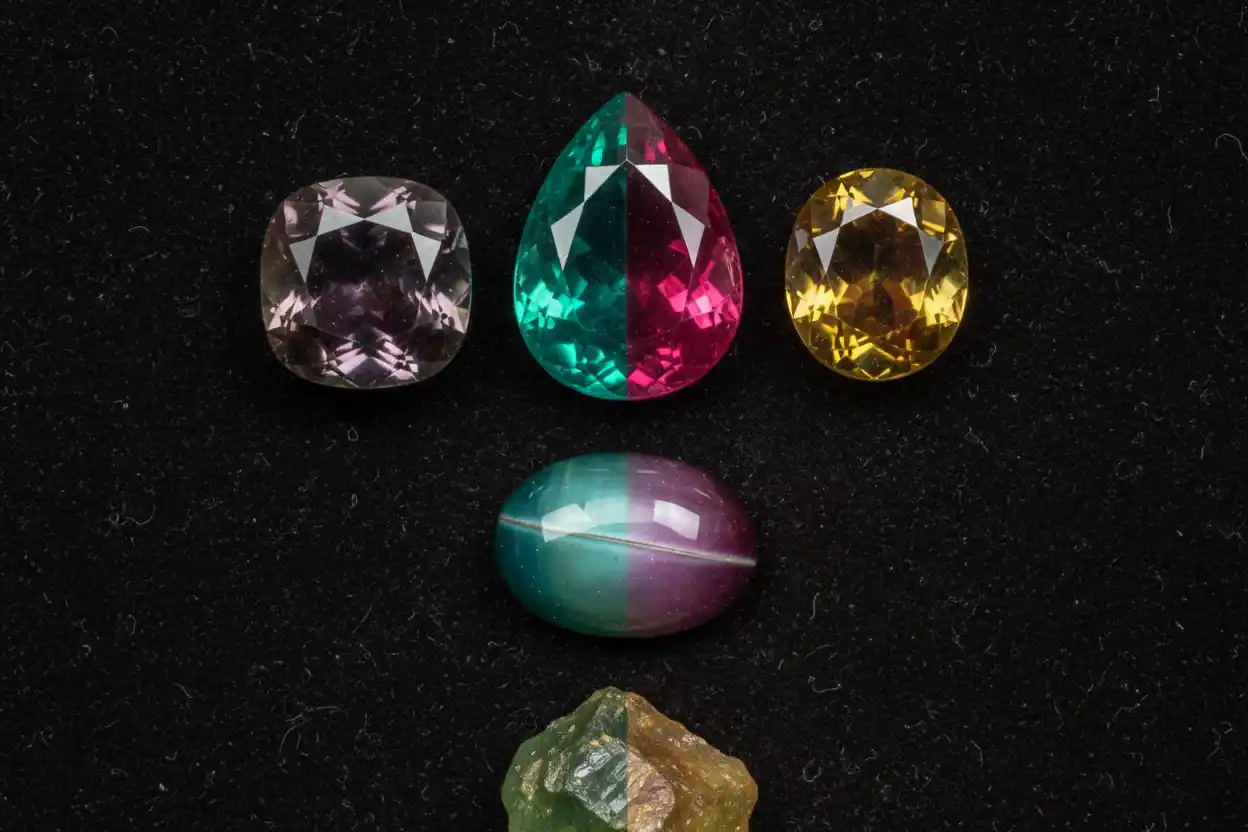
Types of Alexandrite: Colors and Varieties Explained
Alexandrite is the color-changing chromium-bearing variety of chrysoberyl. Fine stones shift from green, blue-green, or teal in daylight-equivalent light to red, purplish red, raspberry, or violet under warm incandescent-equivalent light.
Alexandrite does not have numerous mineral species in the way Garnet does. Its meaningful “types” are based mainly on geographic origin, strength and direction of color change, transparency, chatoyancy, natural or laboratory-grown origin, and treatment status.
Alexandrite at a Glance
| Property | Alexandrite |
|---|---|
| Composition | Beryllium aluminum oxide, BeAl₂O₄, colored mainly by chromium |
| Group or type | Color-changing variety of Chrysoberyl |
| Main daylight colors | Green, blue-green, teal, olive green, yellow-green |
| Main warm-light colors | Red, purplish red, raspberry, violet-red, brownish red |
| Crystal system | Orthorhombic |
| Optical character | Biaxial and strongly pleochroic |
| Transparency | Transparent to translucent |
| Mohs hardness | Approximately 8.5 |
| Cleavage | Distinct to imperfect |
| Tenacity | Brittle but generally durable |
| Main cut forms | Faceted stones and rare cat’s-eye cabochons |
| Primary care concern | Misidentification, synthetic material, weak color change, fractures, fillers, and replacement scarcity |
What Is Alexandrite?
Alexandrite is a rare color-change member of the Chrysoberyl family.
Its ideal chemical composition is BeAl₂O₄. Chromium replaces a small amount of aluminum and creates the unusual balance of light absorption responsible for its green-to-red change.
The Alexandrite parent page owns general history, properties, symbolism, and formation. This article focuses on the categories buyers encounter when Alexandrite is divided by origin, phenomenon, color quality, and manufacturing method.
A green Chrysoberyl that changes only weakly toward brown may be described by a laboratory as color-change Chrysoberyl rather than Alexandrite. The exact naming threshold can depend on color direction, change strength, and laboratory policy.
Therefore, the word Alexandrite should reflect gemological identity rather than any stone that appears different under two light sources.
Main Alexandrite Types
| Type | Typical daylight-equivalent appearance | Typical warm-light appearance | Main market distinction |
|---|---|---|---|
| Russian Alexandrite | Bluish green to emerald green | Purplish red to red | Historic Ural provenance and classic color ideal |
| Brazilian Alexandrite | Green, teal, or blue-green | Purple-red, raspberry, or red | Often strong and attractive color change |
| Sri Lankan Alexandrite | Yellow-green, olive, or green | Brownish red, purple-red, or violet | Often larger, but colour may be less classically saturated |
| Indian Alexandrite | Green to blue-green | Red, purple-red, or brown-red | Variable quality; some chatoyant material |
| Tanzanian Alexandrite | Green, teal, yellow-green | Purple, raspberry, or red-brown | East African production with varied colour balance |
| Zimbabwean Alexandrite | Green to blue-green | Red to purple-red | Historically important African source |
| Madagascan Alexandrite | Green, olive, or teal | Violet, purple-red, or brown-red | Variable modern source |
| Faceted Alexandrite | Depends on source and orientation | Depends on source and orientation | Brilliance, transparency, and color change |
| Cat’s-eye Alexandrite | Greenish with a moving eye | Reddish or purple with a moving eye | Combines chatoyancy with color change |
| Synthetic Alexandrite | Can closely copy strong green-red change | Red or purple-red | Laboratory-grown Chrysoberyl |
| Alexandrite simulant | May imitate color change | Variable | Different material, such as synthetic Sapphire or glass |
Russian Alexandrite
Russian Alexandrite is the historic benchmark associated with the Ural Mountains.
Fine Ural material is traditionally described as blue-green or emerald green in daylight and purplish red or red under incandescent-equivalent light.
The most desirable stones combine strong saturation, a high percentage of color change, good transparency, and minimal brown or grey.
Historic Russian crystals are usually small, and fine faceted gems above one carat are exceptionally scarce.
The Russian label carries a substantial premium only when supported by a respected independent laboratory and credible provenance. Colour appearance alone cannot prove Ural origin.
Antique jewelry may contain genuine Russian Alexandrite, synthetic Alexandrite, colour-change Sapphire, Garnet, or glass. Age and setting style are not sufficient authentication.
Brazilian Alexandrite
Brazil became an important Alexandrite source after major discoveries around Hematita in Minas Gerais during the late twentieth century.
Fine Brazilian material can show strong green, teal, or blue-green daylight color and vivid purple-red, raspberry, or red under warm light.
Some Brazilian Alexandrite rivals the classic Russian ideal. Other stones remain olive, brownish, dark, or incompletely changed.
Brazilian crystals may be larger than many Ural examples, but clean strongly changing stones above several carats remain rare.
Color zoning and inclusions can influence orientation. A cutter may sacrifice weight to align the table with the strongest green-red transformation.
Laboratory origin confirmation can support a premium, but the stone’s actual color change and cutting remain more important than country name alone.
Sri Lankan Alexandrite
Sri Lanka has supplied color-change Chrysoberyl and Alexandrite from alluvial gem gravels for many years.
Sri Lankan stones are often larger than fine Russian material, but their colors commonly lean toward yellow-green, olive, brownish green, brown-red, or violet-red.
Fine exceptions exist and can show attractive green-to-purple-red change.
Some Sri Lankan material is relatively clean and well suited to faceting. Other pieces contain fluid inclusions, mineral crystals, feathers, or strong color zoning.
The phrase Ceylon Alexandrite refers to Sri Lankan origin. It does not guarantee a specific change percentage or quality grade.
Large size should not compensate automatically for a weak brown-dominant change.
Indian Alexandrite
India has produced Alexandrite and color-change Chrysoberyl from several metamorphic gem regions, including deposits in Odisha and southern India.
Material can shift from green or blue-green toward red, purplish red, violet, or brownish red.
Both transparent faceting rough and chatoyant material occur.
Quality varies widely. Some stones have a strong change but are highly included, while others are clean but display only a moderate shift.
Indian origin claims should be supported by laboratory evidence or strong mine-level provenance because commercial parcels may pass through cutting centers far from their geological source.
Tanzanian Alexandrite
Tanzania produces Alexandrite and related Chrysoberyl from metamorphic deposits in East Africa.
Daylight colors can include green, blue-green, teal, yellow-green, and olive. Warm-light colors may be purple-red, raspberry, violet, or brown-red.
Some Tanzanian stones show good transparency and useful color change. Others are dark, yellowish, or incomplete in transition.
East African material may occur with Garnet, Sapphire, Spinel, and other gems, making alluvial rough identification difficult.
A Tanzanian label should not be used generically for every African Alexandrite.
Zimbabwean Alexandrite
Zimbabwe has historically produced notable Alexandrite, including material with attractive green-to-red or blue-green-to-purple-red change.
Production has been limited and inconsistent, contributing to scarcity.
Older Zimbabwean stones may circulate through estate jewelry and specialist dealer inventories.
Geographic origin requires laboratory support because the color range overlaps with Brazilian, Russian, Tanzanian, and other material.
A documented fine Zimbabwean gem can have significant collector interest, but value still depends on its observable quality.
Madagascan Alexandrite
Madagascar has produced color-change Chrysoberyl and Alexandrite from several gem-bearing regions.
Material can appear green, olive, teal, or yellow-green in daylight-equivalent illumination and violet, purple-red, brown-red, or raspberry under warm light.
As with other modern sources, quality ranges from weak commercial change to fine stones.
Madagascan origin alone does not establish rarity. Laboratory identity, change strength, size, clarity, and cutting remain decisive.
Faceted Alexandrite
Transparent Alexandrite is normally faceted to maximize brilliance and reveal color change.
Oval, cushion, round, emerald, pear, and mixed cuts are common. Irregular shapes may preserve scarce rough.
Cut orientation matters because Alexandrite is strongly pleochroic. One direction may show a better green, while another produces a stronger red or purple.
A shallow stone can look pale and windowed. Excessive depth retains weight but can make the gem appear dark and smaller face-up.
The best faceted type balances three qualities:
- Attractive colour under both lighting conditions
- A strong and reasonably complete change
- Good brilliance without excessive hidden weight
The detailed purchase process belongs on the Alexandrite buying guide.
Cat’s-Eye Alexandrite
Cat’s-eye Alexandrite combines color change with chatoyancy.
Parallel needles, channels, or other aligned inclusions reflect one narrow band across a cabochon. Under a point light, the eye should move smoothly over the dome.
The stone may appear greenish or blue-green in daylight and reddish, purple, or brown-red under warm light.
Fine examples show a sharp centred eye, strong change, attractive body color, and enough translucency to keep the cabochon lively.
Cat’s-eye Alexandrite is exceptionally rare because the rough must contain both the correct chromium chemistry and a dense oriented inclusion structure.
A weak colour-changing Chrysoberyl cat’s-eye should not automatically receive the Alexandrite name.
Strong-Change Alexandrite
Dealers often describe Alexandrite by the percentage of colour change.
A nearly complete change means little of the daylight color remains under warm illumination. For example, green may become predominantly red or purple-red rather than merely greenish brown.
A partial change may show mixed colours, such as green with red flashes or olive changing to brown-purple.
Change percentage is not the only quality factor. Muddy colours can change completely and still look unattractive.
Both endpoint colours should have useful saturation and brightness.
Photographs should use standardized daylight-equivalent and incandescent-equivalent sources. Ordinary phone images can distort green, red, and purple dramatically.
Blue-Green to Red Alexandrite
Blue-green-to-red material most closely matches the classic commercial ideal.
Fine Russian and Brazilian stones are especially associated with this direction, although other sources can produce it.
The blue component improves contrast with the warm red endpoint.
Strongly saturated examples are rare because Chromium absorption must be balanced precisely.
A stone that appears bright blue under artificial LED light but olive under natural daylight should not be judged from one controlled photograph.
Green to Purple-Red Alexandrite
Green-to-purple-red is common among attractive modern Alexandrite.
The warm-light endpoint may appear raspberry, wine, violet-red, or reddish purple rather than pure red.
This type can be highly desirable when both colours are saturated and the change remains strong.
Purple modifiers are not inherently inferior. Brown and grey have a greater negative effect than a clean violet or raspberry tone.
Yellow-Green to Brown-Red Alexandrite
Yellow-green-to-brown-red material represents a lower commercial range unless the stone has exceptional size, clarity, or cutting.
Sri Lankan and some African stones commonly show these modifiers, although fine examples from the same regions also occur.
A complete transition between two muddy colours should not be graded above a smaller stone with cleaner green and red endpoints.
Such material may still be attractive for collectors who prefer earthy or autumnal colours.
Colour-Change Chrysoberyl
Not every changing Chrysoberyl qualifies equally as Alexandrite.
A stone may shift from yellow-green to brown, greenish yellow to orange, or olive to red-brown without showing the classic Chromium-related Alexandrite direction strongly enough.
Laboratories may call such material colour-change Chrysoberyl.
This distinction protects the Alexandrite name from being applied to every lighting-dependent Chrysoberyl.
The report wording should control the commercial description, especially when rarity affects price.
Natural Unheated Alexandrite
Most natural Alexandrite is expected to be untreated.
Heat treatment generally offers limited benefit because it can alter color unpredictably without reliably improving the desired green-red balance.
Natural unheated status is therefore common rather than an exceptional premium factor in the way it is for Ruby or Sapphire.
A laboratory report remains important because it confirms natural Chrysoberyl, Alexandrite classification, and any detected filling or coating.
The dedicated treated Alexandrite page owns enhancement and synthetic-identification detail.
Synthetic Alexandrite
Synthetic Alexandrite is laboratory-grown Chrysoberyl with chemical and optical properties closely related to the natural gem.
Flux-grown and melt-grown methods can produce high-quality crystals with strong green-to-red change.
Synthetic material may show curved growth features, flux inclusions, metallic platelets, gas bubbles, seed remnants, or other process-specific features.
Some laboratory-grown stones have cleaner colour change than most natural Alexandrite and can be valuable as precision-cut gems, but they should never receive natural pricing.
The distinction between synthetic and imitation material is explained in lab-grown vs natural gemstones.
Alexandrite Simulants
A simulant resembles Alexandrite but has a different composition.
Color-change synthetic Sapphire is one of the most common substitutes. It may shift from blue, greenish, or violet toward purple or red under warm light.
Color-change glass can reproduce dramatic colour shifts at low cost.
Some colour-change Garnets, Spinels, Diaspore, Fluorite, and manufactured crystals may also be marketed incorrectly as Alexandrite.
A visual colour change is not enough for identification.
The dedicated real vs fake Alexandrite guide owns detailed tests for natural, synthetic, and imitation stones.
How Alexandrite Is Identified
Alexandrite has a hardness of approximately 8.5, refractive indices around 1.746–1.755, specific gravity near 3.73, and biaxial optical character.
It is strongly pleochroic, showing different colours along different crystallographic directions.
Chromium-related absorption creates the characteristic colour-change response.
Microscopy can reveal natural crystals, fluid inclusions, fingerprints, growth zoning, synthetic flux, curved structures, or filling.
Advanced laboratories may use Raman spectroscopy, ultraviolet-visible spectroscopy, infrared testing, chemical analysis, and inclusion comparison.
The report should identify natural or laboratory-grown Alexandrite specifically rather than merely “natural color-change gemstone.”
For expensive stones, the broader role of documentation is covered in gemstone certification.
Alexandrite Treatments
Routine heating is uncommon. Surface coating and fracture filling are more plausible concerns.
Oil or resin can enter surface-reaching fissures and improve apparent clarity temporarily.
Coatings may modify green, red, or purple color and can wear at facet junctions.
Doublets can combine natural or synthetic components to imitate a valuable colour-changing gem.
Treatment does not create natural Alexandrite identity. The host stone must first be confirmed as Chrysoberyl.
Durability and Jewelry Types
Alexandrite’s hardness makes it suitable for rings, earrings, pendants, and bracelets when the stone is structurally sound.
It is harder than Quartz, Beryl, Feldspar, and Tanzanite, though still brittle enough to chip under a hard blow.
The Alexandrite ring page owns setting, style, and daily-wear decisions.
Lower-impact options appear in the Alexandrite necklace and Alexandrite earrings guides.
Bracelet durability and repeated impact belong on the Alexandrite bracelet page.
Alexandrite Value and July 2026 Asking Prices
Detailed valuation belongs on the dedicated Alexandrite price page.
As of July 2026, small natural stones with weak-to-moderate change commonly carry asking prices around $500–$2,500 per carat.
Fine sub-carat gems with attractive green-to-red or green-to-purple-red change often appear around $2,500–$8,000 per carat.
Fine stones above one carat can ask approximately $8,000–$25,000 per carat, depending on change strength, clarity, cut, and origin.
Exceptional natural stones with strong classical change, important size, and respected Russian or Brazilian provenance may exceed $30,000 per carat.
Cat’s-eye Alexandrite varies widely. Fine stones with a sharp eye and strong colour change can command several thousand dollars per carat, while weak opaque cabochons may cost much less.
Synthetic Alexandrite should be priced separately from natural material regardless of how attractive its colour change appears.
The general mechanics behind these differences are explained in how gemstone prices work.
Buying the Right Alexandrite Type
Start with the laboratory report rather than the seller’s variety name.
View the stone under standardized daylight-equivalent and warm incandescent-equivalent illumination. Request video showing the transition rather than two unrelated edited photographs.
Compare both endpoint colours, percentage of change, brightness, clarity, cut, dimensions, and treatment status.
Country of origin matters less than quality unless a respected laboratory and credible provenance support the claim.
A Russian label without evidence should not receive a premium. Likewise, a Brazilian or Sri Lankan stone should not be discounted automatically when its actual colour change is excellent.
As a modern June birthstone, Alexandrite is also discussed in the June birthstone jewelry guide, but gift symbolism should not replace gemological verification.
The gem’s green, red, and purple endpoints can be compared with broader green gemstones, red gemstones, and purple gemstones directories.
Cleaning and Storage
Detailed care belongs on how to clean Alexandrite jewelry.
For routine cleaning, use lukewarm water, mild soap, and a soft brush.
Avoid harsh acids, bleach, abrasive compounds, and sudden temperature changes.
A sound untreated Alexandrite may tolerate ultrasonic cleaning, but hand cleaning remains safer when fractures, fillings, coatings, or an antique setting are present.
Keep the gem separate from Diamond, Sapphire, and Ruby, which can scratch it.
Documentation, photographs, measurements, receipts, and laboratory reports should remain stored with the stone.
Frequently Asked Questions
1. Are Russian, Brazilian, and Sri Lankan Alexandrite different minerals?
No. They are the same Chrysoberyl variety but may differ statistically in color, inclusions, size, and geological origin.
2. Which Alexandrite origin is considered most valuable?
Fine documented Russian material carries a historic premium, but an exceptional Brazilian or other stone can be more beautiful than an average Russian gem.
3. What is the best Alexandrite color change?
The classic ideal is blue-green or green in daylight changing to red or purplish red in warm light.
4. Is purple-red Alexandrite lower quality than pure red?
Not necessarily. Clean raspberry or purple-red can be highly desirable; brown and grey modifiers are generally more damaging.
5. What is cat’s-eye Alexandrite?
It is chatoyant Alexandrite cut as a cabochon, showing both a moving eye and colour change.
6. Is colour-change Chrysoberyl always Alexandrite?
No. Stones with weak or nonclassic change may be reported as colour-change Chrysoberyl instead.
7. Is natural Alexandrite usually heat treated?
No. Routine heat treatment is uncommon and most natural market material is expected to be untreated.
8. Is synthetic Alexandrite real Alexandrite?
It is laboratory-grown Chrysoberyl with Alexandrite-type colour change, but it is not naturally mined.
9. What is commonly sold as fake Alexandrite?
Color-change synthetic Sapphire, glass, synthetic Spinel, and other colour-changing gems are common substitutes.
10. Can origin be identified by colour alone?
No. Laboratory testing and inclusion evidence are needed, and some stones still receive no conclusive origin.
11. Why are Alexandrites above one carat so expensive?
Fine rough is scarce, cutting yield is low, and strong colour change with good clarity becomes much rarer as size increases.
12. What information should an Alexandrite report include?
It should confirm natural or laboratory-grown Alexandrite, note detectable treatment, and state geographic origin only when the evidence supports it.
Alexandrite types are most useful when they clarify what can actually be tested: natural origin, synthetic growth, chatoyancy, colour-change direction, and geographic evidence. Country names and dramatic photographs should remain secondary to the gem’s two colours, transition quality, cutting, and independent report.