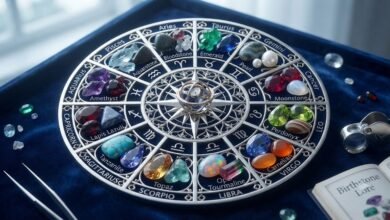

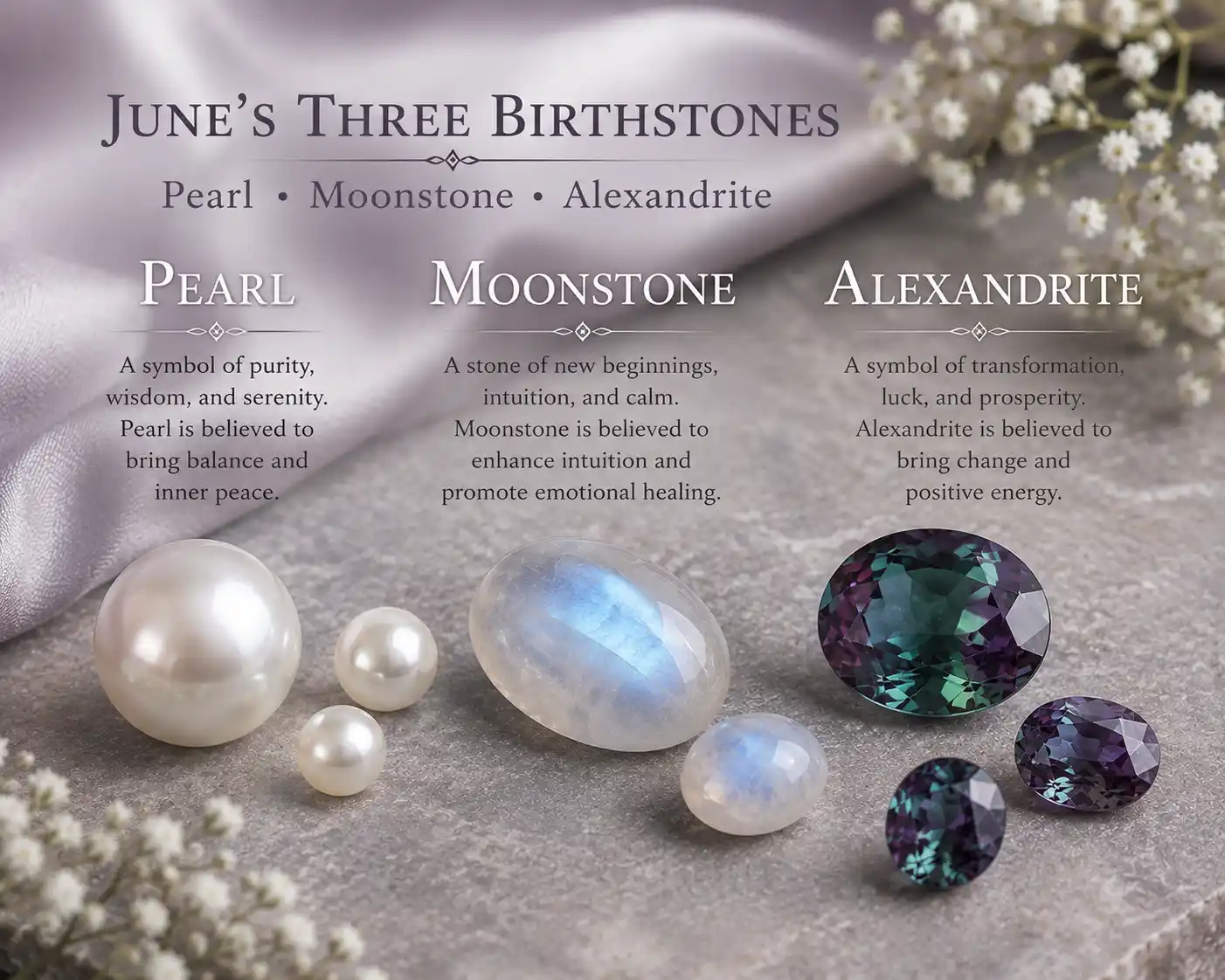

June has three recognized birthstones: pearl, moonstone, and alexandrite. Few other months offer such a varied choice. Pearl is an organic gem produced by a living mollusk, moonstone is a feldspar admired for its floating adularescence, and alexandrite is a rare chrysoberyl whose color changes under different light sources.
Those differences give June-born wearers several distinct options. Pearl offers soft luster and a long association with refinement. Moonstone provides an ethereal optical glow and strong lunar symbolism. Alexandrite combines exceptional durability with one of the gem world’s most dramatic color-change effects.
The complete birthstones-by-month guide places these gems within the annual calendar. Readers who are choosing a present rather than researching their history can use the dedicated June birthstone jewelry gift guide.
June Birthstones at a Glance
| Feature | Pearl | Moonstone | Alexandrite |
|---|---|---|---|
| Material type | Organic gem produced by a mollusk | Feldspar gemstone | Chrysoberyl variety |
| Best-known appearance | White or cream with orient and luster | Colorless to white with floating blue or white sheen | Green to bluish green changing to red or purplish red |
| Mohs hardness | Approximately 2.5–3 | Approximately 6–6.5 | Approximately 8.5 |
| Toughness | Variable; surface is delicate | Poor to fair, with cleavage risk | Excellent |
| Common treatment concerns | Bleaching, dyeing, irradiation, coating and filling | Coating, backing and imitation material | Laboratory growth, fracture filling and occasional treatment |
| Best jewelry uses | Earrings, necklaces, pendants and protected rings | Earrings, pendants, brooches and protected rings | Rings, earrings, necklaces and bracelets |
| Main quality factor | Luster and overall pearl quality | Adularescence and transparency | Strength and quality of color change |
| Traditional symbolism | Purity, wisdom, sincerity and calm | Intuition, transition, cycles and emotional reflection | Balance, transformation, adaptability and good fortune |
| Primary care concern | Scratching, cosmetics and chemicals | Impact, cleavage, heat and scratching | Correct identification and fracture condition |
Why Does June Have Three Birthstones?
Birthstone lists developed through a mixture of religious references, regional traditions, jewelry marketing, calendar systems, and later standardization. As those lists changed, some months retained more than one accepted gem.
Pearl represents one of June’s oldest and most widely recognized associations. Moonstone entered modern birthstone lists as an accessible gem with strong lunar imagery, while alexandrite gave the month a rare, durable, color-changing alternative.
The three-gem system also solves a practical problem. Natural fine alexandrite can be extremely expensive, while pearl and moonstone provide options across broader price ranges. Therefore, June-born buyers can choose according to lifestyle, budget, color preference, and the degree of rarity they value.
Pearl: June’s Organic Birthstone
Pearl differs fundamentally from most gemstones because it forms inside a living mollusk rather than within rock. Layers of nacre or related shell material develop around an irritant, tissue implant, bead nucleus, or naturally occurring internal event.
Natural pearls form without deliberate human intervention. Cultured pearls result from a process initiated by pearl farmers, but the mollusk still produces the pearl’s nacre and surface. Cultured pearls are genuine pearls rather than imitations.
The wider pearl gemstone guide explains formation, symbolism, historical use, and material properties. The guide to types of pearl separates Akoya, freshwater, South Sea, Tahitian, natural, cultured, bead-nucleated, tissue-nucleated, and other pearl categories.
Pearl Colors
White and cream are the traditional June birthstone colors, yet pearls can also appear silver, gray, black, green, blue, pink, peach, gold, and combinations of bodycolor, overtone, and orient.
Color does not operate like paint on a flat surface. A pearl may have a white bodycolor with rose or green overtone, while orient creates subtle iridescent color movement.
Dyed and otherwise color-treated pearls also exist. Consequently, an unusually strong or uniform color should receive clear treatment disclosure.
Pearl Quality
Pearls are not graded through the diamond 4Cs. Their quality depends on seven closely related factors:
| Pearl factor | What it describes |
|---|---|
| Size | Diameter or dimensions, usually measured in millimeters |
| Shape | Round, near-round, button, drop, oval, baroque, circled or another form |
| Color | Bodycolor, overtone and orient |
| Luster | Sharpness and brightness of surface reflections |
| Surface | Blemishes, pits, wrinkles, spots and other characteristics |
| Nacre | Thickness, quality and visual integration of the nacre |
| Matching | Consistency within earrings, strands and multi-pearl jewelry |
Luster is often the first quality a viewer notices. Fine pearls produce bright, sharp reflections rather than a dull or chalky glow. Surface marks are normal, although numerous deep blemishes can reduce beauty and durability.
The pearl buying guide owns the complete purchasing process, while the pearl price guide explains how type, size, luster, nacre, surface, shape, color, matching, origin, and documentation affect value.
Pearl Durability
Pearl is the least scratch-resistant of June’s birthstones. Its surface can be marked by harder gems, rough fabric, metal edges, dust, and careless storage.
Cosmetics, perfume, hairspray, perspiration, acidic substances, heat, dehydration, and cleaning chemicals can also damage luster. Pearls should be the last jewelry put on and the first removed.
Earrings and necklaces generally protect pearls better than rings and bracelets. Strands also require periodic restringing because silk or cord can stretch, absorb residue, and fail.
Follow How to Clean Pearl Jewelry Safely rather than using steam, ultrasonic equipment, abrasive cloths, or household jewelry dips.
Moonstone: June’s Luminous Feldspar
Moonstone is a feldspar gemstone admired for adularescence, a mobile glow that appears to move beneath the surface as the gem or light source changes position.
The effect develops through microscopic internal layers with slightly different optical properties. Light scatters between those layers, creating a soft white, silver, or blue sheen.
The dedicated moonstone guide owns the gem’s formation, symbolism, optical structure, and uses. Meanwhile, types of moonstone separates white, colorless, peach, gray, black, cat’s-eye, star, and commercially named varieties.
Moonstone Colors and Adularescence
Moonstone bodycolor can be colorless, white, gray, peach, brown, green, or nearly black. Its adularescence may appear white, silver, pale blue, or intensely electric blue.
The finest traditional moonstones combine high transparency, minimal distracting inclusions, and a strong centered blue sheen that moves smoothly across the crown.
A milky white stone can still be attractive, although it should not be priced as highly as a transparent gem with vivid blue adularescence solely because both carry the moonstone name.
Rainbow Moonstone Is Usually Labradorite
Material sold as rainbow moonstone commonly belongs to the plagioclase feldspar series and is generally classified as transparent labradorite rather than traditional orthoclase moonstone.
It can display blue, green, yellow, orange, and rainbow-colored flashes. The rainbow moonstone guide covers that trade material separately.
This naming difference does not automatically make rainbow moonstone undesirable. However, sellers should disclose the actual feldspar identity rather than implying that every iridescent white stone is the same mineral variety.
Moonstone Durability
Moonstone ranks approximately 6–6.5 on the Mohs scale, yet its practical weakness comes from poor toughness and cleavage. A sharp impact can chip or split it along structural planes.
For that reason, moonstone performs best in earrings, pendants, brooches, and protected rings. A low bezel is generally safer than a high prong setting.
Ultrasonic and steam cleaning should be avoided. Heat can worsen fractures, while vibration can exploit cleavage. The full care process appears in How to Clean Moonstone Jewelry Safely.
The moonstone buying guide explains how to judge adularescence, transparency, bodycolor, inclusions, cut, orientation, treatment, and seller photography. For value context, consult the moonstone price guide.
Alexandrite: June’s Color-Change Birthstone
Alexandrite is the color-changing variety of chrysoberyl. Fine stones appear green to bluish green in daylight or fluorescent-equivalent lighting and red to purplish red under warmer incandescent illumination.
The phenomenon occurs because chromium-bearing alexandrite absorbs and transmits different portions of the visible spectrum. When the available light spectrum changes, the dominant face-up color changes with it.
The complete alexandrite guide covers its mineral identity, formation, symbolism, history, and physical properties. The guide to types of alexandrite separates natural, laboratory-grown, cat’s-eye, source-related, and color-quality categories.
Alexandrite Color Change
Color change is the most important alexandrite quality factor. A fine gem should show attractive colors under both lighting conditions rather than an impressive change between two muddy or brownish tones.
Buyers should consider:
- The percentage of the stone that changes visibly
- The strength of the green or bluish-green daylight color
- The quality of the red or purplish-red warm-light color
- Saturation under both conditions
- Extinction and windowing
- Whether the change remains visible in ordinary real-world lighting
Photographs can exaggerate the phenomenon by using selected light sources and camera processing. Request continuous video showing the same stone moving between clearly described lighting environments.
Alexandrite Rarity
Fine natural alexandrite is rare, particularly above one carat. Large stones with strong color change, attractive saturation, good transparency, and balanced cutting can command exceptionally high prices.
Historic Russian material carries prestige, although fine alexandrite also comes from Brazil, Sri Lanka, East Africa, and other sources. Geographic origin cannot be proved from color alone.
The alexandrite buying guide owns quality evaluation and seller checks, while the alexandrite price guide covers the sharp relationship among size, color change, clarity, origin, treatment, and value.
Alexandrite Durability
Alexandrite ranks approximately 8.5 on the Mohs scale. It has excellent toughness and no pronounced cleavage, making it the most durable of June’s three birthstones.
Sound natural or laboratory-grown alexandrite can work in rings, bracelets, earrings, and necklaces. Existing fractures and fracture filling still require caution, however.
Warm soapy water is the safest universal cleaning method. Ultrasonic and steam equipment may be suitable for sound unfilled stones, but How to Clean Alexandrite Jewelry Safely should guide the final decision.
Pearl vs Moonstone vs Alexandrite
| Decision factor | Pearl | Moonstone | Alexandrite |
|---|---|---|---|
| Best for traditional elegance | Excellent | Moderate | Moderate |
| Best for visible optical movement | Orient and luster | Adularescence | Color change |
| Best for daily rings | Least suitable | Requires protection | Most suitable |
| Broadest accessible price range | Yes | Yes | Natural fine material is expensive |
| Best for matching a white wardrobe | White and cream pearls | Colorless or white moonstone | Less typical |
| Best for unusual rarity | Natural pearl | Fine blue-adularescent material | Fine natural alexandrite |
| Best surprise-gift form | Studs or pendant | Pendant or earrings | Studs or pendant |
| Main identification risk | Imitation, coating and cultured/natural confusion | Glass, coated stones and rainbow-moonstone labeling | Laboratory-grown stones and color-change simulants |
June Birthstone Meanings
Pearl is commonly associated with wisdom, sincerity, purity, emotional composure, and experience gained over time. Those associations reflect its gradual formation, luminous surface, use in ceremonial jewelry, and long cultural history.
Moonstone is linked with the moon, cycles, intuition, transition, fertility symbolism, and emotional reflection. Its mobile glow naturally encouraged lunar interpretations across different periods.
Alexandrite is often associated with transformation, adaptability, balance, duality, creativity, and good fortune. Its change between green and red provides a strong visual metaphor for adjusting to different conditions.
These meanings are traditional or spiritual interpretations. They do not establish that any June birthstone changes hormones, improves fertility, balances emotions, protects a pregnancy, or treats physical or psychological illness.
June Zodiac Connections
June spans Gemini and Cancer.
The Gemini birthstone guide owns zodiac traditions associated with early and middle June. The Cancer birthstone guide covers later June and July dates.
Month birthstones and zodiac stones come from separate systems. A June-born Gemini or Cancer can choose pearl, moonstone, or alexandrite as a month stone regardless of other astrological recommendations.
Natural, Cultured, Laboratory-Grown and Imitation Materials
The terminology differs among the three birthstones.
A cultured pearl is a genuine pearl produced after human intervention in the mollusk. A natural pearl forms without deliberate cultivation. Glass or shell beads coated to resemble pearl are imitations.
Natural moonstone forms geologically. Glass, assembled products, coatings, and other feldspars can imitate or substitute for it.
Natural alexandrite forms within the Earth, while laboratory-grown alexandrite has substantially similar crystal structure and optical properties but a manufactured origin. Color-change sapphire, synthetic sapphire, glass, and other materials may imitate its appearance.
For pearl-specific post-purchase concerns, the guide to real versus fake pearl explains safe observations and professional testing.
Which June Birthstone Should You Choose?
Choose pearl when soft luster, formal versatility, organic origin, and a traditional appearance matter most.
Select moonstone when the wearer prefers an ethereal glow, cabochon cutting, pale color, and symbolic connections with cycles or the moon.
Choose alexandrite when durability, rarity, color change, and collector interest justify a higher budget.
A gift does not need to use the most expensive option. A well-matched cultured-pearl pair, a strong blue-adularescent moonstone pendant, or a small natural alexandrite with convincing color change can each represent June successfully.
Frequently Asked Questions
1. What are the three June birthstones?
Pearl, moonstone, and alexandrite are the three widely recognized June birthstones.
2. Which June birthstone is the traditional one?
Pearl is generally regarded as June’s oldest and most traditional birthstone. Moonstone and alexandrite provide accepted modern alternatives.
3. Which June birthstone is the most valuable?
Fine natural alexandrite usually reaches the highest prices, especially in larger sizes with strong green-to-red color change. Exceptional natural pearls can also be extremely valuable.
4. Which June birthstone is best for a daily ring?
Alexandrite is the strongest choice because it has Mohs hardness around 8.5, excellent toughness, and no pronounced cleavage. Moonstone and pearl require considerably more protection.
5. Is a cultured pearl a real birthstone?
Yes. Cultured pearls are genuine pearls produced by mollusks after human-assisted nucleation or tissue implantation.
6. Is rainbow moonstone a true moonstone?
Most material sold as rainbow moonstone is transparent white labradorite, a related feldspar rather than traditional orthoclase moonstone. It remains a natural gemstone when accurately identified.
7. Why does alexandrite change color?
Its chromium-bearing crystal structure interacts differently with the spectral composition of daylight-equivalent and warm incandescent light, producing different dominant colors.
8. Can June birthstones be worn together?
Yes, but the setting must respect their different durability levels. Hard alexandrite and metal edges should not rub directly against softer pearl or moonstone.
9. Which June birthstone is best for earrings?
All three can work well. Earrings especially protect pearl and moonstone, while alexandrite provides durability and color change.
10. Are June birthstones normally treated?
Pearls may be bleached, dyed, irradiated, coated, or filled. Moonstone is less routinely treated but may be coated or backed. Alexandrite is usually untreated, although laboratory-grown material and fracture filling occur.
11. Do pearl, moonstone and alexandrite have proven healing powers?
No. Their healing and spiritual meanings are traditional or personal beliefs rather than scientifically established medical effects.
12. Which June birthstone is easiest to buy on a limited budget?
Cultured freshwater pearl and commercial moonstone generally provide the broadest affordable options. Fine natural alexandrite is usually the most expensive choice.
June’s birthstones provide three very different forms of beauty. Pearl reflects light from a delicate organic surface, moonstone creates a floating internal glow, and alexandrite transforms as the illumination changes. The right choice depends less on a hierarchy of value than on how the gem will be worn, which visual effect the wearer enjoys, and whether the seller accurately discloses identity, treatment, and origin.
Pearl, moonstone, and alexandrite symbolism belongs to cultural, historical, or spiritual tradition. These gems are not scientifically proven to treat illness, regulate fertility, alter hormones, protect pregnancy, improve mental health, or guarantee good fortune.