
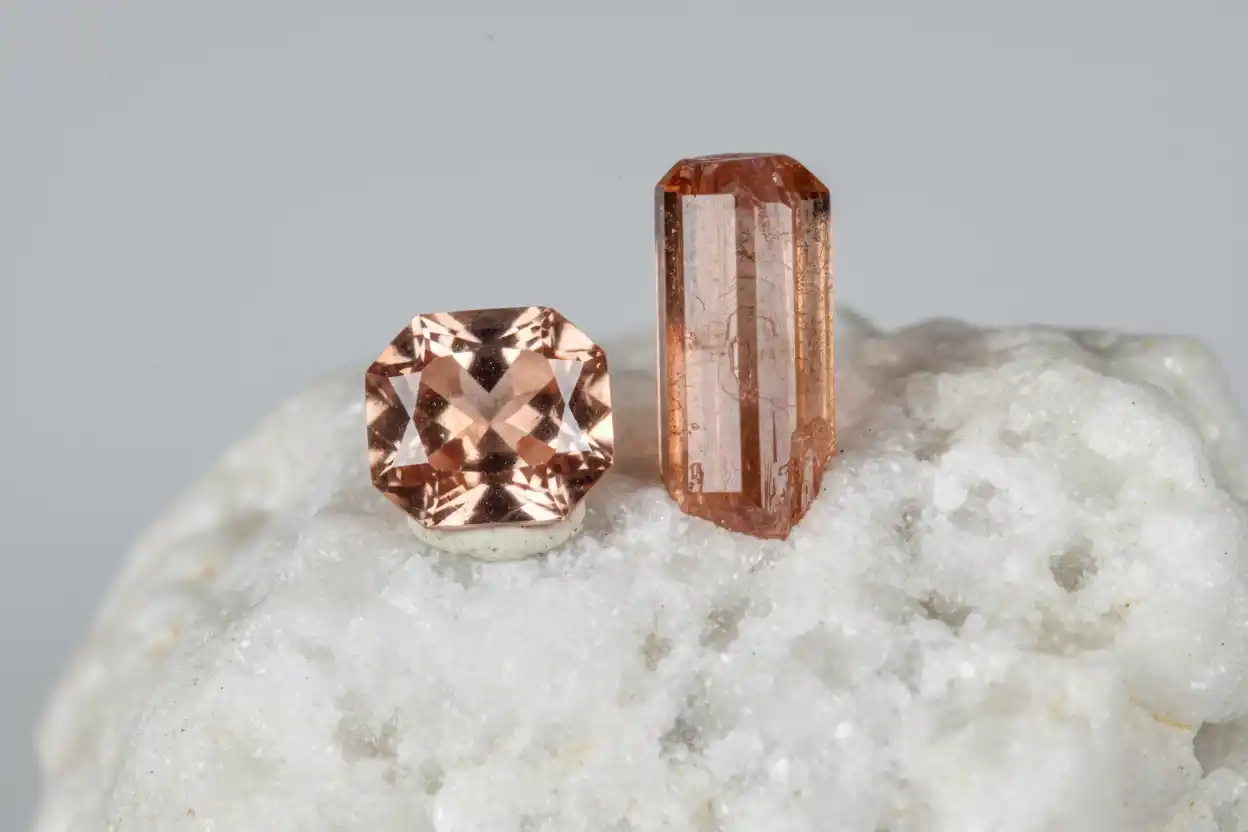

Vayrynenite is a rare manganese-beryllium phosphate best known for delicate pink, salmon, orange-pink and reddish crystals from granitic pegmatites. Transparent facetable material is exceptionally scarce, and stones weighing more than one carat have historically been unusual.
Recent Nigerian production has introduced larger and cleaner orange-to-orangy-pink gems, but vayrynenite remains a specialist collector material rather than a mainstream jewelry stone.
Vayrynenite at a Glance
| Property | Vayrynenite |
|---|---|
| Mineral class | Phosphate |
| Chemical formula | BeMn²⁺(PO₄)(OH) |
| Possible substitution | Minor fluorine may replace hydroxyl |
| Typical colors | Light pink, rose red, salmon pink, orangy pink, orange, pale gray and brown |
| Crystal system | Monoclinic |
| Common habit | Prismatic, tabular, bladed, granular or small embedded crystals |
| Luster | Vitreous |
| Transparency | Transparent to opaque |
| Refractive indices | Approximately 1.64–1.67 |
| Birefringence | Moderate, commonly around 0.02 |
| Optical character | Biaxial |
| Specific gravity | Approximately 3.20–3.25 |
| Mohs hardness | 5 |
| Cleavage | Good to perfect in more than one direction |
| Tenacity | Brittle |
| Common use | Rare faceted collector gems and mineral specimens |
| Main care concern | Softness, cleavage, brittleness and extremely limited replacement availability |
What Is Vayrynenite?
Vayrynenite is a recognized mineral species composed of beryllium, manganese, phosphate and hydroxyl.
Manganese is responsible for much of its pink-to-orange coloration. Minor iron and other substitutions can shift the tone toward brown, gray or red.
The mineral’s ideal formula is BeMn²⁺(PO₄)(OH). Fluorine may replace a small amount of hydroxyl in some specimens.
It belongs to a structural relationship with minerals such as herderite-group phosphates, although its exact composition and crystal symmetry remain distinct.
Vayrynenite is not a variety of apatite. Both are phosphates, but they have different chemistry, structure and physical properties.
The diversity of phosphate gems appears in the types of apatite guide, while vayrynenite retains its own rare-mineral identity.
How Vayrynenite Got Its Name
The mineral was named in honor of Heikki Allan Väyrynen, a Finnish geologist and professor of mineralogy.
It was recognized as a new mineral during the mid-twentieth century from the Viitaniemi pegmatite in Finland.
The correct Finnish spelling is väyrynenite. Because English slugs and keyboards often omit diacritics, vayrynenite is the practical ASCII spelling used for this page.
Alternative misspellings include vayrenite, vayryenite and veyrynenite. These should be treated as spelling variants rather than separate minerals.
Vayrynenite Colors
Light Pink
Pale pink is the classic color associated with Finnish and Pakistani material. Some crystals approach nearly colorless or grayish pink.
Light stones may show good transparency but limited saturation, reducing visual impact in very small cuts.
Salmon and Orangy Pink
Salmon pink and orangy pink are among the most desirable colors. Fine stones combine warm saturation with enough brightness to avoid appearing brown.
Recent Nigerian material has produced clear orangy-pink gems in sizes that are unusually large for the species.
Orange
Orange vayrynenite is less familiar but increasingly visible because of Nigerian production.
Some stones shift between orange and pink under different lighting because their hue sits near the boundary between the two color categories.
Rose Red
Rose-red and reddish-pink crystals occur but are rare. Deep stones may become overly dark when cut too deeply.
Brown and Gray
Brown, gray and dull orange-pink material is more common in mineral specimens than in faceted gems.
Some supposed brown vayrynenite may be another pegmatite phosphate, making laboratory confirmation particularly important.
How Vayrynenite Forms
Vayrynenite forms in evolved granitic pegmatites enriched in beryllium, manganese and phosphorus.
Pegmatites crystallize from the final fluid-rich portions of granitic magma. Elements that do not fit readily into common feldspar, quartz and mica become concentrated in these late fluids.
As cooling continues, rare phosphates grow in pockets, fractures and replacement zones.
Vayrynenite commonly occurs with albite, quartz, muscovite, tourmaline, topaz and beryl-group minerals.
The broader pegmatite relationship with beryl reflects shared beryllium enrichment, although the two minerals have entirely different structures.
Changes in fluid chemistry can replace an earlier phosphate or create reaction rims around neighboring minerals.
Important Localities
Viitaniemi, Finland
The Viitaniemi pegmatite is the type locality. Finnish material is historically important and may occur as small pink crystals associated with hurlbutite, quartz and other phosphates.
Fine crystals from the locality are sought by systematic mineral collectors, even when they are too small or included for faceting.
Gilgit-Baltistan, Pakistan
Pakistan became the best-known source of gem-quality vayrynenite before the recent Nigerian discovery.
Pegmatites around Shengus, the Braldu Valley and the wider Skardu region have produced salmon, orange-red and pink crystals.
Pakistani material may occur with albite, topaz, tourmaline, muscovite, fluorapatite and beryl.
The best crystals can be transparent and strongly colored, but many are fractured, small or confused with eosphorite and other phosphates.
Nigeria
GIA reported a new Nigerian source in 2025. The studied cut stones ranged from approximately 0.72 to 2.45 carats and showed orange to orangy-pink colors with high clarity.
This production is significant because older faceted stones above one carat were particularly uncommon.
Nigeria has not made vayrynenite abundant. It has instead expanded the small number of high-quality gems available to collectors.
Other Occurrences
Vayrynenite is also documented from Portugal, the United States and a small number of other pegmatite localities.
Most occurrences produce microscopic or specimen-grade material rather than transparent gem rough.
Inclusions and Internal Features
Pakistani stones commonly contain healed fractures, fluid inclusions, mineral crystals and growth zoning.
Two-phase inclusions may contain liquid and a gas bubble. Their arrangement can follow healed fracture planes.
The 2025 Nigerian stones examined by GIA were eye-clean but contained healed fractures with two-phase fluid inclusions under magnification.
Strong facet doubling can be visible because of the mineral’s birefringence. Rear facet edges may appear doubled when viewed through the crown.
Color zoning can shift from pale pink to orange or brownish areas.
Surface-reaching fractures require careful inspection because they reduce durability in an already soft and cleavable gem.
Identifying Vayrynenite
Color and locality provide useful clues but cannot establish the species.
A gemologist combines refractive index, birefringence, optic character, density, spectroscopy and microscopic examination.
Raman spectroscopy can confirm the mineral structure. Chemical analysis detects manganese, beryllium and phosphorus.
The stone’s hardness of approximately 5 helps separate it from harder pink tourmaline and topaz, but scratch testing should never be performed on a rare finished gem.
The full identification sequence follows how to identify crystals.
Because commercial examples are so rare, an independent laboratory report is appropriate for any expensive faceted stone.
Common Lookalikes
Eosphorite
Eosphorite is a manganese-aluminum phosphate that can show pink, orange and brown colors.
Its crystal habit and geological association overlap vayrynenite closely enough that field labels are sometimes incorrect.
Chemical and spectroscopic testing provides a reliable distinction.
Pink Tourmaline
Pink tourmaline can show similar color but is generally harder and has different refractive and spectroscopic properties.
Tourmaline also commonly forms strongly striated trigonal prisms.
Morganite
Morganite is pink beryl and occurs in pegmatites. It is harder, less dense and has different optical properties.
Rhodochrosite
Rhodochrosite can be salmon pink but is much softer and reacts with acid. Transparent faceted examples are also rare.
Topaz
Pink or orange topaz can resemble a clean vayrynenite. Topaz is considerably harder and has different cleavage and optical data.
Synthetic and Imitation Materials
Pink glass, synthetic spinel and synthetic corundum can imitate the face-up color.
Their abundance, durability and growth features differ significantly from natural vayrynenite.
Treatments and Synthetic Material
No routine commercial treatment is established for vayrynenite.
Heat could damage fractures or change a sensitive phosphate without producing a predictable commercial improvement.
Fracture filling is theoretically possible, but the market is too small for a standardized enhancement pipeline. Any resin, oil or filler should be disclosed.
Laboratory-grown vayrynenite may be synthesized for mineralogical research, but no meaningful jewelry supply exists.
Most suspect stones are more likely to be a different natural mineral or a color imitation than a synthetic chemical counterpart.
The terminology for treatment and manufactured material appears in gemstone treatments explained and lab-grown versus natural gemstones.
Cutting and Polishing
Vayrynenite’s hardness of 5 and good-to-perfect cleavage make cutting difficult.
The lapidary must orient the rough to avoid splitting along cleavage planes while preserving as much weight as possible.
Small crystals encourage oval, cushion and emerald-style cuts that follow the natural rough.
Deep cutting can darken orange or reddish stones, while shallow cutting may create a broad window.
Moderate birefringence produces visible facet doubling, which can soften the appearance of internal reflections.
Polishing heat must be controlled carefully. Fractures and cleavage can extend if the stone is overheated or pressed too aggressively.
Durability and Jewelry Suitability
Vayrynenite ranks only 5 on the gemstone hardness chart.
It can be scratched by quartz dust, household objects and most mainstream jewelry stones.
Its cleavage adds a more serious breakage risk. The issue is explained in gemstone cleavage explained.
The difference between scratch resistance and breakage resistance appears in gemstone toughness versus hardness.
Faceted stones are best kept in gem collections or mounted in protected pendants and earrings.
Rings and bracelets expose the gem to impacts that could be impossible to repair or replace.
Vayrynenite Prices in 2026
Vayrynenite has no standardized market because production is tiny and individual stones appear irregularly.
Small included crystals and modest thumbnail specimens commonly range from approximately $25–$150.
Better Pakistani crystals with attractive color and partial transparency may sell for $150–$1,000.
Exceptional gemmy crystals and important locality specimens can reach $1,000–$5,000 or more.
Very small faceted stones below 0.25 carat may cost approximately $150–$600 total, creating high apparent per-carat figures.
Fine faceted gems between roughly 0.5 and 2.5 carats may be offered around $1,000–$4,000 per carat, with exceptional color, size and documentation commanding more.
Current listings vary dramatically, so asking prices should not be treated as a formal price index.
The mineral belongs naturally in discussions of the rarest gemstones in the world.
What Determines Value?
Natural origin and correct identification are essential because pink pegmatite minerals are easily confused.
Color is the next major factor. Saturated orangy pink, salmon and rose-red material generally receives more interest than gray or brown stones.
Transparency and clarity strongly influence faceted value. Eye-clean material is unusual.
Size creates a substantial premium because most crystals do not yield clean gems above one carat.
Cut quality should balance brilliance, pleochroism, facet doubling and weight retention.
For mineral specimens, crystal form, matrix association, damage, locality and old labels matter more than theoretical carat value.
Buying Guidance
Purchase from a specialist in rare minerals or collector gems.
Require a laboratory report for a faceted stone carrying a four-figure price.
Ask whether the locality is Finland, Pakistan, Nigeria or another documented occurrence.
View the stone under daylight-equivalent and warm light because orange-pink balance can shift noticeably.
Inspect every edge and facet junction for abrasion. A stone can be correctly identified yet still be badly worn.
Check for surface-reaching fractures, glue and repair around matrix specimens.
Do not assume that a large orange-pink pegmatite crystal is vayrynenite solely because of its seller label.
Cleaning, Water and Storage
Clean only when necessary, using lukewarm water, mild soap and a very soft brush.
Avoid soaking. Fractures, associated matrix minerals and possible repairs may respond unpredictably.
Do not use ultrasonic or steam cleaning.
Keep the gem away from acids, strong alkaline cleaners and sudden temperature changes.
Store faceted stones in an individual padded container. Quartz, sapphire and topaz can scratch them.
Mineral specimens should be supported by their matrix rather than held by a projecting crystal.
Meaning and Symbolism
Vayrynenite has limited historical gemstone lore because it was recognized recently and has never circulated widely.
Modern crystal traditions associate its pink and orange colors with patient ambition, curiosity, creative confidence and appreciation of rare opportunities.
Its geological formation in highly evolved pegmatites encourages symbolism involving uncommon outcomes emerging from the final stages of a long process.
These interpretations are cultural, spiritual or personal rather than scientifically proven effects.
Its colors overlap modern collections of pink crystals, orange crystals and red crystals.
Frequently Asked Questions
1. Is vayrynenite a real mineral?
Yes. It is a recognized manganese-beryllium phosphate with the formula BeMn²⁺(PO₄)(OH).
2. How is väyrynenite pronounced and spelled?
The original spelling includes the Finnish letter ä. “Vayrynenite” is the common ASCII spelling used in English URLs and databases.
3. Why is vayrynenite so rare?
It requires an unusual combination of beryllium, manganese and phosphorus in highly evolved pegmatites, and most crystals are too small or fractured for cutting.
4. What color is vayrynenite?
It occurs in pale pink, salmon, orangy pink, orange, rose red, gray and brown.
5. Where is gem-quality material found?
Pakistan has been the classic gem source, while Nigeria produced notable larger and cleaner material reported in 2025.
6. Is Nigerian vayrynenite natural?
Yes. GIA documented natural orange-to-orangy-pink stones from a new Nigerian source.
7. Is vayrynenite suitable for rings?
It is not recommended for everyday rings because it has hardness 5, brittle tenacity and strong cleavage.
8. Is vayrynenite treated?
No routine treatment is established. Any filling, coating or repair should be disclosed.
9. How is it distinguished from eosphorite?
Their colors and localities can overlap. Chemical analysis and Raman spectroscopy provide dependable separation.
10. Can vayrynenite go in water?
Brief gentle washing may be acceptable for a sound gem, but soaking is unnecessary and risky for fractured or matrix material.
11. How much is vayrynenite worth?
Fine faceted stones can command thousands of dollars per carat, while specimens range from modest thumbnails to several-thousand-dollar gem crystals.
12. Does vayrynenite have scientifically proven healing properties?
No. Its symbolism may be personally meaningful, but scientific evidence does not establish healing effects.
Vayrynenite remains rare even after the emergence of cleaner Nigerian material. Its value lies not simply in a pink-orange color that other gems can imitate, but in a demanding pegmatite chemistry, limited crystal size and the difficulty of preserving a soft, cleavable mineral through mining and cutting.
Vayrynenite appears in Crystals That Start With V and Gemstones That Start With V.
Safety disclaimer: Intact vayrynenite can be handled as a collector mineral, but cutting or grinding beryllium-bearing material can create hazardous mineral dust. Use professional wet cutting, local ventilation and appropriate respiratory and eye protection.