Where to Buy Real Mangano Calcite and Avoid Dyed Pink Fakes
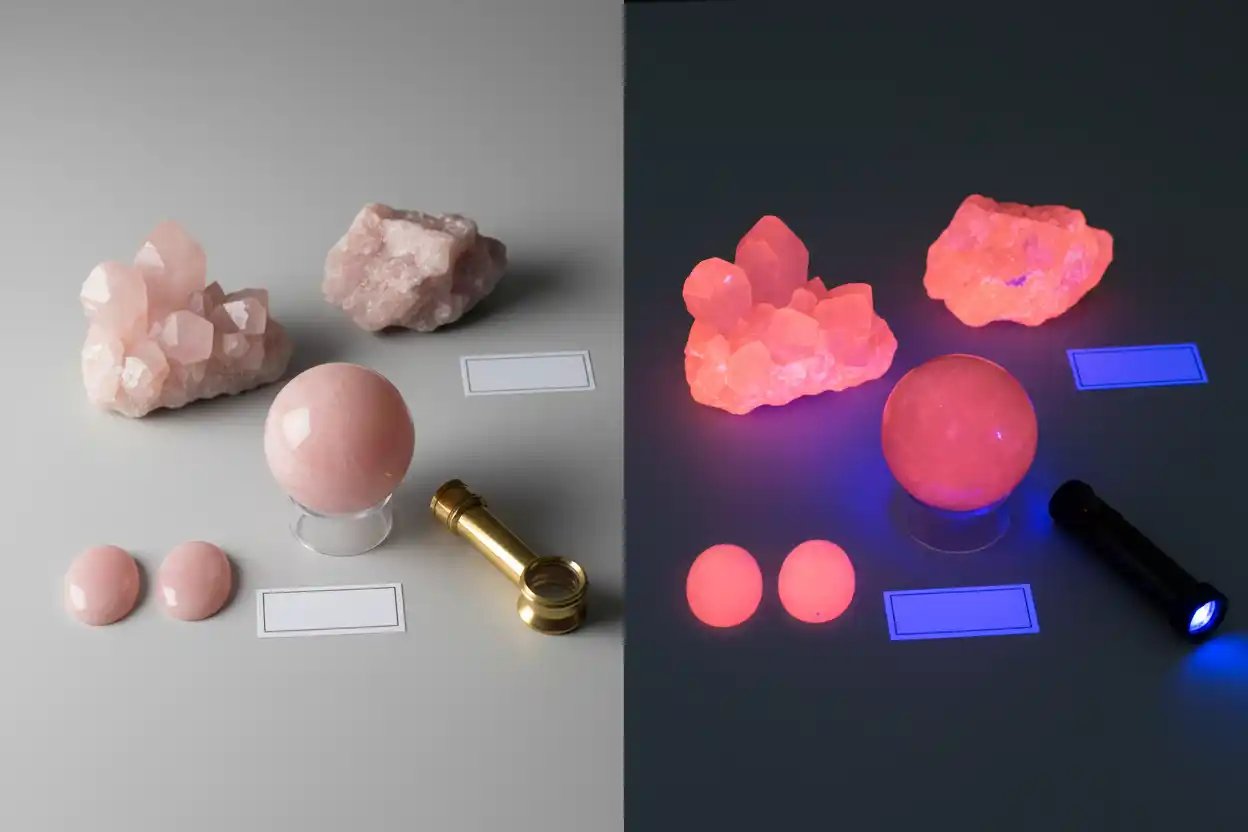
Real Mangano Calcite is Calcite containing measurable manganese. It commonly appears pale pink, blush, peach-pink, rose, salmon or nearly white and may show orange, pink or red fluorescence under ultraviolet light.
“Mangano Calcite” is a commercial shortening of manganoan or manganese-bearing Calcite. It is not a separate approved mineral species with one fixed manganese concentration.
That flexible naming creates several buying problems. Ordinary pink Calcite may be sold with an unsupported manganese claim, while Cobaltocalcite, Rhodochrosite, Kutnohorite, dyed white Calcite, resin composites and other pink carbonates can receive the Mangano Calcite label.
The Mangano Calcite meaning and properties guide covers mineral identity and traditional symbolism. This buying guide focuses on composition, fluorescence, seller evidence, treatment, lookalikes and selecting specimens or polished products without relying on color alone.
Mangano Calcite Means Manganese-Bearing Calcite
Calcite is calcium carbonate, CaCO3. In Mangano Calcite, some manganese substitutes for calcium within the crystal structure.
The amount of manganese varies. Consequently, material can range from almost colorless to distinct pink.
The Calcite meaning and properties guide explains the parent mineral. The types of Calcite guide separates color varieties, crystal habits and related commercial terms.
“Manganocalcite” is also used as a synonym for manganese-bearing Calcite. “Calciorhodochrosite,” however, has been used inconsistently and should not replace a proper compositional identification.
A seller should avoid claiming that every pale-pink Calcite contains a high manganese percentage.
Choose the Product Form Before Shopping
| Product form | Best source | Main buying concern |
|---|---|---|
| Natural crystal specimen | Specialist mineral dealer | Composition, cleavage, locality and coatings |
| Matrix specimen | Mineral dealer | Calcite versus Kutnohorite or Rhodochrosite, repairs and associated minerals |
| Massive rough | Lapidary supplier | Manganese claim, fractures, dye and cutting yield |
| Slab | Lapidary dealer | Color depth, resin, banding and mixed carbonate composition |
| Cabochon | Independent cutter | Backing, filler and limited durability |
| Sphere | Experienced carving retailer | Dyed Calcite, filled cleavage and artificial color |
| Tower or carving | Specialist stone seller | Repaired tips, coating and composite construction |
| Bead strand | Established supplier | Dyed white Calcite, glass and drill-hole fractures |
| Fluorescent specimen | Mineral dealer with UV details | Wavelength, fluorescence intensity and overreliance on UV response |
| Jewelry | Jeweler familiar with soft carbonates | Protective setting, glue and acid sensitivity |
Collector crystals need composition and condition evidence. Decorative products require stronger scrutiny for dye, resin and mixed carbonate material.
Where to Buy Genuine Mangano Calcite
Specialist mineral dealers
A knowledgeable dealer is the strongest source for crystals from documented manganese deposits.
Listings should include the precise locality, dimensions, habit, matrix, condition and basis for the manganese-bearing identification.
Ask whether the mineral was analyzed or identified through locality, fluorescence and appearance alone. Locality and UV response can support an identification but may not separate every pink carbonate.
Request photographs under normal white light and both long-wave and short-wave ultraviolet light when fluorescence affects value.
Lapidary suppliers
A supplier should distinguish Mangano Calcite from ordinary pink Calcite, banded carbonate and Rhodochrosite-rich material.
Request dry sawn-face photographs. Water and oil deepen pink color and temporarily conceal scratches and cleavage.
Ask whether test cabochons from the parcel polish evenly and whether resin was needed. Calcite’s perfect cleavage makes large polished yield uncertain.
Gem and mineral shows
Shows let you compare Mangano Calcite with Cobaltocalcite, Rhodochrosite, Rose Quartz, Pink Opal and dyed Calcite.
Use a loupe to inspect cleavage, color zoning, resin and coatings.
UV fluorescence can be helpful, but observe which wavelength the seller uses. A strong response under one lamp does not guarantee the same reaction under another.
Never use vinegar or acid on merchandise. The reaction damages carbonate minerals and cannot reliably separate all pink carbonate species.
Established online sellers
The online gemstone buying guide covers seller verification and return rights.
Request daylight-equivalent images and neutral backgrounds. Warm lighting can make pale pink Calcite appear peach or orange, while heavy saturation creates an unrealistic bubblegum color.
For fluorescent material, request a video that states the UV wavelength and shows the lamp switching on and off without editing.
Independent cutters and jewelers
A cutter may know whether the material behaved like soft Calcite and whether resin entered cleavage fractures.
Ask to see the loose stone before setting. Backing, foil and colored adhesive can intensify pale pink material.
What Genuine Mangano Calcite Looks Like
Natural material commonly ranges from white with a faint pink tint to blush, peach-pink, rose and salmon.
Crystals may be rhombohedral, scalenohedral, tabular, prismatic or complex combinations typical of Calcite.
Transparency ranges from clear to translucent and opaque. Massive commercial material is often cloudy or banded.
Fresh faces show vitreous luster, while cleavage surfaces can appear pearly.
Color may be even, zoned or concentrated in particular growth layers. Manganese content can vary within one crystal, producing differences in both body color and fluorescence.
Small chips and cleavage are common because Calcite has Mohs hardness 3 and perfect rhombohedral cleavage.
Fluorescence as a Buying Feature
Manganese commonly acts as a luminescence activator in Calcite. Many manganese-bearing specimens fluoresce orange, red-orange, pink or red.
However, fluorescence depends on composition, activators, quenchers and the excitation wavelength.
Iron can suppress fluorescence, while trace elements other than manganese may modify the response.
Some genuine Mangano Calcite fluoresces strongly under long-wave UV, while other material responds better to short-wave or medium-wave radiation.
A nonfluorescent pink Calcite is not automatically fake. Likewise, strong orange fluorescence does not prove that the mineral is Mangano Calcite rather than another manganese-bearing carbonate.
Mangano Calcite Versus Ordinary Pink Calcite
Pink Calcite is a broad color description. Mangano Calcite adds a compositional claim that manganese substitutes within Calcite.
Many sellers use the names interchangeably. That practice is understandable for inexpensive commercial material but becomes problematic when a manganese premium is charged.
If the seller has no analysis, “pink Calcite believed to be manganese-bearing” is a more accurate description.
Color alone cannot determine manganese concentration.
Mangano Calcite Versus Cobaltocalcite
Cobaltocalcite is cobalt-bearing pink-to-purple Calcite. It commonly shows stronger, more saturated pink, magenta or purplish color.
Mangano Calcite is often paler and more pastel, but visual overlap occurs.
Cobalt and manganese can both be present in one Calcite specimen. Therefore, a bright pink color does not prove a pure cobalt-related cause.
The Cobaltocalcite guide owns the cobalt-rich variety’s mineral identity.
Chemical analysis is the safest way to determine which element dominates the coloration.
Mangano Calcite Versus Rhodochrosite
Rhodochrosite is manganese carbonate, MnCO3, rather than Calcite containing a smaller amount of manganese.
The two minerals can form related compositions and occur in the same deposits, but they have different identities and market values.
Rhodochrosite commonly appears stronger pink, rose red or banded pink-and-white. Mangano Calcite is often paler and more translucent.
Nevertheless, appearance overlaps. The future guide to buying genuine Rhodochrosite will own Rhodochrosite-specific banding, treatment and provenance.
Raman spectroscopy, X-ray diffraction and chemical analysis provide better separation than color.
Mangano Calcite Versus Kutnohorite
Kutnohorite is a calcium-manganese carbonate with an ordered dolomite-type structure and an ideal Ca-to-Mn relationship different from manganese-bearing Calcite.
It can be pale pink, white, cream or brownish and may occur with Mangano Calcite and Rhodochrosite.
Fluorescence and visual appearance can overlap. A specimen from a manganese deposit may contain several carbonate phases across small areas.
Therefore, one test point cannot describe the entire specimen. Laboratory analysis may be needed at several locations.
Mangano Calcite Versus Rose Quartz
Rose Quartz is pink quartz with Mohs hardness 7 and no carbonate cleavage.
Mangano Calcite is much softer, has prominent rhombohedral cleavage and reacts with acids.
The two can look similar in cloudy spheres and carvings. Refractive testing and Raman spectroscopy provide safer identification than scratching.
The real-versus-fake Rose Quartz guide owns pink-quartz imitations and treatment.
Mangano Calcite Versus Pink Opal
Pink Opal is hydrated silica rather than a carbonate.
It commonly shows waxy luster and soft opaque-to-translucent pink color without Calcite’s rhombohedral cleavage.
Some Pink Opal may contain carbonate or clay components, so complex decorative stones require more than visual identification.
Dyed Pink Calcite
White or pale Calcite can be dyed pink.
Artificial color may collect along cleavage cracks, grain boundaries, cavities and drill holes.
Chipped edges can expose a pale or white interior. However, natural manganese zoning can also create uneven color, so several clues are necessary.
A dyed stone remains Calcite but should not receive an untreated manganese-bearing premium.
The fake-crystal buyer’s guide provides broader dye and composite checks.
Coating, Oil and Wax
Oil and wax can deepen pink color and reduce the visibility of fine cleavage temporarily.
Clear lacquer may create a high gloss and help stabilize a soft surface. Colored coating can intensify pink or purple tones.
Inspect worn edges, drill holes and chipped corners for a change in color or luster.
The gemstone treatments guide explains surface treatment, fracture filling and impregnation.
Resin Filling and Reconstruction
Large spheres and carvings may contain clear or color-matched resin within cleavage fractures.
Resin can make a crack less visible and improve the object’s stability.
Calcite fragments or powder can also be mixed with polymer and molded into decorative shapes. Such products may contain real mineral but are not one solid natural piece.
Bubbles, mold seams and resin-rich chips support composite construction.
Glass and Ceramic Imitations
Pink glass can imitate translucent Mangano Calcite. Round bubbles, flow lines and conchoidal chips support glass.
Ceramic and resin can reproduce opaque pastel-pink carvings. Mold seams and repeated patterns provide useful clues.
Neither glass nor ceramic shows Calcite’s strong birefringence and rhombohedral cleavage.
How to Evaluate a Crystal Specimen
Color
Assess the pink body under neutral white light. Avoid judging from UV photographs alone.
Crystal habit
Look for plausible Calcite rhombohedra, scalenohedra or complex forms.
Cleavage
Inspect internal flat planes and fresh chips. Significant cleavage reduces value and shipping stability.
Fluorescence
Request the UV wavelength and compare body-color zones with fluorescence zones.
Matrix
Quartz, sulfides, manganese minerals and other carbonates may accompany the specimen. Their identity should be stated cautiously.
Repairs
Ask whether crystals or matrix were reattached. Adhesive can fluoresce and be mistaken for a mineral response.
Locality
A famous manganese mine claim requires labels or collection records.
How to Evaluate Rough and Slabs
Request dry natural surfaces and sawn faces.
Determine whether pink color continues through the block. A surface stain or dye may disappear during cutting.
Look for cleavage planes crossing the intended cutting area. A heavy piece can yield very little polished material.
Ask whether the parcel was tested for Calcite, Rhodochrosite or Kutnohorite and whether resin was required.
How to Judge Spheres, Towers and Carvings
Request a complete rotation under ordinary light and UV when fluorescence is part of the listing.
A sphere should have no assembly seam or resin-rich cavity hidden beneath its stand.
Most towers are carved. Their points did not form naturally.
Carvings should avoid thin projections because Calcite scratches and splits readily.
A mirror-like gloss may result from coating rather than the mineral polish alone.
Buying Beads and Jewelry
Calcite beads are vulnerable around drill holes. Inspect for radial cracks, dye and resin.
Natural strands should show plausible variation in color and fluorescence.
Pendants and earrings are more realistic than rings and bracelets. The gemstone hardness chart explains Calcite’s low scratch resistance.
The gemstone cleavage guide and toughness-versus-hardness guide explain why impact and setting pressure can split the stone.
Locality and Provenance
Manganese-bearing Calcite occurs in numerous manganese and polymetallic deposits worldwide.
Notable commercial specimens have come from South Africa, Mexico, Peru, China, Bulgaria, Slovakia and other regions.
Appearance cannot prove a mine. Locality premiums require original labels, invoices or a trustworthy dealer chain.
Some mines produce Mangano Calcite alongside Rhodochrosite, Kutnohorite and other manganese minerals, making precise identification especially important.
The ethical gemstone sourcing guide provides practical questions about mining, labor and provenance.
Price and Value
Common pale-pink Mangano Calcite is generally affordable. Fine natural crystals, strong fluorescence, attractive transparency, unusual crystal form and documented locality can command more.
Value factors include:
- Natural pink color
- Verified manganese-bearing composition
- Crystal form
- Transparency
- Fluorescence
- Size
- Cleavage and condition
- Matrix aesthetics
- Treatment
- Locality and provenance
Fluorescence should enhance a good specimen rather than compensate for heavy damage or weak ordinary-light appearance.
A deeper pink stone is not automatically more valuable because Cobaltocalcite, Rhodochrosite, dye or image editing may create similar saturation.
Questions to Ask the Seller
Ask whether Mangano Calcite is being used as a synonym for manganese-bearing Calcite.
Request the basis for the manganese identification and whether chemical or spectroscopic testing was performed.
Ask whether the specimen could contain Rhodochrosite, Kutnohorite or Cobaltocalcite.
Confirm dye, coating, oil, wax, resin, filling, backing, glue and repair.
For fluorescent specimens, request the UV wavelength and unedited switching video. For polished objects, request front, back and edge views.
Finally, obtain a return policy that permits independent identification.
Professional Identification
Raman spectroscopy and X-ray diffraction can identify Calcite and distinguish it from Rhodochrosite, Kutnohorite, Aragonite, glass and other materials.
Chemical analysis is needed to measure manganese and cobalt content.
Fluorescence spectroscopy can characterize the luminescence response, but fluorescence alone is not a complete identification.
Microscopy reveals dye-filled cleavage, coatings, resin and repairs.
Because specimens may contain several carbonates, laboratories may need to test multiple pink and white zones separately.
Ethical Sourcing and Care
Clean Mangano Calcite with a soft dry cloth or a slightly damp cloth followed by immediate drying.
Avoid vinegar, lemon juice, descalers and other acids. Even weak acid permanently etches Calcite.
Do not soak dyed, filled, glued or matrix specimens. Avoid steam and ultrasonic cleaning.
For traditional practices, the completed Calcite cleansing and charging guide offers non-destructive options without presenting metaphysical claims as scientific effects.
Store polished pieces away from quartz and harder gemstones.
Frequently Asked Questions
1. Is Mangano Calcite a separate mineral species?
No. It is a commercial name for manganese-bearing or manganoan Calcite.
2. What makes Mangano Calcite pink?
Manganese substituting within Calcite commonly contributes to pale pink, peach or rose coloration.
3. Does every pink Calcite contain manganese?
Not necessarily. Pink color can have different causes, and the manganese content may be untested.
4. Does Mangano Calcite always fluoresce?
No. Many specimens fluoresce orange, pink or red, but intensity depends on composition, wavelength and quenching elements.
5. Is strong orange fluorescence proof of Mangano Calcite?
No. Other manganese-bearing carbonates and some repairs or coatings can fluoresce too.
6. Is Mangano Calcite the same as Rhodochrosite?
No. Mangano Calcite is calcium carbonate containing manganese, while Rhodochrosite is manganese carbonate.
7. Is it the same as Cobaltocalcite?
No. Cobaltocalcite contains cobalt-related color, though one specimen can contain both cobalt and manganese.
8. Can Mangano Calcite be dyed?
Yes. White or pale Calcite can be dyed pink, especially along cleavage and fractures.
9. Can it contain resin?
Yes. Cleavage cracks in spheres, towers and carvings may be filled or stabilized.
10. Is Mangano Calcite suitable for daily-wear rings?
Generally, no. Mohs hardness 3 and perfect cleavage make exposed daily rings impractical.
11. Should I use vinegar to test it?
No. Vinegar permanently etches Calcite and cannot reliably distinguish all pink carbonate minerals.
12. What is the biggest warning sign in a listing?
Be cautious when a neon-pink carving is called high-manganese natural Calcite without chemical evidence, cleavage views or treatment disclosure.
Buy the Carbonate Composition, Not Only the Pink Glow
Mangano Calcite should be evaluated as manganese-bearing Calcite rather than as any fluorescent pink stone. Color and UV response are useful observations, but composition, cleavage, treatment and provenance determine whether the label is defensible.
The M crystal directory, M gemstone directory, pink gemstones guide and visual gemstone guide provide wider comparisons. Choose a seller who distinguishes Calcite from related manganese carbonates instead of relying on one ultraviolet photograph.
Safety note: Mangano Calcite is not a dietary manganese source and should not be ingested or placed in drinking water. Avoid acid testing and dry cutting or grinding. Lapidary work requires wet methods, effective extraction and suitable eye and respiratory protection.