Where to Buy Real Pyrite and Avoid Gold-Colored Fakes
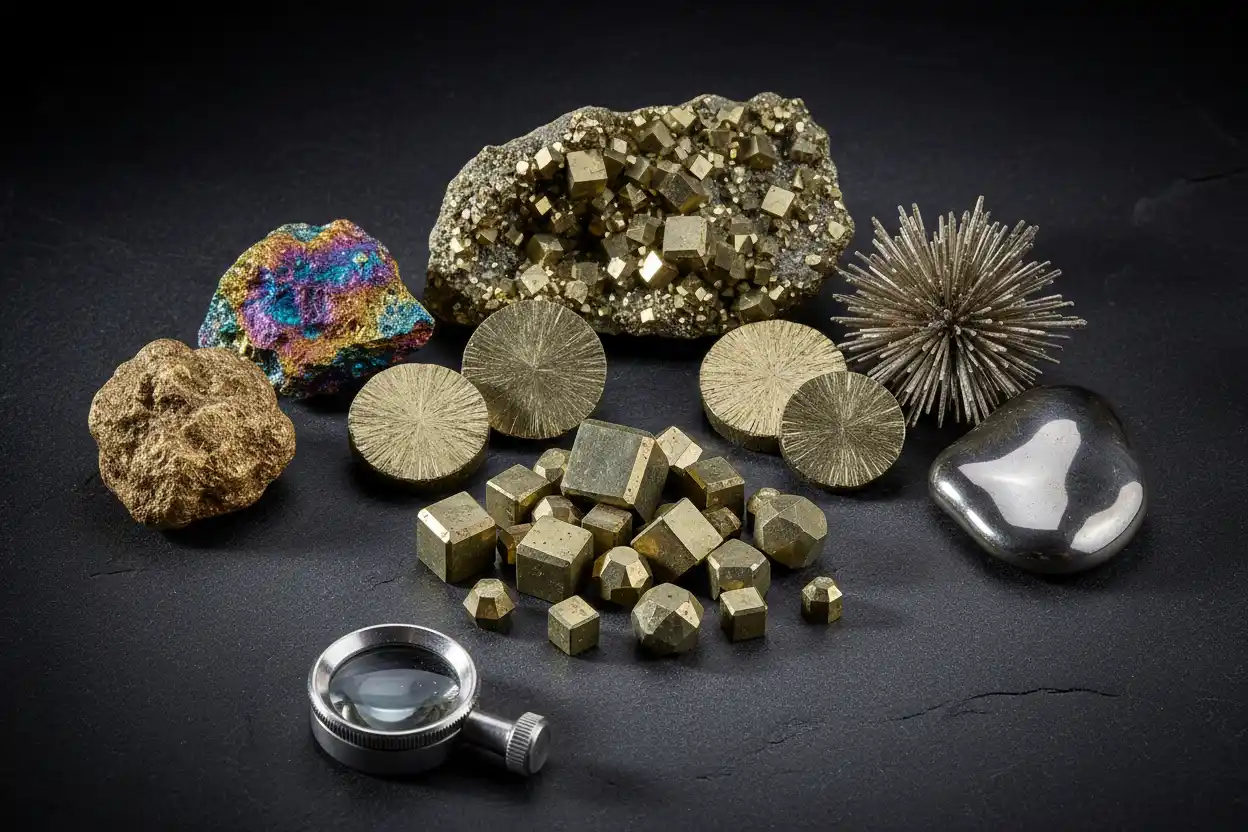
Real Pyrite is an iron sulfide mineral with a pale brass-yellow color, metallic luster and distinctive crystal forms. It commonly occurs as cubes, pyritohedra, octahedra, crystal clusters, nodules, discs, fossil replacements and granular masses.
Its resemblance to native gold produced the familiar name “fool’s gold.” Nevertheless, Pyrite is not merely a cheap gold imitation. Sharp Spanish cubes, aesthetic matrix specimens, unusually large crystals, pyritized fossils and historic locality pieces form an active collector market of their own.
Buyers may encounter Chalcopyrite, Marcasite, Bornite, metallic glass, coated stone, cast metal, resin composites and reconstructed crystal clusters under Pyrite descriptions. Genuine specimens can also be polished, coated, glued, repaired or artificially iridescent.
The Pyrite meaning and properties guide covers mineral identity and traditional symbolism. This page focuses on sellers, crystal form, condition, treatment, lookalikes, storage and realistic value without duplicating the completed real-versus-fake Pyrite guide.
Pyrite Is Iron Disulfide
Pyrite has the chemical formula FeS2 and crystallizes in the cubic system.
It commonly develops:
- Cubes
- Pyritohedra with twelve pentagonal faces
- Octahedra
- Combinations of several cubic forms
- Radiating discs or “suns”
- Nodules
- Framboidal microscopic aggregates
- Massive granular material
- Fossil replacements
Crystal faces may carry fine parallel striations. On adjacent cube faces, the striation direction often changes because of the mineral’s crystal symmetry.
Pyrite has metallic luster and pale brass-yellow color. Its streak is generally dark greenish-black to brownish-black rather than yellow.
The crystal identification guide provides wider mineral-identification context.
Choose the Product Form Before Shopping
| Pyrite product | Best source | Main buying concern |
|---|---|---|
| Sharp cube specimen | Specialist mineral dealer | Natural crystal form, repair and matrix authenticity |
| Pyritohedron | Fine-mineral dealer | Correct form, edge damage and locality |
| Cluster | Mineral dealer | Glued crystals, coating and matrix reconstruction |
| Pyrite sun or dollar | Geological dealer | Natural sedimentary formation, repair and fragility |
| Pyritized fossil | Fossil or mineral specialist | Genuine replacement, conservation and legal provenance |
| Massive rough | Ore-mineral supplier | Chalcopyrite, Marcasite, weathering and mixed sulfides |
| Tumbled stone | Reputable crystal retailer | Coating, unstable fragments and metallic resin |
| Bead strand | Established supplier | Reconstructed material, cast metal and surface plating |
| Cabochon or carving | Specialist lapidary | Resin stabilization and structural condition |
| “Marcasite” jewelry | Antique or jewelry specialist | Whether the stones are actually cut Pyrite and condition of settings |
Specimen buyers should prioritize crystal form and provenance. Jewelry buyers need clear disclosure of construction, coating and susceptibility to moisture.
Where to Buy Genuine Pyrite
Specialist mineral dealers
A mineral dealer is the strongest source for sharp crystals, classic localities and matrix specimens.
Listings should include dimensions, weight, locality, condition, associated minerals and repair history.
Request photographs of every face and the specimen base. Fresh pale breaks, missing corners and reattached cubes can be difficult to see against reflective surfaces.
Ask whether the specimen shows active oxidation, powdery deposits or an acidic odor. A dealer should not ship unstable material without disclosure.
Gem and mineral shows
Shows allow direct comparison with Chalcopyrite, Marcasite, Bornite, Galena, gold-colored glass and metal castings.
Use a loupe to inspect striations, edges, glue, coatings and oxidation products.
Natural Pyrite feels solid and relatively heavy but not as heavy or malleable as gold. Do not bend, scratch or strike a specimen.
Look at the matrix relationship. A natural cube should enter or rest within a geologically plausible socket rather than sit on a glossy adhesive pad.
Fossil and geological specialists
Pyrite can replace shells, wood, ammonites and other fossils.
A specialist should distinguish complete mineral replacement from a surface coating or metallic paint.
Ask how the fossil has been conserved and whether oxidation has started. Pyritized fossils may require more controlled storage than stable large crystals.
Legal provenance and collection location also matter for scientifically important fossils.
Established online sellers
The online gemstone buying guide covers payment protection, seller identity and return rights.
Request neutral-light images because warm illumination can make Pyrite appear more gold-like.
Ask for close-ups of the base, damaged edges and any white, green, yellow or brown powder.
Confirm how the item will be packed. Heavy cubes can detach from fragile matrix during shipping.
Antique and jewelry dealers
Much jewelry sold as “Marcasite” is set with small faceted Pyrite.
A dealer should identify the metal, stone-setting method, missing stones, corrosion and replacement work.
Vintage pieces may use silver, base metal, adhesive or mixed settings. The historical trade name is acceptable, but material disclosure should explain what the stones actually are.
What Genuine Pyrite Looks Like
Fresh Pyrite is pale brass yellow with a bright metallic luster.
Some specimens develop darker bronze, brown, blue, purple or rainbow tarnish. Tarnish may be natural, environmentally induced or deliberately created.
Crystal faces can be mirror-bright, finely striated, matte or lightly etched.
Sharp cubes are especially common and can appear surprisingly geometric. Their regularity does not make them artificial.
Natural clusters may contain cubes of different sizes, intergrown edges and incomplete faces where crystals contacted one another.
Massive material can be granular or compact. Without visible crystal form, it becomes harder to distinguish from Chalcopyrite, Marcasite and other sulfides.
Pyrite Versus Native Gold
Gold is a metallic element, while Pyrite is an iron sulfide.
Gold is richer yellow, much denser, soft and malleable. A small gold flake bends or deforms rather than shattering.
Pyrite is harder and brittle. It commonly forms geometric crystals and breaks rather than flattening.
Gold generally leaves a yellow streak, while Pyrite’s streak is dark.
These tests can damage specimens, so buyers should rely on professional examination rather than crushing or scratching a finished piece.
A retailer should never describe Pyrite as “raw gold” or “natural gold crystal” unless actual gold has been confirmed.
Pyrite Versus Chalcopyrite
Chalcopyrite is copper iron sulfide and often has a warmer, deeper brass-yellow color.
It is softer than Pyrite and frequently tarnishes in bright blue, purple, pink or green colors.
Many heavily iridescent “Peacock Ore” specimens are treated Chalcopyrite rather than Pyrite.
Pyrite can also tarnish, but its sharp cubes and greater hardness often provide useful clues.
Raman spectroscopy, X-ray diffraction or chemical analysis can separate the minerals safely.
Pyrite Versus Bornite
Bornite is a copper iron sulfide commonly associated with purple, blue and bronze tarnish.
Fresh Bornite is usually darker and less bright yellow than fresh Pyrite.
Retail “Peacock Ore” may consist of Bornite or chemically treated Chalcopyrite. The color alone does not establish either mineral.
A rainbow coating over cube-shaped Pyrite should be described as treated Pyrite when that identity has been confirmed.
Pyrite Versus Marcasite
Marcasite has the same FeS2 composition as Pyrite but a different orthorhombic crystal structure.
Marcasite commonly forms spearhead twins, radiating aggregates, cockscomb structures and nodules rather than Pyrite’s cubes and pyritohedra.
It is generally more prone to deterioration in ordinary collection conditions.
The jewelry trade traditionally uses “Marcasite” for small faceted Pyrite, so mineralogical and commercial terminology differ.
A specimen seller should not use the jewelry convention to label an unidentified sulfide crystal.
Pyrite Versus Galena
Galena is lead sulfide with silver-gray metallic color and very high density.
It commonly forms cubes and can therefore resemble gray or tarnished Pyrite in shape.
Galena is substantially softer and has perfect cubic cleavage. Pyrite is usually brass yellow and lacks Galena’s heavy lead-bearing composition.
Do not perform destructive streak or cleavage tests. Laboratory identification is safer.
Pyrite Versus Hematite
Hematite is iron oxide rather than iron sulfide.
Metallic Hematite appears steel gray or black and commonly leaves a reddish-brown streak.
Pyrite is pale brass yellow with a darker greenish-black or brown-black streak.
The completed guide to buying genuine Hematite covers magnetic ceramic beads and metallic substitutes.
Pyrite Versus Goldstone
Goldstone is manufactured glass containing reflective metallic crystals.
Its sparkle usually consists of numerous evenly distributed points within a brown, blue, green or dark glass body.
Pyrite has an opaque metallic body and natural crystal surfaces rather than glitter suspended inside glass.
Round bubbles, mold seams and uniform sparkle support Goldstone or another manufactured glass.
Cast Metal and Metallic Resin
Cubes, clusters and skull carvings can be cast from metal or molded from resin with metallic powder.
Mold seams, identical repeated shapes and a uniform artificial texture suggest manufacture.
Metal castings may feel heavier than expected and can show tool marks or a plated surface.
Resin composites may contain genuine Pyrite powder or fragments. They should be sold as reconstructed products rather than one natural crystal.
The fake-crystal buyer’s guide provides broader composite checks.
Coated and Iridescent Pyrite
Pyrite can develop natural tarnish after exposure to air and moisture.
Sellers may also apply heat, chemicals, lacquer or metallic coatings to produce or preserve iridescence.
Artificial color can appear unusually uniform across protected and exposed surfaces. It may also pool in recesses or stop at chipped edges.
The completed treated-Pyrite guide owns the detailed treatment workflow.
Treated material can remain attractive, but it should not receive a rare natural-tarnish premium.
Glued Crystal Clusters
Individual cubes may be attached to matrix or assembled into decorative groups.
Inspect every base. Clear or dark adhesive can hide against limestone, shale or metallic crystals.
Natural intergrowth should show crystals penetrating one another or entering plausible matrix pockets.
A repaired original cluster differs from a fabricated arrangement, but both affect value and must be disclosed.
Spanish Pyrite Cubes
Spain is famous for exceptionally sharp Pyrite cubes, particularly material from Navajún in La Rioja.
Fine crystals may sit within pale marl matrix and show precise geometry with fine striations.
Their perfection is natural rather than machined. However, damaged cubes may be reattached, and loose crystals can be placed into fabricated matrix sockets.
A locality premium requires an original label, dealer record or credible supply chain.
Pyrite Suns and Dollars
Pyrite suns are flattened radiating discs commonly associated with coal-bearing shale deposits in Illinois.
Their unusual shape reflects growth within sediment rather than cutting.
These discs can be thin and fragile. Edge repairs, backing and coatings should be disclosed.
An ordinary circular metallic casting should not receive the Pyrite-sun name without natural radiating texture and provenance.
Pyritized Fossils
Pyrite can replace or coat fossil material during burial.
Fine examples may preserve shells, plant structures and other biological detail with a metallic surface.
However, finely divided Pyrite and Marcasite associated with fossils can be especially vulnerable to oxidation.
Ask whether the fossil shows cracking, powdery sulfate deposits or recent conservation work.
Do not soak a pyritized fossil or store it in a humid display case.
Pyrite Oxidation and “Pyrite Disease”
Pyrite can oxidize when exposed to oxygen and moisture. The reaction may produce iron sulfates, sulfuric acid and secondary iron minerals.
Stable large crystals can remain intact for decades under ordinary dry conditions. However, fine-grained, porous, fractured or Marcasite-bearing material may deteriorate more quickly.
Warning signs include:
- White, yellow, green or gray powder
- New cracks or swelling
- Crumbling matrix
- Rust-brown staining
- A sharp acidic or sulfurous odor
- Corrosion on nearby metal or labels
An affected specimen should be isolated from other objects and assessed by a geological conservator.
How to Evaluate a Crystal Specimen
Check whether the crystal form is plausible for Pyrite: cubes, pyritohedra, octahedra or combinations.
Inspect edges for fresh breaks and repaired corners. Then examine the matrix contact for adhesive.
Look for active powder or cracking rather than assuming every dark tarnish is harmful.
Request locality documentation when the specimen carries a premium.
Finally, verify whether any coating was applied to stabilize or brighten the surface.
Buying Massive Rough
Massive Pyrite should show a pale brass-yellow metallic body rather than only a thin gold-colored surface.
Inspect broken areas for mixed Chalcopyrite, Galena, quartz and other ore minerals.
Ask whether the material has shown oxidation during storage and whether it came from an active mine, old stock or weathered waste.
A large heavy block may contain weak granular zones that crumble during cutting.
Buying Tumbled Stones and Carvings
Pyrite is difficult to tumble cleanly because fractured grains, pits and mixed matrix can affect the finish.
A polished object may contain resin or lacquer to bind loose material and prevent tarnish.
Inspect cavities for bubbles and thick filler.
Carvings made from Pyrite-rich composite material should be described differently from objects cut from one solid massive piece.
Buying Beads and Jewelry
Pyrite beads may consist of solid pieces, compressed powder, fragments in resin or metallic-coated substitutes.
Inspect drill holes for a contrasting core and resin.
In jewelry, the traditional “Marcasite” stones are commonly small cut Pyrite pieces. Check for missing stones, tarnished settings and adhesive.
The gemstone hardness chart and toughness-versus-hardness guide explain why Pyrite’s hardness does not prevent brittle fracture.
Avoid prolonged skin moisture, perfume and household chemicals.
Locality and Provenance
Pyrite occurs worldwide in igneous, metamorphic, sedimentary and hydrothermal environments.
Important collector material comes from Spain, Peru, Italy, the United States, China, Romania, Bulgaria and many other regions.
Different localities produce distinctive habits, matrices and associations. Nevertheless, crystal form alone rarely proves a mine.
The ethical crystal sourcing guide provides questions about legal extraction, mining conditions and provenance.
Price and Value
Common small Pyrite clusters and massive pieces are affordable. Fine sharp crystals and important locality specimens can command substantial prices.
Value depends on:
- Crystal sharpness
- Size
- Luster
- Striation quality
- Crystal form
- Matrix aesthetics
- Condition
- Stability
- Repairs
- Coatings
- Locality and provenance
- Historical importance
A smaller undamaged Spanish cube may be more valuable than a large glued cluster.
Similarly, an attractive pyritized fossil can carry value through preservation and provenance rather than metallic brightness alone.
The gemstone pricing guide explains how quality, documentation and restoration affect retail prices.
Questions to Ask the Seller
Ask whether the item is Pyrite, Chalcopyrite, Marcasite, Bornite, cast metal, resin or a composite.
Request locality and the evidence supporting it.
Confirm chemical tarnishing, coating, lacquer, resin, glue and restoration.
Ask whether the specimen has shown powder, cracking or oxidation during storage.
For clusters, request close-ups of every matrix contact. For jewelry, request drill-hole or setting photographs.
Finally, obtain a return policy that permits nondestructive examination.
Professional Identification
Reflected-light microscopy, streak on a sacrificial fragment, hardness, crystal form and density can support identification.
Raman spectroscopy and X-ray diffraction separate Pyrite from Marcasite, Chalcopyrite and other sulfides.
Chemical analysis can confirm iron and sulfur while revealing copper, arsenic, lead or other associated elements.
Microscopy can identify coatings, glue and reconstructed material.
Testing one cube may not identify every mineral in a mixed ore specimen.
Cleaning and Storage
Keep Pyrite dry. Use a soft brush or dry cloth rather than soaking it.
The completed Pyrite cleansing and charging guide offers non-water options for traditional practices.
Avoid steam, ultrasonic cleaning, acids, bleach and household chemicals.
Store stable specimens in a dry environment with good air-quality control. Keep them away from acidic paper, damp wood and vulnerable nearby objects.
If powder or cracking appears, isolate the specimen rather than trying to wash the reaction products away.
Frequently Asked Questions
1. Is Pyrite real gold?
No. Pyrite is iron disulfide, while gold is a metallic element.
2. Why is Pyrite called fool’s gold?
Its pale brass-yellow color and metallic luster can resemble gold superficially.
3. Are perfect Pyrite cubes natural?
Yes. Pyrite naturally crystallizes as exceptionally sharp cubes, pyritohedra and related forms.
4. Is “Marcasite” jewelry made from Marcasite?
Most traditional Marcasite jewelry uses small cut Pyrite stones rather than mineralogical Marcasite.
5. How is Pyrite different from Chalcopyrite?
Chalcopyrite is softer, contains copper and commonly shows warmer yellow color or strong iridescent tarnish.
6. Can Pyrite be artificially rainbow-colored?
Yes. Chemical, heat or coating treatments can create or intensify iridescence.
7. Can Pyrite crystals be glued to matrix?
Yes. Natural specimens may be repaired, while artificial clusters may be assembled. Both require disclosure.
8. What is Pyrite disease?
It is deterioration caused by oxidation of iron sulfides, producing acidic compounds, salts, cracking and crumbling.
9. Should Pyrite be washed in water?
Routine soaking is not recommended, especially for porous, fractured, fossil-associated or unstable specimens.
10. Is Pyrite suitable for everyday jewelry?
It can be worn carefully, but brittleness, moisture, tarnish and construction must be considered.
11. Do ordinary Pyrite cubes need laboratory reports?
Usually not. Testing is more useful for expensive localities, mixed sulfides, treatments and disputed reconstructions.
12. What is the biggest warning sign in a listing?
Be cautious when a perfect cluster shows glossy material beneath every cube or when powdery unstable specimens are sold without a condition report.
Buy the Crystal Form and Its Stability Together
Pyrite’s appeal comes from its natural geometry, metallic luster and varied geological associations. Brightness alone does not determine quality.
The raw-crystals guide, P crystal directory, P gemstone directory and visual gemstone guide provide broader comparison points. Choose a specimen whose identity, repair history and long-term condition are all disclosed.
Safety note: Do not ingest Pyrite or place it in drinking water. Oxidizing specimens can produce acidic compounds, while mixed sulfide ores may contain arsenic, lead, copper or other potentially hazardous elements. Avoid dry cutting and inhaling dust; use professional extraction and suitable protective equipment.