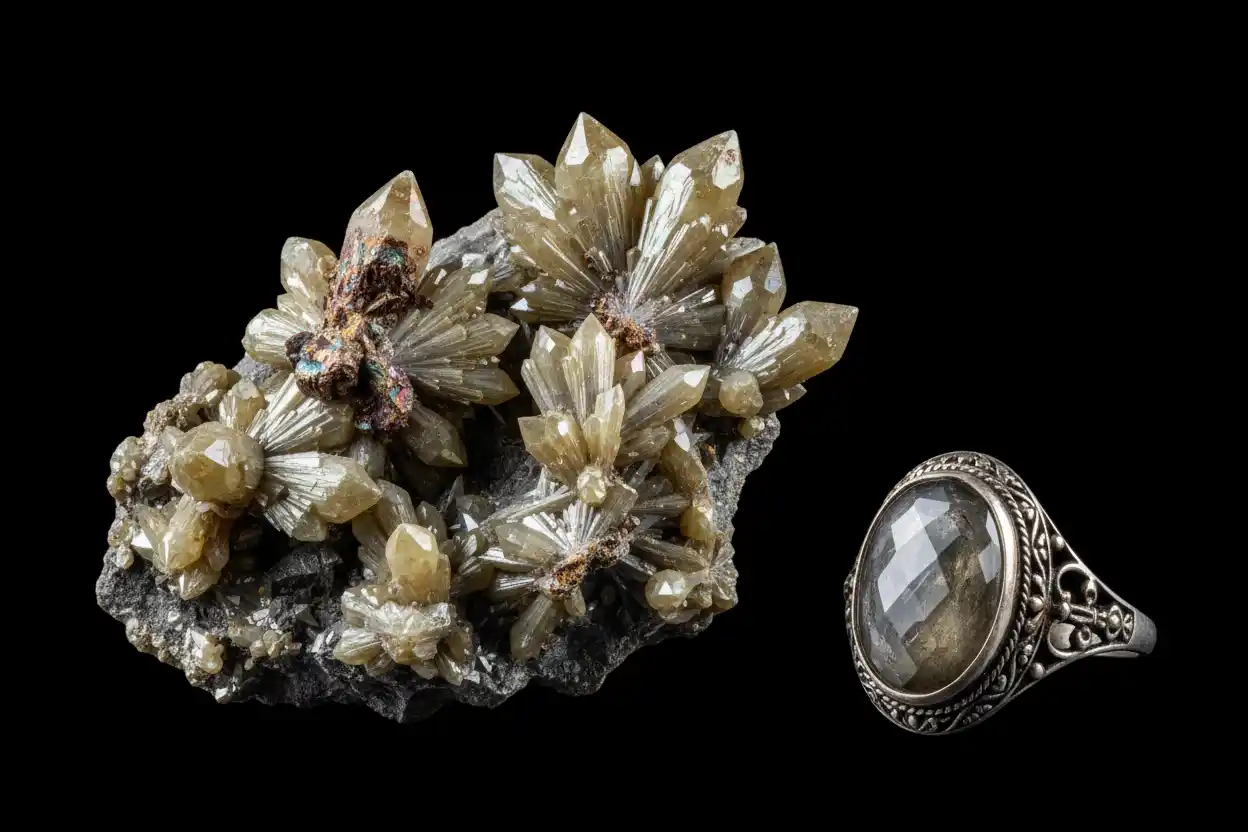
Marcasite: Meaning, Properties & Symbolism
Marcasite is an iron disulfide mineral with the formula FeS₂ and an orthorhombic crystal structure. It shares its chemistry with pyrite, yet the two minerals arrange their atoms differently and develop distinct crystal habits, stability, and practical uses.
The word also creates one of jewelry’s most persistent naming problems. Most items sold as “marcasite jewelry” contain small faceted pieces of pyrite rather than true marcasite, which is too brittle and chemically vulnerable for dependable jewelry use.
Marcasite at a Glance
| Property | True marcasite |
|---|---|
| Material type | Sulfide mineral |
| Composition | Iron disulfide, FeS₂ |
| Relationship | Dimorph of pyrite |
| Color | Tin-white, silvery yellow, pale bronze, yellow-brown or iridescent after tarnishing |
| Crystal system | Orthorhombic |
| Habit | Tabular, bladed, spearhead twins, cockscomb clusters, radiating nodules, reniform and massive forms |
| Luster | Metallic |
| Transparency | Opaque |
| Mohs hardness | 6–6.5 |
| Cleavage | Distinct in one direction; traces in another |
| Tenacity | Brittle |
| Fracture | Uneven |
| Specific gravity | About 4.89 |
| Common uses | Mineral specimens, geological collections, fossil replacements; rarely true gem use |
| Main care concern | Oxidation, humidity, acidic decay products, crumbling, and contamination of nearby objects |
Marcasite and Pyrite Have the Same Formula
Both marcasite and pyrite have the formula FeS₂. However, pyrite crystallizes in the cubic system, while marcasite crystallizes in the orthorhombic system.
Minerals that share a composition but possess different crystal structures are polymorphs. In this specific two-form relationship, mineralogists often describe marcasite and pyrite as dimorphs.
Their structural difference changes their outward forms. Pyrite commonly develops cubes, pyritohedra, and octahedra. Marcasite instead forms tabular crystals, spearhead twins, radiating clusters, and comb-like aggregates.
The distinction also affects stability. Pyrite can oxidize, particularly when fine-grained or porous, but marcasite frequently proves even more vulnerable in humid collections.
Because chemistry alone cannot separate them, reliable identification must also consider crystal structure, habit, optical behavior, and analytical testing.
How Marcasite Forms
Marcasite commonly develops under low-temperature, acidic conditions. Sedimentary rocks, coal beds, chalk, limestone, shale, and low-temperature hydrothermal veins provide characteristic environments.
In sedimentary settings, marcasite can form nodules, concretions, radiating masses, and replacements of shells or other fossil material. Acidic pore fluids favor its formation relative to pyrite under certain conditions.
Hydrothermal solutions may deposit marcasite in veins alongside calcite, dolomite, quartz, fluorite, galena, sphalerite, pyrrhotite, and pyrite. Changes in fluid chemistry can produce intergrowths or replacement textures between several sulfides.
Marcasite also forms secondarily through alteration of minerals such as pyrrhotite or chalcopyrite. Therefore, a specimen may contain more than one iron sulfide even when a seller provides a single name.
Recognizable Crystal Habits
Cockscomb marcasite consists of repeated tabular crystals arranged in fan-like or comb-like groups. Curved surfaces and repeated twinning can give these clusters a distinctive serrated outline.
Spearhead twins form pointed, angular shapes created by twinning on characteristic crystallographic planes. These habits contrast strongly with the cubes associated with pyrite.
Radiating nodules can show fibrous or bladed crystals spreading outward from a center. When split or polished, such nodules may reveal sunburst patterns.
Reniform and stalactitic masses develop rounded, kidney-shaped, or hanging forms. Fine-grained examples may lack obvious crystals and require analytical work for confirmation.
Fresh marcasite often looks tin-white or pale bronze rather than richly brassy gold. Exposure to air can darken it or produce yellow, brown, blue, or iridescent tarnish.
Important Marcasite Localities
The Joplin district of Missouri and nearby mining areas in Oklahoma and Kansas have produced notable marcasite associated with Mississippi Valley-type lead and zinc deposits.
Cap Blanc-Nez in northern France and chalk deposits near Dover and Folkestone in England are known for nodules and sharp crystals formed in sedimentary environments.
German localities include Clausthal in the Harz Mountains and mining districts around Freiberg and Annaberg in Saxony. The Czech Republic has also produced marcasite from several sedimentary and mining districts.
Other documented sources include Santa Eulalia in Chihuahua, Mexico; Llallagua in Bolivia; Tavistock in Devon, England; and Akita Prefecture in Japan.
Modern commercial specimens are also offered from Pakistan and other countries. However, mixed pyrite-marcasite specimens and incorrect labels occur frequently, so locality information should accompany a clear mineral identification.
How to Identify True Marcasite
Crystal habit offers the most useful initial clue. Orthorhombic spearheads, cockscombs, bladed groups, and radiating nodules support marcasite, while perfect cubes strongly support pyrite.
Color can help but does not prove identity. Fresh marcasite usually appears paler and more silvery than typical pyrite, although tarnish and surface alteration create overlap.
Both minerals have metallic luster, dark streaks, similar hardness, and high density. Therefore, scratch testing or heft alone rarely settles the distinction.
Marcasite’s hardness of 6–6.5 may seem substantial, but hardness only measures scratch resistance. Its brittleness and tendency to degrade make it far less durable than the number suggests. The distinction appears more clearly in the gemstone hardness chart and hardness-versus-toughness guide.
Raman spectroscopy and X-ray diffraction provide dependable separation because they reveal different structures. Reflected-light microscopy can also show strong optical anisotropy in marcasite, whereas pyrite behaves differently.
The procedures in how to identify crystals help determine when visual clues are sufficient and when laboratory confirmation becomes necessary.
Why “Marcasite Jewelry” Usually Contains Pyrite
The jewelry use of the word predates the strict modern mineralogical distinction between marcasite and pyrite. Historically, related iron sulfides shared overlapping names.
Today, marcasite jewelry generally uses small pieces of pyrite cut with flat backs and faceted tops. Jewelers set or cement these stones into silver, steel, or other pale metals to create a dark metallic sparkle.
True marcasite is unsuitable for the same role because it can split, crumble, tarnish, and oxidize. Consequently, a seller describing an antique silver brooch as “marcasite” is usually using an accepted jewelry style name rather than making a precise mineral identification.
This does not automatically mean the jewelry is fake. It means that the trade name and mineral species differ.
Pyrite-set marcasite jewelry became especially associated with intricate brooches, earrings, rings, buckles, watches, and geometric silver designs. Nevertheless, age, metal purity, maker, workmanship, and condition usually contribute more value than the small pyrite stones.
Marcasite, Pyrite, and Chalcopyrite
Pyrite has a brighter brassy-yellow appearance and frequently forms cubes or pyritohedra. It is the normal material behind jewelry sold under the marcasite name.
Marcasite tends to appear paler, more silvery, and more strongly associated with bladed or twinned forms. However, altered surfaces can obscure those differences.
Chalcopyrite contains copper as well as iron and sulfur, with the formula CuFeS₂. It is softer than pyrite and marcasite and often develops strong purple, blue, or rainbow tarnish.
Artificially enhanced “peacock ore” is frequently acid-treated chalcopyrite or pyrite. Iridescence alone therefore cannot prove marcasite.
Where pyrite identification affects a purchase, the dedicated guide to real versus fake pyrite covers manufactured substitutes, altered surfaces, and misleading labels in greater detail.
Why Marcasite Can Decay
Oxygen and moisture can oxidize iron sulfides. The resulting reactions may produce iron sulfates, sulfuric acid, and other corrosive products.
Early warning signs include a sulfurous or acidic odor, pale powder, yellow or white crusts, brown staining, new cracks, swelling, and crumbling. Paper labels and cardboard boxes may also discolor.
Fine-grained, porous, fractured, or compositionally impure specimens often deteriorate faster than dense, well-crystallized material. However, stability varies enough that two visually similar pieces may age differently.
Once oxidation begins, acidic products can accelerate further damage. They may also corrode storage hardware and harm nearby minerals, fossils, labels, and jewelry.
For that reason, collectors should isolate a deteriorating specimen rather than leaving it in direct contact with the rest of a collection.
Storing True Marcasite Specimens
Keep marcasite in a cool, dry environment with stable humidity. Avoid bathrooms, kitchens, damp basements, window ledges, and cabinets against uninsulated exterior walls.
A dry sealed container with an appropriate desiccant can help protect vulnerable material. However, the desiccant requires monitoring and replacement because a saturated packet no longer controls moisture.
Use acid-free labels and inert storage materials. Do not store marcasite directly on cardboard, wood, cotton wool, or reactive metals if decay has begun.
Inspect specimens periodically under good light. Early isolation is easier than managing extensive acidic contamination.
Do not apply household varnish, oil, wax, or corrosion inhibitor without conservation advice. Coatings may trap moisture, alter scientific value, or hide continuing deterioration.
A museum conservator or experienced mineral specialist should assess important historical, fossil-bearing, or actively degrading specimens.
Jewelry Suitability
True marcasite is not a practical jewelry stone. Even an apparently solid crystal can fracture during cutting, setting, or wear.
By contrast, pyrite-set marcasite jewelry can function well when the stones remain secure and the piece stays dry. Small stones often sit in recessed settings or adhere with cement, so impact and soaking can loosen them.
Rings and bracelets receive more wear than brooches, earrings, or pendants. Missing stones, bent settings, degraded adhesive, and tarnished metal commonly affect older pieces.
A jeweler familiar with antique silver should perform repairs. Modern replacement stones may differ in size, color, facet style, or backing from the original pyrite.
Treatments, Coatings, and Imitations
True marcasite specimens usually receive no accepted gem treatment. Some sellers clean them mechanically or chemically, although aggressive cleaning can expose fresh reactive surfaces or remove scientifically useful alteration.
Clear coatings sometimes appear on unstable specimens. While a coating may slow short-term moisture exposure, it can also yellow, crack, trap contaminants, and complicate later conservation.
Pyrite used in marcasite jewelry may receive polishing, coatings, or adhesive backing. Silver settings may also receive oxidized finishes that increase contrast around the stones.
Glass, steel, molded resin, and other metallic-looking materials can imitate faceted pyrite. Repeated identical facets, bubbles, peeling coatings, low weight, and magnetic response may provide clues, although none proves identity alone.
Common enhancement and coating practices are explained in gemstone treatments. Pyrite-specific alterations belong on the dedicated treated pyrite guide.
Current Marcasite Asking Prices
True mineral specimens and jewelry sold under the marcasite style name occupy separate markets.
| Product type | Broad retail asking range |
|---|---|
| Small true or purported marcasite specimen | About $10–$40 |
| Attractive miniature specimen | About $30–$100 |
| Medium display specimen with good habit | About $75–$250 |
| Fine, rare, or documented locality specimen | About $200–$500 or more |
| Simple modern sterling “marcasite” jewelry | About $25–$100 |
| Vintage sterling brooch, pendant, or earrings | About $40–$200 |
| Large, signed, or high-quality antique jewelry | About $150–$1,000 or more |
| Replacement faceted pyrite stones | Usually inexpensive, depending on cut and quantity |
These are current asking ranges rather than formal appraisals. Some online “marcasite” specimens are actually pyrite, pyrite-marcasite mixtures, or material identified only by a supplier.
Anyone shopping primarily for pyrite rather than true orthorhombic marcasite can use the dedicated pyrite buying guide for seller and authenticity criteria.
What Determines Value?
A true marcasite specimen gains value from recognizable crystal habit, luster, condition, locality, association, and stability. Sharp spearheads or balanced cockscomb groups usually attract more interest than damaged massive material.
Verified provenance matters because some historic mines and sedimentary localities produce characteristic forms. An old collection label can therefore add scientific and collector significance.
Active oxidation reduces value sharply unless the specimen has exceptional research or historical importance. Crumbling surfaces, acidic residue, and lost crystal edges also raise conservation costs.
For jewelry, the word marcasite describes the style rather than the true mineral. Metal purity, maker’s marks, design period, condition, completeness, and quality of setting determine most of the price.
A signed Art Deco silver piece can command far more than a larger unsigned item because the pyrite stones themselves remain relatively inexpensive.
Buying Marcasite
Decide whether you want a true mineral specimen or jewelry sold under the historical style name. Those are fundamentally different purchases.
For a specimen, request clear photographs of crystal habit, matrix, damaged areas, and any powder or staining. Ask whether the identification has been confirmed or whether the material may contain pyrite.
Avoid pieces showing obvious active decay unless you understand conservation requirements. A low price may not compensate for contamination risk.
For jewelry, assume the metallic stones are pyrite unless laboratory documentation states otherwise. Inspect every recess for missing stones and check that no glue appears soft, yellow, or excessive.
Look for silver fineness marks and maker’s marks, but remember that marks can be worn, altered, or imitated. An experienced jeweler can evaluate construction and metal content.
Marcasite belongs in the crystals beginning with M directory and the gemstones beginning with M directory, although true specimens serve collectors more often than jewelers.
Cleaning Marcasite Jewelry and Specimens
Do not wash a true marcasite specimen. Water and humidity can accelerate oxidation, especially in fractured, fine-grained, or already unstable material.
Remove loose surface dust with a soft dry brush while wearing suitable protection if the specimen shows powdery decay. Avoid vigorous brushing that dislodges crystals or spreads acidic residue.
For pyrite-set marcasite jewelry, use a soft dry cloth. A barely damp cotton swab may clean intact metal away from the stones, but the piece should be dried immediately.
Never soak antique marcasite jewelry. Water can attack pyrite, adhesive, backing, and hidden corrosion beneath the stones.
Avoid ultrasonic machines, steam, silver dip, acidic polish, and abrasive paste. A professional should clean heavily tarnished silver because aggressive polishing can loosen or remove the tiny settings.
The general water-safety guide for crystals reinforces why sulfide minerals and assembled jewelry need conservative care.
Marcasite Meaning and Symbolism
Modern crystal traditions associate marcasite with mental organization, discipline, courage, persistence, and the ability to recognize structure within a complicated situation.
Its pale metallic luster has also inspired symbolism involving reflection, discernment, and seeing beyond appearances. That last interpretation fits the material particularly well because marcasite and pyrite share chemistry while expressing different structures.
Collectors may find a more concrete symbolism in preservation. A stable specimen requires awareness of environment, change, and the consequences of neglect.
These interpretations remain spiritual or personal. Scientific evidence does not show that marcasite creates protective fields, improves health, or produces guaranteed psychological effects.
Frequently Asked Questions
Is marcasite the same mineral as pyrite?
No. Both have the formula FeS₂, but marcasite is orthorhombic and pyrite is cubic. Their structures, crystal habits, and stability differ.
Does marcasite jewelry contain real marcasite?
Usually not. Most marcasite jewelry contains small faceted pyrite stones set into silver or another pale metal.
Why does true marcasite sometimes crumble?
Moisture and oxygen can trigger oxidation that produces iron sulfates and sulfuric acid. These products crack and weaken the specimen.
What crystal shapes does marcasite form?
Typical forms include tabular crystals, spearhead twins, cockscomb clusters, radiating nodules, reniform masses, and fossil replacements.
How can I separate marcasite from pyrite?
Crystal habit provides a clue, but Raman spectroscopy or X-ray diffraction gives much stronger confirmation. Cubes indicate pyrite rather than marcasite.
Where is collectible marcasite found?
Documented sources include the central United States, northern France, England, Germany, the Czech Republic, Mexico, Bolivia, and Japan.
Can true marcasite be set in jewelry?
It is technically possible but impractical. Brittleness, oxidation, and instability make true marcasite unsuitable for dependable jewelry.
Should marcasite be placed in water?
No. Water and humidity can accelerate oxidation, and soaking can damage jewelry adhesives and metal settings.
How should vintage marcasite jewelry be cleaned?
Use a soft dry cloth and avoid soaking, steam, ultrasonic equipment, silver dip, and abrasive polish. Seek professional help for extensive tarnish.
Does tarnish mean a marcasite specimen is fake?
No. Natural marcasite can tarnish. However, heavy powder, staining, cracks, or sulfurous odor may indicate active decay rather than harmless surface color.
Is marcasite safe to handle?
Stable specimens can be handled briefly, followed by hand washing. Decaying material requires greater caution because acidic powder and sulfur-bearing products may irritate skin and damage nearby objects.
What makes a marcasite specimen valuable?
Sharp crystal habit, luster, condition, locality, matrix aesthetics, documentation, rarity, and long-term stability determine collector value.
True marcasite is best appreciated as a structurally distinctive and sometimes challenging mineral specimen. For jewelry carrying its name, understanding the properties of pyrite and its common imitations provides the more practical buying foundation.
Do not ingest marcasite, make mineral-infused drinking water with it, or handle actively decaying material with bare hands. Isolate powdery specimens, avoid inhaling dust, wash after handling, and seek conservation advice when acidic deterioration is visible.