Types of Fluorite: Colors and Varieties Explained
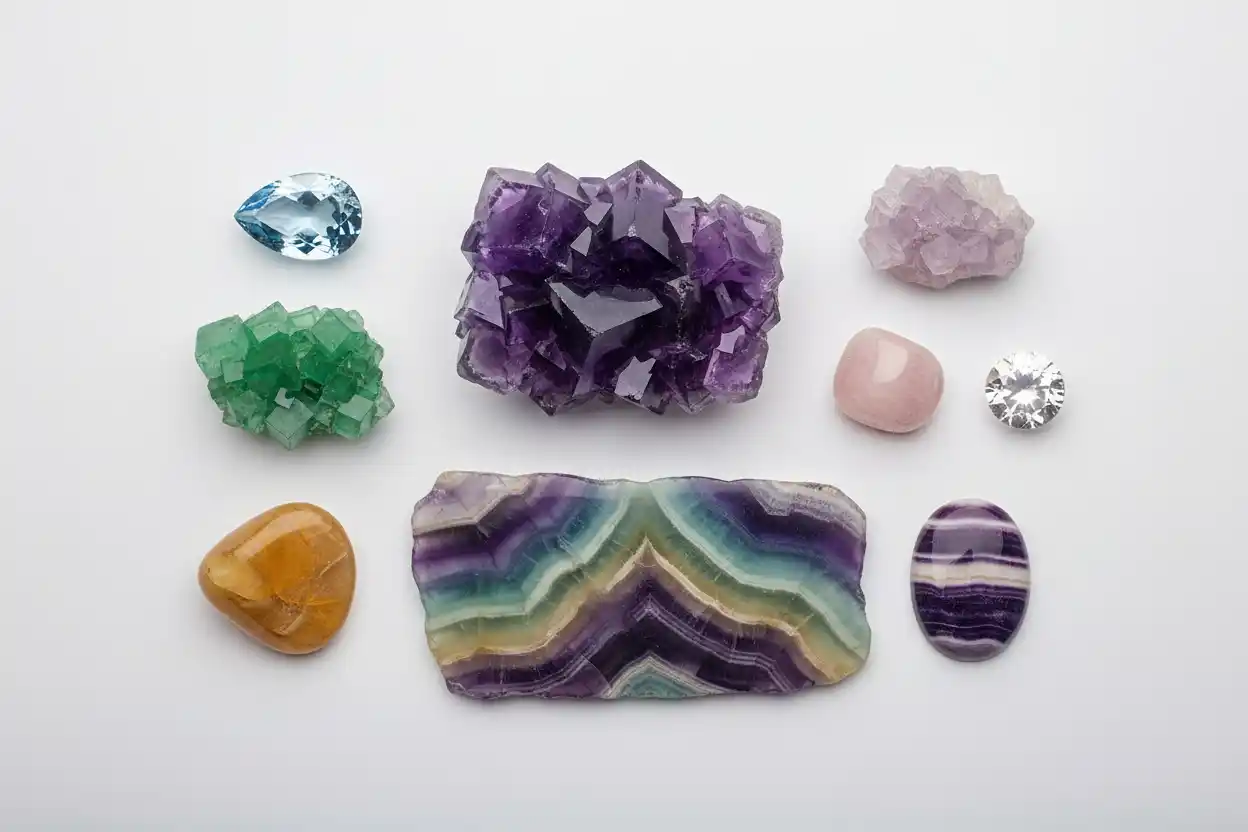
Fluorite is calcium fluoride, but few minerals display such a broad range of colors, zoning patterns, crystal forms, fluorescence responses, and locality-specific appearances. Transparent cubes may be deep purple, sea green, golden yellow, electric blue, or almost colorless, while massive fluorite can form banded ornamental material in several contrasting shades.
Most types of fluorite are not separate mineral species. Instead, collectors and gem dealers classify them by color, trace-element chemistry, color centers, fluorescence, crystal habit, texture, and origin. The main fluorite meaning and properties guide covers the mineral as a whole, while this guide focuses on its principal varieties and trade categories.
Fluorite at a Glance
| Property | Fluorite |
|---|---|
| Composition | Calcium fluoride, CaF₂ |
| Mineral group | Halide minerals |
| Main colors | Colorless, purple, violet, lilac, blue, green, yellow, orange, pink, red, brown, gray, and black |
| Crystal system | Cubic |
| Typical habit | Cubes, octahedra, modified cubes, interpenetrant twins, granular masses, banded material, and rare botryoidal forms |
| Luster | Vitreous |
| Transparency | Transparent to translucent; occasionally opaque |
| Mohs hardness | 4 |
| Cleavage | Perfect octahedral cleavage in four directions |
| Tenacity | Brittle |
| Common uses | Mineral specimens, collector faceted gems, carvings, ornamental objects, optics, metallurgy, and fluorochemical production |
| Main care concern | Easy scratching, perfect cleavage, chipping, heat sensitivity, and damage from ultrasonic or steam cleaning |
How Fluorite Types Are Classified
Fluorite varieties can be organized in several overlapping ways.
Color names such as purple fluorite or green fluorite describe visual appearance. Chemical names such as yttrian fluorite indicate unusual trace-element substitution. Locality names such as Blue John refer to material associated with a specific deposit and distinctive banding. Other terms, including chlorophane and antozonite, describe unusual luminescence, color, odor, or physical behavior.
Crystal shape provides another classification. Cubic fluorite, octahedral fluorite, twinned crystals, banded massive fluorite, and botryoidal aggregates may share the same CaF₂ composition while looking entirely different.
Consequently, “type” should not automatically be interpreted as a formally recognized mineral variety. The broader types of gemstones guide explains the difference between a mineral species, color variety, locality name, and commercial label.
Colorless Fluorite
Chemically pure fluorite is colorless. Transparent colorless crystals can resemble glass, quartz, calcite, or colorless topaz, although fluorite’s low hardness, perfect cleavage, isotropic optical character, and refractive index separate it from those materials.
Fine colorless fluorite often displays exceptional transparency. However, internal zoning may become visible under ultraviolet light even when no strong body color appears in ordinary illumination.
Colorless crystals may fluoresce blue, violet, cream, yellow, or another color depending on trace elements and structural defects. Fluorescence intensity varies by locality and should not be treated as a universal identification test.
Transparent colorless material can be faceted for collectors, but finished stones abrade quickly and remain unsuitable for exposed daily-wear jewelry.
Purple Fluorite
Purple and violet are among fluorite’s most familiar colors. Shades range from pale lilac and lavender to deep grape, plum, bluish violet, and nearly black purple.
Color commonly results from lattice defects, radiation-related color centers, trace elements, or combinations of these factors. The precise cause can differ among deposits, which is why two similarly colored specimens may behave differently under heat or ultraviolet light.
Purple zoning often follows cubic growth layers. Some crystals have a colorless or pale core enclosed by increasingly dark violet bands, while others display thin purple edges or geometric phantom zones.
Fine purple fluorite is abundant enough to remain affordable, yet certain localities command premiums for exceptional luster, crystal form, association, and provenance. The dedicated purple fluorite guide owns the material-specific symbolism and buying intent.
Purple fluorite can resemble amethyst, particularly after cutting. The focused fluorite versus amethyst guide explains why hardness, cleavage, crystal structure, and optical behavior matter more than color.
Green Fluorite
Green fluorite ranges from pale mint and apple green to emerald green, grass green, blue-green, and deep forest tones.
Trace rare-earth elements, structural defects, and radiation-related processes may contribute to the color. In some deposits, green crystals show distinctive fluorescence or daylight-related color behavior.
Rogerley Mine fluorite from northern England became famous for transparent green cubes that can appear more vivid in daylight or under ultraviolet-rich illumination. Other important green fluorites come from China, Namibia, Morocco, Mexico, Pakistan, and the United States.
Strongly saturated transparent green crystals can be spectacular mineral specimens. Nevertheless, an attractive color alone does not establish locality because several deposits produce similar shades.
The dedicated green fluorite guide retains the variety-specific interpretation, while the related green fluorite buying guide owns seller and authenticity checks.
Blue Fluorite
Blue fluorite is less common than purple or green material and may range from pale sky blue and gray-blue to teal, indigo, and intense electric blue.
Color centers, rare-earth elements, and lattice defects can all play a role. Some blue crystals shift toward violet or green under different illumination or viewing conditions.
Highly transparent blue fluorite is prized for faceting and specimen collecting. However, dark material may lose its apparent blue color in thick crystals or poorly proportioned cuts.
Blue fluorite can resemble blue topaz, aquamarine, sapphire, glass, or blue calcite. Fluorite’s hardness of 4 and perfect octahedral cleavage provide important distinctions, although destructive scratch testing should never be used on finished gems.
Yellow and Golden Fluorite
Yellow fluorite ranges from pale lemon and straw yellow to honey, golden, amber, and brownish yellow.
Some crystals display yellow cores beneath purple, green, or blue outer zones. Others form clean golden cubes or transparent octahedra.
Iron, rare-earth elements, color centers, and natural irradiation may contribute to yellow coloration. The exact mechanism depends on deposit chemistry and crystal history.
Well-cut golden fluorite can be bright and attractive, yet it remains a collector stone because facet edges scratch and chip readily. Dark honey-colored material may also show reduced brilliance if the cut is too deep.
The planned yellow fluorite guide retains the color-specific search intent without duplicating the broader classification provided here.
Pink and Red Fluorite
Pink fluorite is uncommon and especially desirable when it forms sharp transparent octahedra or complex crystal groups.
Alpine deposits are strongly associated with pink fluorite, including material from Switzerland, France, Pakistan, and other mountain regions. Fine crystals may occur with quartz, adularia, calcite, or feldspar.
Colors range from soft blush and rose to raspberry and pinkish red. Some pieces appear more intense under warm illumination.
True red fluorite is rarer and may lean toward burgundy, wine, or red-purple rather than pure scarlet. Because online photographs often exaggerate saturation, important pink or red specimens should be evaluated under neutral lighting.
Pink fluorite is usually worth more intact as a crystal than cut into a gem, particularly when it retains a sharp octahedral form and documented alpine provenance.
Orange, Brown, Gray, and Black Fluorite
Orange fluorite may appear peach, apricot, amber-orange, or reddish brown. It commonly overlaps with yellow and brown categories.
Brown and gray fluorite can result from color centers, inclusions, radiation damage, or mixed mineral matter. Although these colors attract less mainstream jewelry demand, well-formed crystals from classic mining districts remain collectible.
Very dark purple, gray, or black fluorite may transmit color at thin edges. Some black material is associated with antozonite or fetid fluorite, although not every dark crystal belongs to that category.
The value of dark fluorite depends more on crystal form, rarity, association, fluorescence, and provenance than conventional gem brightness.
Rainbow Fluorite
Rainbow fluorite displays two or more colors in visible zones or bands. Purple, green, blue, yellow, and colorless layers are particularly common.
The bands record changes in fluid chemistry, temperature, trace-element availability, radiation environment, and growth conditions while the crystal developed.
Some rainbow fluorite shows sharp cubic phantoms. Other material has softer stripes, chevrons, or broad bands suitable for slabs, spheres, carvings, and cabochons.
Color zoning can reduce the value of a conventional faceted stone if it creates an unbalanced face-up appearance. In specimens and carvings, however, zoning is often the primary source of beauty.
The dedicated rainbow fluorite guide covers its symbolism, while the rainbow fluorite buying guide handles treatment and seller questions.
Blue John Fluorite
Blue John is a historically important banded fluorite associated with the Castleton area of Derbyshire, England.
The material typically shows purple-blue, violet, yellow, cream, and white bands. Its name has several proposed origins, but it is now strongly tied to Derbyshire ornamental fluorite.
Blue John occurs in veins and cavities within Carboniferous limestone. Mining produced enough material for bowls, vases, panels, jewelry, inlay, and decorative objects, although large sound pieces have always been limited by fractures and cleavage.
Its purple and yellow colors may fade or alter when exposed to excessive heat during cutting and repair. Traditional workers therefore developed careful methods of stabilization, backing, and polishing.
Authentic Derbyshire provenance adds substantial importance. Generic blue-and-yellow banded fluorite from another country should not be marketed as Blue John.
Yttrian Fluorite
Yttrian fluorite contains appreciable yttrium substituting for part of the calcium. The term may also appear as yttrium-bearing fluorite or yttrofluorite in older mineralogical and commercial literature.
Material is often pale lavender, purple, gray, cream, yellow, or greenish, although color alone does not prove elevated yttrium.
The substitution can influence specific gravity, fluorescence, crystal form, and association with rare-earth mineral deposits. Many yttrian fluorites occur as massive or imperfectly crystallized material rather than transparent gem crystals.
A laboratory analysis is required to confirm meaningful yttrium content. Sellers should not apply the term solely because a specimen is lavender or comes from a rare-earth locality.
The planned yttrian fluorite guide owns its dedicated chemistry and symbolism intent.
Chlorophane
Chlorophane is a fluorite variety or descriptive category known for thermoluminescence. When gently warmed, some examples emit visible green, blue-green, or bluish light.
The glow comes from trapped energy associated with defects and impurities in the crystal lattice. Heat releases that energy as visible light.
Repeated heating may weaken or exhaust the response, and excessive heat can crack or permanently alter the specimen. Owners should not test valuable chlorophane with a flame, hot plate, oven, or other uncontrolled heat source.
The name has been applied inconsistently to several greenish or luminescent fluorites. A green body color alone does not establish chlorophane behavior.
Antozonite and Fetid Fluorite
Antozonite, often called fetid fluorite, is a dark fluorite that can release a distinctive odor when crushed or fractured.
Radiation damage and chemical reactions within the material may generate reactive fluorine-bearing species and other compounds associated with the smell. The phenomenon is principally of mineralogical interest.
Breaking a specimen to test for odor destroys it and can create sharp fragments and dust. Therefore, the term should be used from established locality or analytical evidence rather than a home fracture test.
Antozonite is typically dark violet, blackish, or opaque and usually serves as specimen material instead of a lapidary gem.
Fluorite Crystal Habits
Fluorite’s cubic crystal system produces some of the mineral world’s most recognizable geometric forms.
Cubic Fluorite
Cubes are the most common habit. Faces may be smooth, frosted, stepped, etched, or covered with smaller growth features.
Cubic zoning often appears as nested squares when a crystal is viewed through a face. Modified cubes may include small octahedral or dodecahedral faces at corners and edges.
Octahedral Fluorite
Natural octahedra have eight triangular faces. Fluorite’s perfect cleavage can also produce octahedral fragments, so not every loose octahedron represents a naturally terminated crystal.
Collectors distinguish natural growth faces from cleavage surfaces through luster, texture, edge relationships, and context.
Twinned Fluorite
Interpenetrant twins, especially spinel-law twins, can form complex paired cubes. Twinning may create notched, symmetrical, or seemingly interlocked crystal shapes.
Well-formed twins are particularly desirable when both individuals remain intact and clearly visible.
Botryoidal, Stalactitic, and Massive Fluorite
Botryoidal fluorite forms rounded grape-like surfaces. Stalactitic material grows as hanging or columnar deposits, while massive fluorite fills veins and replacement bodies without forming distinct external crystals.
Banded massive fluorite supplies carving rough, decorative slabs, and industrial ore.
Fluorescent Fluorite
The term fluorescence was derived from fluorite because certain specimens glow strongly under ultraviolet radiation.
Blue and violet fluorescence are common, frequently associated with europium-related activators. Green, yellow, cream, red, and white responses also occur.
Not every fluorite fluoresces, and two specimens from the same locality may differ substantially. Long-wave and short-wave ultraviolet lamps can produce different colors and intensities.
Some fluorite also exhibits phosphorescence, continuing to glow briefly after the ultraviolet source is removed. Thermoluminescence and triboluminescence represent separate phenomena.
Fluorescence adds collector interest but should never serve as the only identity test.
Fluorite Formation and Geology
Fluorite commonly forms from hydrothermal fluids moving through fractures, faults, carbonate rocks, and ore-bearing veins.
It frequently occurs with calcite, barite, quartz, dolomite, galena, sphalerite, pyrite, chalcopyrite, and other hydrothermal minerals. Changes in fluid temperature and chemistry cause calcium and fluoride to combine and precipitate.
Carbonate-replacement deposits can contain enormous masses of industrial fluorspar. Pegmatites, granites, alkaline complexes, skarns, and sedimentary environments provide additional occurrences.
Color zoning reflects repeated fluid pulses and changes during growth. Etched faces and dissolved edges may record later corrosive fluids after a crystal had already formed.
Major Fluorite Localities
China and Mexico are major industrial and specimen-producing countries. Chinese deposits have supplied purple, green, blue, yellow, and multicolored crystals in a wide range of habits.
Mexico produces transparent collector crystals, massive carving material, and major fluorspar ore. Morocco has become known for colorful cubes, octahedra, and combinations with barite, calcite, quartz, and sulfide minerals.
The United Kingdom is important for Blue John and green daylight-responsive fluorite from northern England. Historic mines in Illinois produced some of the world’s most celebrated purple, blue, yellow, and multicolored crystals.
Pakistan supplies alpine-style pink, purple, blue, and green fluorite, often associated with quartz or feldspar. Namibia, Spain, Germany, France, Switzerland, South Africa, Canada, Russia, and the United States also provide notable collector material.
Locality claims should be supported by labels, collection history, or reliable dealer records. Color and crystal shape alone rarely prove origin.
Fluorite Mining Context
Industrial fluorite is called fluorspar and is graded according to chemical purity and intended use.
Acid-grade fluorspar supplies hydrofluoric acid and fluorochemicals. Metallurgical-grade material acts as a flux, while ceramic-grade fluorite enters glass, enamel, and related manufacturing.
Industrial ore is commonly crushed, concentrated, and processed rather than preserved as crystals. Collector specimens survive when miners identify attractive pockets and remove them carefully before bulk extraction.
The value of a specimen may therefore have little connection to the bulk price of fluorspar. A museum-quality crystal group can be worth thousands of dollars even though ordinary ore sells by weight as an industrial commodity.
Inclusions and Internal Features
Fluorite may contain fluid inclusions, growth tubes, mineral crystals, healed fractures, cleavage feathers, color phantoms, and suspended particles.
Inclusions of pyrite, chalcopyrite, galena, quartz, calcite, hydrocarbons, and other materials can create attractive or scientifically important specimens.
Internal fractures are especially relevant to faceting because they may connect with fluorite’s cleavage directions. A stone that appears intact can split under polishing or setting pressure.
Color phantoms increase specimen value when their geometry remains visible and balanced. In a faceted stone, the same feature may create uneven face-up color.
How Fluorite Is Identified
Fluorite defines Mohs hardness 4 and scratches much more easily than quartz, amethyst, topaz, or sapphire. The gemstone hardness chart places it among the softer commonly collected minerals.
Its perfect cleavage produces octahedral fragments. The gemstone cleavage guide explains why this directional weakness creates chipping risk even when a crystal appears thick.
Fluorite is singly refractive because it belongs to the cubic system. It has a relatively low refractive index and specific gravity around 3.0–3.3, with some rare-earth-rich varieties becoming denser.
Ultraviolet response, color zoning, crystal habit, and association help support identification but cannot replace optical and physical testing. The crystal identification guide covers a safer evidence-based approach.
Common Lookalikes
Purple fluorite resembles amethyst, glass, scapolite, and synthetic materials. Green fluorite can resemble glass, calcite, tourmaline, beryl, or green quartz.
Colorless fluorite may be confused with calcite, quartz, topaz, and optical glass. Blue material overlaps visually with topaz, aquamarine, and glass.
Calcite is softer and doubly refractive, while quartz is harder and lacks cleavage. Glass may contain bubbles, flow lines, or mold features.
A seller using a color name such as “emerald fluorite” or “sapphire fluorite” is describing appearance, not mineral identity.
Treatments, Synthetics, and Imitations
Routine heat treatment is not central to the fluorite gem market because heat can damage color, cleavage, and transparency.
Irradiation can modify fluorite color, while coatings, dye, oil, resin, and fracture filling may alter lower-quality material. Stabilization is particularly relevant to fractured carving rough and repaired ornamental objects.
Synthetic calcium fluoride is produced for optical and technological applications because high-purity material transmits ultraviolet and infrared wavelengths. Synthetic optical fluorite can be extremely clean and colorless.
Commercial jewelry imitations are more likely to involve glass, resin, dyed calcite, or another inexpensive material than deliberately manufactured gem fluorite.
Treatment terminology is covered in the gemstone treatments guide. Significant collector specimens should disclose repair, glue, reconstructed matrix, polishing, and artificial color.
Cutting Behavior
Fluorite is among the more difficult collector gems to facet successfully.
Perfect cleavage in four directions can cause rough to split during sawing, preforming, polishing, or transfer between dops. Low hardness also allows facet edges to round or abrade before polishing is complete.
Cutters use gentle pressure, careful orientation, fresh laps, controlled speed, and minimal heat. Ovals, cushions, rounds, pears, and freeforms are common because they can avoid weak corners and preserve color zoning.
Large transparent stones may show a window if the pavilion is too shallow. Conversely, overly deep cuts can darken saturated purple, blue, or green material.
Many exceptional crystals should remain uncut. A sharp natural cube, octahedron, twin, or locality specimen often has greater mineral value than the faceted gem it might produce.
Durability and Jewelry Suitability
Fluorite’s hardness of 4 makes it vulnerable to scratches from dust, metal, quartz, and most jewelry gemstones.
Perfect cleavage and brittle tenacity create a second weakness. The difference between scratch resistance and breakage resistance is explained in gemstone toughness versus hardness.
Pendants, earrings, brooches, and protected collector pieces are safer than rings or bracelets. Even in a pendant, the setting should protect the girdle and avoid direct pressure over fractures.
Fluorite is unsuitable for an engagement ring expected to withstand unrestricted daily wear. Replacement can also be difficult when the stone has unusual zoning, color, or provenance.
Fluorite Prices in 2026
Ordinary fluorite remains affordable, but exceptional crystals and precision-cut gems occupy a much higher collector market.
Small tumbled stones, cleavage pieces, and commercial points commonly sell for $2–$20. Attractive palm stones, towers, spheres, and small clusters often range from $15–$100.
Commercial faceted fluorite may sell for approximately $5–$20 per carat. Better transparent green, yellow, purple, blue, or multicolored stones commonly fall around $20–$50 per carat.
Eye-clean precision-cut gems, unusual blue or pink colors, strong color change, exceptional zoning, or documented rare locality material may reach approximately $50–$100-plus per carat. Artistic cutting can raise the price further because labor and cutting risk dominate the cost.
Collector specimens vary from $20 to several hundred dollars for attractive cabinet pieces. Fine Blue John objects, classic Illinois fluorite, Rogerley green cubes, alpine pink octahedra, large transparent twins, and museum-quality combinations may cost thousands or substantially more.
The detailed transaction intent belongs in the fluorite buying guide, while the general gemstone pricing guide explains why provenance, aesthetics, repair history, and rarity can outweigh weight.
Buying Guidance
First determine whether you want a natural crystal, a matrix specimen, a carving, a fluorescent piece, or a faceted collector gem.
For specimens, inspect every corner, termination, cleavage surface, and contact point. Ask whether the crystal has been repaired, glued, reconstructed, acid cleaned, polished, or mounted on artificial matrix.
For faceted stones, request exact dimensions, weight, color under neutral lighting, clarity description, and video showing zoning. A large carat weight does not guarantee a large face-up appearance.
Strong locality claims should come with provenance. “Blue John,” “Rogerley,” “Illinois,” or “alpine pink” carries more meaning than a generic color description.
When purchasing online, follow the safeguards in how to buy gemstones online.
Cleaning Fluorite
Remove loose dust with a bulb blower or very soft brush before wiping the surface. Dust can contain quartz particles that scratch fluorite.
When necessary, use cool-to-lukewarm water, a small amount of mild soap, and minimal pressure. Rinse briefly and dry with a soft lint-free cloth.
Avoid hot water, steam, acids, harsh chemicals, abrasive cleaners, and sudden temperature changes. Ultrasonic vibration can open cleavage fractures, so fluorite should not enter an ultrasonic machine. The broader equipment guidance appears in gemstones in ultrasonic cleaners.
Prolonged soaking is unnecessary, particularly for repaired specimens or composite carvings. The general crystals in water guide explains why brief cleaning and prolonged immersion are different questions.
Sunlight and Storage
Some fluorite colors can fade under prolonged intense ultraviolet-rich sunlight. Dark purple, blue, or green specimens should not be stored permanently on a bright windowsill.
The broader sunlight-fading guide provides conservative display practices.
Wrap faceted stones and polished objects individually. Specimens should sit in padded boxes with enough clearance that crystal corners do not strike the lid or nearby minerals.
Spiritual cleansing practices should avoid salt, heat, prolonged water, direct sunlight, and impact. Safer non-contact approaches appear in the dedicated guide to cleansing fluorite.
Meaning and Symbolism
Modern crystal traditions commonly associate fluorite with organization, concentration, discernment, learning, and the ability to sort through competing ideas.
Purple fluorite is often linked with reflection and intuition, green with renewal and balance, blue with communication, yellow with confidence, and rainbow material with flexibility or integration.
The detailed comparison among colors belongs in the fluorite color meaning guide.
These interpretations arise from modern spiritual practice, color symbolism, and personal experience. Mineralogical science does not demonstrate that fluorite colors produce specific cognitive, emotional, or medical effects.
Frequently Asked Questions
1. How many types of fluorite are there?
There is no fixed number. Fluorite is classified by color, trace chemistry, fluorescence, crystal habit, texture, zoning, locality, and trade name.
2. What is the rarest fluorite color?
Transparent red and vivid natural pink are among the rarest colors. Fine electric-blue material and certain locality-specific colors can also be exceptionally scarce.
3. What is the most common fluorite color?
Purple and violet are among the most widespread collector colors, although green, yellow, colorless, and multicolored fluorite are also common.
4. Is rainbow fluorite a separate mineral?
No. Rainbow fluorite is ordinary CaF₂ with visible layers or zones of different colors produced during changing growth conditions.
5. What makes Blue John different from other fluorite?
Blue John is a locality-linked banded ornamental fluorite from Derbyshire, England, known for purple-blue, yellow, cream, and white patterns.
6. Is yttrian fluorite always lavender?
No. Yttrium-bearing fluorite can be lavender, purple, gray, yellow, greenish, cream, or another color. Chemical analysis is required for confirmation.
7. Does every fluorite glow under ultraviolet light?
No. Fluorescence varies with trace elements, defects, locality, and ultraviolet wavelength. Some specimens glow strongly, while others show little or no response.
8. Is an octahedral fluorite always a natural crystal?
No. Perfect cleavage can split fluorite into octahedral fragments. Natural growth faces and cleavage surfaces have different textures and relationships.
9. Can fluorite change color?
Some fluorites shift in appearance under different light sources or ultraviolet-rich daylight. Other color changes result from fading, heat, irradiation, or treatment.
10. Is fluorite suitable for everyday jewelry?
No. Hardness 4, perfect cleavage, and brittleness make it vulnerable to scratches and chips. Protected occasional-wear pendants or earrings are safer.
11. Is synthetic fluorite available?
High-purity synthetic calcium fluoride is manufactured for optical and technical uses. Gem-market imitations are more commonly glass or resin.
12. Why are some fluorite specimens expensive?
Exceptional color, crystal perfection, fluorescence, aesthetics, rare associations, historic locality, old-mine provenance, and lack of repair can create strong collector premiums.
Fluorite’s many “types” record changes in trace chemistry, radiation, hydrothermal fluids, crystal growth, and mining history. A lavender yttrian mass, Derbyshire Blue John slab, green Rogerley cube, pink alpine octahedron, and rainbow-zoned carving remain calcium fluoride, yet each preserves a different geological and cultural story. Additional F entries appear in the crystals that start with F directory and the gemstones that start with F guide.