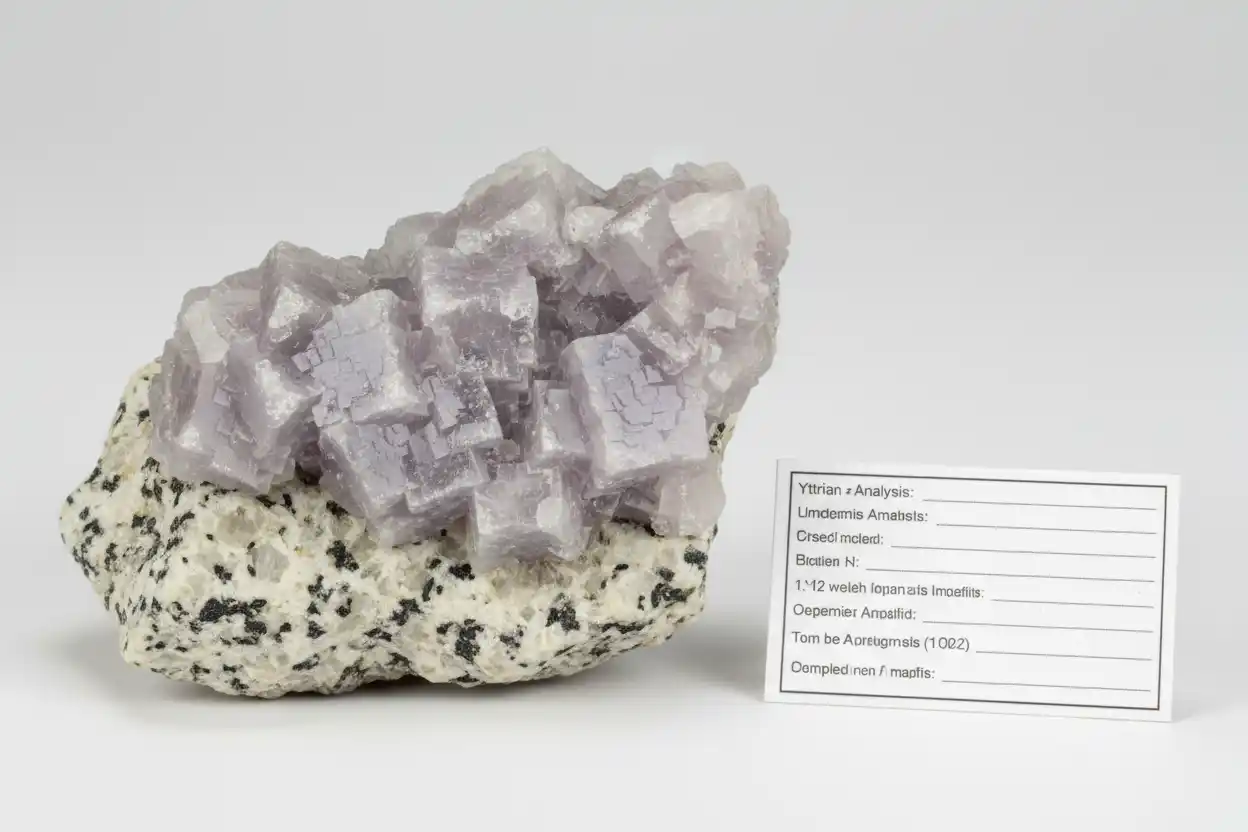
Yttrian Fluorite Meaning, Properties and Identification
Yttrian fluorite is a rare-earth-bearing variety of fluorite in which yttrium replaces part of the calcium within the crystal structure. The name describes chemical composition rather than a guaranteed purple color, locality or metaphysical subtype.
Because ordinary fluorite is frequently marketed as “yttrium fluorite,” credible identification requires chemical analysis rather than color, fluorescence or seller terminology alone. Its broader mineral family is covered in the fluorite meaning guide.
Yttrian Fluorite at a Glance
| Property | Yttrian Fluorite |
|---|---|
| Material type | Yttrium-bearing variety of fluorite |
| General composition | Calcium fluoride with partial yttrium substitution |
| Approximate notation | (Ca₁₋ₓYₓ)F₂₊ₓ, with composition varying by specimen |
| Mineral class | Halide |
| Crystal system | Cubic |
| Common colors | Colorless, gray, pale violet, lilac, brownish, yellowish, greenish and blue-gray |
| Typical habit | Massive, granular, compact, cubic, octahedral or irregular replacement material |
| Luster | Vitreous |
| Transparency | Transparent to opaque |
| Refractive index | Close to fluorite, commonly around 1.43–1.44 |
| Specific gravity | Usually near or slightly above ordinary fluorite, depending on yttrium and other rare-earth content |
| Mohs hardness | 4 |
| Cleavage | Perfect octahedral cleavage in four directions |
| Tenacity | Brittle |
| Common use | Mineral specimens, research material and occasional protected lapidary pieces |
| Main care concern | Very easy cleavage, low scratch resistance and widespread commercial misidentification |
What Is Yttrian Fluorite?
Ordinary fluorite has the formula CaF₂. In yttrian fluorite, trivalent yttrium ions replace some divalent calcium ions.
That substitution creates a charge imbalance. Additional fluorine or related structural adjustments maintain electrical neutrality, which is why the composition may be written in a form such as (Ca₁₋ₓYₓ)F₂₊ₓ rather than as perfectly pure CaF₂.
The amount of yttrium varies. A specimen containing only a trace of yttrium may remain ordinary fluorite in practical nomenclature, whereas appreciable substitution supports the descriptive term yttrian fluorite or yttrofluorite.
Yttrium often occurs with other rare-earth elements. Consequently, chemical analysis may reveal dysprosium, ytterbium, cerium, lanthanum or related elements alongside yttrium.
Yttrian fluorite remains fluorite structurally. It is not a separate crystal family, a synthetic product or a color variety comparable with the materials classified in the types of fluorite guide.
Yttrian Fluorite, Yttrofluorite and Yttrocerite
Yttrian fluorite and yttrofluorite are commonly used for fluorite containing significant yttrium.
Yttrocerite is a historical term for fluorite reported to contain both yttrium and cerium-group rare-earth elements. Early mineralogists created the name before modern chemical instruments could measure trace elements accurately.
Many nineteenth-century specimens labeled yttrocerite or yttrofluorite were later found to be ordinary colored fluorite without exceptional rare-earth enrichment. Therefore, historic labels are useful provenance but not definitive chemical proof.
Modern descriptions should report analytical results whenever possible. A label stating “fluorite with yttrium” is more informative than an unsupported rare-variety name.
Why Color Does Not Identify Yttrian Fluorite
Commercial listings often portray yttrian fluorite as uniformly lavender, purple or lilac. However, yttrium substitution does not produce one mandatory body color.
Verified material can appear gray, colorless, brownish, pale violet, yellowish or greenish. Color may result from other rare-earth elements, structural defects, radiation-related color centers or microscopic inclusions.
Ordinary purple fluorite can contain little significant yttrium. Likewise, a chemically verified yttrian specimen may show no purple at all.
Green material should not automatically be grouped with green fluorite as a purely color-based variety, while yellowish material remains chemically distinct from the broader yellow fluorite guide.
Multicolored zoning can resemble rainbow fluorite, but visible bands still do not establish rare-earth content.
Crystal Habits and Appearance
Yttrian fluorite can retain the cubic structure and familiar forms of ordinary fluorite. Cubes, octahedra and modified combinations are possible.
However, many documented rare-earth-rich examples occur as massive, fine-grained or irregular material rather than sharp transparent cubes. Replacement textures, granular surfaces and associations with granite or pegmatite minerals are common.
Some pieces have a waxier or less transparent appearance than gem fluorite. Others form pale compact zones inside rare-earth-rich rock.
Cleavage fragments can resemble natural octahedral crystals. Flat triangular faces created by breakage should not automatically be described as complete crystal growth.
How Yttrian Fluorite Forms
Yttrian fluorite requires a geological environment in which calcium, fluorine and yttrium-rich fluids interact.
Such conditions commonly develop in granitic pegmatites, alkaline igneous complexes, rare-metal granites and hydrothermal systems enriched in rare-earth elements.
Fluorine-rich fluids can transport yttrium and other rare-earth elements. As fluorite crystallizes, some yttrium enters calcium sites within the structure.
The process may occur beside feldspar, quartz, mica, zircon, xenotime, monazite, gadolinite and other rare-earth-bearing minerals. Nevertheless, an association with one of these minerals does not prove that the fluorite itself contains substantial yttrium.
Late-stage alteration may replace earlier fluorite or redistribute rare-earth elements along fractures and grain boundaries. A single specimen can therefore contain zones with very different yttrium concentrations.
Important Localities
Historic yttrian fluorite and related material has been reported from rare-earth-rich pegmatites and alkaline complexes in Norway, Sweden and Finland.
Hundholmen in Norway is associated with the early description of yttrium-bearing fluorite. Scandinavian rare-earth pegmatites remain important for scientifically documented material.
Namibia’s alkaline and granitic complexes have also produced yttrium-bearing fluorite and associated rare-earth minerals.
Occurrences have been reported from Russia, Japan, Canada and several other countries with rare-metal pegmatites or alkaline igneous rocks.
Commercial material from Qinglong in Guizhou, China, is widely sold as yttrian fluorite. However, at least some analyzed material marketed from this area has proved to be ordinary fluorite without meaningful yttrium enrichment.
Accordingly, a Chinese locality name should not replace laboratory evidence. The same standard applies to material from every source.
Fluorescence and Other Optical Effects
Fluorite gave fluorescence its name, yet not every fluorite specimen glows under ultraviolet light.
Rare-earth elements can activate, modify or suppress fluorescence. Yttrium itself may influence the structural environment of luminescent ions without producing one predictable color.
A specimen may fluoresce blue, violet, green, cream or not at all. Different areas of the same piece can react differently under shortwave and longwave ultraviolet lamps.
Phosphorescence and thermoluminescence also occur in some fluorites. Neither effect proves yttrium enrichment.
Because fluorescence varies across ordinary fluorite colors and meanings, ultraviolet response should remain a supporting observation rather than a species-level test.
Inclusions and Internal Features
Yttrian fluorite may contain quartz, feldspar, mica, iron oxides and microscopic rare-earth minerals.
Color zoning can follow cubic growth sectors or later fractures. Fine purple, gray or brown bands may represent changing fluid chemistry rather than uniform yttrium distribution.
Cleavage fractures are extremely common. They often form smooth internal planes that reflect light strongly and can be mistaken for growth layers.
Fluid inclusions may record the saline or fluorine-rich solutions from which the fluorite grew. However, their appearance generally cannot distinguish yttrian material from ordinary fluorite.
Some specimens contain radioactive accessory minerals from the surrounding rare-earth pegmatite. This does not make all yttrian fluorite radioactive; safety assessment must address the complete specimen and locality rather than the trade name.
How Yttrian Fluorite Is Identified
Standard tests can establish that a specimen is fluorite. Its cubic optical character, refractive index near 1.43, hardness of 4 and perfect octahedral cleavage are characteristic.
Those properties do not measure yttrium. A conventional refractometer or ultraviolet lamp cannot determine whether the mineral qualifies as yttrian fluorite.
X-ray fluorescence can detect yttrium and other heavier elements, although surface contamination, attached matrix and instrument limitations may affect the result.
Electron-microprobe analysis, laser-ablation mass spectrometry or comparable quantitative chemical methods provide stronger evidence. Multiple points should be tested when the specimen is visibly zoned.
Raman spectroscopy can confirm fluorite structure, but an ordinary Raman result does not necessarily quantify the amount of yttrium.
The full testing logic follows the principles in how to identify crystals. An online seller’s color description is not equivalent to laboratory identification.
Common Lookalikes and Mislabels
Ordinary Purple Fluorite
This is the most common substitution. Purple color may come from structural defects or trace elements unrelated to significant yttrium.
The distinctions in fluorite versus amethyst help separate fluorite from quartz, but they do not establish yttrium content.
Lavender Calcite
Pale purple calcite can resemble massive fluorite. Calcite is softer, has rhombohedral cleavage and reacts with dilute acid.
Gypsum or Satin Spar
Pale fibrous gypsum may be sold under unusual trade names. It is substantially softer and lacks fluorite’s cubic structure and octahedral cleavage.
Dyed or Coated Fluorite
Dye can enter fractures and cleavage planes, while surface coatings can create a uniform lavender appearance. Concentrated color around cracks or worn edges raises suspicion.
Glass and Resin
Manufactured objects may imitate pale translucent fluorite. Rounded bubbles, mold seams and low hardness can reveal glass or resin, but chemistry is still required to confirm yttrium-bearing fluorite.
Treatments, Synthetic Material and Imitations
Routine treatment is uncommon because yttrian fluorite is marketed primarily as a rare mineral specimen rather than a fine transparent gem.
Ordinary fluorite can be irradiated to create or intensify purple, blue or green color. Heating may alter or remove some radiation-related colors.
Dyeing and coating are possible in massive material. Resin may also stabilize fractured carvings or slabs.
Synthetic calcium fluoride crystals are manufactured for optical, laser and research applications. Scientists can intentionally dope them with yttrium or other rare-earth elements.
Such laboratory material may be chemically sophisticated, but it is not natural yttrian fluorite. The distinction follows the principles in lab-grown versus natural gemstones.
A coated ordinary fluorite is an imitation of appearance rather than a synthetic chemical equivalent. The broader disclosure categories appear in gemstone treatments explained.
Cutting and Polishing Behavior
Fluorite’s perfect cleavage makes it difficult to cut even before rarity or chemical zoning is considered.
Pressure applied at an unfavorable angle can split the rough into octahedral fragments. Sudden heat may also extend fractures.
The mineral accepts a bright polish, but its hardness of 4 means facet edges abrade quickly. Polished pieces can become dull through ordinary contact with dust.
Massive yttrian material may be shaped into cabochons, free forms or small carvings. However, cutting removes scientifically useful matrix and can destroy locality value.
A rare analytically verified specimen is generally more valuable intact than as an anonymous polished stone.
Durability and Jewelry Suitability
Yttrian fluorite has essentially the same durability limitations as ordinary fluorite.
Its position at hardness 4 on the gemstone hardness chart means that quartz dust, metal objects and most jewelry gems can scratch it.
Hardness does not protect it from splitting. As explained in gemstone toughness versus hardness, fluorite’s perfect cleavage creates a serious breakage risk.
The cleavage system is discussed further in gemstone cleavage explained.
Rings and bracelets are unsuitable for frequent wear. A protected pendant or display setting is more realistic, although even enclosed stones should avoid impact and temperature changes.
Yttrian Fluorite Prices in 2026
Yttrian fluorite has no standardized per-carat market. Most material is sold as a specimen, and pricing depends heavily on whether the yttrium claim has analytical support.
Small commercial pieces marketed under the name commonly retail for approximately $10–$50. Many have no independent chemical documentation.
Attractive medium-sized specimens with a named locality generally range from $50–$200.
Larger commercial pieces from China are currently offered around $150–$500, although the asking price does not establish yttrium content.
Analytically verified specimens from recognized rare-earth localities may sell for $200–$750 or more, especially when accompanied by old labels, published analysis or an unusual associated mineral.
Exceptional museum or research pieces can exceed those ranges. Conversely, a visually attractive but unverified lavender specimen should be priced as fluorite rather than as a proven rare-earth variety.
Ordinary buying principles appear in where to buy fluorite, but yttrian material requires stronger chemical and provenance documentation.
What Determines Value?
Analytical proof is the most important premium factor. A quantitative result showing appreciable yttrium provides far greater confidence than a handwritten retail label.
Locality and provenance follow closely. Historic Scandinavian material or specimens from a documented rare-earth occurrence may receive stronger collector interest.
Visible crystal form, color, luster and condition still matter. However, a dull verified specimen can remain scientifically more important than an attractive unverified purple cluster.
Associated minerals can add value when they support the geological context. Rare-earth minerals, zircon or unusual pegmatite assemblages may make the piece more informative.
Repairs, coatings, excessive glue and incomplete locality records reduce collector confidence.
Buying Guidance
Ask whether the material was chemically tested and request the actual method and result. A statement such as “contains rare earths” is too vague.
Check whether the analysis tested the fluorite itself or only an attached matrix mineral. Yttrium in nearby xenotime does not prove yttrium substitution within fluorite.
Request photographs under neutral light. Highly edited lavender color should not substitute for mineralogical evidence.
Inspect cleavage fractures, glued surfaces and chipped edges. Fluorite damage can spread during shipping even when a specimen initially appears stable.
Treat unverifiable pieces as ordinary fluorite for pricing purposes. The market guidance in where to buy purple fluorite and where to buy green fluorite can help assess whether a color-based price is more reasonable than a rare-earth premium.
Cleaning, Water, Heat and Sunlight
Remove dust with a soft brush or hand air blower. Support the specimen from below rather than holding it by a projecting crystal.
Brief wiping with lukewarm water may be acceptable for sound fluorite, but prolonged soaking is unnecessary. Matrix minerals, repairs and coatings may have different sensitivities.
The general crystals-in-water guide should be adapted to the complete specimen rather than fluorite alone.
Avoid acids. Strong acidic contact with calcium fluoride can create hazardous fluorine-containing compounds and damage the mineral surface.
Ultrasonic and steam cleaners are inappropriate because vibration, heat and cleavage can combine to break the stone.
Some fluorite colors fade or shift under prolonged sunlight. Store the specimen away from bright windows and follow the broader precautions in crystals that fade in sunlight.
Dry, low-contact practices from how to cleanse fluorite are safer than saltwater, burial or prolonged sun exposure.
Meaning and Symbolism
Modern crystal traditions often associate yttrian fluorite with discernment, specialized knowledge, independent thought and the willingness to verify assumptions.
Its chemical identity provides a natural symbolic lesson: two specimens can look alike while differing substantially at the atomic level.
Some collectors use the stone as a reminder to distinguish evidence from labels or to examine a subject more carefully before accepting a confident claim.
These interpretations are modern cultural, spiritual or personal associations rather than scientifically demonstrated effects of yttrium or fluorite.
Frequently Asked Questions
1. Is yttrian fluorite a separate mineral species?
No. It is a yttrium-bearing variety of fluorite in which yttrium replaces part of the calcium.
2. Is yttrofluorite the same as yttrian fluorite?
The terms are commonly used interchangeably. Both refer to fluorite with appreciable yttrium substitution.
3. Is all lavender fluorite yttrian fluorite?
No. Most lavender or purple fluorite cannot be classified as yttrian without chemical analysis.
4. What is yttrocerite?
Yttrocerite is a historical name for fluorite reported to contain yttrium and cerium-group rare-earth elements. Many old identifications require modern reanalysis.
5. Does yttrium make fluorite purple?
Not necessarily. Yttrian fluorite occurs in several colors, and ordinary purple fluorite may contain little yttrium.
6. Can ultraviolet light identify yttrian fluorite?
No. Fluorescence varies widely in ordinary and rare-earth-bearing fluorite. Chemical analysis is required.
7. Is yttrian fluorite radioactive?
Yttrium’s naturally occurring isotope is stable. However, some rare-earth pegmatite specimens contain associated uranium- or thorium-bearing minerals, so the complete specimen may require separate testing.
8. Can yttrian fluorite be faceted?
It can be cut, but its perfect cleavage and hardness of 4 make faceting difficult. Verified specimens are normally more valuable intact.
9. Is Chinese yttrian fluorite genuine?
Some marketed material may contain yttrium, but locality and color do not prove it. At least some analyzed specimens sold under the name have been ordinary fluorite.
10. Can yttrian fluorite go in water?
Brief gentle contact may be acceptable for a sound specimen, but soaking should be avoided because of cleavage, matrix minerals and possible repairs.
11. How much is yttrian fluorite worth?
Unverified commercial pieces commonly cost $10–$200. Large marketed specimens may reach several hundred dollars, while analytically documented rare-locality material can command more.
12. Does yttrian fluorite have scientifically proven healing properties?
No. Its symbolism may hold personal meaning, but scientific evidence does not establish healing effects from wearing or handling the mineral.
Yttrian fluorite is most interesting when its rarity can be demonstrated rather than merely advertised. A careful collector looks beyond lavender color and asks whether the fluorite itself was analyzed, how much yttrium it contains and whether its locality supports the claimed geological context.
Yttrian fluorite appears in Crystals That Start With Y.