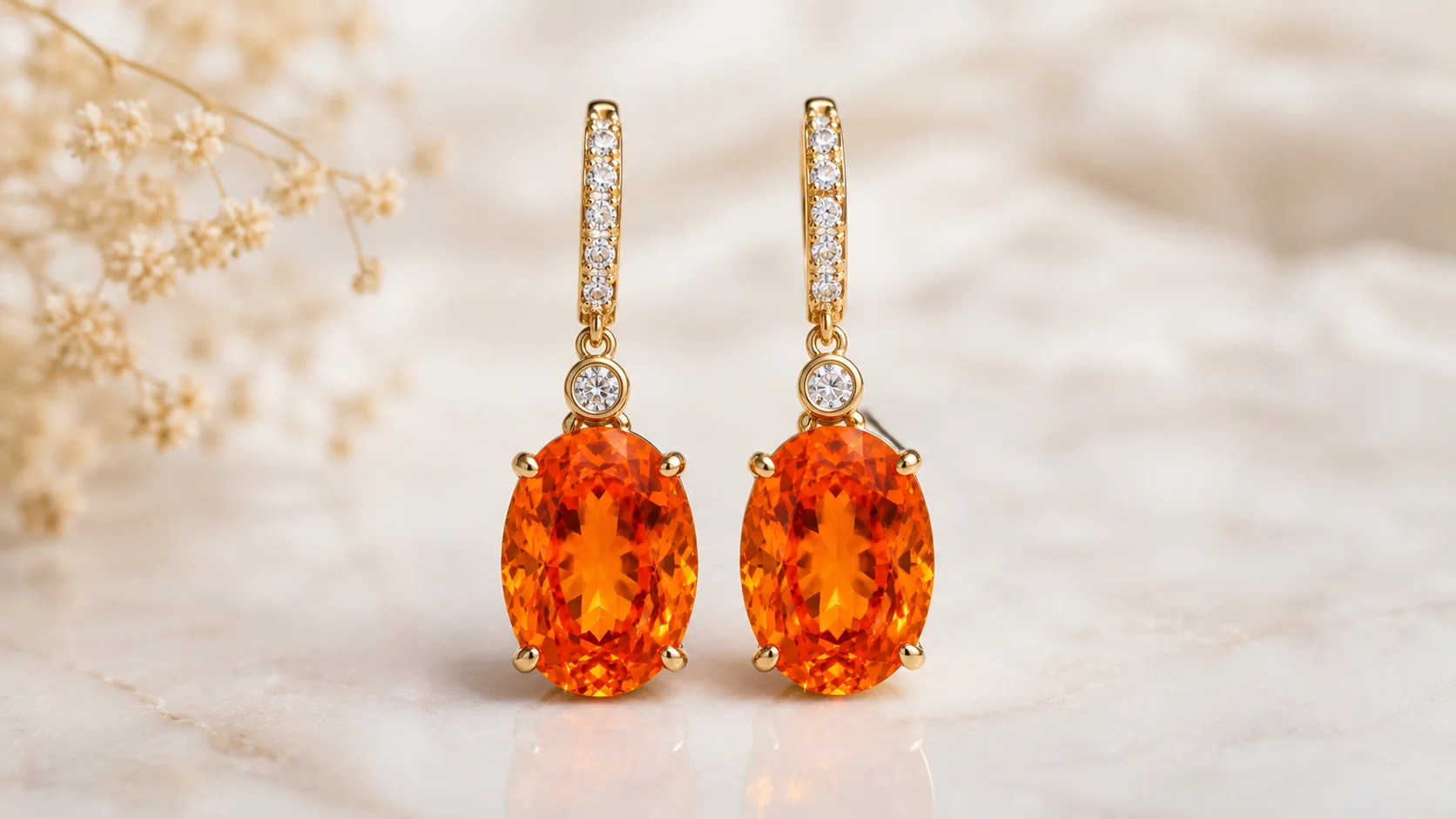
Spessartite Garnet Earrings: A Style Guide
Spessartite Garnet earrings bring concentrated orange color close to the face without the sizing difficulties of a ring or bracelet. Fine stones can appear tangerine, mandarin orange, reddish orange or warm golden orange, giving the earrings a distinctive presence in both minimal and formal designs.
Because earrings experience fewer direct impacts than rings, they are one of the most practical ways to wear this Garnet variety. The best pair still requires careful matching, lively cutting, secure settings and backings that suit the size and weight of the design.
Spessartite Garnet Earrings at a Glance
| Feature | What to Consider |
|---|---|
| Gem species | Spessartine, commonly called Spessartite Garnet in jewelry |
| Main colors | Yellow-orange, vivid orange, reddish orange and orange-brown |
| Popular styles | Studs, halos, drops, dangles, hoops and clusters |
| Best everyday option | Low-profile studs or compact bezel drops |
| Most important quality factor | Attractive, well-matched color |
| Common cuts | Round, oval, cushion, pear and trillion |
| Hardness | Approximately 7–7.5 |
| Cleavage | None |
| Main durability concern | Chipping from hard blows or pressure on included stones |
| Typical treatment | Usually untreated; rare fracture filling requires disclosure |
| Safe cleaning | Lukewarm water, mild soap and a soft brush |
| Gift connection | Garnet is January’s birthstone |
Why Spessartite Garnet Works Well in Earrings
Spessartite Garnet has enough hardness for regular jewelry wear, while its lack of cleavage reduces the likelihood of splitting along a single preferred plane. Earrings also avoid much of the impact, abrasion and chemical exposure experienced by rings and bracelets.
The stone’s high luster and strong orange body color remain visible at modest sizes. A pair of well-cut three- or four-millimeter stones can provide clear color without becoming heavy, while larger gems can anchor statement drops or formal halos.
The broad mineral and symbolic background appears in the dedicated Spessartite Garnet meaning guide. This page concentrates on earring design, matching, comfort and practical selection.
Spessartite Garnet Stud Earrings
Studs place the gemstone directly on the earlobe and provide the most versatile format. Round and cushion cuts create a balanced appearance, while ovals can make a modest carat weight look slightly larger.
A simple four-prong basket allows substantial light around the gem. However, the prongs must remain smooth and evenly positioned so that one side does not carry disproportionate pressure.
Bezel-set studs surround the girdle with metal and offer stronger edge protection. The design may make the stone appear slightly smaller, but it works particularly well for active wearers or anyone who frequently catches earrings on clothing.
For everyday use, moderate stone size often performs better than maximum carat weight. Oversized studs can tilt downward unless the setting, post and backing distribute the weight effectively.
Halo Earrings
A halo surrounds each Spessartite Garnet with smaller accent stones. Diamonds, white Sapphires or colorless Zircon can increase apparent size and create strong contrast with the orange center.
Halos also introduce more maintenance. Every accent stone has its own setting components, and accumulated lotion or hair products can dull the spaces beneath the stones.
A well-designed halo should frame the center gem rather than overwhelm it. If the Spessartite appears dark, a bright white surround may improve contrast. Conversely, a pale orange center can lose visual authority inside an excessively large halo.
Drop and Dangle Earrings
Drop earrings suspend the stone below the earlobe, allowing movement to produce flashes of orange. Pears, elongated cushions and ovals work especially well because their vertical proportions follow the line of the design.
Short drops can remain practical for dinners, professional settings and regular wear. Longer dangles create more drama but may tangle in hair, scarves or high collars.
Movement should occur through properly fitted joints rather than weak open links. Examine every connection point, especially where the gemstone component attaches to the upper earring.
A heavy drop requires a secure backing and a post strong enough to resist bending. Comfort should be assessed over several minutes rather than judged only when the earrings are first inserted.
Spessartite Garnet Hoops
Orange Garnets may be set along the front of a hoop, placed inside and outside the curve, or suspended as removable charms.
Front-facing stones provide clear visibility while limiting total gem weight. Inside-out hoops offer greater sparkle but require precise setting because stones on the inner curve can contact the skin or opposite side of the earring.
Hinged hoops should close with a distinct click. A weak hinge, thin post or poorly aligned latch presents a greater loss risk than the gemstone itself.
Small Spessartite charms can also transform plain gold hoops into birthstone or color-focused earrings. Check that the charms cannot slide off when the hoop opens.
Cluster and Multicolor Designs
Cluster earrings arrange several small Spessartite Garnets into floral, geometric or asymmetrical patterns. Their combined surface area can create strong color without requiring two large matching center stones.
A cluster can also mix yellow-orange, mandarin and reddish orange gems intentionally. The design should look graduated rather than accidentally mismatched.
Multicolor Garnet earrings may combine Spessartite with red, pink or green Garnets. The guide to types of Garnet explains how the wider group includes several species and mixed compositions.
For a cooler purple-red contrast, compare Rhodolite Garnet earrings. Green Demantoid Garnet earrings create an entirely different appearance and require their own value and durability considerations.
Matching the Two Stones
Pair matching is one of the most important quality factors in gemstone earrings. The stones should coordinate in hue, tone, saturation, visible size and face-up brightness.
Exact chemical composition does not need to be identical, but one stone should not appear strongly yellow while the other looks dark reddish brown unless the mismatch is intentional.
Dimensions often matter more than carat weight. Two stones with equal weights can have different diameters if one has a deeper pavilion.
Cutting also affects the pair. One gem may return light evenly while the other has a dark center, window or noticeably different facet pattern. View the earrings together under neutral light rather than inspecting each stone separately.
Exceptionally well-matched vivid gems may command a premium because the cutter or jeweler must sort through more material to assemble the pair. The Spessartite Garnet buying guide provides a fuller explanation of color, clarity and cutting quality.
Choosing the Best Orange Color
Fine Spessartite commonly displays vivid orange to orangy red. “Mandarin Garnet” is a popular trade description for bright orange material, but it is not a separate mineral species or a universally regulated grade.
Pure orange stones produce the most recognizable appearance. Yellow-orange gems feel lighter and brighter, while reddish orange stones create a warmer, deeper effect.
Brown modifiers are not automatically unattractive. A rich burnt-orange pair can suit antique-inspired jewelry, autumn colors and yellow gold. Nevertheless, excessive darkness may reduce brilliance.
View the pair in daylight-equivalent light, normal indoor light and lower evening illumination. A photograph taken under strong studio lighting may not show how the stones perform in everyday conditions.
The Garnet color meaning guide discusses the broader symbolic associations of red, orange, green and other Garnet colors.
Cut and Shape
Round brilliant cuts deliver even sparkle and are comparatively easy to match. Ovals provide greater face-up length, while cushions can emphasize saturated color through broader facets.
Pear shapes suit drops and dangles, although their pointed ends require secure prong protection. Trillions create a modern geometric appearance but also have vulnerable corners.
Dark rough often benefits from cutting that reduces extinction and allows more light to escape through the crown. A stone cut too deeply may preserve weight but look smaller and darker than expected.
A window appears when the center becomes transparent enough for the skin or setting to show clearly through it. Minor windowing may be acceptable in small commercial stones, but severe windowing weakens color and brilliance.
The general Garnet quality and grading guide explains why color, clarity and cut must be evaluated together rather than through a diamond-style grading formula.
Clarity and Inclusions
Spessartite frequently contains needles, crystals, veils or small fractures. Eye-clean stones are less common than included material, especially when color and size are also strong.
Small inclusions may disappear in earrings because the stones are viewed from conversational distance. Structural fractures remain more important than minor visible crystals.
Avoid stones with large surface-reaching breaks near prongs. Pressure during setting, repair or an accidental impact could enlarge those fractures.
A completely flawless-looking pair at an implausibly low price deserves careful verification. Orange glass, synthetic Spinel, cubic zirconia and other materials can imitate the appearance.
The guide to real versus fake Garnet covers substitutes, assembled stones and misleading descriptions.
Selecting the Right Size
Small studs between approximately three and five millimeters provide visible orange color while remaining comfortable for long wear.
Larger studs create more impact but need supportive backs. Once a setting becomes heavy, the earring can tilt or pull the lobe downward.
Drop earrings can use larger stones because the weight hangs beneath the ear rather than projecting forward. Nevertheless, the combined mass of the gem, metal and accents still affects comfort.
Measure dimensions rather than relying only on total carat weight. Garnet has relatively high density, so a one-carat Spessartite may appear smaller than a one-carat gem with lower specific gravity.
Earring Backings
Friction backs are simple and convenient for small or moderate studs. The backing should grip the post firmly without requiring excessive force.
Screw backs provide additional security for valuable studs, though they take longer to fasten and may be uncomfortable if the threaded post presses against the skin.
La pousette or locking backs combine a secure mechanism with relatively easy removal. They can also provide a larger surface that supports heavier studs.
Lever backs and hinged hooks work well for drops. Open fishhook wires are convenient but present a greater loss risk unless paired with small silicone stoppers.
The backing should match the value and weight of the earrings. A fine pair of Garnets deserves more than a thin, loose friction clutch.
Metal Choices
Yellow gold intensifies the warmth of orange Spessartite and creates a rich, cohesive appearance. It works especially well with mandarin, yellow-orange and burnt-orange stones.
Rose gold complements reddish orange gems but may reduce contrast. The combination should be viewed directly because some stones blend into the metal more than expected.
White gold and platinum provide a cooler frame that makes saturated orange stand out. Silver offers a similar visual contrast at a lower price but can tarnish and may not suit the value of exceptional stones.
Metal sensitivity also matters. Nickel-containing alloys can cause reactions in some wearers, especially because earring posts pass through the skin. Ask for alloy information when sensitivity is known.
Choosing Earrings for Personal Style
A minimal jewelry wardrobe may suit round or cushion studs in a simple bezel. Someone who regularly wears movement and color may prefer pear-shaped drops or hoops with removable charms.
Short hairstyles and tied-back hair expose the whole earring, while longer hair may call for brighter color, a larger outline or more movement. These are styling considerations rather than rigid rules.
The wearer’s existing jewelry provides the most reliable guide. Match the usual metal color, preferred earring length and level of formality rather than choosing solely from a product photograph.
The broader Garnet earrings guide compares the family’s red, orange, pink and green options.
Treatments and Disclosure
Most Spessartite Garnet is sold without routine heat treatment. That relative lack of standard enhancement adds to its appeal.
Rare Garnets may be fracture filled with a glass-like or resinous substance to reduce the visibility of surface-reaching breaks. Filled stones require more conservative cleaning and repair.
A seller should disclose known treatments in writing. The word “enhanced” alone provides less useful information than a direct statement describing the process.
The price should reflect color, clarity, cut, matching, treatment and construction. Current value factors appear in the Spessartite Garnet price guide.
Natural Spessartite and Imitations
Laboratory-created Garnet materials exist, but synthetic gem-quality Spessartine is not a routine mass-market product in the way synthetic Sapphire or cubic zirconia is.
Many low-cost orange earrings use glass, synthetic Spinel, cubic zirconia or other natural gems. These can be attractive when correctly identified.
For a significant pair, request a clear description of gemstone identity, natural or manufactured origin, treatments, metal fineness and total gem weight.
Independent gemological testing may be worthwhile when the stones are unusually large, vivid, expensive or represented with exceptional origin claims.
January Birthstone Earrings
Garnet is January’s modern birthstone, making orange Spessartite an unconventional alternative to familiar dark red Garnet.
The January birthstone guide explains the month’s Garnet association, while the January birthstone jewelry gift guide compares rings, earrings, necklaces and bracelets.
Earrings are particularly practical gifts because they avoid ring and wrist sizing. Confirm that the recipient has pierced ears and check whether studs, drops or hoops are normally worn.
Orange Spessartite may also suit a recipient who has no January connection but prefers vivid warm-colored gemstones. Related options appear in the orange gemstones guide and orange crystals list.
Comparing Earrings With Other Jewelry Formats
Earrings provide strong visibility with relatively low exposure to impact. A Spessartite Garnet necklace offers similar protection but places the color at the neckline.
A Spessartite Garnet bracelet remains visible to the wearer but experiences more contact with surfaces. A Spessartite Garnet ring gives the stone maximum prominence while demanding greater setting protection.
Choose the format according to lifestyle rather than assuming one category is universally superior.
Cleaning and Care
Clean Spessartite Garnet earrings with lukewarm water, mild soap and a soft brush. Support them over a bowl or closed drain while cleaning.
Brush gently behind the settings and around the posts, where skin oils and hair products accumulate. Rinse briefly and dry with a lint-free cloth.
Steam cleaning is not recommended. Ultrasonic cleaning should be avoided when stones contain significant fractures, have been fracture filled or sit in delicate settings.
Inspect prongs, posts, hinges and backings before each important wear. A loose backing presents a more immediate loss risk than ordinary surface dirt.
The dedicated guide to cleaning Spessartite Garnet jewelry provides a fuller treatment-aware procedure. The general guide to whether Garnet is durable enough for everyday wear explains hardness and impact resistance across the family.
Storage
Store each earring in a separate compartment or soft pouch so the stones and metal do not strike one another.
Keep the matching backs with the pair. Small locking mechanisms and screw backs are easily lost when stored loose.
Avoid placing Garnet earrings beneath Diamonds, Sapphires or other harder gemstones. Those materials can scratch polished surfaces and abrade metal settings.
Spessartite appears in the crystals beginning with S and gemstones beginning with S directories for readers comparing other materials with the same initial.
Final Perspective
Spessartite Garnet earrings succeed when their color is vivid, the two stones perform as a pair and the design remains comfortable enough to wear. A well-matched set of modest studs can be more satisfying than larger gems with uneven tone, weak cutting or insecure backings.
Choose the earring format before chasing carat weight. Once the setting, backing and proportions suit the wearer, the orange Garnets can provide years of distinctive color without the higher impact risks faced by hand jewelry.
Frequently Asked Questions
1. Is Spessartite Garnet suitable for everyday earrings?
Yes. Earrings face relatively little impact, and Spessartite’s hardness and lack of cleavage make it practical when the stones and settings are sound.
2. Are Spessartite and Spessartine the same gemstone?
Yes. Spessartine is the preferred mineralogical species name, while Spessartite remains widely used in jewelry and trade descriptions.
3. What color is best for Spessartite Garnet earrings?
Vivid orange to orangy red is especially valued. The best pair should also remain bright and evenly matched under ordinary indoor light.
4. What does Mandarin Garnet mean?
Mandarin Garnet is a trade description for bright orange Spessartite. It is not a separate mineral species or a universally defined quality grade.
5. Are studs or drop earrings better?
Studs are easier for everyday wear, while drops provide more movement and visual presence. Comfort, hairstyle and the wearer’s established style should guide the choice.
6. How closely should the two Garnets match?
They should coordinate in color, tone, visible dimensions and brightness. Laboratory-level chemical identity is less important than a harmonious face-up appearance.
7. Which metal looks best with orange Garnet?
Yellow gold emphasizes warmth, while white gold and platinum create stronger contrast. Rose gold works well with reddish orange stones when sufficient contrast remains.
8. Is Spessartite Garnet normally treated?
Most material is sold without routine heat treatment. Rare fracture filling should be disclosed because it affects value and cleaning.
9. Do Spessartite earrings need laboratory reports?
Small commercial earrings usually do not. Reports become more useful for large, expensive or exceptionally represented natural stones.
10. Can ultrasonic cleaners be used?
Only with caution. Avoid ultrasonic cleaning for fractured, filled or insecurely set stones. Warm soapy water remains the safest routine method.
11. Are Spessartite Garnet earrings appropriate for January birthdays?
Yes. Spessartite belongs to the Garnet group, which is January’s modern birthstone, and provides a bright orange alternative to traditional red Garnet.
12. How should Spessartite earrings be stored?
Keep them in separate padded compartments with their backs attached or stored beside them. Avoid contact with harder gemstones and heavy jewelry.