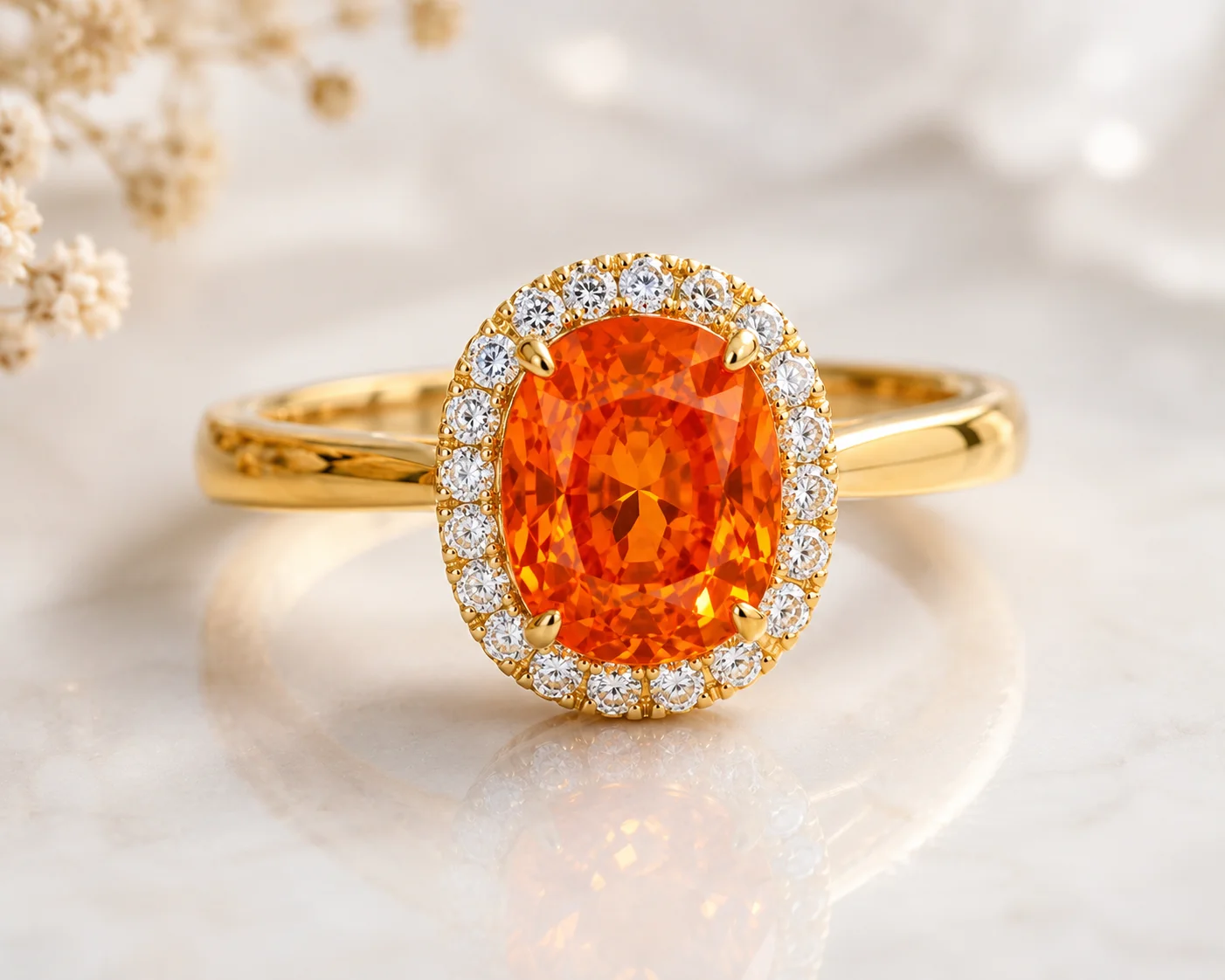
Spessartite Garnet Rings: Styles and Buying Tips
Spessartite Garnet rings place one of the Garnet family’s brightest colors in the most visible jewelry format. Fine stones can show vivid mandarin orange, tangerine, yellow-orange or reddish-orange color, often with enough brilliance to remain lively in relatively small sizes.
A ring also exposes the gem to more impact and abrasion than earrings or pendants. Choosing well therefore requires a balance between color, cutting, structural clarity, setting protection, ring profile and the wearer’s daily routine.
Spessartite Garnet Rings at a Glance
| Feature | What to Consider |
|---|---|
| Mineral species | Spessartine, widely called Spessartite Garnet |
| Main colors | Yellow-orange, vivid orange, tangerine and reddish orange |
| Mohs hardness | Approximately 7–7.5 |
| Cleavage | None |
| Toughness | Fair to good, but brittle under sharp impact |
| Best setting styles | Bezel, halo, substantial prongs and low-profile designs |
| Most important quality factor | Attractive, lively orange color |
| Common cuts | Oval, cushion, round, pear and emerald-style cuts |
| Typical treatment | Usually untreated; any filling should be disclosed |
| Strongest everyday concern | Chipping and gradual facet abrasion |
| Safest cleaning | Lukewarm water, mild soap and a soft brush |
| Birthstone connection | Garnet is January’s modern birthstone |
Why Choose a Spessartite Garnet Ring?
Spessartite offers a color that few mainstream gemstones reproduce exactly. Fire Opal may show intense orange but lacks Garnet’s scratch resistance. Orange Sapphire is harder, yet fine material can be expensive and often displays a different, more restrained character. Citrine is widely available, although its brilliance and density differ from those of Garnet.
The gem’s strong orange color also remains recognizable without relying on a large center stone. A carefully cut one-carat Spessartite can produce more visual impact than a larger brownish or overly dark gem.
For buyers who want the mineralogical and symbolic background first, the Spessartite Garnet meaning guide explains its manganese-rich Garnet composition, geological formation and modern symbolism. This ring guide concentrates on design and purchasing decisions.
Is Spessartite Durable Enough for Rings?
Spessartite generally falls near 7–7.5 on the Mohs scale. That gives it reasonable resistance to routine scratches, although Quartz-rich dust, harder gemstones and abrasive surfaces can still mark polished facets over time.
The absence of cleavage is helpful because the crystal does not split readily along one preferred atomic plane. Nevertheless, Garnet remains brittle. A strong blow against a countertop, metal doorframe or stone surface can chip an exposed edge or enlarge an internal fracture.
Occasional rings, dress rings and protected everyday designs are therefore practical. A person who works extensively with tools, machinery, stone, ceramics or heavy exercise equipment may prefer to reserve the ring for lower-risk wear.
The broader guide to whether Garnet is durable enough for everyday wear examines hardness, toughness and lifestyle considerations across the Garnet family.
Solitaire Rings
A solitaire places one Spessartite Garnet at the center of the design. This style reveals color and cutting clearly, making it ideal for a gem with strong saturation and balanced brilliance.
Four-prong settings create an open appearance but leave more of the girdle exposed. Six prongs offer greater redundancy for round and oval stones, although they introduce more visible metal.
A cathedral setting raises the center gem between sloping shoulders. The design can feel elegant, yet a tall profile increases snagging and impact risk.
For frequent wear, a lower basket or partially enclosed gallery usually performs better. The stone can still receive light without standing unnecessarily high above the finger.
Bezel-Set Rings
A bezel surrounds most or all of the gem’s girdle with metal. It is one of the safest settings for Spessartite because it protects the edge most likely to chip.
Full bezels create a clean modern outline and reduce snagging. Partial bezels expose more of the stone while protecting selected sides.
The jeweler must form the bezel carefully. Excessive pressure can damage a heavily included stone, especially when a fracture reaches the surface.
A bezel may make a gem appear slightly smaller, but the uninterrupted metal border can also intensify orange color. White metal creates crisp contrast, while yellow gold produces a warm, unified appearance.
Halo Rings
A halo surrounds the center Garnet with smaller accent stones, often Diamonds, white Sapphires or colorless Zircon.
This format enlarges the overall face-up appearance without requiring a much larger Spessartite. Bright colorless accents can also help a medium-dark orange stone look more luminous.
However, every small accent adds prongs or beads that require maintenance. Lotion, soap and hand cream can collect beneath the halo and dull both the center stone and surrounding gems.
A low halo that follows the center stone closely is generally more practical than a tall double halo. The design should support the orange gem rather than overwhelm it with metal and accents.
Three-Stone Rings
Three-stone rings may use a Spessartite center with Diamond or white-Sapphire sides. Tapered baguettes provide a clean geometric frame, while round or pear-shaped sides produce a softer look.
Another option combines three orange Garnets in graduated sizes. Matching becomes important because one brownish or weakly cut side stone can disrupt the complete design.
A mixed-color Garnet ring can pair Spessartite with purple-red Rhodolite or green Demantoid. Such combinations highlight the range covered in the guide to types of Garnet.
Three-stone rings often spread farther across the finger than solitaires. The shoulders should remain comfortable between adjacent fingers, and the side settings should not expose sharp edges.
Cluster and Cocktail Rings
Cluster rings use several smaller Garnets to create a flower, starburst or asymmetrical composition. They can deliver considerable orange color at a lower cost than one large, clean center stone.
Cocktail rings typically use a substantial gem, dramatic setting or broad decorative outline. Spessartite’s saturation suits this format particularly well.
These rings are best treated as statement jewelry rather than rugged everyday pieces. Larger stones and projecting clusters have more opportunities to strike hard surfaces.
Inspect the underside of a cluster carefully. The gallery should feel smooth, and open areas should allow cleaning without leaving weak connecting points.
Engagement Rings
Spessartite can be used in an engagement ring, but the decision should reflect the wearer’s lifestyle and willingness to maintain the piece.
Its hardness and lack of cleavage make it more practical than many softer colored gems. However, it does not match the scratch resistance of Sapphire or Diamond, and exposed edges can abrade during decades of daily wear.
A bezel, protective halo or substantial six-prong setting offers better long-term security than a very high four-prong basket. Accent Diamonds should not rub directly against the Garnet’s girdle.
Couples who prioritize unusual color and accept periodic professional inspection may find Spessartite highly rewarding. Those who expect the ring to remain on during every physical activity may prefer a harder center stone or use Spessartite in an anniversary or right-hand ring instead.
The general Garnet ring guide compares ring suitability across several Garnet varieties.
Color Quality
Color normally has the strongest influence on Spessartite’s visual appeal. Fine stones show vivid orange to orangy red with enough brightness to avoid looking brown, burnt or black.
“Mandarin Garnet” is a trade description commonly used for bright orange material. It does not represent a separate mineral species or a universally controlled grade.
Yellow-orange gems can appear fresh and sunny. Pure orange provides the most recognizable Spessartite look, while reddish-orange stones feel deeper and warmer.
Brown is not automatically undesirable. An autumnal burnt-orange stone can look exceptional in an antique-inspired ring. The key question is whether the gem remains lively in normal indoor light.
Compare candidates against the skin and under daylight-equivalent, office and evening illumination. Strong jewelry-store lights can make a dark stone appear brighter than it will at home.
The orange gemstones guide places Spessartite beside other warm-colored options, while orange crystals approaches the color through modern symbolism.
Clarity and Structural Safety
Spessartite commonly contains needles, crystals, veils and small fractures. A minor inclusion that does not affect face-up beauty may be entirely acceptable.
Large surface-reaching fractures deserve more caution in rings. Setting pressure and repeated impact can enlarge them, especially when they sit near a prong or pointed corner.
An eye-clean gem typically costs more, but clarity should not be considered separately from color. A vivid orange stone with a few harmless inclusions may look more attractive than a flawless but brownish gem.
Examine the ring under magnification before purchase. Look for chips along the girdle, fractures extending from prongs and cavities concealed beneath metal.
The broader Garnet quality and grading guide explains why Garnets are not evaluated through one universal grading scale.
Cut and Brilliance
Oval and cushion cuts dominate Spessartite rings because they preserve weight while returning color effectively. Round cuts provide symmetry and even brilliance but may require greater sacrifice from the rough.
Pear, marquise and trillion shapes create distinctive outlines, although their points need protection. Emerald-style cuts can show broad orange flashes but reveal inclusions and windowing more clearly.
A visible window occurs when the center leaks light and allows the setting or finger to show through. Excessive depth creates the opposite problem: the stone may look small and dark despite substantial weight.
Color extinction appears as black or lifeless areas that remain when the gem moves. Some extinction is normal, but a fine cut should distribute light across most of the face.
The Spessartite Garnet buying guide provides a complete loose-stone evaluation process without limiting the discussion to rings.
Carat Weight and Visible Size
Spessartite has relatively high density, so it may look smaller than a lower-density gem of equal carat weight.
Dimensions therefore matter more than carat weight alone. Compare millimeter length, width and depth alongside the stated weight.
Larger gems increase in value when strong color and clarity continue. Size does not compensate for excessive darkness, weak cutting or unstable fractures.
A halo can create greater visual coverage without requiring an unusually large center. Alternatively, an elongated oval or pear may appear larger than a deep round of similar weight.
Natural, Synthetic and Imitation Material
Natural Spessartite is the expected material in fine jewelry. Synthetic Garnet materials exist, but gem-quality laboratory-grown Spessartine is not a routine mass-market product in the way synthetic Sapphire is.
Orange glass, synthetic Spinel, cubic zirconia, Sapphire, Fire Opal and other gems may imitate Spessartite’s appearance. These alternatives are legitimate when accurately disclosed.
A seller should identify the stone, natural or manufactured origin, known treatment, metal fineness and total weight in writing.
The guide to real versus fake Garnet explains common substitutes and why home scratch tests are unsafe.
Treatments
Spessartite is not routinely heat treated. Most fine material reaches the market with its natural color.
Fracture filling may occasionally be used to reduce the visibility of surface-reaching breaks. A filled stone requires gentler cleaning and may not tolerate heat from repair procedures.
Ask for direct disclosure rather than accepting a vague word such as “enhanced.” A jeweler should also record treatment information on the invoice for a significant ring.
Current price factors appear in the Spessartite Garnet price guide. Treatment, color, clarity, cutting and setting quality should all be reflected in the final cost.
Metal Choices
Yellow gold emphasizes orange and creates a rich, cohesive effect. It works particularly well with yellow-orange and mandarin stones.
Rose gold complements reddish-orange material, although the reduced contrast can make some gems blend into the mounting.
White gold and platinum frame orange with a cooler border. This contrast can make a vivid center appear brighter and more contemporary.
Sterling silver provides a lower-cost alternative, but the setting must remain substantial enough for the gem. Fine Spessartite should not be secured by weak, thin prongs simply to reduce metal cost.
The wearer’s skin sensitivity also matters. Ask about alloy content when nickel or other metal reactions are a concern.
Ring Sizing and Comfort
Obtain an accurate finger measurement before purchasing. Finger size changes with temperature, time of day and band width.
Wide bands generally fit more tightly than narrow bands. A broad cocktail ring may therefore require a slightly different size from a delicate solitaire.
Eternity-style designs, engraved shoulders and complex halos can limit resizing. Confirm the available adjustment range before finalizing the ring.
The setting should not rotate continuously or press sharply against adjacent fingers. A slightly larger decorative head may require sizing beads or a supportive shank to remain centered.
Comparing Other Spessartite Jewelry
A Spessartite Garnet necklace allows a larger stone with less impact exposure.
Spessartite Garnet earrings provide strong color close to the face without requiring ring sizing. A Spessartite Garnet bracelet keeps the orange gems visible to the wearer but experiences frequent contact with surfaces.
Within the Garnet family, Rhodolite Garnet rings offer raspberry and purple-red colors. Demantoid Garnet rings feature green Andradite and have different rarity, inclusion and durability considerations.
January Birthstone Rings
Garnet is the modern birthstone for January. Spessartite provides a bright alternative to the dark red Garnet traditionally associated with the month.
The January birthstone guide explains Garnet’s calendar history and color range. The January birthstone jewelry guide compares rings with earrings, necklaces and bracelets as gifts.
A Spessartite ring can also commemorate a graduation, anniversary or creative milestone without any birthstone connection.
When a Laboratory Report Is Useful
A report is not essential for every modest commercial ring. Written disclosure from a knowledgeable jeweler may be adequate for a smaller purchase.
Independent testing becomes more useful when the center stone is large, unusually vivid, expensive or represented with exceptional origin or treatment claims.
A laboratory can identify the material and detect many treatments. Geographic origin determination is less routine for Spessartite than it is for gems such as Ruby or Sapphire, so extravagant mine claims deserve caution.
An insurance appraisal documents the complete ring and replacement value but does not automatically provide the same scientific conclusions as a gemological laboratory report.
Cleaning and Maintenance
Clean a sound Spessartite Garnet ring with lukewarm water, mild soap and a soft brush. Work gently beneath the setting, where hand cream and soap accumulate.
Rinse briefly and dry with a lint-free cloth. Do not clean over an open drain.
Steam cleaning is not recommended. Ultrasonic cleaning should be avoided for fracture-filled, heavily included or structurally uncertain stones.
Remove the ring before exercise, gardening, household cleaning and work involving hard surfaces. Have prongs and the girdle inspected periodically, especially after a noticeable impact.
The dedicated guide to cleaning Spessartite Garnet jewelry provides treatment-specific instructions. The guide to whether Garnet is safe in water and sunlight distinguishes brief washing from unnecessary soaking and heat exposure.
Buying Priorities
Begin with color under realistic lighting. Then inspect the cut for brightness, windowing and extinction.
Next, evaluate structural clarity. A small internal inclusion may be harmless, while a large surface-reaching fracture can become a durability concern.
Consider setting protection before metal weight or decorative detail. A well-built bezel or substantial prong setting often provides better long-term value than a larger gem in a fragile mounting.
Finally, request written disclosure, return terms and repair information. The complete Garnet buying guide provides family-level questions that remain relevant to the purchase.
Spessartite is also listed in the crystals beginning with S and gemstones beginning with S directories.
Frequently Asked Questions
1. Is Spessartite Garnet good for a ring?
Yes. Its hardness, lack of cleavage and strong color make it suitable when the gem is structurally sound and the setting provides protection.
2. Can a Spessartite Garnet ring be worn every day?
Regular wear is possible, but the ring should be removed for physical work, exercise and household cleaning. Protective settings improve long-term performance.
3. Which ring setting is safest?
A full or partial bezel gives the strongest girdle protection. Low halos and substantial prongs can also perform well.
4. What is Mandarin Garnet?
It is a trade description for vivid orange Spessartite, not a separate mineral species or universally regulated grade.
5. Is orange color more important than clarity?
Color usually has the greatest visual influence, but large surface-reaching fractures can create durability problems even in an attractive stone.
6. Which cut is best for Spessartite?
Ovals and cushions frequently balance color and brilliance well. The quality of the individual cut matters more than the shape name.
7. Does Spessartite Garnet scratch easily?
It resists many routine scratches but can be abraded by harder gemstones, Quartz-rich dust and rough surfaces.
8. Is Spessartite Garnet normally treated?
Most is not routinely heat treated. Any fracture filling or other enhancement should be disclosed.
9. Which metal looks best with orange Garnet?
Yellow gold emphasizes warmth, while white gold and platinum provide stronger contrast. Rose gold suits reddish-orange gems when enough contrast remains.
10. Does a Spessartite ring need a laboratory report?
Not every ring does. A report becomes more useful for a large, valuable or unusually represented center stone.
11. Is Spessartite a January birthstone?
Yes. It belongs to the Garnet group, January’s modern birthstone, and offers an orange alternative to traditional red Garnet.
12. How should a Spessartite Garnet ring be cleaned?
Use lukewarm water, mild soap and a soft brush. Avoid steam and do not use ultrasonic equipment when fractures or filling may be present.