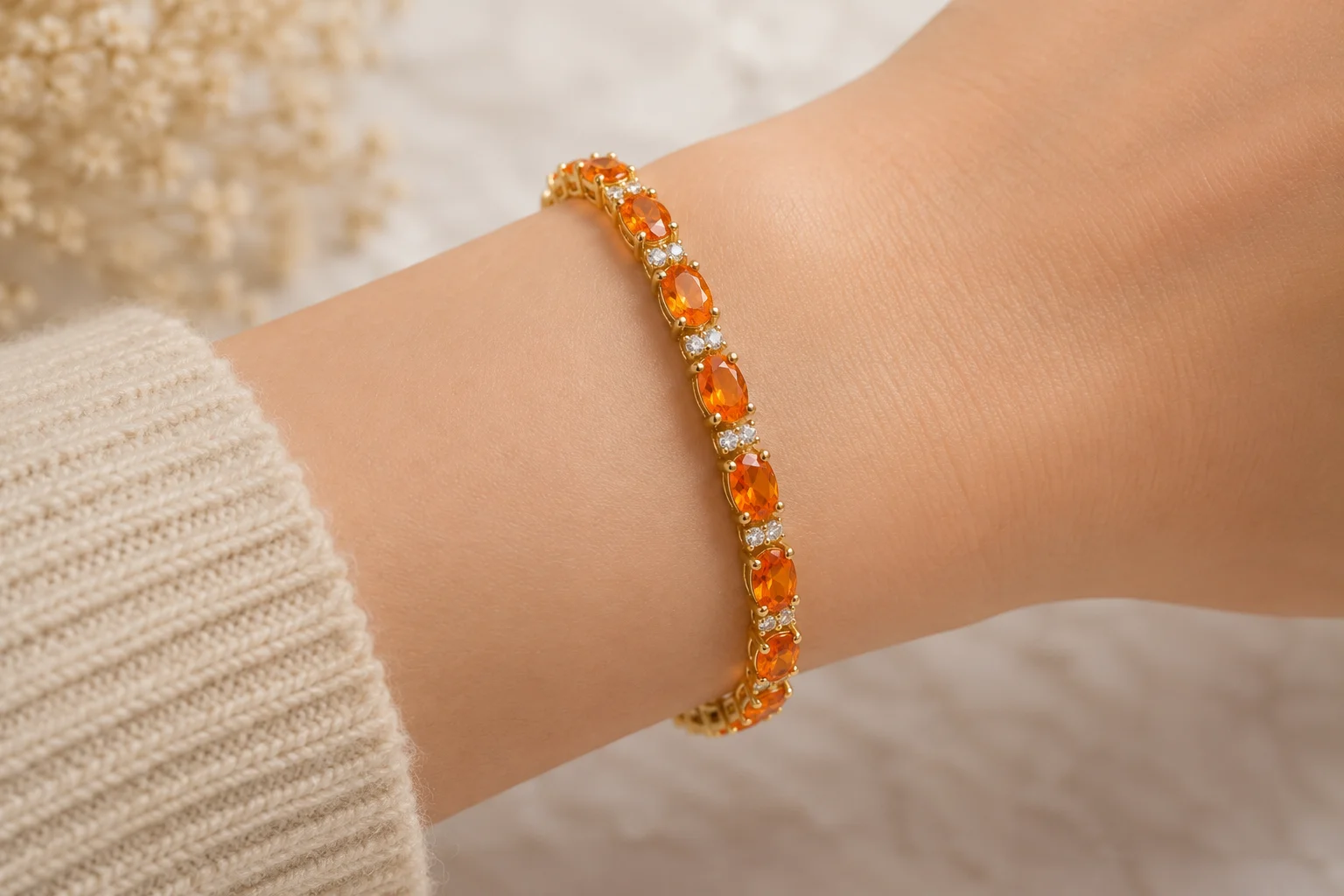
Spessartite Garnet Bracelets: How to Choose and Wear
Spessartite Garnet bracelets bring vivid orange, tangerine, reddish orange and warm golden color to a jewelry format that remains visible throughout the day. Fine examples can rival the saturation of Fire Opal or orange Sapphire while offering the lively brilliance and practical durability expected from Garnet.
A successful bracelet depends on more than choosing the brightest stones. Matching quality, clasp security, setting height, wrist fit, treatment disclosure and the design’s ability to protect each gem all determine how well the piece will wear.
Spessartite Garnet Bracelet at a Glance
| Feature | Buying Consideration |
|---|---|
| Mineral species | Spessartine, a manganese-aluminum Garnet |
| Common jewelry name | Spessartite Garnet |
| Main colors | Yellow-orange, vivid orange, tangerine and reddish orange |
| Mohs hardness | Approximately 6.5–7.5 |
| Toughness | Fair to good |
| Cleavage | None |
| Best bracelet formats | Station, line, tennis, bezel, bead and charm designs |
| Most important quality factor | Attractive orange color |
| Common treatment status | Usually untreated; rare filling should be disclosed |
| Main durability concern | Chipping from hard blows or exposed settings |
| Safest cleaning | Warm water, mild soap and a soft brush |
| Gift association | Garnet is January’s birthstone |
Spessartite or Spessartine?
Spessartine is the mineralogical name for the manganese-rich member of the Garnet group. Spessartite is a long-established alternative used widely in jewelry retail, gem dealing and search terminology.
Both names normally refer to the same Garnet species. A seller using “Spessartite Garnet” is not necessarily describing a different stone.
The forthcoming Spessartite Garnet meaning guide covers mineral identity, formation, localities and symbolism. This bracelet guide focuses on jewelry selection, construction, fit and wear.
Why Spessartite Works in Bracelets
Spessartite combines high refractive index with saturated warm color. Well-cut stones can return bright orange flashes even at relatively small calibrated sizes, making them effective in repeated bracelet layouts.
Its lack of cleavage reduces the risk of splitting along one preferred plane. However, Garnet remains brittle enough to chip after a hard impact, especially at exposed facet junctions.
Bracelets experience more contact than earrings and necklaces because they strike desks, doorframes and hard surfaces. The design therefore needs to protect the stones rather than relying only on their hardness.
Buyers comparing other formats can consult the dedicated guides to Spessartite Garnet earrings, Spessartite Garnet necklaces and Spessartite Garnet rings.
Spessartite Garnet Bracelet Styles
Line and Tennis Bracelets
A line bracelet places closely matched gems in a continuous row. This design delivers the strongest color statement and allows light to enter each stone from several directions.
Matching becomes critical. One brownish or poorly cut gem can interrupt the rhythm of an otherwise fine bracelet.
Individual links should articulate smoothly so the bracelet follows the wrist rather than twisting. A substantial clasp and secondary safety mechanism are important because the combined value of many matched stones can be significant.
Station Bracelets
Station bracelets space individual Spessartite Garnets along a chain. They use fewer stones and usually cost less than a full line bracelet.
The open design feels lighter and works well for everyday styling. Bezel-set stations provide added protection and reduce snagging.
Check that the stations remain oriented correctly. Poorly balanced settings may flip constantly, hiding the stones against the wrist.
Beaded Bracelets
Beaded Spessartite bracelets are less common than faceted line designs because transparent gem-quality rough is usually more valuable when faceted.
Commercial orange Garnet beads may contain abundant inclusions, mixed Garnet compositions or darker brown material. Their lower transparency does not make them fake, but descriptions should remain accurate.
Inspect every drill hole for fractures. A crack extending from the hole can enlarge as beads strike one another.
Charm and Accent Bracelets
A single Spessartite charm creates a more affordable introduction to the gem. It also allows the orange stone to be combined with initials, symbols or other birthstones.
The charm should hang freely without repeatedly striking harder metal components. A protective rim or bezel helps prevent edge damage.
Cuffs and Hinged Bangles
A cuff or hinged bangle can support a bold central Spessartite cluster. The rigid structure keeps the gemstones in a controlled orientation and may offer better protection than a loose link bracelet.
Hinges must close cleanly without side-to-side play. A weak hinge or hidden tension point can make an expensive bracelet unreliable.
Color Quality
Color is usually the dominant quality factor in Spessartite Garnet. The most sought-after stones display vivid orange or slightly reddish orange without excessive brown, gray or darkness.
Bright “mandarin” orange is especially popular. The term Mandarin Garnet is a trade description rather than a separate mineral species or universally regulated grade.
A bracelet does not require every stone to match under magnification, but the row should appear harmonious at normal viewing distance. Slight variations may be acceptable in an artisanal design and distracting in a formal tennis bracelet.
Evaluate the piece in daylight-equivalent illumination, ordinary indoor light and lower evening light. Some orange Garnets lose apparent brightness when lighting becomes weak.
The dedicated Spessartite Garnet buying guide examines color, clarity and cut in more detail.
Yellow-Orange, Mandarin and Reddish Orange
Yellow-orange Spessartite can look bright and sunny, particularly in yellow gold. It may also provide a more affordable alternative to strongly saturated mandarin material.
Pure vivid orange creates the classic high-impact appearance. Fine examples remain lively rather than becoming opaque or brown in normal room light.
Reddish orange stones feel warmer and may blend visually with certain Hessonite or mixed-composition Garnets. The distinction can become gradual because natural Garnet compositions form solid-solution mixtures.
Choose the shade that complements the wearer’s wardrobe and skin tone rather than purchasing a trade label alone.
The orange gemstones guide places Spessartite among other warm-colored gems, while the orange crystals directory approaches the color from a broader symbolic perspective.
Clarity and Inclusions
Transparent Spessartite may contain needles, crystals, veils or small fractures. Eye-clean stones generally command stronger prices, especially in vivid colors and larger sizes.
A bracelet contains many stones viewed together, so minor inclusions can become less noticeable than they would in a solitaire ring. Structural inclusions remain important, however.
Avoid gems with large surface-reaching fractures near prongs or drill holes. Repeated wrist movement can place stress on these areas.
Perfect clarity at an unusually low price deserves scrutiny. Glass, synthetic materials and other orange gems can imitate Spessartite’s appearance.
Cut and Brilliance
Round and oval cuts dominate line bracelets because they match efficiently and fit standardized settings. Cushions, pears and mixed shapes create a more individualized design but require careful spacing.
Dark orange stones benefit from shallower or brighter cutting that returns sufficient light. Excessive depth can preserve weight while causing the center to appear dark.
A visible window occurs when the center leaks light and allows the setting or skin to show clearly through the gem. Small windows may be less obvious in tiny bracelet stones, but severe windowing weakens the overall color.
Facet junctions should remain crisp. Abraded edges may indicate prolonged wear, poor storage or low-quality finishing.
Matching Multiple Stones
A matched suite is one of the hardest parts of creating a fine Spessartite bracelet. The gems must coordinate in hue, tone, saturation, dimensions and face-up brightness.
Matching by carat weight alone is unreliable. Two stones of equal weight can have different depths and visible sizes.
Ask whether replacement stones are available. If one gem is lost years later, matching the original orange color may be difficult.
A jeweler may preserve one or two spare stones for an important custom bracelet. The additional upfront cost can simplify future repair.
Natural Stones, Imitations and Laboratory Material
Natural Spessartite is the standard material in fine orange Garnet jewelry. Laboratory-grown Garnet materials exist, but synthetic gem-quality Spessartine is uncommon in mainstream consumer bracelets.
Orange glass, synthetic Spinel, cubic zirconia and other gems can imitate the color. Their presence is not automatically improper when disclosed, but they should not be sold as natural Spessartite.
A basic gemological examination can separate many substitutes through refractive index, density and optical properties. Visual inspection alone cannot establish natural origin reliably.
The general guide to real versus fake Garnet explains common substitutes and misleading sales claims.
Treatments
Most Spessartite Garnet is sold without routine heat treatment. That natural treatment profile adds to its appeal among colored-stone buyers.
Rare Garnets may be fracture filled to improve apparent clarity. Fillers can affect durability, repair procedures and cleaning.
Any known enhancement should appear in writing. A vague description such as “enhanced” is less useful than a specific disclosure.
Treatment status, color and size influence value, but they should be considered together. The current Spessartite Garnet price guide covers pricing factors without reducing every stone to a fixed per-carat number.
Bracelet Settings
Prong settings expose more of the gemstone and can produce a light, open appearance. Each prong must contact the stone securely without creating excess pressure.
Four-prong heads are common for small rounds. Shared prongs reduce visible metal but provide less redundancy if one prong becomes damaged.
Bezels surround the girdle and offer stronger edge protection. They suit active wearers and station bracelets, although heavy bezels may reduce the apparent size of small stones.
Channel settings can create a smooth surface, but replacing one damaged stone may require more extensive work. The channel walls must remain thick enough to hold every gem.
Choosing the Metal
Yellow gold amplifies the warmth of orange Spessartite and creates a rich, cohesive appearance. It is especially effective with yellow-orange and mandarin shades.
Rose gold complements reddish orange stones but can reduce contrast. Compare the actual combination before ordering because some stones blend into the metal more than expected.
White gold and platinum create the strongest cool contrast. They can make saturated orange stones appear brighter and more modern.
Sterling silver offers a lower-cost option but may tarnish and requires more maintenance. Thin silver settings may also be inadequate for a valuable multi-stone bracelet.
Metal allergy, budget, clasp strength and repair access should guide the decision alongside color.
Bracelet Length and Fit
Measure the wrist with a flexible tape at the point where the bracelet will sit. Add enough ease for comfort without allowing the piece to slide over the hand.
A close-fitting tennis bracelet may need approximately one finger’s width of movement. A station chain can tolerate slightly more looseness, while a rigid bangle must fit over the hand or use a reliable hinge.
Excessive looseness increases impact and snagging. An overly tight bracelet strains links, hinges and clasp components.
Check the total length rather than relying on labels such as small, medium or standard. Those terms vary between sellers.
Clasp Security
A box clasp with a secondary safety latch is a strong choice for a valuable line bracelet. Double safety catches provide additional reassurance.
Lobster clasps suit lighter station designs, provided the jump rings are soldered or sufficiently substantial. Open jump rings can pull apart.
Magnetic clasps are convenient but may release unexpectedly and are rarely ideal for expensive gemstone bracelets.
Operate the clasp several times before purchase. It should close positively without requiring force or feeling loose.
Daily Wear
Spessartite is durable enough for regular bracelet wear when the settings protect it and the wearer avoids hard impacts.
Remove the bracelet before exercise, gardening, moving furniture, household cleaning and any activity involving tools or hard surfaces.
Desk work can also abrade the underside of a bracelet. A low-profile design causes less contact than tall baskets or projecting charms.
The broader guide to whether Garnet is durable enough for everyday wear explains hardness, toughness and setting-related risk.
Styling Spessartite Bracelets
A fine line bracelet can stand alone because vivid orange already provides strong visual impact. Pairing it with a simple watch or narrow gold bangle keeps the arrangement controlled.
Station bracelets layer easily with chains of similar thickness. Leave enough space to prevent harder diamonds or rough metal edges from rubbing against the Garnets.
Orange works naturally with navy, charcoal, cream, olive, brown and black clothing. White metals create a sharper modern contrast, while yellow gold suits warm neutral wardrobes.
For mixed-gem combinations, consider relative hardness and setting height. Attractive colors do not guarantee safe physical contact.
Comparing Garnet Bracelet Varieties
A general Garnet bracelet guide covers the full color family. Spessartite differs primarily through its orange palette and the challenge of matching vivid stones.
Rhodolite Garnet bracelets offer purple-red and raspberry tones. Their cooler color creates a very different effect despite belonging to the same broad gem family.
Demantoid Garnet bracelets feature green Andradite and require closer attention to rarity, inclusions and the slightly lower hardness typical of Demantoid.
The guide to types of Garnet explains how Spessartine relates to Almandine, Pyrope, Grossular, Andradite and mixed varieties.
Buying Priorities
Begin with color. A smaller bracelet with lively, well-matched orange stones usually looks better than a larger suite dominated by brown or extinction.
Next, inspect construction. Stones should sit evenly, links should move smoothly and the clasp should include suitable security.
Confirm treatment disclosure, metal fineness, total gemstone weight and individual stone dimensions. Return terms should allow enough time to inspect the bracelet in ordinary lighting.
The Garnet quality and grading guide explains why Garnet evaluation does not follow one universal grading scale.
For broader family-level purchasing advice, consult the Garnet buying guide and Garnet price guide.
When a Laboratory Report Is Useful
A report may not be economical for every small calibrated stone in a bracelet. Seller documentation and a reputable jeweler often provide sufficient assurance for modest commercial pieces.
Independent testing becomes more useful when the bracelet contains large vivid stones, carries a high price or includes exceptional origin and treatment claims.
A report should identify the tested gems and disclose detectable treatments. It may not establish a precise mine for every stone.
An appraisal serves a different purpose. It estimates replacement value and documents the finished jewelry for insurance but does not automatically provide the same gemological conclusions as an independent laboratory.
Birthstone and Gift Meaning
Garnet is the traditional modern birthstone for January. Spessartite offers an alternative to the familiar dark red image of January jewelry.
The January birthstone guide explains Garnet’s calendar association, while the January birthstone jewelry guide compares gift formats.
An orange Spessartite bracelet can also mark an anniversary, graduation or personal achievement without relying on birthstone symbolism.
Record the bracelet length and return policy before gifting. A beautiful piece loses impact when it cannot be worn comfortably.
Cleaning and Long-Term Care
Clean Spessartite Garnet with lukewarm water, mild soap and a soft brush. Support the bracelet over a bowl or closed drain so it cannot be lost.
Brush gently beneath the stones where lotion and skin oils collect. Rinse briefly and dry with a soft lint-free cloth.
Ultrasonic cleaning may be suitable for sound, untreated Garnet, but it should be avoided when stones contain significant fractures or uncertain filling. Steam cleaning is not recommended.
Inspect prongs, links, hinges and clasp components periodically. A loose gem requires repair before the bracelet is worn again.
The complete guide to cleaning Spessartite Garnet jewelry provides treatment-sensitive instructions. The general Garnet jewelry cleaning guide covers the wider family.
Water and Sunlight
A brief wash is normally appropriate for sound, untreated Spessartite Garnet. Prolonged soaking is unnecessary and may affect filled fractures, glue, thread or other bracelet components.
Garnet color is generally stable under normal light. Storage away from sustained high heat remains sensible because extreme temperature changes can stress inclusions and settings.
The guide to whether Garnet is safe in water and sunlight separates the gem’s properties from the limitations of mountings, fillers and associated materials.
Directory Placement
Spessartite Garnet appears within the crystals beginning with S and gemstones beginning with S. Its parent family remains Garnet, a group containing several related mineral species and mixed compositions.
Frequently Asked Questions
1. Is Spessartite Garnet the same as Spessartine?
Yes. Spessartine is the mineralogical species name, while Spessartite is a widely used jewelry and trade spelling.
2. What is Mandarin Garnet?
Mandarin Garnet is a trade term generally used for vivid orange Spessartite. It is not a separate mineral species or universally regulated quality grade.
3. Is Spessartite Garnet durable enough for bracelets?
Yes, with appropriate settings and care. It has no cleavage and generally falls near 6.5–7.5 on the Mohs scale, but hard blows can still chip it.
4. Which bracelet setting protects Spessartite best?
Bezel settings provide strong girdle protection. Low-profile prongs can also work well when they are secure and inspected regularly.
5. Is orange color more important than clarity?
Color usually has the greatest visual impact. However, large surface-reaching fractures can reduce durability even when the color is excellent.
6. Is Spessartite Garnet usually treated?
Most is sold without routine heat treatment. Rare fracture filling or other enhancement should be disclosed.
7. How should a Spessartite tennis bracelet fit?
It should move comfortably without sliding over the hand or striking hard surfaces excessively. Approximately one finger of ease often works, but personal preference varies.
8. Which metal looks best with orange Garnet?
Yellow gold creates a warm unified appearance, while white gold and platinum provide stronger contrast. Rose gold works particularly well with reddish orange stones.
9. Can I wear a Spessartite bracelet every day?
Regular wear is possible, but remove it during exercise, household work, bathing and activities involving impact or chemicals.
10. Does a Spessartite bracelet need a laboratory report?
Not every commercial bracelet does. Reports are more useful for large, high-value stones or exceptional treatment and origin claims.
11. How do I clean a Spessartite Garnet bracelet?
Use lukewarm water, mild soap and a soft brush. Avoid steam and use ultrasonic cleaning only when the stones are unfilled, minimally included and securely set.
12. Is Spessartite appropriate for a January birthstone gift?
Yes. It belongs to the Garnet family and offers a vivid orange alternative to traditional red January birthstone jewelry.