Crystals That Start With B: Names and Meanings
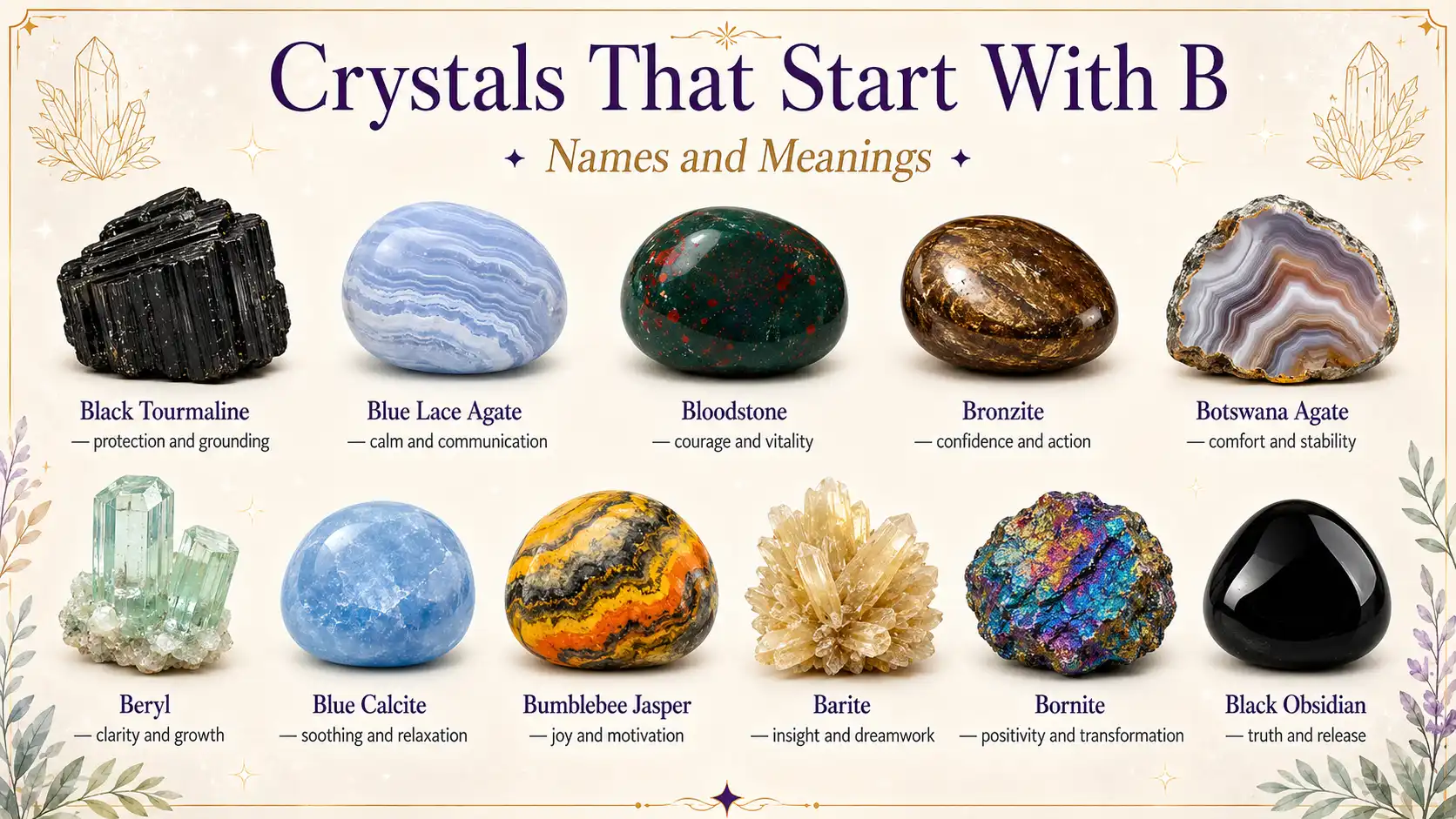
Crystals that start with B include barite, benitoite, beryl, bismuth, black kyanite, black moonstone, black obsidian, bloodstone, blue calcite, blue chalcedony, Botswana agate, boulder opal and bronzite.
This concise directory covers each material’s appearance, mineral identity and commonly associated symbolic meaning.
Crystal meanings are cultural and spiritual interpretations, not scientifically proven healing effects.
B Crystals at a Glance
| Crystal or material | Typical appearance | Common symbolic meaning |
|---|---|---|
| Barite | White, blue, yellow or tabular crystals | Order and purposeful action |
| Benitoite | Bright blue crystals | Insight and individuality |
| Beryl | Green, blue, yellow, pink or colorless | Clarity and resilience |
| Bismuth | Iridescent geometric hopper crystals | Transformation and structure |
| Black Kyanite | Black bladed formations | Boundaries and grounding |
| Black Moonstone | Dark feldspar with pale flashes | Reflection and new cycles |
| Black Obsidian | Glossy black volcanic glass | Truth and protection |
| Black Opal | Dark body color with spectral play-of-color | Creativity and emotional depth |
| Bloodstone | Dark green chalcedony with red spots | Courage and endurance |
| Blue Aventurine | Blue quartz with subtle sparkle | Focus and self-discipline |
| Blue Calcite | Pale blue, cloudy or translucent | Calm communication |
| Blue Chalcedony | Soft blue, translucent quartz | Gentle expression |
| Blue Kyanite | Blue bladed crystals | Communication and alignment |
| Blue Lace Agate | Pale blue banded chalcedony | Calm and thoughtful speech |
| Blue Tiger’s Eye | Blue-gray fibrous quartz | Observation and composure |
| Botswana Agate | Gray, pink or brown banded chalcedony | Stability during change |
| Boulder Opal | Opal veins within brown ironstone | Creativity and grounded expression |
| Bronzite | Bronze-brown stone with metallic sheen | Confidence and practical action |
| Brookite | Dark brown or black metallic crystals | Direction and focused growth |
| Brucite | White, blue, green or yellow plates | Simplicity and release |
Barite
Barite, also spelled baryte, is a barium sulfate mineral that may form tabular, bladed or rose-like crystals.
Common colors include:
- White.
- Cream.
- Pale blue.
- Yellow.
- Brown.
Barite is noticeably heavy for its size. It is commonly associated with organization, direction and turning broad intentions into manageable steps.
Because it is relatively soft, store it separately from quartz and other harder stones.
Benitoite
Benitoite is a rare blue mineral best known from California.
Its color may range from pale blue to vivid sapphire-like blue. Some specimens fluoresce strongly under ultraviolet light.
Benitoite is symbolically associated with:
- Individuality.
- Insight.
- Clear personal direction.
- Recognizing uncommon strengths.
Gem-quality benitoite is rare, so buying, value and authenticity questions belong in its dedicated guides rather than this directory.
Beryl
Beryl is a mineral family that includes several familiar gemstones:
- Emerald.
- Aquamarine.
- Morganite.
- Heliodor.
- Goshenite.
- Red beryl.
Its appearance depends on trace elements within the crystal.
Beryl is commonly associated with clarity, resilience and maintaining direction under pressure. Each variety also has its own separate symbolism and gemological identity.
Bismuth
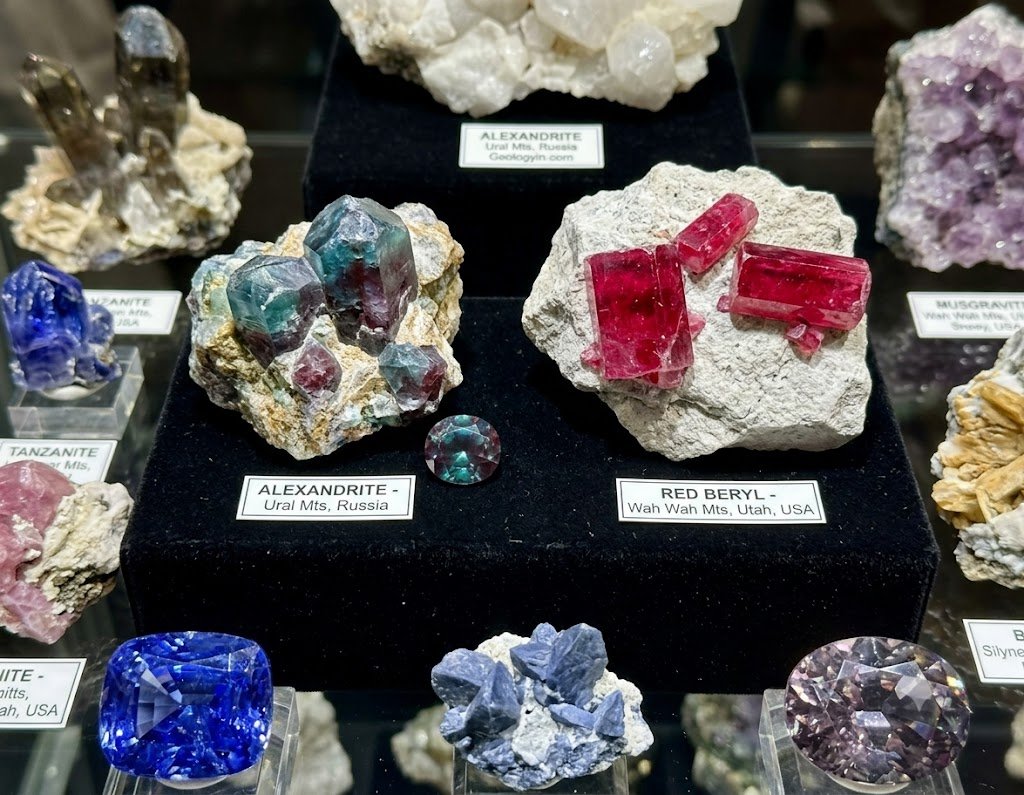
Natural bismuth crystals are uncommon. The brightly colored, staircase-like specimens widely sold in crystal shops are usually laboratory-grown from refined bismuth metal.
They display rainbow colors caused by a thin oxide layer on the surface.
Bismuth is commonly associated with:
- Transformation.
- Order.
- Cooperation.
- Finding structure within complexity.
Lab-grown bismuth should be disclosed accurately rather than presented as a naturally formed mine specimen.
Black Kyanite
Black kyanite commonly forms dark fan-shaped or bladed crystals.
It is traditionally associated with:
- Grounding.
- Personal boundaries.
- Clearing mental clutter.
- Separating your responsibilities from those of others.
Kyanite has directional hardness and distinct cleavage, so thin blades can split or chip. It is better suited to careful display than loose pocket carrying.
Black Moonstone
Black moonstone is a dark feldspar that may show silver, gray, peach or blue flashes.
It is commonly linked with:
- Reflection.
- Emotional transitions.
- New cycles.
- Responding thoughtfully to uncertainty.
Moonstone can scratch or fracture more easily than quartz, so store it separately from harder crystals.
Black Obsidian
Black obsidian is natural volcanic glass rather than a mineral crystal.
It usually has a glossy black surface and may break with very sharp edges.
Its symbolic meanings include:
- Truth.
- Protection.
- Grounding.
- Recognizing uncomfortable patterns.
Use caution with raw or chipped pieces because obsidian fractures can be sharp.
Black Opal
Black opal is precious opal with a dark body tone that makes its play-of-color appear especially vivid.
It may display flashes of:
- Blue.
- Green.
- Red.
- Orange.
- Violet.
Black opal is commonly associated with creativity, emotional depth and expressing individuality.
Opal requires careful handling because heat, dryness, impact and sudden temperature changes may damage some material.
Bloodstone
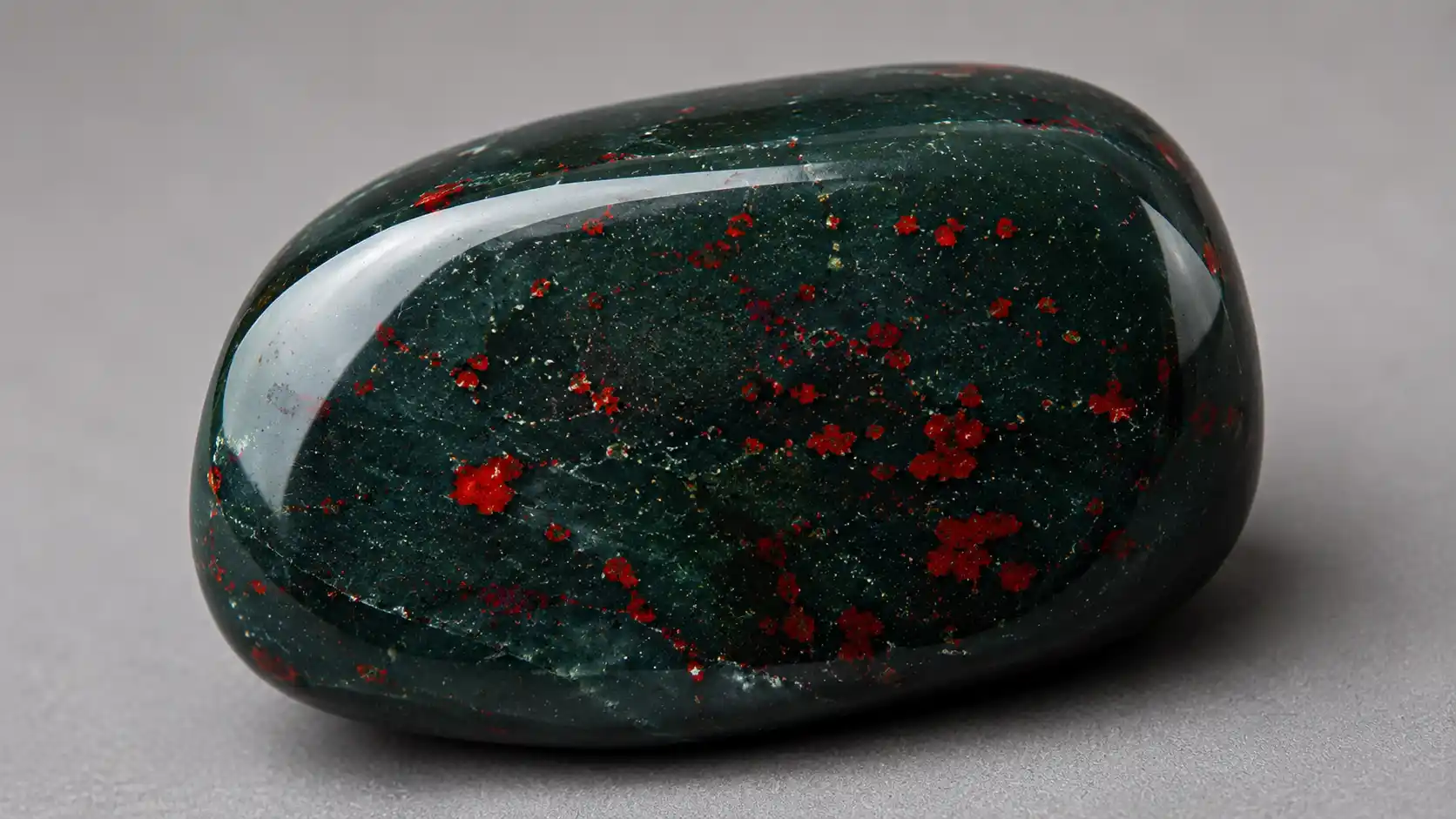
Bloodstone is a dark green variety of chalcedony marked with red or reddish-brown spots, traditionally associated with drops of blood.
Its symbolism commonly includes:
- Courage.
- Endurance.
- Steady action.
- Resilience during demanding periods.
The dedicated guide to bloodstone healing properties explores traditional uses while distinguishing spiritual claims from medical evidence.
Blue Aventurine
Blue aventurine is a blue quartz material that may show subtle sparkle from mineral inclusions.
It is commonly associated with:
- Focus.
- Self-discipline.
- Calm decision-making.
- Reducing impulsive reactions.
Blue aventurine is less common than green aventurine. Color should be examined carefully because some inexpensive material may be dyed or mislabeled.
Blue Calcite
Blue calcite is usually pale blue, cloudy and translucent to opaque.
It is traditionally associated with:
- Calm.
- Gentle communication.
- Emotional decompression.
- Slowing down before responding.
Calcite is soft and reacts with acids. Avoid storing it loose with quartz and do not use harsh household cleaners.
Blue Chalcedony
Blue chalcedony is a fine-grained quartz material with soft blue, gray-blue or lavender-blue coloring.
Its common symbolic meanings include:
- Thoughtful speech.
- Listening.
- Emotional composure.
- Clear but gentle expression.
Blue chalcedony is a broad material category. Trade names and treatments should be disclosed when buying.
Blue Kyanite
Blue kyanite forms elongated blue blades and may show white, gray or darker blue areas.
It is commonly associated with:
- Communication.
- Alignment between values and behavior.
- Honest self-expression.
- Resolving internal contradictions.
Because kyanite has variable hardness depending on direction, it requires more careful handling than its appearance may suggest.
Blue Lace Agate
Blue lace agate is a pale blue, delicately banded variety of chalcedony.
It is traditionally linked with:
- Calm communication.
- Patience.
- Choosing words carefully.
- Reducing tension before a conversation.
Some material sold under this name may be enhanced or inaccurately labeled, so buy from sellers who disclose treatments clearly.
Blue Tiger’s Eye
Blue tiger’s eye, also called hawk’s eye, is a blue-gray fibrous quartz that can display a moving band of reflected light.
It is commonly associated with:
- Observation.
- Composure.
- Wider perspective.
- Thinking before acting.
It is related to golden tiger’s eye but retains cooler blue and gray tones.
Botswana Agate
Botswana agate is known for fine bands in gray, white, brown, pink and muted purple tones.
It is commonly associated with:
- Stability during transition.
- Patient adjustment.
- Emotional steadiness.
- Gradual progress.
The name refers to material traditionally associated with Botswana, but locality claims should still be verified where provenance matters.
Boulder Opal
Boulder opal forms as veins or patches of precious opal within brown ironstone.
The natural host rock usually remains part of the finished specimen or gemstone.
Its symbolic meanings include:
- Grounded creativity.
- Integrating imagination with practical reality.
- Expressing individuality.
- Building from existing foundations.
Boulder opal varies widely in appearance and should not be judged by the same standards as solid black or white opal.
Bronzite
Bronzite is a bronze-brown mineral with a metallic or silky reflective surface.
It is commonly associated with:
- Confidence.
- Practical action.
- Decisiveness.
- Remaining steady under pressure.
Bronzite is often sold as tumbled stones, beads and carvings.
Brookite
Brookite is a titanium dioxide mineral that may form dark brown, reddish-brown or black metallic crystals.
It is less common in beginner collections and is usually valued as a mineral specimen.
Its modern symbolism often centers on:
- Direction.
- Focus.
- Growth through deliberate choices.
Natural brookite crystals can be small and delicate, so secure display is preferable to loose handling.
Brucite
Brucite is a magnesium hydroxide mineral that may occur in white, pale blue, green or bright yellow forms.
Its crystals can be soft and fragile.
Brucite is commonly associated with:
- Simplicity.
- Releasing unnecessary burdens.
- Direct communication.
- Reducing complexity.
Avoid water soaking and abrasive cleaning unless the specimen has been properly identified and evaluated.
Other Crystal Names Beginning With B
Additional minerals and materials beginning with B include:
- Barytocalcite.
- Bastnäsite.
- Bauxite.
- Bixbyite.
- Boji stones.
- Bornite.
- Brazilianite.
- Bustamite.
- Bytownite.
Some are mainly mineral specimens, trade names or rocks rather than common polished crystals.
“Peacock ore” sold as bornite may sometimes be acid-treated chalcopyrite, so seller disclosure matters.
Crystals vs. Gemstones Beginning With B
This page focuses on materials commonly encountered in crystal collections, mineral displays and metaphysical traditions.
The separate Gemstones That Start With B directory should focus on:
- Jewelry suitability.
- Cutting.
- Durability.
- Rarity.
- Gem quality.
- Buying and value.
This separation prevents both pages from targeting the same search intent.
For beginner guides and crystal-care information, visit the Crystals 101 category.
Choosing a B Crystal
Choose according to physical use first.
For Everyday Handling
Bloodstone, Botswana agate, blue chalcedony and bronzite are generally more manageable than delicate crystal clusters, although every specimen should still be protected from impact.
For Mineral Display
Barite, bismuth, brookite and brucite offer distinctive formations but may require careful handling.
For Symbolic Reflection
Connect the traditional meaning with a practical action:
- Black kyanite: establish one clear boundary.
- Blue calcite: pause before a difficult conversation.
- Bloodstone: complete one demanding responsibility.
- Botswana agate: make one gradual adjustment.
- Bronzite: choose the next practical step.
The broader guide to choosing the right crystal provides a complete selection process.
Frequently Asked Questions
What is the most popular crystal that starts with B?
Bloodstone, black obsidian, blue calcite and Botswana agate are among the most familiar B crystals.
Which blue crystals start with B?
Benitoite, blue aventurine, blue calcite, blue chalcedony, blue kyanite and blue tiger’s eye are notable examples.
Which black crystals start with B?
Black kyanite, black moonstone, black obsidian and black opal all begin with B when listed by their full names.
Is bismuth a natural crystal?
Bismuth occurs naturally, but the colorful geometric crystals commonly sold in shops are usually laboratory-grown.
Is black obsidian a crystal?
Obsidian is natural volcanic glass, not a mineral crystal, but it is commonly included in crystal collections.
Which B crystals should be kept out of water?
Soft, fragile, metallic or unidentified specimens—including barite, brucite and some mixed-mineral pieces—should not be soaked without material-specific guidance.
Final Summary
Crystals that start with B range from familiar materials such as bloodstone and black obsidian to rare minerals such as benitoite and brookite.
Notable examples include:
- Barite.
- Benitoite.
- Beryl.
- Bismuth.
- Black kyanite.
- Black moonstone.
- Black obsidian.
- Bloodstone.
- Blue calcite.
- Blue chalcedony.
- Blue kyanite.
- Botswana agate.
- Boulder opal.
- Bronzite.
Use this page as a concise alphabetical directory. Follow the dedicated links for complete properties, symbolism and care information.