Adamite Meaning: Zinc Arsenate, Color & Fluorescence
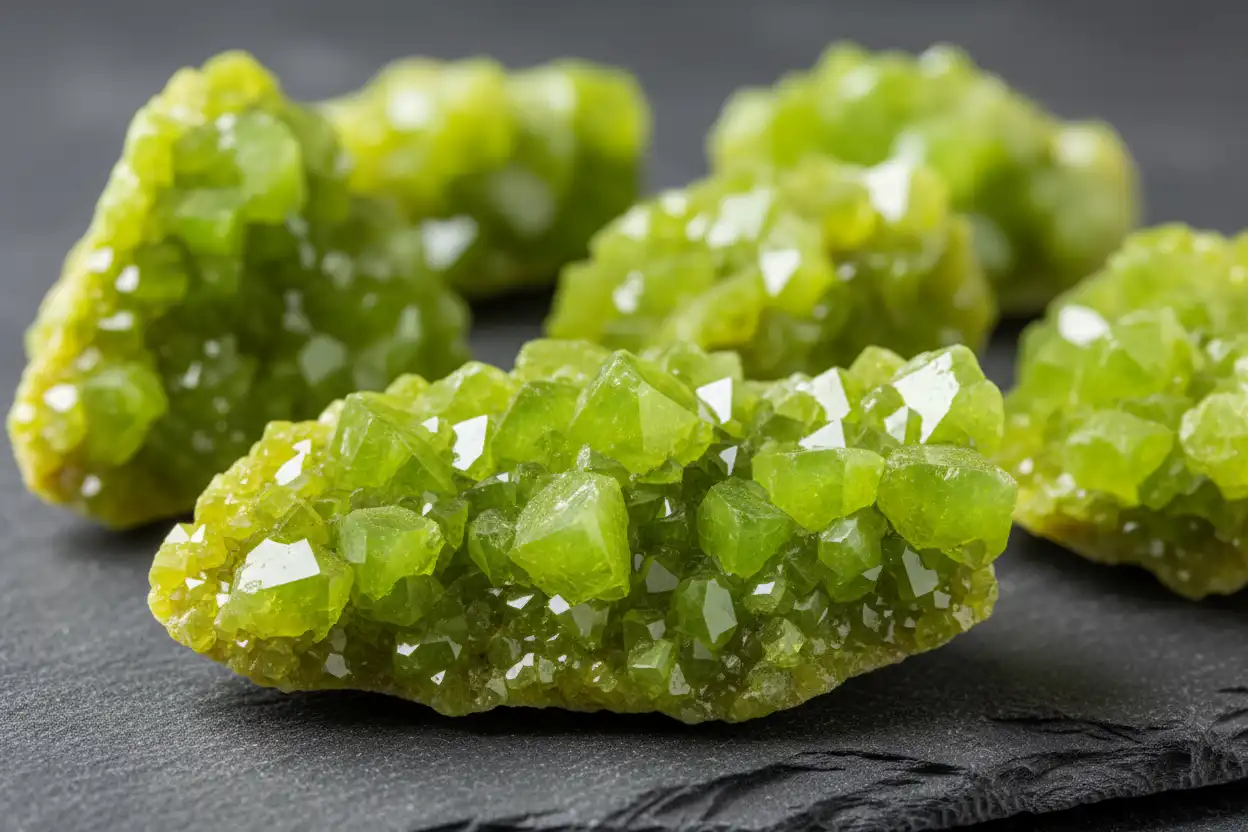
Adamite is a zinc arsenate hydroxide best known for yellow, honey-colored and green crystals that grow as radiating fans, rounded aggregates, crystalline crusts and sharply terminated individual forms. Its transparent edges and vitreous luster can make a fine specimen appear gem-like, yet adamite is principally a collector mineral rather than a practical jewelry stone because it is soft, brittle and compositionally unsuitable for casual lapidary work.
Many people first encounter adamite through photographs of bright yellow crystals on dark matrix or green specimens described as cuprian adamite. Others recognize it for the lemon-yellow fluorescence shown by some examples under ultraviolet light. These features are useful observations, but none identifies the mineral on its own. Color, fluorescence, crystal habit, density, matrix and locality must be considered together.
Within symbolic traditions, adamite is associated with curiosity, purposeful action, confidence and intellectual clarity. These are personal interpretations rather than measurable mineral effects. Its factual identity comes from its zinc, arsenate and hydroxyl chemistry, orthorhombic structure and formation in oxidized ore deposits.
Adamite Identification Table
| Property | Adamite |
|---|---|
| Mineral class | Arsenate mineral |
| Chemical formula | Zn₂(AsO₄)(OH) |
| Crystal system | Orthorhombic |
| Common colors | Pale yellow, honey yellow, brownish yellow, green, colorless, white and reddish |
| Less common colors | Blue, pink, rose or purple |
| Luster | Vitreous |
| Transparency | Transparent to translucent |
| Mohs hardness | Approximately 3.5 |
| Specific gravity | Approximately 4.32–4.48 |
| Cleavage | Good in one direction and poor in another |
| Fracture | Uneven to subconchoidal |
| Tenacity | Brittle |
| Common habits | Elongated crystals, equant crystals, radial fans, rosettes and crystalline crusts |
| Fluorescence | Some specimens fluoresce or phosphoresce lemon yellow |
| Formation | Secondary mineral in oxidized zinc- and arsenic-bearing deposits |
| Main use | Mineral collecting and occasional faceted collector stones |
| Handling concern | Contains arsenic as part of its mineral structure |
Adamite feels comparatively heavy for a small nonmetallic crystal because its density is greater than that of quartz and many common display minerals. That weight can support an identification when the specimen is sufficiently pure, although matrix material makes informal comparisons unreliable.
Why Adamite Forms Above Zinc Ore
Adamite develops as a secondary mineral rather than crystallizing directly from a large body of molten rock. It usually forms near the surface where oxygen-bearing groundwater alters zinc- and arsenic-bearing minerals in a hydrothermal deposit. Zinc released from earlier ore minerals can combine with arsenate and hydroxyl components, then crystallize along fractures, cavity walls and weathered zones.
These environments produce complex mineral associations because several metals can move through the same oxidized deposit. Adamite may occur with smithsonite, iron and manganese oxides, calcite, quartz and other secondary minerals. Brown material described as limonite frequently provides a contrasting matrix, although limonite is a field term for mixtures dominated by hydrated iron oxides and hydroxides rather than one precisely defined mineral species.
The resulting specimen can record several stages of alteration. An early coating may line the cavity, followed by later adamite fans, isolated crystals or a younger mineral overgrowth. This sequence makes the matrix more than decoration: it can preserve evidence about how fluids changed while the deposit weathered.
Reading Adamite Crystal Habits
Well-formed adamite crystals are commonly elongated, but their proportions and faces vary enough to produce several recognizable appearances. Some crystals are slender and individually separated, while others grow together as broad fans. Radial groups may resemble wheat sheaves, rounded sprays or overlapping rosettes. Crystalline crusts consist of many small crystals covering the matrix rather than a few dominant individuals.
Fanlike groups are particularly characteristic in the specimen market. Their quality depends on the completeness of the radiating form, sharpness of the terminations and absence of bruised edges. A group may appear intact from the front while several crystals are broken where the specimen was removed from its host rock, so side and rear photographs are essential.
Rounded aggregates require closer inspection because curved yellow surfaces can belong to other secondary minerals. Magnification may reveal that an apparently smooth mound consists of tightly packed adamite terminations. Conversely, a seller may apply the name adamite to yellow matrix staining without showing identifiable crystals.
What Produces Yellow, Green and Pink Adamite?
Pale yellow and honey yellow are the best-known adamite colors. Individual crystals may appear colorless near thin edges, deeper yellow through thicker areas and brownish where inclusions or matrix show through. Uneven thickness can therefore create apparent zoning without proving that the chemistry changed between each visible band.
Green adamite is commonly associated with copper entering zinc positions within the structure. Copper-bearing material is described as cuprian adamite, and increasing copper influence connects adamite compositionally toward copper arsenates in the adamite–olivenite relationship. A saturated green color can support the possibility of copper, but only chemical analysis can establish the amount and distribution present.
Pink, rose and purple material may be cobalt-bearing. These colors are less familiar than yellow and green, making attractive specimens desirable to specialized collectors. The word cobaltian should still describe demonstrated compositional influence rather than serve as a decorative sales term.
Adamite can therefore appear in both collections of yellow crystals and references covering yellow gemstones, although most specimens are not suitable for conventional gem wear. Cuprian material also overlaps visually with lists of green crystals and green gemstones. Placement in a color category does not replace mineral identification.
Adamite Fluorescence
Some adamite specimens fluoresce lemon yellow under shortwave or longwave ultraviolet light, and certain examples continue glowing briefly after the ultraviolet source is removed. That continued emission is phosphorescence. The strength and duration vary, so a specimen that remains inert is not automatically misidentified.
Fluorescence is produced when energy absorbed by the mineral activates light-emitting centers within its structure. Trace elements, structural defects and chemical substitutions can strengthen, weaken or suppress the response. Two crystals from different zones of one specimen may therefore react differently.
A yellow glow is supporting evidence rather than a diagnostic verdict. Other minerals fluoresce, and artificial materials can also respond to ultraviolet light. Fluorite provides a familiar example of a mineral whose fluorescence varies significantly among specimens, colors and localities.
Ultraviolet observations should record the lamp type, wavelength category and visible response. Shortwave and longwave results should not be merged into a single statement such as “UV reactive.” Use a shielded viewing setup, protect eyes and skin, and never look directly into the lamp.
The Six-View Adamite Evidence Card
A useful specimen record can be made without scratching, dissolving or breaking the mineral. Photograph the same piece under consistent conditions and preserve the results with its label.
| Record | What to capture | Why it matters |
|---|---|---|
| Front view | Entire crystal group and matrix | Documents overall form and display quality |
| Side view | Crystal height, contacts and repairs | Reveals broken edges and glued sections hidden from the front |
| Rear view | Matrix, saw marks and mounting material | Helps evaluate natural matrix and preparation |
| Scale view | Ruler or measured dimensions beside the specimen | Prevents size exaggeration in close photography |
| Neutral-light view | Color under daylight-balanced white light | Reduces misleading warmth or saturation |
| UV comparison | Separate visible-light, shortwave and longwave images | Records fluorescence without treating it as conclusive identification |
Add the specimen’s dimensions, weight, stated locality, seller, acquisition source, matrix description, visible damage, fluorescence response and any repair or coating disclosure. Preserve the original label even when its identification is later questioned; an old label is evidence of provenance, not automatic proof that every statement on it is correct.
A strong record separates observations from conclusions. “Lemon-yellow fluorescence under shortwave UV” is an observation. “Authentic Ojuela adamite” is a conclusion requiring supporting mineral and locality evidence.
Adamite Lookalikes
Adamite is most easily confused with other yellow, green or orange minerals found in oxidized metal deposits. Similar color is particularly misleading when the crystals are small, partially coated or photographed under intense lighting.
Wulfenite commonly forms orange, yellow or red tabular crystals and contains lead and molybdate rather than zinc arsenate. Its square or thin plate-like forms usually differ from adamite fans, although broken or distorted crystals can obscure the distinction.
Vanadinite typically develops hexagonal barrel-shaped crystals in red, orange, brown or yellow. It is denser than adamite and belongs to a different chemical group. Small yellow vanadinite crystals on brown matrix can nevertheless look similar in poorly lit photographs.
Cerussite is a lead carbonate that can be colorless, white, gray or pale yellow. Its high density, twinning and brilliant luster can help distinguish it, but the presence of lead also makes casual destructive testing inappropriate.
Calcite may occur as pale yellow crystals or coatings, yet it is softer, lighter and chemically distinct. Acid reactions are sometimes used to distinguish carbonates, but acid testing can destroy a collectible specimen and should not be performed on adamite or an unidentified arsenate-bearing piece.
Green cuprian adamite may occur near malachite or azurite in copper-bearing oxidation zones. A mixed specimen can contain more than one green or blue mineral, so one color label should not be applied across the entire surface.
A Non-Destructive Identification Sequence
Begin with the seller’s label and locality, then treat both as claims to investigate. Examine the specimen under neutral white light and magnification, recording whether the crystals are elongated, fanlike, rounded, tabular or hexagonal. Check whether the matrix resembles an iron-rich coating, carbonate crust or crystalline quartz.
Measure dimensions and weight without removing crystals from the matrix. Density calculations are meaningful only when the tested material is reasonably pure and its volume can be measured accurately. A heavy mixed specimen does not prove that its yellow crystals are adamite.
Observe fluorescence under controlled shortwave and longwave ultraviolet sources if appropriate equipment is available. Record an inert response as carefully as a strong one. Do not reject the identification merely because the specimen fails to glow.
For an important, valuable or scientifically significant piece, non-destructive Raman spectroscopy may provide useful confirmation. X-ray diffraction and chemical analysis can resolve more difficult cases, but sampling methods may remove material. The laboratory should be told that the specimen is a zinc arsenate candidate before testing begins.
Adamite, Paradamite and Olivenite
Adamite and paradamite share the same ideal chemical formula but have different crystal structures. Minerals with identical composition and different structures are called polymorphs. Paradamite is much rarer, so an unusual-looking crystal should not receive that name without structural confirmation.
Adamite also forms a compositional relationship with olivenite, a copper arsenate hydroxide. Copper can substitute for zinc, producing intermediate chemistry and contributing to green coloration. Minerals near the intermediate part of this relationship require more than visual naming because green intensity does not map perfectly to a formal species boundary.
This is one reason the label “cuprian adamite” can be more defensible than a highly specific intermediate name when complete analytical data are unavailable. It communicates copper influence while leaving room for compositional uncertainty.
Major Adamite Localities
The Ojuela Mine in Mapimí, Mexico, is especially associated with large, lustrous yellow adamite crystals and attractive groups on dark matrix. Provenance from this locality should be supported by a credible label or collection history because the visual style alone cannot establish origin.
Tsumeb in Namibia produced notable adamite, including green copper-bearing material and specimens associated with complex secondary minerals. Other recognized occurrences include mining districts in Greece, France, England, Germany, Chile, Australia and the United States.
Locality affects more than prestige. It can narrow the expected matrix, mineral associations, color range and crystal habits. However, specimens travel between dealers and collections, old labels are sometimes separated from their pieces, and famous locality names may be added without evidence. A precise mine-level claim deserves stronger documentation than a broad country attribution.
Is Adamite Suitable for Jewelry?
Adamite has a Mohs hardness of approximately 3.5, placing it below many materials encountered in ordinary wear. It can be scratched by household dust containing quartz, harder gemstones, metal edges and abrasive cloths. The broader gemstone hardness chart shows why hardness describes scratch resistance rather than complete durability.
The mineral is also brittle and has cleavage. A crystal can break from impact, setting pressure or vibration even when its surface has not accumulated obvious scratches. The distinction between resistance to scratching and resistance to breakage is explained in gemstone toughness versus hardness.
Transparent adamite has occasionally been faceted for collectors, but the finished stone is better treated as a protected display object than wearable jewelry. Cutting also creates dust from an arsenic-bearing mineral, making casual home lapidary work inappropriate. Natural crystal specimens should never be drilled for pendants simply to create a wearable form.
Safe Adamite Handling
Adamite contains arsenic as arsenate within its crystal structure. This does not make an intact display specimen equivalent to loose arsenic powder, but it does justify controlled handling. Exposure route, physical condition and frequency matter.
Do not lick adamite, place it in drinking water, use it to prepare crystal elixirs or allow children and pets to handle it. Avoid eating, drinking or touching the face while working with the specimen. Disposable nitrile gloves reduce direct contact, and hands should still be washed after handling.
Cutting, grinding, sanding, drilling, crushing and dry brushing can generate dust. These activities should not be performed as casual household projects. Acid testing is also inappropriate because it damages the specimen and may mobilize hazardous constituents.
A stable piece is best kept in a closed display case or fitted specimen box with its identity and handling warning clearly marked. Broader precautions for compositionally sensitive minerals appear in the toxic crystals safety list.
If a specimen is crumbling, powdery or detached from unstable matrix, isolate the container rather than repeatedly cleaning the surface. Advice from a qualified mineral conservator or hazardous-material professional is more appropriate than experimentation.
Cleaning Adamite Without Damaging It
Adamite crystals can detach, chip or dissolve unevenly when subjected to aggressive cleaning. Water may also affect associated matrix, repairs, labels and coatings even when the adamite itself appears unchanged.
Start with no-contact inspection. If loose household dust rests on a stable specimen, use a clean hand-operated air bulb from a safe distance while keeping the specimen inside a controlled work area. Do not use compressed air, a vacuum nozzle or a stiff brush.
Avoid ultrasonic cleaners, steam, acids, vinegar, bleach, ammonia and commercial jewelry dips. Do not soak the specimen. If professional cleaning is necessary, the method should be selected after identifying both the crystals and every matrix mineral present.
Adamite Storage
Use a rigid, closed container large enough to prevent the crystals from touching the lid or sides. Support the matrix rather than placing padding against delicate crystal tips. Do not wrap fine crystal groups tightly in tissue, cotton or fibrous fabric because these materials can catch terminations and pull them away.
Keep the specimen label inside a separate sleeve or store a digital copy with the photographic record. The container should state that adamite is an arsenate mineral and should not be cut, ground or placed in water.
Store it away from food, kitchen equipment, children’s collections and unrestricted classroom handling. Guidance on separating fragile, reactive and compositionally sensitive specimens is available in how to store crystals safely.
Evaluating Adamite Before Purchase
A specimen’s desirability depends on crystal form, luster, color, transparency, matrix contrast, damage, locality and documentation. Strong fluorescence can add interest, but it should not outweigh broken crystals, uncertain identity or unsupported provenance.
Ask for photographs under neutral white light rather than accepting only heavily saturated images. Yellow adamite can appear orange under warm lighting, while pale green material may look dramatically brighter after digital editing. Request an image showing the specimen beside a scale and another showing the back.
Examine crystal tips for bruising and contact damage. A contact is the natural interruption left where a crystal grew against another surface, whereas a fresh break usually has a sharp irregular texture. Neither automatically makes a specimen worthless, but the seller should describe condition accurately.
Check for glue lines, filled fractures, artificial bases and reconstructed clusters. Crystals may be reattached during preparation, and repairs are not necessarily unacceptable when disclosed. Undisclosed assembly is a different issue because it changes how the specimen should be valued and handled.
The locality should be as specific as the evidence supports. “Mexico” is broad; a named mine is more informative but requires better documentation. An old collection label, specimen number, dealer record and previous owner history can collectively strengthen provenance.
Adamite Value Factors
Adamite does not follow a consistent per-carat jewelry market. Most pieces are sold as mineral specimens, so aesthetic and historical qualities matter more than weight alone.
| Value factor | Stronger specimen characteristic | Common value reduction |
|---|---|---|
| Crystal form | Sharp, complete, clearly separated crystals or balanced fans | Crushed tips, incomplete groups or indistinct crusts |
| Color | Attractive natural yellow, green or unusual documented color | Artificially intensified photographs or dull staining |
| Luster | Bright vitreous faces | Etching, abrasion or surface residue |
| Transparency | Clear edges or transparent crystals where expected | Cloudiness caused by damage or coatings |
| Matrix | Stable, contrasting and visually balanced | Crumbling, excessive trimming or hidden repairs |
| Condition | Minimal damage with disclosed contacts | Unreported breaks, glue or reconstruction |
| Locality | Credible mine-level provenance | Famous locality claim without documentation |
| Fluorescence | Clearly recorded response under identified UV source | Vague “glows strongly” claim without comparable images |
| Association | Well-identified complementary minerals | Mixed specimen labeled entirely as adamite |
Large size alone does not guarantee quality. A small, undamaged crystal group with excellent provenance can be more desirable than a larger specimen with repaired fans, unstable matrix and uncertain origin.
Adamite Meaning and Symbolism
Adamite’s modern symbolism commonly emphasizes curiosity, constructive decision-making, confidence and turning observation into action. Yellow specimens are often connected with alertness and optimism, while green cuprian material is associated with growth, balance and adaptability.
Its radiating fans provide a visual metaphor for several possibilities emerging from one starting point. A collector may use that form as a reminder to compare evidence before choosing a direction. This is a personal reflective practice, not a physical property of the mineral.
There is no reliable scientific evidence that adamite treats illness, removes toxins, changes hormone levels or produces guaranteed emotional effects. It should not be worn against the body, added to water or used as a substitute for medical or psychological care.
Questions Collectors Ask
Is adamite rare?
Adamite occurs at numerous zinc- and arsenic-bearing deposits, but large, undamaged and aesthetically arranged crystals are much less common than small crusts or incomplete groups. Rare color, strong provenance and exceptional crystal form can increase collector interest.
Why does adamite glow?
Some specimens contain structural features or activating components that emit visible lemon-yellow light after absorbing ultraviolet energy. The response varies, and some genuine adamite remains weak or inert.
Is green adamite natural?
Natural green adamite exists and commonly reflects copper influence. Chemical testing is required when a seller makes a precise compositional claim such as cuprian adamite or an intermediate adamite–olivenite species.
Is adamite poisonous?
Adamite contains arsenic within an arsenate mineral. An intact enclosed specimen is not the same exposure condition as inhaled dust or ingested material, but it should still be handled cautiously and never cut, licked or placed in water.
Can adamite go in water?
It should not be soaked or used in drinking water. Water can affect the specimen’s matrix, repairs and surface condition, while preparing mineral-infused water creates an unnecessary ingestion risk.
Can adamite be worn as jewelry?
Its low hardness, brittleness, cleavage and arsenate composition make it a poor choice for routine jewelry. Rare faceted examples are primarily collector stones intended for protected display.
How can I identify adamite without damaging it?
Record crystal habit, color, luster, matrix, locality, density and fluorescence without scratching or applying chemicals. Valuable or uncertain specimens can be examined using non-destructive spectroscopy and other laboratory methods.
Is fluorescence proof of adamite?
No. Fluorescence can support an identification, but genuine adamite may be inert and unrelated minerals can fluoresce. The response must be combined with structural and compositional evidence.
What is cuprian adamite?
Cuprian adamite is copper-bearing adamite, commonly green because copper substitutes for part of the zinc. The amount of copper and the correct species classification cannot be determined reliably from color alone.
What should an adamite label contain?
Record the mineral name, locality, dimensions, acquisition source, previous collection information, matrix, fluorescence response, repairs and analytical results. Preserve older labels even when later research updates the identification.