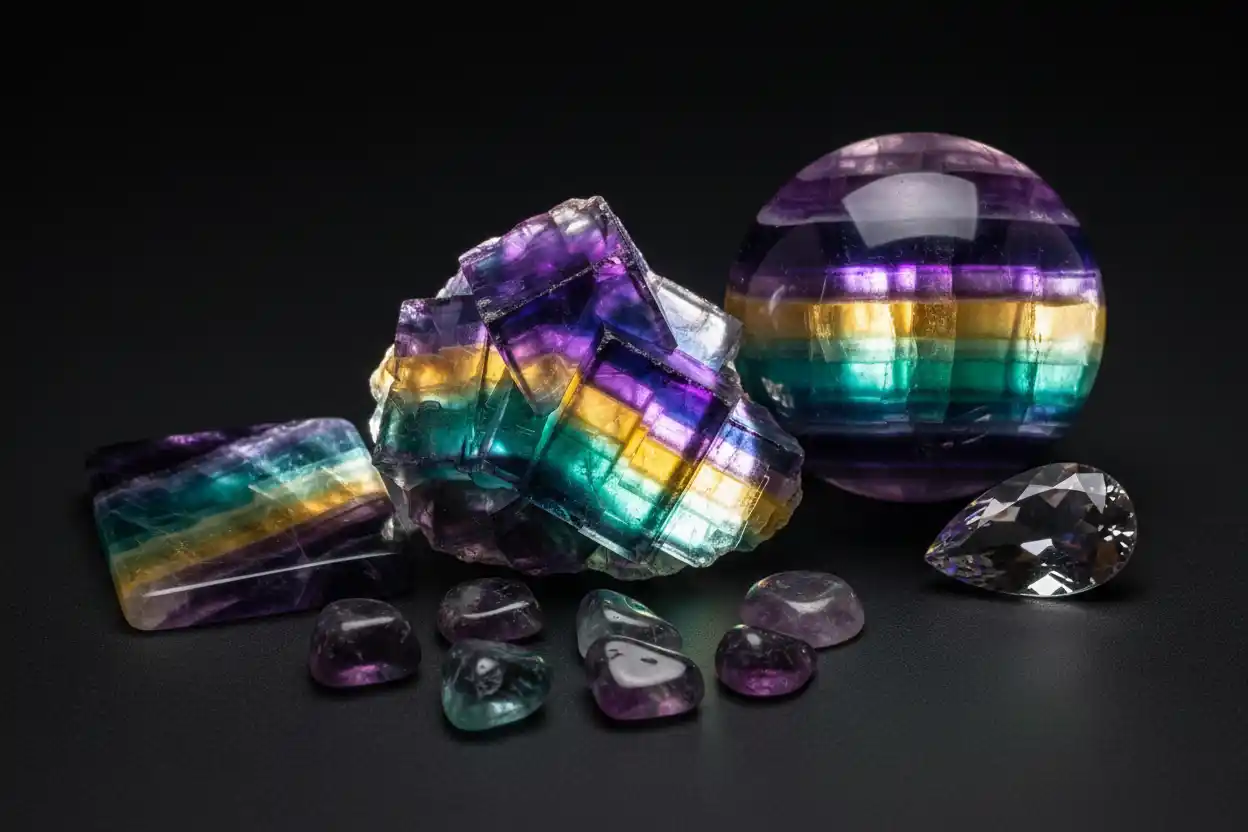
Rainbow Fluorite Meaning, Properties, Identification & Value
Rainbow Fluorite is multicolored fluorite displaying two or more visible growth zones, commonly purple, green, blue, yellow, gray, and colorless. Its “rainbow” appearance comes from internal bodycolor banding rather than the spectral diffraction or surface iridescence seen in materials such as precious opal.
The stone remains calcium fluoride, CaF₂, throughout its principal zones. Changes in impurities, radiation-related defects, rare-earth elements, and growth conditions create the alternating colors.
Rainbow Fluorite at a Glance
| Property | Rainbow Fluorite |
|---|---|
| Material type | Multicolored and color-zoned fluorite |
| Composition | Calcium fluoride, CaF₂ |
| Mineral class | Halide |
| Common colors | Purple, lavender, green, blue, teal, yellow, gray, white, and colorless |
| Color arrangement | Straight, stepped, cubic, phantom-like, concentric, chevron-like, or irregular bands |
| Crystal system | Cubic |
| Typical habit | Cubes, octahedrons, interpenetrant twins, stepped crystals, massive banded material, and cleavage fragments |
| Luster | Vitreous |
| Transparency | Transparent to opaque |
| Mohs hardness | 4 |
| Cleavage | Perfect octahedral cleavage in four directions |
| Tenacity | Brittle |
| Specific gravity | Approximately 3.18 |
| Optical character | Isotropic |
| Common uses | Mineral specimens, spheres, towers, slabs, carvings, cabochons, beads, faceted collector stones, and protected jewelry |
| Main care concern | Cleavage, scratching, color instability, resin or dye, thermal shock, and water entering internal fractures |
What “Rainbow” Means in Fluorite
Rainbow Fluorite does not need to display all spectral colors.
Most commercial examples combine purple and green, sometimes with blue, yellow, white, or colorless layers.
The term describes multicolored zoning that becomes visible across a crystal, slab, or polished object.
A purple-green piece may qualify even when red and orange are absent.
The parent Fluorite guide owns the mineral’s general composition, industrial uses, and broad history.
The dedicated types of Fluorite guide places Rainbow Fluorite among the mineral’s color varieties without treating it as a separate species.
How Color Zoning Forms
Fluorite grows from mineral-bearing fluids in veins, cavities, replacement deposits, and granite-related systems.
The fluid composition can change while a crystal remains in place.
A growth stage may contain more rare-earth elements, structural defects, vacancies, or radiation-sensitive impurities than the layer before it.
Temperature, pressure, oxidation state, fluid source, and growth rate also change over time.
Each new layer records those conditions.
Because fluorite grows in the cubic system, zoning commonly follows cube faces. A polished cross-section may show squares, rectangles, diamonds, stepped bands, or geometric phantoms.
Octahedral growth creates triangular or diamond-shaped internal boundaries.
A sphere cuts through the zones from several directions, producing curved bands that did not exist as curved layers inside the original crystal.
What Creates Fluorite Colors?
Pure calcium fluoride is colorless.
Natural fluorite color can involve missing fluorine ions, trapped electrons, displaced atoms, rare-earth elements, and trace impurities.
Ionizing radiation from surrounding rocks can create or modify color centers.
Purple and blue zones are commonly associated with radiation-related defects and interactions involving calcium, fluorine vacancies, and rare-earth elements.
Green, yellow, and other colors may involve different centers, impurity combinations, or oxidation states.
No universal formula assigns one element to every green, purple, or blue zone.
Modern studies show that multiple color centers can operate within one deposit or even within one crystal.
The dedicated Fluorite color guide separates geological color causes from modern color symbolism.
Purple Zones
Purple Fluorite is one of the most common components of Rainbow Fluorite.
The purple may form a central core, thin edge, repeated band, or dark outer cube.
Deep zones can appear nearly black until backlit.
Purple color is frequently connected with radiation-related structural defects, although the precise centers vary.
A strong purple band does not prove unusual radioactivity in the finished specimen.
The color records past defect formation rather than functioning as a simple radiation detector.
Green Zones
Green Fluorite can range from mint and apple green to teal, emerald, and dark forest tones.
Green commonly alternates with purple or colorless layers.
Some green material changes toward blue or violet under different light sources.
Other green zones fade or become paler after prolonged sunlight exposure.
A green outer layer around a purple core may represent later crystal growth rather than a treatment or weathered coating.
Yellow Zones
Yellow Fluorite contributes lemon, honey, amber, golden, and brown-yellow bands.
Yellow-purple combinations create particularly strong visual contrast.
Iron-related impurities, rare-earth elements, vacancies, and color centers can contribute, depending on the deposit.
Heat may weaken or alter yellow and purple zones differently.
Consequently, heating a multicolored stone to improve one band can damage another.
Blue and Colorless Zones
Blue layers range from pale sky blue to gray-blue, teal, and deep violet-blue.
Blue fluorite may show strong daylight color change or fluorescence in some deposits.
Colorless bands contain fewer visible color-producing defects or impurities, although they can still fluoresce under ultraviolet light.
A transparent clear layer can make a colored core appear suspended inside the crystal.
Polished spheres and towers often show apparent white lines that are actually internal fractures reflecting light rather than true colorless growth bands.
Fluorescence and Phosphorescence
Fluorite gave its name to fluorescence, but Rainbow Fluorite does not always glow.
One zone may fluoresce strongly while an adjacent band remains inert.
Blue, violet, white, green, yellow, and red emissions can occur depending on activators, impurities, and defects.
Long-wave and short-wave ultraviolet light can produce different responses.
Phosphorescence refers to continued emission after the ultraviolet source is removed. It is less common and also varies by locality.
Fluorescence should be treated as an additional property rather than proof of authenticity.
Coatings and associated minerals can produce an artificial or misleading glow.
Repeated ultraviolet exposure is unnecessary for light-sensitive material.
Color Change versus Color Zoning
Color zoning remains physically present under every light source, although its hues may shift slightly.
Color-change fluorite alters its dominant appearance under daylight, fluorescent light, incandescent light, or another illumination spectrum.
A zoned stone can also show color change, but the two features should be described separately.
Recent Nigerian material, for example, has shown blue-green to violet-blue changes alongside visible zoning.
A genuine color-change claim should be demonstrated under standardized lighting and supported by photographs using controlled white balance.
Changing the color saturation during editing does not establish a gemological phenomenon.
Does Rainbow Fluorite Fade?
Some fluorite colors are stable, while others fade, bleach, darken, or shift under light and heat.
Response depends on the deposit, defect structure, impurities, radiation history, and treatment.
Direct sunlight presents the greatest avoidable risk.
Sunlight passing through a window still supplies visible and ultraviolet energy capable of modifying some color centers.
Strong display lamps and continuous ultraviolet illumination can also cause change.
Heat may alter or remove one zone while leaving another relatively intact.
Because the behavior cannot be predicted reliably from color alone, conservative low-light display and cool storage are preferable.
Geological Formation
Fluorite commonly forms in hydrothermal veins, especially those associated with lead, zinc, silver, and other ore minerals.
It also develops in carbonate-replacement deposits, granite-related veins, greisens, pegmatites, and sedimentary environments.
Calcium- and fluorine-bearing fluids move through fractures or porous rock.
As temperature, pressure, pH, and fluid chemistry change, CaF₂ precipitates.
Repeated fluid pulses create new growth layers with different colors.
Common associated minerals include quartz, calcite, barite, galena, sphalerite, pyrite, chalcopyrite, dolomite, and topaz.
Later dissolution can etch cube faces before another generation of fluorite grows over them.
Important Rainbow Fluorite Sources
China supplies much of the modern banded material used for spheres, towers, carvings, and collector specimens.
Deposits in Hunan, Jiangxi, Fujian, Inner Mongolia, Yunnan, and other provinces produce purple-green, blue-green, yellow-purple, and colorless-zoned fluorite.
Mexico supplies banded material, octahedrons, carvings, and transparent gems from several northern mining districts.
England’s Weardale region is famous for purple, green, color-changing, fluorescent, and twinned crystals.
Spain produces transparent cubes with geometric blue, purple, and colorless zoning.
The Illinois-Kentucky Fluorspar District yielded classic American purple-yellow, blue, and multicolored crystals.
Pakistan, Morocco, Namibia, Nigeria, France, Germany, Peru, South Africa, Mongolia, and Russia also produce attractive zoned fluorite.
A color combination may suggest a region but cannot establish origin without provenance.
Rainbow Fluorite versus Rainbow Moonstone
Rainbow Moonstone is commonly transparent white labradorite displaying blue or multicolored labradorescence.
Its rainbow effect moves across the stone as light reflects from internal feldspar structures.
Rainbow Fluorite shows fixed bodycolor zones. The purple and green bands remain in place while the object moves.
Moonstone is slightly harder and has feldspar cleavage, while fluorite has Mohs hardness 4 and perfect octahedral cleavage.
The two can be distinguished through optical properties, density, hardness, cleavage, and the nature of the visible colors.
Rainbow Fluorite versus Rainbow Obsidian
Rainbow Obsidian is volcanic glass with subtle colored sheen caused by internal layers and microscopic inclusions.
It commonly appears black until a curved polished surface is viewed under directed light.
Rainbow Fluorite is a crystalline mineral whose color bands remain visible more consistently.
Obsidian has conchoidal fracture and no mineral cleavage. Fluorite splits readily along octahedral planes.
Their compositions, densities, optical behavior, and geological formation differ completely.
Rainbow Fluorite and Amethyst
Purple bands can be confused with Amethyst, particularly in small tumbled stones.
Fluorite is softer, denser, isotropic, and perfectly cleavable.
Amethyst is Quartz with a hardness of 7 and no cleavage.
Green-purple banded fluorite may also be mistaken for mixed Amethyst and Prasiolite.
The full separation is covered in Fluorite versus Amethyst.
How to Identify Rainbow Fluorite
Cubic or octahedral form provides a strong preliminary clue in natural specimens.
Perfect cleavage may produce triangular steps and internal reflective planes.
Hardness is approximately 4, but scratching a polished object is unnecessary and damaging.
Specific gravity near 3.18 makes fluorite noticeably heavier than Quartz of equal volume.
Transparent material has a refractive index around 1.43–1.45 and remains singly refractive because of cubic symmetry.
Magnification may reveal geometric color boundaries, fluid inclusions, cleavage fractures, mineral inclusions, resin, dye, and coatings.
Raman spectroscopy and X-ray diffraction confirm CaF₂.
The practical testing sequence appears in how to identify crystals.
Common Imitations
Dyed calcite, glass, resin, ceramic, banded agate, and manufactured composites can imitate multicolored fluorite.
Glass may contain round bubbles, flow lines, mold seams, and a lack of cleavage.
Dyed calcite is also soft but reacts with acid and has strong birefringence.
Resin products feel lighter and may show surface scratches, seams, or trapped bubbles.
Thin colored films can be placed between transparent layers to create artificial banding.
Synthetic calcium fluoride is manufactured for optical uses and can be colored, although ordinary glass and dyed stone are more common retail substitutes.
The general warning signs appear in how to spot fake crystals.
Treatments and Enhancements
Irradiation can create or modify fluorite color centers.
Heat can bleach, intensify, or shift colors depending on the defects present.
Dye enters fractures and porous massive material.
Clear resin stabilizes cleavage-rich carvings and fills cracks.
Surface coatings can create iridescence, stronger color, artificial fluorescence, or phosphorescence.
Backing can intensify translucent cabochons.
The presence of treatment does not make the core material synthetic, but it affects value and care.
The broader enhancement categories appear in gemstone treatments explained.
Cutting and Jewelry Use
Rainbow Fluorite is commonly carved into spheres, towers, hearts, bowls, animals, and freeforms.
Cabochons preserve broad color bands better than brilliant faceting.
Transparent rough can be faceted into collector gems, but perfect cleavage and low hardness make cutting difficult.
Orientation determines whether several colors remain visible face-up.
A deep cut can preserve zones but create excessive darkness, while a shallow design may lose a narrow band.
Pendants, earrings, brooches, and occasional-wear jewelry are safer than rings and bracelets.
The gemstone hardness chart shows how easily fluorite scratches compared with Quartz and corundum.
The separate distinction between hardness and breakage appears in gemstone toughness versus hardness.
Current Rainbow Fluorite Asking Prices
Rainbow Fluorite is widely available in commercial polished forms, while exceptional natural crystals occupy a higher specimen market.
| Rainbow Fluorite product | Broad July 2026 retail asking range |
|---|---|
| Small tumbled stone | About $2–$10 |
| Small tower or palm stone | About $8–$35 |
| Standard cabochon | About $7–$30 |
| Fine translucent zoned cabochon | About $20–$75 |
| Small sphere around 30–40 mm | About $8–$40 |
| Medium sphere around 50–65 mm | About $25–$100 |
| Large sphere around 80–100 mm | About $75–$300 |
| Small natural specimen | About $20–$100 |
| Fine color-zoned cabinet specimen | About $100–$750 |
| Exceptional classic-locality specimen | About $750–$5,000 or more |
| Sterling-silver jewelry | About $30–$250 |
These are broad asking prices rather than appraisals or guaranteed resale values.
Current listings include small spheres below $20, commercial cabochons around $7–$25, and 60 mm spheres around $70.
Detailed retailer and authenticity checks belong on where to buy real Rainbow Fluorite.
What Gives Rainbow Fluorite Value?
Color contrast is the principal factor.
Purple-green combinations dominate the market, but strong blue, yellow, colorless, and unusual geometric zones can add interest.
Transparency makes internal phantoms and cubic growth more visible.
The arrangement should remain attractive after cutting. Muddy mixed color is generally less desirable than distinct bands.
Crystal form matters for specimens. Sharp cubes, twins, stepped faces, natural etching, and balanced matrix raise value.
Fluorescence or color change can add collector appeal when natural and documented.
Condition is critical because cleavage chips and repaired corners are common.
Locality, treatment disclosure, size, polish, and provenance complete the valuation.
Buying Rainbow Fluorite
View the exact stone under daylight-equivalent and warm indoor lighting.
Request photographs of the front, back, sides, and any fractures.
For spheres and towers, inspect whether white “rainbows” are actual bands, cleavage cracks, or reflected polishing damage.
Ask whether the color is natural, irradiated, heated, dyed, or coated.
Confirm whether fluorescence comes from the fluorite rather than a surface powder, glue, or associated mineral.
Do not rely on AAA or super-rainbow grading, which has no universal standard.
Rainbow Fluorite appears in the rainbow-crystal directory and the rainbow-gemstone directory.
It is also indexed through the crystals beginning with R directory and the gemstones beginning with R directory.
Cleaning and Storage
Clean a stable polished piece with a soft cloth and a small amount of lukewarm soapy water.
Rinse briefly and dry it immediately.
Do not soak fluorite because water can enter cleavage fractures, weaken glue, mobilize dye, and leave deposits.
Avoid ultrasonic and steam cleaning.
Keep the stone away from direct sunlight, continuous ultraviolet display, radiators, and hot windows.
Do not use acids, bleach, abrasive powder, toothpaste, or strong commercial jewelry cleaner.
Store Rainbow Fluorite separately from Quartz, Amethyst, topaz, sapphire, ruby, and diamond.
Metaphysical cleansing methods should not expose the mineral to sunlight or prolonged water. The dedicated Fluorite cleansing guide owns those belief-based practices while preserving physical-care limits.
Rainbow Fluorite Meaning and Symbolism
Modern crystal traditions associate Rainbow Fluorite with organization, integration, adaptability, and considering several perspectives without losing structure.
Its geometric color bands can represent different experiences accumulating within one developing system.
Purple areas receive associations with reflection and imagination, while green is linked with practical renewal.
Blue zones are connected with communication, and yellow bands with curiosity and decision-making.
Because the colors remain distinct rather than blending completely, the stone can symbolize cooperation without uniformity.
These meanings remain personal, artistic, cultural, or spiritual interpretations. Scientific evidence does not show that Rainbow Fluorite treats illness, detoxifies the body, increases intelligence, or balances biological energy.
Frequently Asked Questions
Is Rainbow Fluorite a separate mineral?
No. It is multicolored, color-zoned fluorite with the composition CaF₂.
Does Rainbow Fluorite contain every rainbow color?
No. Most pieces combine two or more colors, especially purple and green.
What creates the color bands?
Changes in lattice defects, rare-earth elements, impurities, radiation exposure, and fluid chemistry during crystal growth create the zones.
Is Rainbow Fluorite iridescent?
Usually not. Its rainbow appearance comes from fixed bodycolor bands rather than surface iridescence or diffraction.
Does all Rainbow Fluorite fluoresce?
No. Fluorescence varies by locality and zone, and some stones remain inert.
Can different zones fluoresce differently?
Yes. One band can glow strongly while another shows a different color or no fluorescence.
Can Rainbow Fluorite fade in sunlight?
Yes, some specimens can fade or shift color. Conservative low-light storage is safest.
Is Rainbow Fluorite the same as Rainbow Moonstone?
No. Moonstone displays moving feldspar iridescence, while fluorite has fixed colored growth zones.
Is Rainbow Fluorite suitable for rings?
Only for protected occasional wear. Its hardness of 4 and perfect cleavage make pendants and earrings safer.
Is Rainbow Fluorite commonly treated?
Irradiation, heat, dye, resin stabilization, coatings, and artificial fluorescent or phosphorescent layers can occur.
Can Rainbow Fluorite go in water?
Brief gentle washing may suit stable untreated material, but soaking is not recommended.
What makes Rainbow Fluorite valuable?
Distinct color zoning, transparency, crystal form, fluorescence, color change, condition, locality, treatment status, size, polish, and provenance determine value.
Rainbow Fluorite’s colors are best understood as a record of repeated crystal growth rather than one surface rainbow effect. Its purple, green, blue, and yellow layers remain part of one cubic calcium-fluoride structure, even when each band responds differently to light.
Do not ingest, lick, heat, burn, powder, or place Rainbow Fluorite in drinking water. Cutting and grinding can generate fluoride-containing and associated-mineral dust; use wet methods, effective local extraction, eye protection, protective clothing, and suitable respiratory controls.